
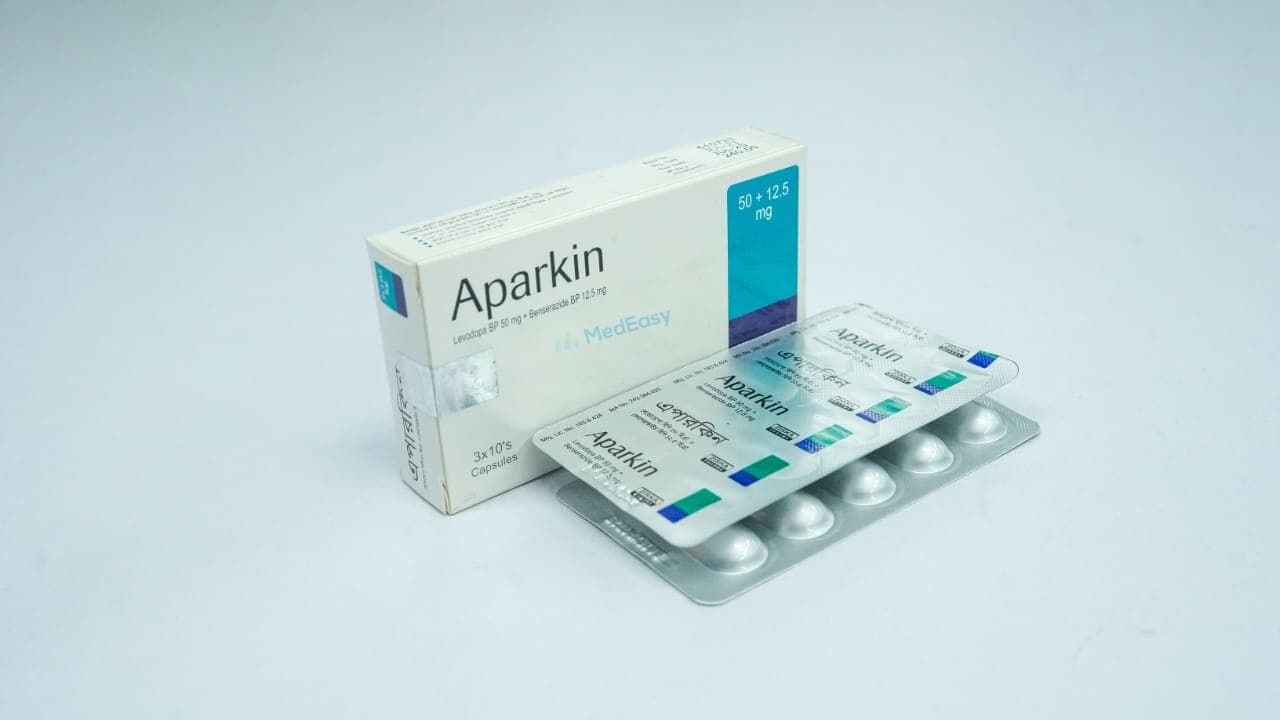

Medicine overview
Indications of Aparkin
Aparkin is indicated for the treatment of Parkinson's disease and parkinsonian syndromes.
Established/Guideline-Supported Uses
- Idiopathic Parkinson's disease - first-line dopaminergic therapy for motor symptoms (tremor, rigidity, bradykinesia, postural instability) across all stages of disease severity.
- Post-encephalitic parkinsonism - symptomatic treatment of parkinsonian features arising after encephalitis.
- Symptomatic (arteriosclerotic) parkinsonism - relief of parkinsonian symptoms of vascular origin.
Uses Requiring Specialist Supervision
- Dopa-responsive dystonia (including Segawa disease) - used off-label under specialist (usually pediatric neurology) supervision when this specific diagnosis is confirmed.
Aparkin is generally not effective for parkinsonism induced by dopamine-blocking drugs (e.g., antipsychotics) and is not indicated for such drug-induced parkinsonism.
Composition
Each formulation of Levodopa + Benserazide combines levodopa with benserazide hydrochloride in a fixed ratio (commonly 4:1 of levodopa to benserazide, e.g., 100 mg levodopa with 25 mg benserazide, 50 mg levodopa with 12.5 mg benserazide, or 200 mg levodopa with 50 mg benserazide), available as capsules, tablets, dispersible tablets, or controlled-release formulations.
Description
Aparkin is a fixed-dose combination anti-parkinsonian medicine used to control the motor symptoms of Parkinson's disease and related parkinsonian syndromes. Levodopa is a precursor of dopamine that crosses the blood-brain barrier and is converted to dopamine within the brain, replenishing the dopamine deficiency characteristic of Parkinson's disease. Benserazide is a peripheral decarboxylase inhibitor that does not cross the blood-brain barrier; it blocks the breakdown of levodopa to dopamine outside the brain, allowing more levodopa to reach the central nervous system while reducing peripheral side effects such as nausea and vomiting. Aparkin is available in several strengths and formulations, including standard-release and controlled-release preparations, and is widely used as an initial and long-term therapy for Parkinson's disease.
Therapeutic Class
Aparkin belongs to the therapeutic class of anti-parkinsonian agents, specifically a dopamine precursor combined with a peripheral decarboxylase inhibitor.
Pharmacology
Levodopa + Benserazide combines two agents that act together to correct the dopamine deficiency of Parkinson's disease while minimizing peripheral adverse effects.
- Levodopa is the metabolic precursor of dopamine. Unlike dopamine itself, levodopa crosses the blood-brain barrier, where it is decarboxylated by aromatic L-amino acid decarboxylase to form dopamine, replenishing striatal dopamine stores depleted in Parkinson's disease.
- Benserazide is a peripheral aromatic L-amino acid decarboxylase inhibitor that does not significantly cross the blood-brain barrier. By inhibiting the decarboxylation of levodopa outside the central nervous system, benserazide reduces peripheral conversion of levodopa to dopamine, increasing the proportion of an administered dose that reaches the brain and substantially reducing peripheral dopaminergic side effects such as nausea, vomiting, and cardiovascular effects.
Pharmacokinetics
Levodopa is rapidly absorbed from the small intestine, with peak plasma concentrations typically reached within 1 to 2 hours; absorption can be delayed or reduced by delayed gastric emptying and by competition with dietary amino acids from high-protein meals. Levodopa has a short plasma half-life of approximately 1 to 2 hours when co-administered with a decarboxylase inhibitor such as benserazide. Benserazide is well absorbed and metabolized in the liver, kidney, and intestinal mucosa. Both components are excreted primarily via the kidneys.
Dosage & Administration of Aparkin
Dosing of Aparkin is individualized and must be titrated gradually by a physician according to therapeutic response and tolerability.
| Indication | Adult Dosing |
|---|---|
| Initial therapy, Parkinson's disease | Starting dose typically equivalent to 50 mg of the levodopa component, 1-2 times daily, increased gradually every few days to weekly based on response and tolerability. |
| Maintenance therapy | Usual maintenance dose ranges from 300 mg to 800 mg of the levodopa component daily, given in 3 to 6 divided doses; some patients on specialist guidance may require higher doses. |
| Controlled-release formulation | Used for patients with motor fluctuations ("wearing-off"); dosing and interval individualized by a specialist, generally given 2-4 times daily. |
| Switching from levodopa alone | Levodopa dose is usually reduced by around 20% when converting to Aparkin, as benserazide increases levodopa bioavailability; a physician must supervise the switch. |
Elderly patients and those with hepatic or renal impairment should generally start at the lower end of the dosing range with slower titration, under close medical supervision (see Use in Special Populations). Doses should never be adjusted or discontinued abruptly without medical advice.
Administration of Aparkin
Aparkin is taken by mouth. Capsules or tablets should be swallowed with water; dispersible tablets should be dissolved in a small amount of water immediately before taking. It may be taken with a small amount of food to reduce nausea, but a consistent relationship with meals (either always with food or always on an empty stomach) is recommended, because high-protein meals can reduce and delay absorption of the levodopa component. Doses should be taken at evenly spaced intervals as directed. Do not crush or chew controlled-release formulations unless specifically instructed. Do not stop taking Aparkin suddenly, as abrupt discontinuation can cause a serious withdrawal reaction resembling neuroleptic malignant syndrome; any change in dose or discontinuation must be supervised by a physician.
Interaction of Aparkin
Aparkin has several clinically significant drug interactions:
- Non-selective monoamine oxidase inhibitors (MAOIs) (e.g., phenelzine, tranylcypromine) - concurrent use or use within 14 days can precipitate a hypertensive crisis; this combination is contraindicated (see Contraindications).
- Antipsychotics and other dopamine-receptor antagonists (e.g., haloperidol, risperidone, metoclopramide) - may antagonize the effect of Aparkin and worsen parkinsonian symptoms.
- Antihypertensive agents - additive risk of orthostatic (postural) hypotension; blood pressure monitoring and dose adjustment may be needed.
- Iron salts - can reduce absorption and plasma levels of the levodopa component through chelation; separate dosing by at least 2 hours where possible.
- Other dopaminergic Parkinson's disease medicines - additive therapeutic and adverse effects when combined intentionally; dose adjustment requires specialist supervision.
- Tricyclic antidepressants - rare reports of hypertension and dyskinesia with concurrent use; use with caution.
Unlike levodopa given alone, the effect of Aparkin is not significantly reduced by vitamin B6 (pyridoxine), because benserazide also inhibits peripheral decarboxylation stimulated by pyridoxine.
Contraindications
Levodopa + Benserazide is contraindicated in the following situations:
- Known hypersensitivity to levodopa, benserazide, or any component of the formulation.
- Angle-closure glaucoma.
- Severe psychotic disorders.
- Concurrent use of non-selective monoamine oxidase inhibitors (MAOIs), or use within the preceding 14 days, due to the risk of hypertensive crisis.
- Known malignant melanoma or undiagnosed skin lesions suspicious for melanoma, as levodopa may activate malignant melanoma.
Side Effects of Aparkin
Aparkin can cause the following adverse effects:
Common
- Nausea, vomiting, loss of appetite
- Dizziness, light-headedness, orthostatic hypotension
- Dry mouth, constipation
- Insomnia, vivid dreams, drowsiness
- Harmless reddish discoloration of urine or sweat
Less Common / Serious
- Dyskinesias (involuntary movements) and motor fluctuations with long-term use
- Confusion, hallucinations, or psychosis, particularly in elderly patients
- Impulse control disorders (e.g., pathological gambling, hypersexuality, compulsive shopping or eating)
- Cardiac arrhythmias
- A withdrawal reaction resembling neuroleptic malignant syndrome if therapy is stopped abruptly (see Precautions and Warnings)
Patients should report any unusual mood, behavioral, or movement changes to their physician promptly.
Pregnancy & Lactation
The safety of Aparkin in human pregnancy has not been well established. It should be used during pregnancy only if the potential benefit to the mother clearly justifies the potential risk to the fetus, and only under close medical supervision. Aparkin can suppress prolactin secretion and may inhibit lactation; because there is limited data on excretion into breast milk and potential effects on the nursing infant, breastfeeding is generally not recommended during treatment unless a physician determines the benefit outweighs the risk. Women who are pregnant, planning pregnancy, or breastfeeding should consult their physician before starting or continuing Aparkin.
Precautions & Warnings
Aparkin requires caution in the following situations:
- Cardiovascular disease - may cause orthostatic hypotension or arrhythmias; use with caution in patients with cardiovascular or cerebrovascular disease, or a history of myocardial infarction.
- History of peptic ulcer disease - increased risk of gastrointestinal bleeding.
- Psychiatric disorders - may worsen psychosis, cause confusion, hallucinations, or impulse control disorders; use with caution in patients with a history of psychiatric illness.
- Long-term use - motor fluctuations ("wearing-off" effect) and dyskinesias may develop and require dose or regimen adjustment by a specialist.
- Abrupt discontinuation - do not stop Aparkin suddenly, as this can precipitate a severe reaction resembling neuroleptic malignant syndrome, with muscle rigidity, hyperthermia, and altered consciousness; any dose reduction or withdrawal must be gradual and physician-supervised.
- Hepatic, renal, cardiac, or pulmonary disease, and endocrine disorders - use with caution and closer monitoring.
- Wide-angle glaucoma - intraocular pressure should be monitored periodically.
- Driving and operating machinery - may cause sudden sleep onset, drowsiness, or dizziness; patients should be cautioned accordingly.
Regular medical follow-up, including monitoring of hepatic, renal, and cardiovascular function, and periodic ophthalmologic checks, is recommended during long-term therapy with Aparkin.
Overdose Effects of Aparkin
Overdose of Aparkin may cause exaggerated adverse effects, including severe nausea and vomiting, confusion, agitation, hallucinations, marked dyskinesias, cardiac arrhythmias, and severe hypotension or hypertension. In case of suspected overdose, seek immediate medical attention or contact a poison control center right away. Management is supportive and should be carried out in a hospital setting, including cardiac monitoring; there is no specific antidote. Do not attempt to manage an overdose at home.
Storage Conditions
Store at room temperature (below 30°C), protected from light and moisture. Keep the container tightly closed and out of reach of children.
Use In Special Populations
Elderly
Elderly patients are more susceptible to the adverse effects of Aparkin, including orthostatic hypotension, confusion, and hallucinations. Treatment should be initiated at the lower end of the dosing range with slower titration and close monitoring.
Pediatric Use
Safety and efficacy of Aparkin in children and adolescents whose bone growth is not complete have not been established for routine use in idiopathic Parkinson's disease, which is rare in this age group. It may be used off-label under specialist (pediatric neurology) supervision for confirmed dopa-responsive dystonia.
Renal Impairment
Use with caution; dose reduction and close monitoring may be needed, although formal dose-adjustment guidelines are not well established.
Hepatic Impairment
Use with caution in patients with significant hepatic impairment, as benserazide is metabolized in the liver; close monitoring is advised.
Duration Of Treatment
Aparkin is typically used as a long-term, often lifelong, therapy for Parkinson's disease, as it treats symptoms rather than the underlying disease process. The dose and regimen are periodically reviewed and adjusted by a physician to balance symptom control against the development of motor fluctuations and dyskinesias with continued use. Treatment should not be stopped or the dose changed without medical advice.
Drug Classes
Anti-Parkinsonian agent; dopamine precursor combined with a peripheral decarboxylase inhibitor.
Mode Of Action
Levodopa + Benserazide acts through the central conversion of levodopa to dopamine combined with peripheral inhibition of that same conversion. Levodopa crosses the blood-brain barrier and is converted to dopamine by dopa-decarboxylase within the brain, replenishing depleted striatal dopamine and improving the motor symptoms of Parkinson's disease. Benserazide inhibits dopa-decarboxylase only in peripheral tissues (it does not cross the blood-brain barrier), which reduces the peripheral breakdown of levodopa, increases the fraction of levodopa reaching the brain, allows lower overall levodopa doses, and reduces peripheral dopaminergic side effects such as nausea and cardiovascular effects.
Pediatric Uses
Use of Aparkin in children and adolescents in whom skeletal (bone) growth is not complete is not routinely recommended, and safety and efficacy for idiopathic Parkinson's disease have not been established in this population, as this condition is rare in children. Under specialist supervision, it may be used off-label for confirmed dopa-responsive dystonia (Segawa disease) in pediatric patients, with dosing individualized by a pediatric neurologist. Parents/caregivers should not give Aparkin to a child except under direct specialist guidance.
Frequently Asked Questions
Q: What is Aparkin 50 mg+12.5 mg Capsule used for?
A: Aparkin 50 mg+12.5 mg Capsule is used to treat the motor symptoms of Parkinson's disease and certain other forms of parkinsonism, such as tremor, stiffness, and slowness of movement.
Q: How should I take Aparkin 50 mg+12.5 mg Capsule?
A: Aparkin 50 mg+12.5 mg Capsule should be taken exactly as prescribed by your physician, at evenly spaced intervals, with a consistent relationship to meals. Do not change your dose or stop taking it without consulting your doctor.
Q: Can I stop taking Aparkin 50 mg+12.5 mg Capsule suddenly if I feel better?
A: No. Stopping Aparkin 50 mg+12.5 mg Capsule abruptly can cause a serious reaction with high fever, muscle rigidity, and confusion, similar to neuroleptic malignant syndrome. Any change in dose must be made gradually under medical supervision.
Q: Is Aparkin 50 mg+12.5 mg Capsule safe during pregnancy?
A: Safety in pregnancy has not been well established. Aparkin 50 mg+12.5 mg Capsule should be used in pregnancy only if the potential benefit clearly outweighs the potential risk, and only under a physician's guidance. It may also reduce breast milk production, so breastfeeding should be discussed with your doctor.
Q: What side effects should I watch for with Aparkin 50 mg+12.5 mg Capsule?
A: Common side effects include nausea, dizziness, and low blood pressure on standing. Report any confusion, hallucinations, unusual urges (such as gambling or compulsive behavior), or involuntary movements to your physician promptly, as these can occur with Aparkin 50 mg+12.5 mg Capsule.
Q: Who should not take Aparkin 50 mg+12.5 mg Capsule?
A: Aparkin 50 mg+12.5 mg Capsule should not be taken by people with a known allergy to either component, angle-closure glaucoma, severe psychotic illness, known malignant melanoma or suspicious undiagnosed skin lesions, or those taking non-selective MAOI medicines (or who have taken them in the past 14 days).
Disclaimer
The information provided is accurate to the best of our knowledge, but it does not replace professional medical advice. We cannot guarantee its completeness or accuracy, and the absence of specific information about a drug should not be taken as an endorsement. We are not responsible for any consequences arising from this information, so please consult a healthcare professional for any concerns or questions.
