
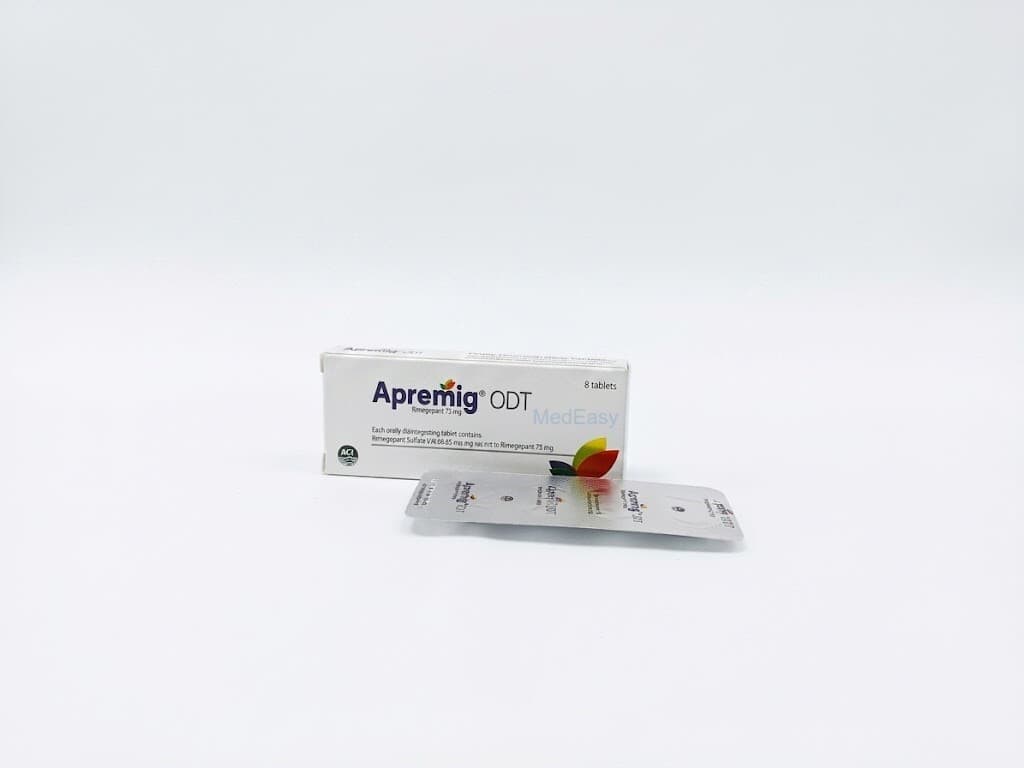

Medicine overview
Indications of Apremig ODT
Apremig ODT is a calcitonin gene-related peptide (CGRP) receptor antagonist (gepant class) approved for two distinct uses in adults:
Established / FDA-Approved Uses
- Acute treatment of migraine with or without aura in adults.
- Preventive treatment of episodic migraine in adults, dosed every other day.
Apremig ODT is not indicated for the treatment of cluster headache or other headache disorders, and it is not approved for use in children.
Composition
Each orally disintegrating tablet (ODT) contains Rimegepant 75 mg (present as rimegepant sulfate).
Description
Apremig ODT is an orally administered, small-molecule calcitonin gene-related peptide (CGRP) receptor antagonist belonging to the "gepant" class of anti-migraine agents. Unlike triptans, Apremig ODT does not act on serotonin receptors and does not cause vasoconstriction, which distinguishes its use in some patients with cardiovascular risk factors, under medical guidance. Apremig ODT is formulated as an orally disintegrating tablet (ODT) that dissolves on or under the tongue without the need for water.
Therapeutic Class
Apremig ODT belongs to the CGRP (Calcitonin Gene-Related Peptide) Receptor Antagonist class — also known as the "Gepant" class of anti-migraine agents.
Pharmacology
Rimegepant is a selective, competitive antagonist of the calcitonin gene-related peptide (CGRP) receptor. CGRP is a neuropeptide released during migraine attacks that causes vasodilation and neurogenic inflammation, contributing to migraine pain. By blocking CGRP receptor activation, Rimegepant interrupts this pathway both acutely (aborting an ongoing attack) and prophylactically (reducing attack frequency when dosed every other day).
Pharmacokinetics
- Absorption: Peak plasma concentration reached in approximately 1.5 hours after administration of the orally disintegrating tablet.
- Metabolism: Primarily via CYP3A4, with a minor contribution from CYP2C9.
- Elimination half-life: Approximately 11 hours.
- Excretion: Mainly via the biliary/fecal route, with a smaller portion excreted renally.
Dosage & Administration of Apremig ODT
Dosing of Apremig ODT differs depending on whether it is used for acute or preventive treatment of migraine.
| Indication | Adult Dose | Maximum |
|---|---|---|
| Acute treatment of migraine | 75 mg orally, as a single dose, as needed | Do not exceed 75 mg in 24 hours; safety of more than 18 doses per 30 days has not been established |
| Preventive treatment of episodic migraine | 75 mg orally every other day | One dose every other day; do not increase frequency |
Hepatic and Renal Adjustment
- Renal impairment: No dose adjustment needed in mild-to-severe renal impairment; use in end-stage renal disease is not recommended.
- Hepatic impairment: No dose adjustment needed in mild or moderate (Child-Pugh A/B) impairment; use in severe hepatic impairment (Child-Pugh C) is not recommended due to markedly increased drug exposure (see Precautions and Warnings).
See Administration below for instructions on taking the orally disintegrating tablet.
Administration of Apremig ODT
Apremig ODT orally disintegrating tablets (ODT) should be administered as follows:
- Dry hands before handling the tablet.
- Peel back the foil of the blister pack (do not push the tablet through the foil).
- Immediately place the tablet on or under the tongue, where it will disintegrate in saliva; it may be swallowed with or without water.
- Use the tablet immediately after removing it from the blister; do not store it outside the packaging.
- May be taken with or without food.
Interaction of Apremig ODT
The most clinically significant interactions with Apremig ODT involve drugs that alter CYP3A4 activity, since Apremig ODT is primarily metabolized by this enzyme.
- Strong CYP3A4 inhibitors (e.g., ketoconazole, itraconazole, clarithromycin, ritonavir): Significantly increase Apremig ODT plasma concentration; concomitant use should be avoided.
- Moderate CYP3A4 inhibitors: Increase exposure to Apremig ODT; another dose should not be taken within 48 hours of the inhibitor.
- Strong or moderate CYP3A4 inducers (e.g., rifampin, carbamazepine, phenytoin, St. John's Wort): May substantially reduce Apremig ODT concentrations and efficacy; concomitant use should be avoided.
- Potent P-glycoprotein (P-gp) inhibitors: May increase exposure to Apremig ODT; another dose should not be taken within 48 hours.
Contraindications
Rimegepant is contraindicated in patients with a known history of hypersensitivity to Rimegepant or any component of the formulation.
Side Effects of Apremig ODT
The most commonly reported adverse effect with Apremig ODT is nausea. Other effects reported include:
- Nausea (most common, seen with both acute and preventive use)
- Abdominal pain and dyspepsia (more common with preventive, every-other-day dosing)
- Hypersensitivity reactions, including dyspnea and rash, in a small proportion of patients (see Precautions and Warnings for details)
Most adverse effects are mild to moderate in severity. Patients should seek prompt medical attention for any signs of a serious allergic reaction.
Pregnancy & Lactation
Pregnancy: Data on the use of Apremig ODT in pregnant women are limited and insufficient to establish a drug-associated risk of major birth defects or miscarriage. Animal reproduction studies showed adverse developmental effects only at exposures associated with maternal toxicity. Apremig ODT should be used during pregnancy only if the potential benefit justifies the potential risk to the fetus, and only under medical supervision.
Lactation: Limited data suggest that Apremig ODT passes into breast milk in small amounts (relative infant dose estimated at less than 1%). The clinical effects on a breastfed infant are not fully established. A physician should be consulted to weigh the benefits of treatment against any potential risk to the infant before using Apremig ODT while breastfeeding.
Precautions & Warnings
Hypersensitivity reactions: Serious hypersensitivity reactions, including anaphylaxis, dyspnea, and rash, have been reported with Apremig ODT, in some cases occurring days after administration. Apremig ODT should be discontinued immediately if a hypersensitivity reaction occurs, and should not be re-administered.
New-onset or worsening hypertension: Cases have been reported post-marketing. Blood pressure should be monitored as clinically indicated, and discontinuation of Apremig ODT considered if blood pressure becomes inadequately controlled.
Raynaud's phenomenon: New onset or worsening of pre-existing Raynaud's phenomenon has been reported; discontinue Apremig ODT if symptoms develop or worsen.
Hepatic effects: Rare reports of elevated liver enzymes/hepatotoxicity have been noted with Apremig ODT; use with caution in patients with hepatic impairment, and avoid use in severe (Child-Pugh C) hepatic impairment.
Dosing limits: Do not exceed the maximum labeled dose or frequency of Apremig ODT for either acute or preventive use (see Dosage and Administration).
Overdose Effects of Apremig ODT
There is limited clinical experience with overdose of Apremig ODT. No specific antidote is available. In case of a suspected overdose, seek immediate medical attention or contact a poison control center. Management is supportive, consisting of monitoring of vital signs and clinical status. Because Apremig ODT is highly protein-bound, it is unlikely to be significantly removed by hemodialysis.
Storage Conditions
Store at room temperature (below 30°C), away from light and moisture. Keep the tablet in its original blister pack until immediately before use, and keep out of reach of children.
Use In Special Populations
Renal impairment: No dose adjustment of Apremig ODT is required in patients with mild, moderate, or severe renal impairment. Use in patients with end-stage renal disease is not recommended.
Hepatic impairment: No dose adjustment is required in mild or moderate hepatic impairment. Use of Apremig ODT in severe hepatic impairment is not recommended (see Precautions and Warnings).
Geriatric patients: No clinically meaningful differences in the pharmacokinetics of Apremig ODT have been observed based on age; no dose adjustment is required based on age alone.
Pediatric patients: See Pediatric Uses.
Pregnancy and lactation: See Pregnancy and Lactation.
Duration Of Treatment
For acute treatment, Apremig ODT is used as a single as-needed dose per migraine attack, not on a continuous schedule. For preventive treatment, Apremig ODT is intended for longer-term, ongoing use, taken every other day; response should be reassessed periodically by the prescribing physician, typically after several months of use, to confirm continued benefit.
Drug Classes
Rimegepant is classified under: Gepants; CGRP (Calcitonin Gene-Related Peptide) Receptor Antagonists; Anti-migraine agents.
Mode Of Action
Rimegepant works by selectively and competitively blocking the calcitonin gene-related peptide (CGRP) receptor. CGRP is released from trigeminal sensory nerves during a migraine attack and promotes vasodilation, sensitization of pain pathways, and neurogenic inflammation. By preventing CGRP from binding to its receptor, Rimegepant interrupts the transmission and amplification of migraine pain signals, providing relief during an acute attack and reducing the frequency of attacks when used preventively.
Pediatric Uses
The safety and effectiveness of Apremig ODT have not been established in pediatric patients. Apremig ODT is approved for use in adults only and should not be administered to children or adolescents outside of a clinical trial setting.
Frequently Asked Questions
Q: What is Apremig ODT 75 mg Dispersible Tablet used for?
A: Apremig ODT 75 mg Dispersible Tablet is used both for the acute treatment of a migraine attack that has already started, and for the prevention of episodic migraine when taken every other day.
Q: Can I take Apremig ODT 75 mg Dispersible Tablet every day?
A: No. For acute use, do not exceed one dose in 24 hours, and do not use more than 18 doses in 30 days. For prevention, Apremig ODT 75 mg Dispersible Tablet is taken only every other day, not daily. Follow your physician's specific instructions.
Q: Is Apremig ODT 75 mg Dispersible Tablet safe during pregnancy?
A: Data are limited. Apremig ODT 75 mg Dispersible Tablet should be used during pregnancy only if clearly needed and if the potential benefit justifies the potential risk to the fetus; always consult your physician before use.
Q: What should I do if I develop a rash or difficulty breathing after taking Apremig ODT 75 mg Dispersible Tablet?
A: Stop taking Apremig ODT 75 mg Dispersible Tablet immediately and seek urgent medical attention, as these may be signs of a serious hypersensitivity reaction, which can sometimes occur even days after the dose.
Q: Can Apremig ODT 75 mg Dispersible Tablet be taken with other migraine medicines?
A: Certain drugs, especially strong CYP3A4 inhibitors and inducers, can significantly change Apremig ODT 75 mg Dispersible Tablet levels in the body. Always inform your physician of all medications you take before starting Apremig ODT 75 mg Dispersible Tablet.
Q: What happens if I take too much Apremig ODT 75 mg Dispersible Tablet?
A: If an overdose of Apremig ODT 75 mg Dispersible Tablet is suspected, seek immediate medical attention or contact a poison control center. Treatment is supportive; there is no specific antidote.
Disclaimer
The information provided is accurate to the best of our knowledge, but it does not replace professional medical advice. We cannot guarantee its completeness or accuracy, and the absence of specific information about a drug should not be taken as an endorsement. We are not responsible for any consequences arising from this information, so please consult a healthcare professional for any concerns or questions.
