

8% Off
Aprima30 mg
Incepta Pharmaceuticals Ltd.
৳552.00
Add to cart
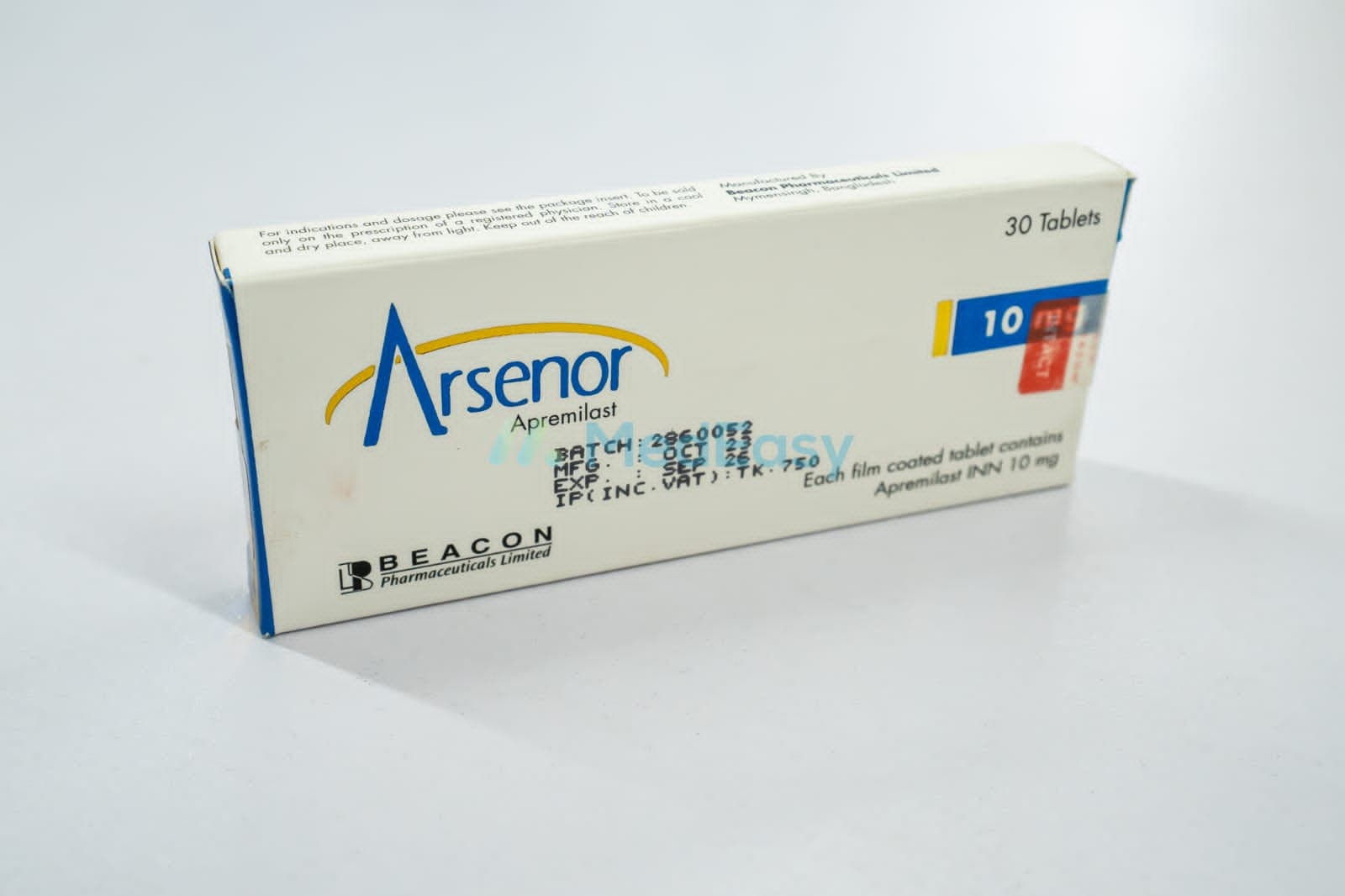
Arsenor 30 mg Tablet is available on MedEasy for ৳552.00 per 10's Strip, with home delivery anywhere in Bangladesh. It is manufactured by Beacon Pharmaceuticals PLC. Its generic name is Apremilast.

Arsenor is a phosphodiesterase-4 (PDE4) inhibitor approved for the following conditions:
Arsenor may also be used off-label, under specialist supervision, for other inflammatory conditions such as certain forms of oral lichen planus, though evidence for such uses is limited and this is not an approved indication.
Each tablet contains Apremilast as the active pharmaceutical ingredient, commonly available in 10 mg, 20 mg, and 30 mg strengths (as part of a titration pack) or as a fixed 30 mg maintenance-dose tablet. Inactive ingredients typically include microcrystalline cellulose, lactose monohydrate, croscarmellose sodium, magnesium stearate, and a film coating.
Arsenor is an oral, small-molecule inhibitor of phosphodiesterase-4 (PDE4), an enzyme that regulates intracellular inflammatory mediators. By inhibiting PDE4, Arsenor increases intracellular cyclic adenosine monophosphate (cAMP), which in turn modulates the production of pro-inflammatory and anti-inflammatory cytokines. It is used to manage chronic inflammatory conditions including psoriatic arthritis, plaque psoriasis, and oral ulcers of Behçet's disease.
Arsenor belongs to the therapeutic class of Phosphodiesterase-4 (PDE4) inhibitors, a class of oral small-molecule anti-inflammatory agents distinct from biologic disease-modifying agents.
Apremilast works intracellularly to inhibit phosphodiesterase-4 (PDE4), the predominant PDE enzyme in inflammatory cells. Inhibition of PDE4 leads to increased levels of cyclic AMP (cAMP), which subsequently down-regulates the inflammatory response by modulating expression of tumor necrosis factor-alpha (TNF-α), interleukin-23 (IL-23), interleukin-17 (IL-17), and other pro-inflammatory mediators, while increasing production of the anti-inflammatory mediator interleukin-10 (IL-10). The precise mechanism by which this translates into clinical benefit in psoriasis, psoriatic arthritis, and Behçet's disease oral ulcers is not fully defined, but the net effect is a reduction in inflammation.
Pharmacokinetics: Apremilast is well absorbed orally (absolute bioavailability ~73%), undergoes extensive hepatic metabolism (primarily via CYP3A4, with contributions from CYP1A2 and CYP2A6), and is eliminated mainly via metabolite excretion in urine and feces. Its elimination half-life is approximately 6-9 hours.
| Indication | Regimen |
|---|---|
| Psoriatic arthritis / Plaque psoriasis / Behçet's disease oral ulcers (adults) | Titrate over 5 days starting at 10 mg once daily, increasing by 10 mg/day increments, to reach a maintenance dose of 30 mg twice daily from Day 6 onward. |
| Severe renal impairment (CrCl <30 mL/min) | Titrate using the morning schedule only (skip evening doses) to a maintenance dose of 30 mg once daily. |
Tablets should be swallowed whole with or without food. Do not split, crush, or chew tablets. If a dose is missed, it should be taken as soon as possible unless it is close to the next scheduled dose; doses should not be doubled. Because gastrointestinal side effects are more common during the initial titration period, the step-wise dose escalation schedule must be followed exactly as prescribed and should not be skipped, even after a missed dose (consult the prescriber for guidance on resuming titration).
Arsenor tablets are taken orally, with or without food, swallowed whole with water. The twice-daily maintenance doses should be spaced approximately 12 hours apart (e.g., morning and evening).
The most clinically significant interaction involves strong CYP3A4 enzyme inducers, including rifampin, phenytoin, carbamazepine, phenobarbital, and St. John's Wort. Co-administration with these agents significantly reduces systemic exposure to Arsenor, resulting in loss of therapeutic efficacy; concomitant use of strong CYP3A4 inducers with Arsenor is not recommended.
No clinically significant interactions have been identified with oral contraceptives, methotrexate, or ketoconazole (a strong CYP3A4 inhibitor), and no dose adjustment of Arsenor is needed with CYP3A4 inhibitors.
Apremilast is contraindicated in patients with known hypersensitivity to apremilast or to any component of the formulation.
The most common adverse reactions associated with Arsenor, particularly during the initial titration period, include:
Less common but clinically important effects include depression and mood changes, and rare hypersensitivity reactions such as angioedema. See Precautions and Warnings for further detail on depression/suicidal ideation risk and weight loss monitoring.
Pregnancy: Data on the use of Arsenor in pregnant women are limited. Animal reproduction studies have shown adverse effects at high doses. Arsenor should be used during pregnancy only if clearly needed and if the potential benefit justifies the potential risk to the fetus; a physician should be consulted before use in pregnancy.
Lactation: It is not known whether Arsenor or its metabolites are excreted in human breast milk. Because many drugs are excreted in breast milk and the effects on a nursing infant are unknown, a decision should be made whether to discontinue breastfeeding or discontinue Arsenor, taking into account the benefits of breastfeeding and the mother's clinical need for the drug; consult a physician before use while breastfeeding.
Depression and suicidal ideation: Treatment with Arsenor is associated with an increased risk of depression. Before starting treatment, prescribers should carefully weigh the risks and benefits in patients with a history of depression or suicidal thoughts. Patients, caregivers, and families should be advised to monitor for new or worsening depression, anxiety, or suicidal thoughts/behavior, and to seek immediate medical attention if these occur. Discontinuation of Arsenor should be considered if such symptoms develop.
Weight loss: Unexplained and sometimes significant weight loss has been reported with Arsenor. Body weight should be monitored regularly during treatment; unexplained or clinically significant weight loss should prompt evaluation and consideration of discontinuation.
Gastrointestinal effects: Severe diarrhea, nausea, and vomiting have been reported, sometimes requiring hospitalization, particularly in elderly patients. Patients at higher risk of fluid loss should be monitored.
Titration requirement: The dose must be titrated as directed at treatment initiation to reduce the frequency of gastrointestinal side effects; the titration schedule should not be skipped.
Renal impairment: Dose reduction is required in patients with severe renal impairment (see Dosage and Administration).
Hypersensitivity: Discontinue immediately if signs of angioedema or anaphylaxis occur.
There is limited clinical experience with Arsenor overdose. In the event of a suspected overdose, the patient should seek immediate medical attention or contact emergency services/a poison control center. Management should be supportive and symptomatic, including monitoring of vital signs; there is no specific antidote for Arsenor overdose.
Store at room temperature (below 30°C), away from light and moisture. Keep out of reach of children.
Renal impairment: In patients with severe renal impairment (creatinine clearance <30 mL/min), the dose of Arsenor should be reduced to 30 mg once daily (morning dose only), using the modified titration schedule; no dose adjustment is needed for mild-to-moderate renal impairment.
Hepatic impairment: No dose adjustment of Arsenor is required in patients with hepatic impairment.
Elderly: No overall differences in efficacy were observed between elderly and younger patients, but elderly patients, especially those 65 years and older, may be at greater risk of complications from severe diarrhea and vomiting; use with appropriate monitoring.
Low body weight: Patients weighing less than 60 kg may be at greater risk of weight loss while on Arsenor; monitor weight closely.
The duration of treatment with Arsenor is individualized based on the condition being treated and clinical response, and is determined by the prescribing physician. Clinical improvement in psoriasis and psoriatic arthritis is typically assessed after approximately 16 weeks of continuous therapy; treatment is generally continued long-term in patients who show benefit, with periodic reassessment of ongoing need, weight, and mood by the physician.
Phosphodiesterase-4 (PDE4) inhibitor; oral small-molecule anti-inflammatory agent.
Apremilast selectively inhibits phosphodiesterase-4 (PDE4), leading to increased intracellular cyclic AMP (cAMP) levels within inflammatory and immune cells. This down-regulates the production of pro-inflammatory mediators (including TNF-α, IL-23, and IL-17) and up-regulates anti-inflammatory mediators (including IL-10), resulting in an overall reduction of the inflammatory processes underlying psoriasis, psoriatic arthritis, and Behçet's disease oral ulcers.
Arsenor is approved for use in pediatric patients 6 years of age and older weighing at least 20 kg for the treatment of moderate-to-severe plaque psoriasis, using weight-based titration and maintenance dosing (20 mg twice daily maintenance for 20-50 kg; 30 mg twice daily maintenance for ≥50 kg, following the standard titration approach). Safety and efficacy of Arsenor for psoriatic arthritis and Behçet's disease oral ulcers have not been established in pediatric patients, and safety and efficacy have not been established in children under 6 years of age or weighing less than 20 kg for any indication.
Q: What is Arsenor 30 mg Tablet used for?
A: Arsenor 30 mg Tablet is used to treat active psoriatic arthritis, moderate-to-severe plaque psoriasis in candidates for phototherapy or systemic therapy, and oral ulcers associated with Behçet's disease in adults; it is also approved for plaque psoriasis in children 6 years and older weighing at least 20 kg.
Q: Why do I need to start with a low dose of Arsenor 30 mg Tablet and increase it gradually?
A: The dose of Arsenor 30 mg Tablet is titrated upward over 5 days to reduce the likelihood and severity of gastrointestinal side effects such as nausea and diarrhea, which are more common when treatment is started at the full maintenance dose. Follow the titration schedule provided by your physician or pharmacist exactly.
Q: Can Arsenor 30 mg Tablet cause depression?
A: Yes. Treatment with Arsenor 30 mg Tablet has been associated with an increased risk of depression, including new or worsening depression and, rarely, suicidal thoughts. Tell your physician immediately, or seek emergency care, if you or a caregiver notice mood changes, anxiety, or thoughts of self-harm while taking Arsenor 30 mg Tablet, especially if you have a prior history of depression.
Q: Does Arsenor 30 mg Tablet cause weight loss?
A: Unexplained weight loss has been reported with Arsenor 30 mg Tablet. Your physician will monitor your body weight periodically during treatment, and you should report any significant or unexplained weight loss promptly, as it may require evaluation or discontinuation of the medicine.
Q: Can I take Arsenor 30 mg Tablet with rifampin or other seizure medicines like carbamazepine or phenytoin?
A: No. Strong CYP3A4 inducers such as rifampin, carbamazepine, phenytoin, phenobarbital, and St. John's Wort significantly reduce blood levels of Arsenor 30 mg Tablet and can cause it to lose effectiveness. Combining these medicines with Arsenor 30 mg Tablet is not recommended; tell your physician about all medicines you take.
Q: Is Arsenor 30 mg Tablet safe during pregnancy or breastfeeding?
A: Data on Arsenor 30 mg Tablet use in pregnancy are limited, so it should be used during pregnancy only if clearly needed and if the potential benefit outweighs the potential risk to the fetus. It is not known if Arsenor 30 mg Tablet passes into breast milk, so consult your physician before breastfeeding while taking this medicine.
Disclaimer
The information provided is accurate to the best of our knowledge, but it does not replace professional medical advice. We cannot guarantee its completeness or accuracy, and the absence of specific information about a drug should not be taken as an endorsement. We are not responsible for any consequences arising from this information, so please consult a healthcare professional for any concerns or questions.