
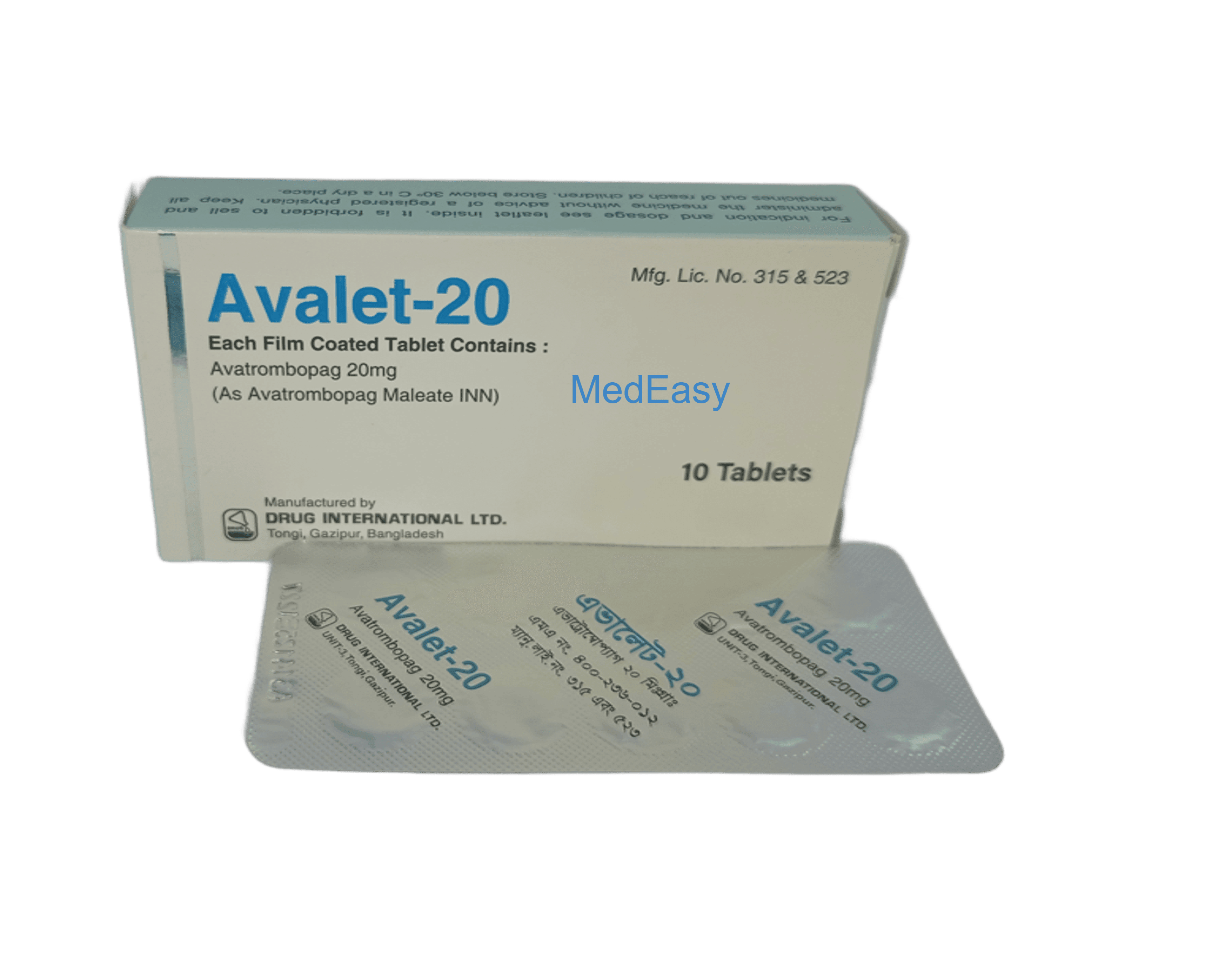

Medicine overview
Indications of Avalet
Avalet is indicated for the treatment of thrombocytopenia in patients scheduled to undergo a procedure, and for the treatment of chronic immune thrombocytopenia (ITP) in patients who have had an insufficient response to a previous treatment.
Established / FDA-approved uses
- Chronic liver disease (CLD) with thrombocytopenia, prior to a scheduled procedure: Avalet is used short-term (a 5-day course) in adults with chronic liver disease to raise platelet counts high enough to safely undergo a planned invasive or surgical procedure.
- Chronic immune thrombocytopenia (ITP) in adults: Avalet is used for adults with chronic ITP who have had an insufficient response to a previous therapy (e.g., corticosteroids, immunoglobulins, splenectomy).
- Chronic/persistent ITP in children 1 year of age and older: Avalet is also approved for pediatric patients with persistent or chronic ITP who have had an insufficient response to a previous treatment; see Pediatric Uses.
Avalet does not address the underlying cause of thrombocytopenia. It is intended to be used as part of a broader treatment plan, under the supervision of a specialist (hepatologist for chronic liver disease, or hematologist for ITP).
Composition
Each film-coated tablet contains Avatrombopag (as avatrombopag maleate) equivalent to 20 mg of avatrombopag base.
Oral granules ("sprinkle" formulation) contain Avatrombopag (as avatrombopag maleate) equivalent to 5 mg or 10 mg of avatrombopag base per packet, for patients unable to swallow tablets.
Tablet and granule formulations of Avatrombopag are not interchangeable on a milligram-for-milligram basis.
Description
Avalet is a small-molecule, orally administered thrombopoietin (TPO) receptor agonist. It works by stimulating the same receptor that the body's natural thrombopoietin uses to signal bone marrow cells to produce platelets, thereby raising platelet counts in people with thrombocytopenia (low platelet counts) related to chronic liver disease or chronic immune thrombocytopenia.
Unlike some earlier oral TPO receptor agonists, Avalet does not require dietary restrictions related to divalent cations and can be taken with a meal.
Therapeutic Class
Avalet belongs to the therapeutic class of thrombopoietin (TPO) receptor agonists, also referred to as platelet growth factor agents or antihemorrhagic/hematopoietic stimulant agents used to increase platelet production.
Pharmacology
Pharmacodynamics
Avatrombopag binds to the transmembrane domain of the human thrombopoietin (TPO) receptor on megakaryocyte precursor cells, a binding site distinct from that of endogenous TPO. This interaction activates intracellular JAK/STAT and MAPK/ERK signalling pathways, promoting proliferation and differentiation of megakaryocytes and ultimately increasing platelet production. Avatrombopag acts synergistically with, rather than by competing against, endogenous thrombopoietin. See Mode of Action for a concise mechanistic summary.
Pharmacokinetics
- Absorption: Peak plasma concentrations are reached approximately 5-6 hours after an oral dose taken with food; taking Avatrombopag with food increases absorption and is required (see Administration).
- Distribution: Highly bound to plasma proteins (greater than 96%).
- Metabolism: Metabolized primarily via CYP2C9 and CYP3A4 hepatic pathways.
- Elimination: Elimination half-life is approximately 19 hours; excreted mainly in feces, with a minor renal component.
Dosage & Administration of Avalet
Dosing of Avalet differs substantially by indication and must be individualized to the patient's baseline platelet count and treatment goal. The lowest dose needed to achieve the desired platelet count for the intended purpose should be used - the goal is not to normalize the platelet count.
Chronic liver disease (CLD), prior to a scheduled procedure
| Baseline platelet count | Avalet dose | Duration |
|---|---|---|
| Less than 40 x 10^9/L | 60 mg once daily | 5 consecutive days |
| 40 to less than 50 x 10^9/L | 40 mg once daily | 5 consecutive days |
Dosing should begin 10 to 13 days before the scheduled procedure, with the procedure performed 5 to 8 days after the last dose. Platelet count should be checked on the day of, or immediately before, the procedure. This regimen is not intended for patients with chronic ITP.
Chronic immune thrombocytopenia (ITP) - adults
Starting dose: 20 mg once daily. The dose is titrated in 20 mg increments/decrements (maximum 40 mg once daily) at intervals of at least 2 weeks, based on platelet count response, aiming for a platelet count sufficient to reduce bleeding risk (generally at or above 50 x 10^9/L) rather than a normal count. If an adequate response is not seen after 2 weeks at the maximum dose, discontinue Avalet.
Chronic/persistent ITP - pediatric patients (1 year and older)
| Age group | Formulation | Starting dose | Maximum dose |
|---|---|---|---|
| 1 to less than 6 years | Oral granules (sprinkle) | 10 mg once daily | 20 mg once daily |
| 6 years and older | Tablet or granules | 20 mg once daily | 40 mg once daily |
Doses are titrated based on platelet count response at intervals of at least 2 weeks. See Pediatric Uses for further detail.
Administration instructions
Avalet must be taken with food; taking it on an empty stomach substantially reduces absorption. Tablets should be swallowed whole. Oral granules should be sprinkled onto a small amount (one tablespoon) of soft food (e.g., pudding, yogurt, applesauce) or mixed into a small amount of water or milk immediately before administration and consumed within a short period - do not prepare in advance.
Missed dose
If a dose is missed, it may be taken the same day once remembered; the patient should not double the dose the next day to make up for a missed one.
Renal and hepatic dose adjustment
No dose adjustment is required based on renal impairment or hepatic impairment (Avalet has been studied specifically in patients with chronic liver disease, including more advanced Child-Pugh classes, for the CLD indication).
Administration of Avalet
Avalet must be taken with food. Tablets are swallowed whole and are not interchangeable with the oral granule ("sprinkle") formulation on a milligram-for-milligram basis. Oral granules must be mixed with a small amount of soft food or liquid immediately before use and taken right away. See Dosage and Administration for full instructions and timing relative to a scheduled procedure.
Interaction of Avalet
CYP2C9 and CYP3A4 modulators (relevant to the chronic ITP dosing regimen)
Avalet is metabolized by CYP2C9 and CYP3A4. In patients being treated for chronic ITP:
- Dual moderate-to-strong CYP2C9 and CYP3A4 inhibitors (e.g., fluconazole) increase Avalet exposure; a reduced starting dose is recommended and the patient should be monitored more closely for adverse effects, particularly thrombotic risk.
- Dual moderate-to-strong CYP2C9 and CYP3A4 inducers (e.g., rifampin) decrease Avalet exposure; an increased starting dose is recommended, with close monitoring of platelet response.
No dose adjustment for these interactions is recommended for the short, fixed 5-day chronic liver disease/procedure regimen, but the prescriber should still be aware of concomitant use.
Other medicines affecting hemostasis
Concomitant use of anticoagulants or antiplatelet agents may add to the thrombotic risk associated with Avalet (see Precautions and Warnings) and warrants closer clinical monitoring.
Contraindications
Avatrombopag is contraindicated in patients with known hypersensitivity to avatrombopag or to any component of the formulation.
Side Effects of Avalet
Chronic liver disease (short 5-day course before a procedure)
Most common: pyrexia (fever), abdominal pain, nausea/vomiting, headache, fatigue, and peripheral edema.
Chronic ITP - adults
Most common: headache, fatigue, contusion (bruising), epistaxis (nosebleed), petechiae, myalgia (muscle pain), and upper respiratory tract infection.
Chronic/persistent ITP - pediatric patients
Most common: viral infection, pyrexia, cough, oropharyngeal pain (sore throat), upper respiratory tract infection, and vomiting.
Serious adverse effects
With Avalet, thrombotic/thromboembolic events (see Precautions and Warnings) and hepatic decompensation in patients with chronic liver disease have been reported; seek prompt medical attention for symptoms such as leg swelling/pain, chest pain, shortness of breath, or worsening confusion/jaundice.
Pregnancy & Lactation
Pregnancy: There are no adequate, well-controlled studies of Avalet in pregnant women. Animal reproduction studies have shown adverse effects on the fetus at maternal exposures relevant to the recommended human dose. Avalet should be used during pregnancy only if clearly needed and if the potential benefit to the mother justifies the potential risk to the fetus; a physician should always be consulted before use in pregnancy.
Lactation: It is not known whether Avalet passes into human breast milk. Because of the potential for serious adverse reactions in a breastfed infant, it is generally recommended to discontinue breastfeeding during treatment and for approximately two weeks after the last dose; consult a physician regarding infant feeding options.
Precautions & Warnings
Thrombotic/thromboembolic events
Avalet, like other thrombopoietin receptor agonists, has been associated with thrombotic and thromboembolic events, including portal vein thrombosis, which is of particular relevance in patients with chronic liver disease - a population that already carries some baseline risk of thrombosis. To reduce this risk, Avalet should be dosed to achieve the platelet count needed for the clinical purpose (safe conduct of a procedure, or reduced bleeding risk in ITP), not to normalize the platelet count.
Hepatic decompensation
Hepatic decompensation has been observed in patients with chronic liver disease receiving thrombopoietin receptor agonists, including Avalet, in some clinical contexts. Patients with chronic liver disease should be monitored clinically for signs of worsening liver function during and after treatment.
Worsening thrombocytopenia after discontinuation
Platelet counts may fall below the pre-treatment baseline after Avalet is stopped, increasing bleeding risk, particularly in ITP; platelet counts should be monitored weekly for at least 4 weeks after discontinuation.
General
Avalet does not treat the underlying cause of thrombocytopenia; it should be used only as part of a broader management plan under the supervision of a hepatologist or hematologist, with regular clinical and laboratory monitoring.
Overdose Effects of Avalet
There is limited clinical experience with Avalet overdose. An overdose could be expected to cause an excessive rise in platelet count, which may increase the risk of thrombotic/thromboembolic complications. If an overdose of Avalet is suspected, seek immediate medical attention or contact a poison control center; platelet counts should be monitored closely and supportive care provided by a physician. Do not attempt to manage a suspected overdose at home without medical guidance.
Storage Conditions
Store Avalet tablets and oral granules at room temperature, between 20°C and 25°C (68°F-77°F); brief excursions outside this range during transport are generally acceptable. Keep tablets in their original blister packaging until immediately before use, protected from excess light and moisture. Keep out of reach of children.
Use In Special Populations
Renal impairment
No dose adjustment of Avalet is required in patients with renal impairment.
Hepatic impairment
Avalet has been specifically studied in patients with chronic liver disease of varying severity for the procedure-related indication; no additional dose adjustment beyond the standard CLD dosing regimen is recommended based on hepatic impairment alone. See Precautions and Warnings for hepatic decompensation monitoring.
Elderly patients
No overall differences in safety or effectiveness of Avalet have been observed between elderly and younger adult patients, though as with any medicine, use with appropriate monitoring in older adults with multiple comorbidities.
Pediatric patients
See Pediatric Uses for age-specific approved use and dosing of Avalet.
Duration Of Treatment
For the chronic liver disease/procedure indication, Avalet is used for a short, fixed 5-day course. For chronic ITP (adult and pediatric), Avalet is typically used long-term/chronically at the lowest dose that maintains a platelet count sufficient to reduce bleeding risk, with regular monitoring; treatment should be discontinued if an adequate platelet response is not achieved after 2 weeks at the maximum dose.
Drug Classes
Avatrombopag belongs to the drug class of thrombopoietin (TPO) receptor agonists - small-molecule, non-peptide agents that stimulate platelet production, distinct from peptide TPO mimetics and from earlier recombinant thrombopoietin products.
Mode Of Action
Avatrombopag binds to the transmembrane domain of the thrombopoietin receptor (MPL) on megakaryocytes and their precursors, at a site distinct from the endogenous ligand. This activates downstream JAK2/STAT and MAPK signalling, driving megakaryocyte proliferation and maturation and leading to increased platelet production, without competing with the body's own thrombopoietin.
Pediatric Uses
Avalet is approved for the treatment of chronic/persistent immune thrombocytopenia (ITP) in children 1 year of age and older who have had an insufficient response to a previous treatment.
- 1 to less than 6 years: oral granule ("sprinkle") formulation only, starting at 10 mg once daily, titrated up to a maximum of 20 mg once daily based on platelet response.
- 6 years and older: tablet or oral granule formulation, starting at 20 mg once daily, titrated up to a maximum of 40 mg once daily.
The safety and effectiveness of Avalet for the chronic liver disease/pre-procedure indication have not been established in pediatric patients. Children receiving Avalet should be monitored by a pediatric hematologist, with the same attention to thrombotic risk and platelet-count targets described in Precautions and Warnings.
Frequently Asked Questions
Q: What is Avalet 20 mg Tablet used for?
A: Avalet 20 mg Tablet is used to raise platelet counts in adults with chronic liver disease who are about to undergo a scheduled procedure, and in adults and children 1 year and older with chronic immune thrombocytopenia (ITP) who have not responded well enough to a previous treatment.
Q: Why must Avalet 20 mg Tablet be taken with food?
A: Food increases the absorption of Avalet 20 mg Tablet into the bloodstream. Taking it on an empty stomach can significantly reduce how much medicine is absorbed, which may make it less effective, so it should always be taken with a meal.
Q: Is Avalet 20 mg Tablet safe during pregnancy?
A: Avalet 20 mg Tablet has not been well studied in pregnant women, and animal studies have shown it can affect the fetus at doses relevant to human use. It should be used in pregnancy only if a physician decides the benefit clearly outweighs the potential risk, and pregnant patients should discuss this carefully with their doctor.
Q: What is the most important risk to know about with Avalet 20 mg Tablet?
A: The most important risk is of blood clots (thrombotic or thromboembolic events), including clots in the portal vein of the liver, particularly in people with chronic liver disease. To reduce this risk, doctors aim for a platelet count that is high enough to be safe rather than a completely normal count, and patients should report leg swelling, chest pain, or shortness of breath immediately.
Q: Can I stop taking Avalet 20 mg Tablet suddenly?
A: Avalet 20 mg Tablet should only be stopped under a doctor's guidance. After stopping, platelet counts can fall - sometimes below the level they were before treatment - which can increase bleeding risk, so doctors typically monitor platelet counts weekly for several weeks after discontinuation.
Q: What should I do if I take too much Avalet 20 mg Tablet?
A: If an overdose of Avalet 20 mg Tablet is suspected, seek immediate medical attention or contact a poison control center right away, since an excessive rise in platelet count can increase the risk of blood clots.
Disclaimer
The information provided is accurate to the best of our knowledge, but it does not replace professional medical advice. We cannot guarantee its completeness or accuracy, and the absence of specific information about a drug should not be taken as an endorsement. We are not responsible for any consequences arising from this information, so please consult a healthcare professional for any concerns or questions.
