
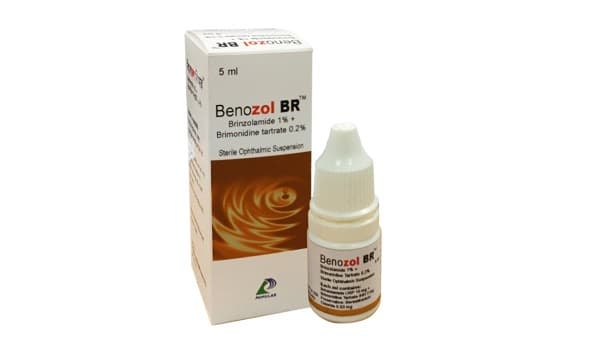

Medicine overview
Indications of Benozol BR
Benozol BR ophthalmic suspension is FDA-approved and guideline-supported for the following indication:
- Reduction of elevated intraocular pressure (IOP) in adult patients with open-angle glaucoma or ocular hypertension.
Benozol BR is typically used when a single topical agent does not adequately control intraocular pressure, or as an alternative to using its two individual components as separate eye drops. It combines a carbonic anhydrase inhibitor (brinzolamide) with an alpha-2 adrenergic agonist (brimonidine tartrate) to lower IOP through complementary mechanisms.
Composition
Each mL of Brinzolamide + Brimonidine Tartrate ophthalmic suspension typically contains:
- Brinzolamide 10 mg (1% w/v)
- Brimonidine tartrate 2 mg (0.2% w/v)
Inactive ingredients commonly include benzalkonium chloride (preservative), carbomer, sodium chloride, mannitol, and purified water, with pH adjusted using sodium hydroxide/hydrochloric acid as needed.
Description
Benozol BR is a fixed-dose combination ophthalmic suspension used to lower elevated intraocular pressure (IOP) in patients with open-angle glaucoma or ocular hypertension. It combines two agents with complementary, additive mechanisms of action: brinzolamide, a carbonic anhydrase inhibitor that reduces aqueous humor production, and brimonidine tartrate, a selective alpha-2 adrenergic agonist that both decreases aqueous humor production and increases uveoscleral outflow.
Benozol BR is administered as eye drops and is generally used when monotherapy with a single IOP-lowering agent is insufficient to achieve target pressure.
Therapeutic Class
Benozol BR belongs to the therapeutic class of anti-glaucoma agents, specifically a fixed-dose combination of a topical carbonic anhydrase inhibitor and a topical alpha-2 adrenergic agonist.
Pharmacology
Brinzolamide + Brimonidine Tartrate lowers intraocular pressure through two complementary mechanisms:
- Brinzolamide inhibits carbonic anhydrase II in the ciliary processes of the eye, reducing bicarbonate ion formation and, consequently, sodium and fluid transport, which decreases aqueous humor secretion.
- Brimonidine tartrate is a relatively selective alpha-2 adrenergic receptor agonist that reduces aqueous humor production and increases uveoscleral outflow, with minimal effect on pupil size or accommodation.
Together, the components of Brinzolamide + Brimonidine Tartrate provide additive IOP-lowering effects compared to either component used alone. Onset of action is typically within one hour, with peak effect around two hours after administration.
Dosage & Administration of Benozol BR
Adult Dose
Instill one drop of Benozol BR into the affected eye(s) three times daily, approximately every 8 hours.
Administration Technique
- Shake the bottle well before each use.
- Wash hands before instilling the drops.
- Tilt the head back, pull down the lower eyelid to form a pocket, and instill one drop without letting the dropper tip touch the eye or surrounding surfaces (to avoid contamination).
- Apply gentle pressure over the tear duct (nasolacrimal occlusion) for 1-2 minutes after instillation to reduce systemic absorption.
- If using other topical ophthalmic medications, space administration at least 5 minutes apart.
- Contact lenses should be removed before instillation and may be reinserted 15 minutes after administration.
Renal/Hepatic Considerations
Benozol BR has not been studied in patients with severe renal impairment (creatinine clearance less than 30 mL/min) and is not recommended in this population due to the brinzolamide component being primarily renally eliminated; use with caution in hepatic impairment as brimonidine is metabolized in the liver.
Administration of Benozol BR
For ophthalmic (topical eye) use only. Not for injection or oral use. See Dosage and Administration for detailed instillation technique.
Interaction of Benozol BR
Benozol BR has the following clinically significant interactions:
- Oral carbonic anhydrase inhibitors (e.g., acetazolamide): concurrent use with Benozol BR may cause additive systemic carbonic anhydrase inhibitor effects; concomitant use is not recommended.
- Monoamine oxidase inhibitors (MAOIs): may increase the systemic effects of the brimonidine component (e.g., hypotension); concurrent use with Benozol BR is contraindicated (see Contraindications).
- CNS depressants (alcohol, opioids, sedatives, barbiturates, anesthetics): may have additive sedative effects when used with Benozol BR.
- Tricyclic antidepressants: may blunt the IOP-lowering and blood-pressure effects of the brimonidine component of Benozol BR.
- Antihypertensives and cardiac glycosides: caution is advised as Benozol BR may have additive effects on blood pressure and heart rate.
Contraindications
Brinzolamide + Brimonidine Tartrate is contraindicated in:
- Patients with known hypersensitivity to brinzolamide, brimonidine tartrate, sulfonamides, or any other component of the formulation (brinzolamide is a sulfonamide derivative and shares cross-sensitivity potential).
- Neonates and infants under 2 years of age, due to risk of serious brimonidine-related central nervous system depression (apnea, bradycardia, hypotension, hypothermia, lethargy, somnolence).
- Patients receiving concurrent monoamine oxidase inhibitor (MAOI) therapy.
Side Effects of Benozol BR
The most commonly reported side effects of Benozol BR include:
- Blurred vision
- Eye irritation, redness, or itching (ocular hyperemia)
- Dysgeusia (bitter or unusual taste in the mouth)
- Dry mouth
- Eye allergy/allergic conjunctivitis
- Drowsiness or fatigue
- Watery eyes (tearing)
- Headache
Less common but serious effects can include eye pain or swelling, significant vision changes, allergic reactions (including signs of severe skin reactions given the sulfonamide component), fainting, marked drowsiness, or slowed heart rate. Patients should seek prompt medical attention if these occur.
Pregnancy & Lactation
Pregnancy: There are no adequate and well-controlled studies of Benozol BR in pregnant women. It should be used during pregnancy only if the potential benefit to the mother clearly justifies the potential risk to the fetus. Consult a physician before use if pregnant or planning pregnancy.
Lactation: It is not known whether the components of Benozol BR are excreted in human breast milk. Because many drugs are excreted in breast milk, caution should be exercised, and a decision should be made whether to discontinue nursing or discontinue the medication, taking into account the importance of the drug to the mother, in consultation with a physician.
Precautions & Warnings
The following precautions apply to Benozol BR:
- Sulfonamide hypersensitivity: Although administered topically, brinzolamide is absorbed systemically; fatal reactions from severe sulfonamide reactions (e.g., Stevens-Johnson syndrome) have been reported with systemic sulfonamides, so caution is warranted in patients with a history of sulfonamide sensitivity.
- Corneal endothelial health: Use with caution in patients with low endothelial cell counts, as brinzolamide's effect on the corneal endothelium has not been studied extensively in compromised eyes.
- Severe renal impairment: Not recommended in patients with creatinine clearance less than 30 mL/min (see Dosage and Administration).
- Cardiovascular and cerebrovascular disease: Brimonidine may lower blood pressure; use with caution in patients with severe or unstable cardiovascular disease.
- Depression and cerebral/coronary insufficiency: Use brimonidine-containing products with caution in patients with depression, orthostatic hypotension, thromboangiitis obliterans, Raynaud's phenomenon, or Raynaud's disease.
- Contact lenses: Should be removed prior to instillation and reinserted after 15 minutes; the preservative benzalkonium chloride may be absorbed by soft contact lenses.
- Vision and driving: Benozol BR may cause temporary blurred vision or drowsiness; patients should exercise caution when driving or operating machinery until effects are known.
- Bacterial contamination: Avoid contaminating the dropper tip; do not share eye drop bottles between patients or between eyes with active infection.
Overdose Effects of Benozol BR
Overdose with Benozol BR is uncommon with topical ophthalmic use but accidental ocular or oral ingestion may cause systemic effects such as sedation, hypotension, bradycardia, hypothermia, respiratory depression, or apnea, particularly in young children. If overdose or accidental ingestion is suspected, seek immediate medical attention or contact a poison control center right away. Do not attempt home treatment for a suspected overdose.
Storage Conditions
Store at room temperature (below 30°C), away from light and moisture. Keep the bottle tightly closed when not in use. Keep out of reach of children.
Use In Special Populations
Pediatric Use
Safety and effectiveness of Benozol BR in pediatric patients below 2 years of age have not been established, and use is contraindicated in this age group due to risk of CNS depression. Use in children aged 2 to younger than 18 years is not well established; caution is advised, especially in low-weight children, due to increased risk of brimonidine-related adverse effects such as somnolence.
Elderly (Geriatric Use)
No overall differences in safety or effectiveness have been observed between elderly and younger adult patients using Benozol BR; no dosage adjustment is required based on age alone.
Renal Impairment
Benozol BR is not recommended in patients with severe renal impairment (creatinine clearance less than 30 mL/min).
Hepatic Impairment
Use with caution in patients with hepatic impairment; such patients have not been specifically studied.
Duration Of Treatment
Duration of treatment with Benozol BR is determined by the treating ophthalmologist based on intraocular pressure response and disease control. Glaucoma and ocular hypertension typically require long-term, often lifelong, maintenance therapy with regular monitoring of intraocular pressure and ocular health. Do not discontinue without consulting a physician, as intraocular pressure may rise again.
Drug Classes
Brinzolamide + Brimonidine Tartrate is a fixed-dose combination of two anti-glaucoma drug classes: a topical carbonic anhydrase inhibitor (brinzolamide) and a topical selective alpha-2 adrenergic agonist (brimonidine tartrate).
Mode Of Action
Brinzolamide + Brimonidine Tartrate lowers intraocular pressure by two complementary mechanisms: brinzolamide inhibits carbonic anhydrase II in the ciliary body, decreasing aqueous humor formation, while brimonidine tartrate stimulates alpha-2 adrenergic receptors to reduce aqueous humor production and increase uveoscleral outflow. The combined effect of Brinzolamide + Brimonidine Tartrate produces greater IOP reduction than either agent alone.
Pediatric Uses
Benozol BR is contraindicated in neonates and infants younger than 2 years of age because of the risk of serious brimonidine-related central nervous system depression, including apnea, bradycardia, hypotension, hypothermia, and lethargy. Safety and effectiveness in children aged 2 to younger than 18 years have not been well established; if used in this age group, it should be under close physician supervision with monitoring for somnolence and other adverse effects, particularly in children with low body weight.
Frequently Asked Questions
Q: What is Benozol BR 1%+0.2% Eye Drops used for?
A: Benozol BR 1%+0.2% Eye Drops is used to reduce elevated intraocular pressure (IOP) in adults with open-angle glaucoma or ocular hypertension.
Q: How often should I use Benozol BR 1%+0.2% Eye Drops?
A: Benozol BR 1%+0.2% Eye Drops is typically instilled as one drop in the affected eye(s) three times daily, about every 8 hours, or as directed by your physician.
Q: Can children use Benozol BR 1%+0.2% Eye Drops?
A: Benozol BR 1%+0.2% Eye Drops is contraindicated in neonates and infants under 2 years of age because of the risk of serious central nervous system depression. Its use in children aged 2 to 18 years has not been well established and should only occur under close physician supervision.
Q: Is Benozol BR 1%+0.2% Eye Drops safe during pregnancy?
A: There is limited data on the use of Benozol BR 1%+0.2% Eye Drops during pregnancy. It should be used only if the potential benefit clearly justifies the potential risk to the fetus, and only under the guidance of a physician.
Q: What are the common side effects of Benozol BR 1%+0.2% Eye Drops?
A: Common side effects of Benozol BR 1%+0.2% Eye Drops include blurred vision, eye redness or irritation, a bitter taste in the mouth, dry mouth, and drowsiness. Contact your physician if side effects are severe or persistent.
Q: Who should not use Benozol BR 1%+0.2% Eye Drops?
A: Benozol BR 1%+0.2% Eye Drops should not be used by patients allergic to sulfonamides or either component, infants and children under 2 years of age, or patients currently taking monoamine oxidase inhibitors (MAOIs).
Disclaimer
The information provided is accurate to the best of our knowledge, but it does not replace professional medical advice. We cannot guarantee its completeness or accuracy, and the absence of specific information about a drug should not be taken as an endorsement. We are not responsible for any consequences arising from this information, so please consult a healthcare professional for any concerns or questions.
