8% Off
Besibac0.6%
Popular Pharmaceuticals Ltd.
৳322.00
Add to cart

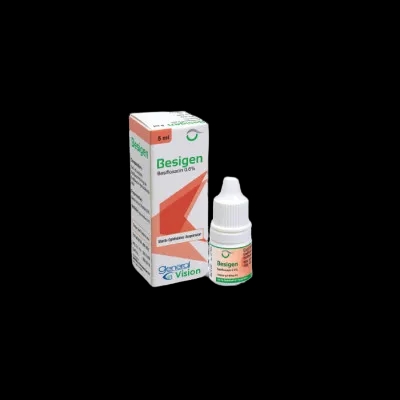
Besigen 0.6% Ophthalmic Solution is available on MedEasy for ৳315.00 per 5 ml drop, with home delivery anywhere in Bangladesh. It is manufactured by General Pharmaceuticals Ltd. Its generic name is Besifloxacin.

Besigen ophthalmic suspension is FDA-approved for the treatment of bacterial conjunctivitis (pink eye) caused by susceptible strains of bacteria in patients 1 year of age and older.
Besigen is intended for topical ophthalmic (eye) use only and is not approved for any systemic infection, viral conjunctivitis, or fungal/other non-bacterial eye infections.
Each mL of Besifloxacin ophthalmic suspension (0.6%) contains besifloxacin (as besifloxacin hydrochloride) equivalent to 6 mg of besifloxacin base, formulated in a sustained-release, mucoadhesive ophthalmic vehicle intended for topical instillation into the eye.
Besigen is a fourth-generation fluoroquinolone antibacterial agent belonging to the chlorofluoroquinolone subclass, distinguished by a chlorine atom at the C-8 position of the quinolone ring, which contributes to enhanced potency against Gram-positive ocular pathogens and reduced potential for resistance selection compared with older fluoroquinolones.
It is formulated exclusively as a topical ophthalmic suspension for the treatment of bacterial conjunctivitis and is not available in oral, injectable, or systemic dosage forms.
Besifloxacin exerts its bactericidal effect by inhibiting two essential bacterial enzymes, DNA gyrase (topoisomerase II) and topoisomerase IV, which are required for bacterial DNA replication, transcription, repair, and recombination. Inhibition of these enzymes leads to breakage of bacterial DNA strands and rapid bacterial cell death.
Besifloxacin demonstrates broad-spectrum in vitro activity against many Gram-positive and Gram-negative bacteria commonly implicated in bacterial conjunctivitis. Following topical ocular administration, systemic absorption is minimal, with plasma concentrations generally below the limit of quantification.
| Indication | Age Group | Dose |
|---|---|---|
| Bacterial conjunctivitis | Adults and children 1 year of age and older | Instill 1 drop of Besigen in the affected eye(s) 3 times daily, 4 to 12 hours apart, for 7 days |
| Bacterial conjunctivitis | Children under 1 year of age | Safety and efficacy of Besigen have not been established; not recommended |
Antibiotic stewardship: Take Besigen exactly as prescribed by your physician; complete the full 7-day course even if symptoms improve earlier. Do not stop, extend, skip doses, or share this medicine with others without medical advice, as incomplete courses may promote the growth of resistant bacteria.
Besigen is for topical ophthalmic (eye) use only. It must never be injected (including subconjunctival injection) or introduced into the anterior chamber of the eye.
Because Besigen is applied topically to the eye and systemic absorption is minimal, clinically significant systemic drug-drug interactions have not been well established in clinical studies.
Besifloxacin ophthalmic suspension is contraindicated in patients with known hypersensitivity to besifloxacin or to other fluoroquinolone antibacterial agents.
The most commonly reported adverse reaction with Besigen in clinical trials was:
Other reported adverse reactions, generally mild and localized to the eye, include:
Hypersensitivity reactions (see Contraindications) can occur rarely; discontinue Besigen and seek medical attention if signs of an allergic reaction occur.
Pregnancy: There are no adequate and well-controlled studies of Besigen in pregnant women. Systemic absorption after topical ocular administration is minimal. Besigen should be used during pregnancy only if the potential benefit justifies the potential risk to the fetus; consult a physician before use.
Lactation: It is not known whether Besigen is excreted in human breast milk after topical ophthalmic use. Because many drugs are excreted in human milk, caution should be exercised and a physician consulted before using Besigen while breastfeeding.
Overdose is unlikely with topical ophthalmic use of Besigen. If excessive medication is instilled into the eye, it may be flushed out with lukewarm water.
If Besigen is accidentally ingested or a significant overdose is suspected, seek immediate medical attention or contact a poison control center/emergency services rather than attempting home treatment.
Store Besigen ophthalmic suspension at 15°C to 25°C (59°F to 77°F). Do not freeze. Keep the bottle tightly closed when not in use and out of reach of children.
C
Besigen ophthalmic suspension is approved for the treatment of bacterial conjunctivitis in children 1 year of age and older, using the same dose as adults: 1 drop in the affected eye(s) 3 times daily, 4 to 12 hours apart, for 7 days.
Safety and efficacy of Besigen in infants below 1 year of age have not been established, and use in this age group is not recommended unless specifically directed by a physician.
Q: What is Besigen 0.6% Ophthalmic Solution used for?
A: Besigen 0.6% Ophthalmic Solution ophthalmic suspension is used to treat bacterial conjunctivitis (pink eye) caused by susceptible bacteria in adults and children 1 year of age and older. It is for eye use only and does not treat viral or allergic conjunctivitis.
Q: How should I use Besigen 0.6% Ophthalmic Solution eye drops?
A: Shake the bottle well, wash your hands, and instill 1 drop of Besigen 0.6% Ophthalmic Solution into the affected eye(s) 3 times daily, 4 to 12 hours apart, for 7 days, unless your physician directs otherwise. Avoid letting the dropper tip touch your eye or any surface. Complete the full course even if your eyes feel better sooner, and do not stop, extend, skip doses, or share this medicine with others without medical advice.
Q: Can I wear contact lenses while using Besigen 0.6% Ophthalmic Solution?
A: No. Contact lenses should not be worn while you have signs or symptoms of bacterial conjunctivitis or during treatment with Besigen 0.6% Ophthalmic Solution, as lenses may worsen the infection or reduce effectiveness.
Q: What are the common side effects of Besigen 0.6% Ophthalmic Solution?
A: The most common side effect of Besigen 0.6% Ophthalmic Solution is redness of the eye (conjunctival redness). Other possible effects include blurred vision, eye irritation or pain, headache, and eye discharge. Most reactions are mild and localized to the eye. Seek medical attention if you notice signs of an allergic reaction such as rash, swelling, or severe itching.
Q: Is Besigen 0.6% Ophthalmic Solution safe during pregnancy or breastfeeding?
A: There are no adequate studies of Besigen 0.6% Ophthalmic Solution in pregnant women, and it is not known whether it passes into breast milk. Although absorption into the body after eye use is minimal, Besigen 0.6% Ophthalmic Solution should only be used during pregnancy or breastfeeding if a physician determines the benefit outweighs any potential risk. Always consult your doctor first.
Q: What should I do if I miss a dose or think I've used too much Besigen 0.6% Ophthalmic Solution?
A: If you miss a dose of Besigen 0.6% Ophthalmic Solution, instill it as soon as you remember and then continue your regular schedule; do not double up. Overdose is unlikely with eye drops, but if you accidentally swallow Besigen 0.6% Ophthalmic Solution or a large amount is used, seek immediate medical attention or contact a poison control center or emergency services.
Disclaimer
The information provided is accurate to the best of our knowledge, but it does not replace professional medical advice. We cannot guarantee its completeness or accuracy, and the absence of specific information about a drug should not be taken as an endorsement. We are not responsible for any consequences arising from this information, so please consult a healthcare professional for any concerns or questions.