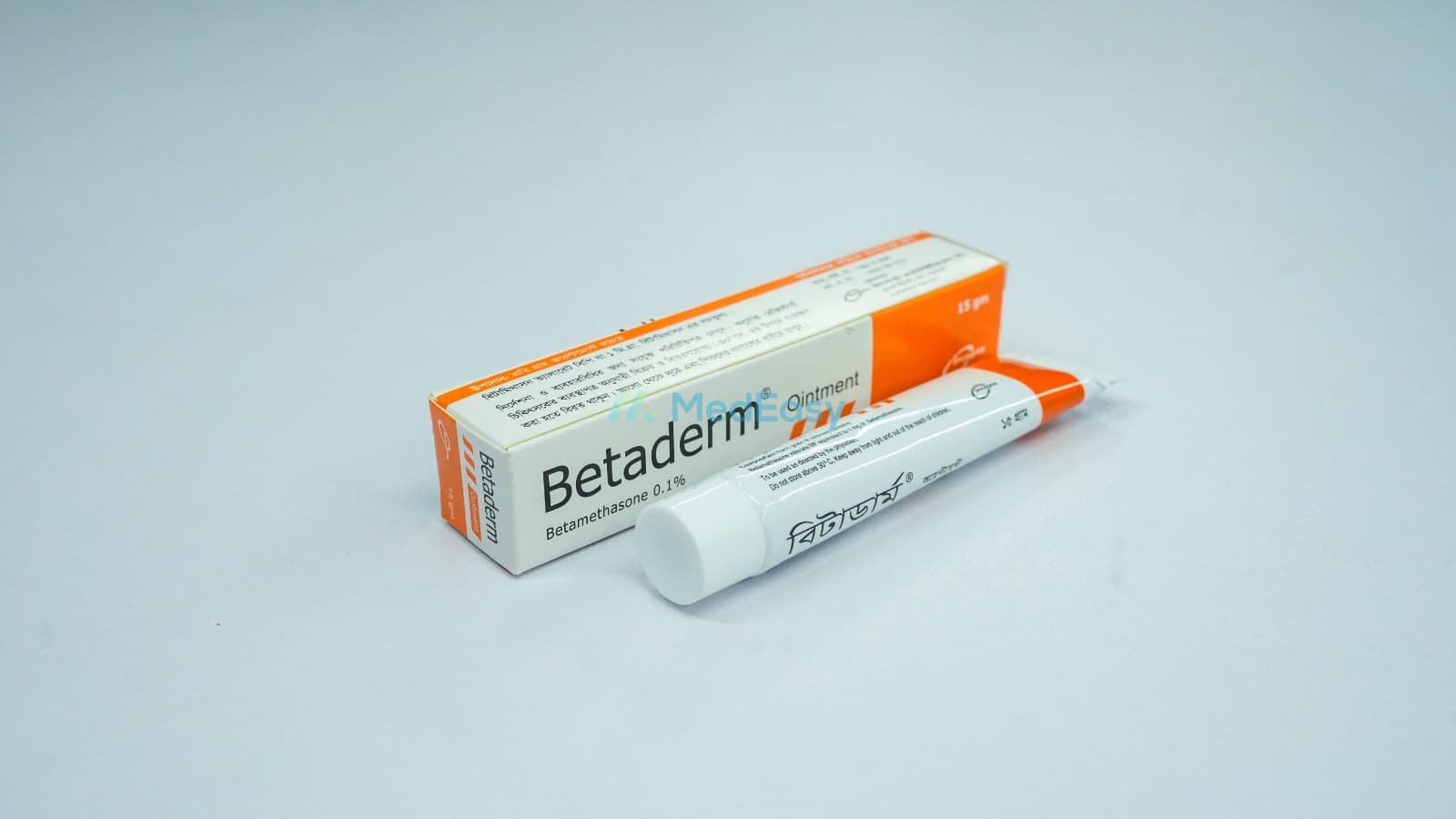
Medicine overview
Indications of Betaderm
Betaderm is a mid-potency topical corticosteroid indicated for the relief of the inflammatory and pruritic manifestations of corticosteroid-responsive dermatoses.
Established / Approved Uses
- Eczema (including atopic, infantile, and discoid eczema)
- Psoriasis, excluding widespread plaque psoriasis
- Seborrhoeic dermatitis
- Neurodermatoses (lichen simplex, lichen planus)
- Contact/irritant dermatitis and contact sensitivity reactions
- Prurigo nodularis
- Discoid lupus erythematosus (localized skin lesions)
Betaderm should be used only for the corticosteroid-responsive skin condition diagnosed and prescribed by a physician; it is not intended for indiscriminate or self-directed use on undiagnosed skin lesions.
Composition
Each gram of cream or ointment contains Betamethasone Valerate BP equivalent to 0.1% w/w Betamethasone, in a suitable topical cream, ointment, or lotion base.
Description
Betaderm is a mid-potency (Group 3, per the US 7-tier topical corticosteroid potency ranking) synthetic glucocorticoid formulated for topical use on the skin. It is available as a cream, ointment, or lotion, typically at a strength of 0.1%. Betaderm works by reducing inflammation, itching, and redness in a range of corticosteroid-responsive skin conditions. It is intended for dermatologic (skin) use only and is not for ophthalmic, oral, or long-term unsupervised use.
Therapeutic Class
Betaderm belongs to the topical corticosteroid (glucocorticoid) class of dermatological preparations. It is classified as a mid-potency (intermediate-strength) topical steroid.
Pharmacology
Betamethasone Valerate is a synthetic corticosteroid that diffuses across cell membranes and binds to intracellular glucocorticoid receptors in skin cells. This receptor-hormone complex translocates to the nucleus and modulates gene transcription, inducing synthesis of lipocortins (proteins that inhibit phospholipase A2), which in turn reduces the release of arachidonic acid and downstream inflammatory mediators such as prostaglandins and leukotrienes.
The overall effect of Betamethasone Valerate is anti-inflammatory, antipruritic (anti-itch), and vasoconstrictive action in the skin, which together relieve redness, swelling, and itching in corticosteroid-responsive dermatoses. Systemic absorption through intact skin is normally low but increases substantially with use on thin or broken skin, large body surface areas, occlusive dressings, and in infants and young children.
Dosage & Administration of Betaderm
General Dosing Principles
Betaderm should be applied as a thin film to the affected skin area only, using the smallest amount and shortest duration needed to control symptoms.
| Indication | Population | Typical Regimen |
|---|---|---|
| Corticosteroid-responsive dermatoses (eczema, psoriasis [excluding widespread plaque psoriasis], neurodermatitis, seborrhoeic dermatitis, contact dermatitis, discoid lupus erythematosus, prurigo nodularis) | Adults | Apply a thin film to the affected area 1–3 times daily until improvement occurs; once control is achieved, reduce to once or twice daily, or apply less frequently as directed by a physician. |
| Same indications, lotion formulation | Adults | Apply a few drops and massage gently into the affected area, usually twice daily (morning and night); frequency may be adjusted by a physician based on response. |
| Corticosteroid-responsive dermatoses | Children aged 1 year and older | Apply sparingly, once or twice daily, for the shortest duration that controls symptoms, under physician supervision; avoid occlusive dressings. |
| Any indication | Infants under 1 year | Not recommended — see Pediatric Use. |
Continuous treatment with Betaderm is generally not recommended beyond about 2–4 weeks without medical reassessment; if there is no improvement within 2 weeks, treatment should be reviewed by a physician. See also Duration of Treatment.
Administration of Betaderm
- Wash and dry hands before and after applying Betaderm, unless the hands are the area being treated.
- Apply a thin film of Betaderm only to the affected skin area; avoid unaffected skin.
- Gently rub in until the Betaderm cream, ointment, or lotion is absorbed.
- Do not cover the treated area with airtight (occlusive) dressings or plastic wrap unless a physician has specifically directed this.
- Avoid contact with the eyes, lips, and mucous membranes.
- Do not apply Betaderm to the face, groin, or armpits for prolonged periods unless directed by a physician.
- Do not use Betaderm on broken or infected skin unless an appropriate antimicrobial is also being used, as directed by a physician.
Interaction of Betaderm
Betaderm is applied topically and systemic drug interactions are uncommon when it is used as directed on limited areas of intact skin. However, clinically relevant interactions can occur in specific situations:
- Other topical or systemic corticosteroids: Concurrent use with other corticosteroid-containing products increases the total corticosteroid exposure and the risk of HPA-axis suppression and systemic side effects; avoid combining without medical advice.
- Occlusive dressings or other topical agents that increase skin permeability: These substantially increase systemic absorption of Betaderm and the risk of systemic corticosteroid effects.
- CYP3A4 inhibitors (e.g., ritonavir, itraconazole): Theoretically, potent CYP3A4 inhibitors could increase systemic corticosteroid levels if significant absorption occurs (e.g., with extensive or prolonged use); clinical significance with limited topical use of Betaderm is low but caution is advised with widespread application.
Contraindications
Betamethasone Valerate is contraindicated in:
- Patients with known hypersensitivity to Betamethasone Valerate, other corticosteroids, or any component of the formulation.
- Untreated cutaneous infections at the site of application, including viral infections (e.g., herpes simplex, varicella), fungal infections, and bacterial infections, unless an appropriate anti-infective is used concurrently under medical supervision.
Betamethasone Valerate is for dermatologic (skin) use only and must not be used in or near the eyes.
Side Effects of Betaderm
Local skin reactions are the most common adverse effects of Betaderm and are usually related to the strength, duration, and area of application:
- Burning, stinging, itching, and dryness at the application site
- Skin thinning (atrophy), striae (stretch marks), and telangiectasia (visible small blood vessels)
- Folliculitis, hypertrichosis (increased hair growth), and acneiform eruptions
- Hypopigmentation or hyperpigmentation of the treated skin
- Perioral dermatitis and allergic contact dermatitis
- Maceration of the skin and secondary skin infection
- Miliaria (heat rash)
With extensive use, prolonged use, use under occlusion, or use on large areas or broken skin, systemic absorption of Betaderm can occur, which may rarely cause features of hypercorticism (Cushingoid features), HPA-axis suppression, hyperglycemia, and glucosuria — see Precautions and Warnings.
Pregnancy & Lactation
Pregnancy: There are no adequate, well-controlled studies of Betaderm in pregnant women. Topical corticosteroids have been shown to be teratogenic in animal studies when given in sufficient systemic quantities. Betaderm should be used during pregnancy only if clearly needed and the potential benefit justifies the potential risk to the fetus; avoid use over large areas, for prolonged periods, or under occlusion during pregnancy. Consult a physician before use.
Lactation: It is not known whether topical application of Betaderm results in sufficient systemic absorption to produce detectable amounts in human breast milk. Caution should be exercised when Betaderm is used by a breastfeeding woman; avoid applying it to the breast/nipple area before nursing, and consult a physician before use.
Precautions & Warnings
HPA-Axis Suppression
Systemic absorption of Betaderm can produce reversible hypothalamic-pituitary-adrenal (HPA) axis suppression, manifestations of Cushing's syndrome, hyperglycemia, and glucosuria. This risk increases with the use of higher potency products, large treatment areas, prolonged use, use under occlusive dressings, and use in infants and young children (due to a larger skin-surface-to-body-weight ratio).
Occlusive Dressings
Occlusive dressings substantially increase percutaneous absorption of Betaderm and should only be used if specifically directed by a physician.
Special Sites
Avoid prolonged use of Betaderm on the face, groin, and axillae (armpits), which are more susceptible to atrophic skin changes. Betaderm is not for ophthalmic use — avoid contact with the eyes, as prolonged exposure may increase the risk of cataracts or glaucoma. Betaderm should not be used for rosacea, acne vulgaris, or perioral dermatitis, as it may worsen these conditions.
Skin Infections
If a skin infection is present or develops, an appropriate antimicrobial agent should be used; if a favorable response does not occur promptly, Betaderm should be discontinued until the infection is adequately controlled.
Local Irritation and Sensitization
Betaderm may cause contact sensitization or local irritation. If irritation develops or worsens, Betaderm should be discontinued and appropriate therapy instituted.
Duration of Use
Betaderm should not be used for prolonged, continuous periods (see Duration of Treatment). If no improvement is seen within 2 weeks, treatment should be reassessed by a physician.
Overdose Effects of Betaderm
Excessive or prolonged use of Betaderm over large areas, especially under occlusion or in children, can lead to sufficient systemic absorption to produce features of hypercorticism (Cushingoid features), HPA-axis suppression, hyperglycemia, and glucosuria. Accidental ingestion of Betaderm is unlikely to cause significant toxicity from a small topical preparation, but any suspected overdose, accidental ingestion, or signs of systemic corticosteroid effects (e.g., unusual weight gain, moon face, muscle weakness) should prompt immediate medical attention. Contact a physician, hospital emergency department, or a poison control center promptly; do not attempt to manage a suspected overdose at home without medical guidance.
Storage Conditions
Store Betaderm at room temperature (below 30°C), away from direct light and moisture. Do not freeze. Keep the container tightly closed when not in use, and keep out of the reach and sight of children.
Use In Special Populations
Pediatric patients: See Pediatric Use.
Elderly patients: Elderly patients may have thinner, more fragile skin and may be more susceptible to skin atrophy, bruising, and local irritation with Betaderm; use the lowest effective amount for the shortest necessary duration.
Renal and hepatic impairment: Specific dose adjustment data for topical Betaderm in renal or hepatic impairment are not established, as systemic exposure from normal topical use is minimal; however, if extensive body surface areas are treated (increasing systemic absorption), caution and physician supervision are advised in patients with significant hepatic impairment, as corticosteroid metabolism may be reduced.
Pregnancy and lactation: See Pregnancy and Lactation.
Duration Of Treatment
Betaderm is intended for short-term, intermittent use. Continuous therapy is generally limited to a maximum of about 2–4 weeks, and many labels recommend reassessment if there is no improvement within 2 weeks. Once symptoms improve, the frequency of application of Betaderm should be reduced, and treatment should be discontinued as soon as clinically appropriate. Prolonged, continuous use — especially on the face, in skin folds, under occlusion, or in children — should be avoided due to the increased risk of skin atrophy and HPA-axis suppression; any need for longer-term use should be reviewed by a physician.
Drug Classes
Topical Corticosteroids; Glucocorticoids; Dermatological Preparations
Mode Of Action
Betamethasone Valerate exerts its effect by binding to cytoplasmic glucocorticoid receptors within skin cells. The activated receptor complex moves into the cell nucleus and alters gene transcription, increasing production of anti-inflammatory proteins (such as lipocortin-1, which inhibits phospholipase A2) and decreasing production of pro-inflammatory mediators (such as prostaglandins, leukotrienes, and cytokines). This produces the characteristic anti-inflammatory, antipruritic, and vasoconstrictive effects of Betamethasone Valerate on the skin, reducing redness, swelling, and itching in corticosteroid-responsive dermatoses.
Pregnancy
C (FDA legacy pregnancy category)
Pediatric Uses
Betaderm is not recommended for use in infants under 1 year of age due to a higher risk of HPA-axis suppression and systemic absorption in this age group. Safety and efficacy of Betaderm in infants under 1 year have not been established.
In children 1 year of age and older, Betaderm may be used under medical supervision, but children are more susceptible than adults to HPA-axis suppression and Cushing's syndrome because of a larger skin-surface-to-body-weight ratio. Use in children should be limited to the least amount compatible with an effective treatment regimen, for the shortest possible duration, and occlusive dressings should generally be avoided. Long-term use of Betaderm in children has been associated with growth retardation, delayed weight gain, and (rarely) intracranial hypertension; growth and development should be monitored periodically in children requiring prolonged treatment.
Frequently Asked Questions
Q: What is Betaderm 15 gm Ointment used for?
A: Betaderm 15 gm Ointment is a topical corticosteroid cream, ointment, or lotion used to relieve inflammation, redness, and itching in skin conditions such as eczema, psoriasis (excluding widespread plaque psoriasis), seborrhoeic dermatitis, contact dermatitis, and other corticosteroid-responsive dermatoses, as prescribed by a physician.
Q: How should I apply Betaderm 15 gm Ointment?
A: Apply a thin film of Betaderm 15 gm Ointment to the affected skin only, usually 1–3 times daily as directed, reducing frequency as symptoms improve. Wash your hands before and after use (unless treating the hands), avoid the eyes and mucous membranes, and do not cover the area with an airtight dressing unless your physician specifically instructs you to.
Q: Can I use Betaderm 15 gm Ointment on my face?
A: Betaderm 15 gm Ointment should generally be avoided on the face for prolonged periods because facial skin is thinner and more prone to atrophy, striae, and telangiectasia with continued corticosteroid use. Only use Betaderm 15 gm Ointment on the face if a physician has specifically directed you to, and for the shortest duration possible.
Q: Is Betaderm 15 gm Ointment safe during pregnancy or breastfeeding?
A: Betaderm 15 gm Ointment should be used during pregnancy only if clearly needed and if the potential benefit justifies the potential risk to the fetus, avoiding large areas, prolonged use, or occlusion. During breastfeeding, caution is advised and Betaderm 15 gm Ointment should not be applied to the breast/nipple area before nursing. Always consult a physician before using Betaderm 15 gm Ointment if you are pregnant or breastfeeding.
Q: How long can I use Betaderm 15 gm Ointment continuously?
A: Betaderm 15 gm Ointment is generally intended for short-term use, typically not more than about 2–4 weeks of continuous therapy. If there is no improvement within 2 weeks, or if you feel you need to use Betaderm 15 gm Ointment for longer, consult your physician for reassessment rather than continuing on your own, since prolonged continuous use increases the risk of skin thinning and adrenal (HPA-axis) suppression.
Q: What should I do if I accidentally use too much Betaderm 15 gm Ointment?
A: Using too much Betaderm 15 gm Ointment, especially over large areas, under occlusive dressings, or for prolonged periods, can lead to systemic absorption and signs such as unusual weight gain, moon face, or muscle weakness. If you suspect overuse, accidental ingestion, or notice such symptoms, seek immediate medical attention or contact a poison control center — do not try to manage it at home.
Disclaimer
The information provided is accurate to the best of our knowledge, but it does not replace professional medical advice. We cannot guarantee its completeness or accuracy, and the absence of specific information about a drug should not be taken as an endorsement. We are not responsible for any consequences arising from this information, so please consult a healthcare professional for any concerns or questions.