
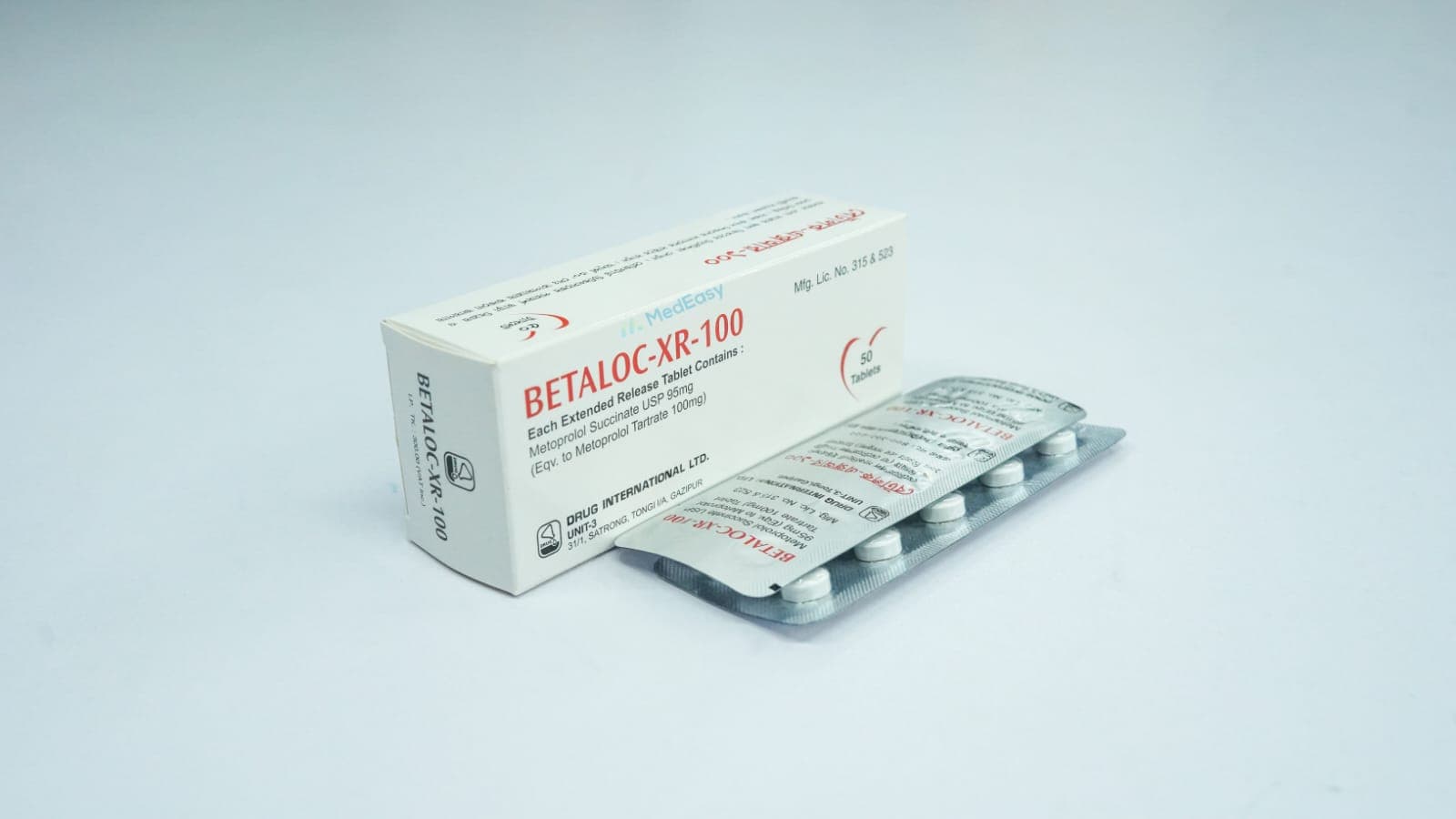
Key facts
Betaloc-XR 100 mg Tablet is available on MedEasy for ৳5.52 per piece, with home delivery anywhere in Bangladesh. It is manufactured by Drug International Ltd. Its generic name is Metoprolol Tartrate.
- Pack sizes
- piece, 50's pack
- Prescription
- Required. Upload a valid doctor's prescription at checkout; a MedEasy pharmacist verifies it before dispatch.
- Delivery
- Home delivery across Bangladesh. Same-day delivery in Dhaka, Chattogram, Sylhet and Bogura city areas; 2-3 days elsewhere.
- Payment
- Cash on delivery, bKash, cards and mobile banking.
- Brand
- Betaloc-XR
- Generic name
- Metoprolol Tartrate
- Manufacturer
- Drug International Ltd.
- Form & strength
- Tablet 100 mg
- Availability
- In stock
- Authenticity
- Sourced from licensed suppliers and the manufacturer's authorised distributors in Bangladesh.

Medicine overview
Indications of Betaloc-XR
Betaloc-XR is a cardioselective beta-1 adrenergic receptor blocker. Its FDA-approved and well-established indications include:
- Hypertension: Used alone or in combination with other antihypertensive agents to lower blood pressure.
- Angina pectoris: Long-term management to reduce the frequency and severity of angina attacks.
- Myocardial infarction (heart attack): To reduce cardiovascular mortality in hemodynamically stable patients, given early after the event.
Guideline-supported and commonly used off-label indications include:
- Rate control in atrial fibrillation and atrial flutter.
- Management of certain supraventricular tachyarrhythmias.
- Symptomatic treatment of hyperthyroidism-related tachycardia (as an adjunct, not a substitute for definitive treatment).
- Migraine prophylaxis (off-label use).
Note: Betaloc-XR is the immediate-release salt form, typically dosed multiple times daily, and is a distinct product from extended-release metoprolol succinate, which is dosed once daily and is separately approved for chronic heart failure.
Composition
Each tablet contains Metoprolol Tartrate USP as the active ingredient, commonly available in strengths of 25 mg, 50 mg, and 100 mg. An injectable formulation (5 mg/5 mL) is also available for hospital use. Excipients vary by manufacturer.
Description
Betaloc-XR is a cardioselective beta-1 adrenergic receptor blocking agent belonging to the beta-blocker class of cardiovascular drugs. It is the immediate-release salt of metoprolol and is used in the management of hypertension, angina pectoris, and after myocardial infarction. At usual clinical doses, Betaloc-XR preferentially blocks beta-1 receptors located mainly in cardiac tissue, reducing heart rate, myocardial contractility, and blood pressure, with comparatively less effect on beta-2 receptors found in bronchial and vascular smooth muscle.
Therapeutic Class
Betaloc-XR belongs to the therapeutic class of selective beta-1 adrenergic receptor blockers (cardioselective beta-blockers), a subgroup within the broader beta-adrenergic blocking agent class used in cardiovascular medicine.
Pharmacology
Metoprolol Tartrate selectively blocks beta-1 adrenergic receptors, which predominate in cardiac tissue, at doses lower than those required to block beta-2 receptors. This selectivity is relative and diminishes at higher doses. By blocking beta-1 receptors, Metoprolol Tartrate reduces the effects of circulating catecholamines on the heart, resulting in:
- Decreased heart rate (negative chronotropic effect)
- Decreased myocardial contractility (negative inotropic effect)
- Decreased cardiac output and blood pressure
- Reduced renin release from the kidneys
Metoprolol Tartrate is well absorbed after oral administration, undergoes significant first-pass hepatic metabolism via the CYP2D6 enzyme pathway, and has an elimination half-life of approximately 3 to 7 hours, which is why it is generally dosed two to three times daily for consistent effect.
Dosage & Administration of Betaloc-XR
| Indication | Adult Dosage |
|---|---|
| Hypertension | Initial: 100 mg/day in single or divided doses; usual maintenance range 100-450 mg/day in divided doses, titrated to response. |
| Angina pectoris | Initial: 100 mg/day in two divided doses; may increase gradually at weekly intervals up to 400 mg/day. |
| Myocardial infarction (early treatment) | In hospital, under close monitoring, followed by 100 mg twice daily by mouth for at least 3 months if tolerated, per treating physician's protocol. |
| Atrial fibrillation/flutter (rate control, off-label) | Individualized dosing, typically 25-100 mg twice daily, per physician judgment. |
Betaloc-XR tablets should be taken with or immediately after meals to ensure consistent absorption. Doses should be taken at evenly spaced intervals.
Renal impairment: No specific dose adjustment is generally required as metoprolol is primarily hepatically metabolized, but caution and clinical monitoring are advised in severe renal impairment.
Hepatic impairment: Since Betaloc-XR undergoes extensive hepatic metabolism, lower doses and careful titration are recommended in patients with significant hepatic impairment.
Important: Do not stop Betaloc-XR abruptly. Discontinuation should be gradual, tapered over 1-2 weeks, under medical supervision, to avoid rebound hypertension, tachycardia, worsening angina, or myocardial infarction.
Administration of Betaloc-XR
Betaloc-XR tablets are for oral use. Take with or immediately following food to help ensure consistent absorption. Swallow tablets whole with water; tablets that are scored may be split if directed by the physician. Do not crush or chew unless instructed. Take doses at the same times each day.
Interaction of Betaloc-XR
Betaloc-XR has clinically significant interactions with the following:
- Verapamil and diltiazem (non-dihydropyridine calcium channel blockers): Additive risk of severe bradycardia, AV block, and hypotension due to combined negative chronotropic and inotropic effects; avoid or use with extreme caution and monitoring.
- Digoxin: Additive bradycardic effect; increased risk of significant bradycardia, requiring monitoring of heart rate.
- Clonidine: Concurrent use requires caution; if both are being discontinued, metoprolol should be withdrawn first, several days before clonidine, to avoid rebound hypertension.
- CYP2D6 inhibitors (e.g., fluoxetine, paroxetine, quinidine, propafenone): Can significantly increase metoprolol plasma concentrations, increasing the risk of bradycardia and hypotension; dose adjustment may be needed.
- Catecholamine-depleting drugs (e.g., reserpine, MAO inhibitors): May cause additive hypotension and bradycardia, including syncope.
- Insulin and oral antidiabetic agents: Betaloc-XR may mask key symptoms of hypoglycemia such as tachycardia and tremor; blood glucose monitoring should be intensified.
- NSAIDs: May reduce the antihypertensive effect of Betaloc-XR.
Contraindications
Metoprolol Tartrate is contraindicated in patients with:
- Known hypersensitivity to metoprolol or any component of the formulation
- Severe bradycardia
- Second- or third-degree atrioventricular (AV) block (unless an artificial pacemaker is in place)
- Sick sinus syndrome without a functioning pacemaker
- Cardiogenic shock
- Decompensated (overt) heart failure
- Severe peripheral arterial circulatory disorders
Side Effects of Betaloc-XR
Common side effects of Betaloc-XR include:
- Fatigue and tiredness
- Dizziness or lightheadedness
- Bradycardia (slow heart rate)
- Hypotension (low blood pressure)
- Cold hands and feet
- Diarrhea, nausea
- Shortness of breath
- Depression, sleep disturbances
Less common but serious side effects requiring prompt medical attention include severe bradycardia, worsening heart failure (swelling, weight gain, breathlessness), bronchospasm (especially in patients with reactive airway disease), and heart block. See Precautions and Warnings for abrupt-discontinuation risks.
Pregnancy & Lactation
Pregnancy: Betaloc-XR crosses the placenta. It should be used during pregnancy only if the potential benefit justifies the potential risk to the fetus, and only under close physician supervision. Neonates born to mothers treated with Betaloc-XR near delivery should be monitored for signs of beta-blockade such as bradycardia, hypotension, hypoglycemia, and respiratory depression.
Lactation: Betaloc-XR is excreted into breast milk in small amounts. Breastfeeding infants should be monitored for signs of beta-blockade (e.g., unusual sleepiness, poor feeding, slow heart rate). Use during breastfeeding only after consulting a physician, weighing benefits against potential risk.
Precautions & Warnings
Do not stop abruptly: Abrupt discontinuation of Betaloc-XR can cause rebound hypertension, exacerbation of angina, tachycardia, ventricular arrhythmias, or myocardial infarction, particularly in patients with underlying coronary artery disease. Discontinue gradually over 1-2 weeks under medical supervision, whenever possible.
Heart failure: Use with caution in patients with compensated heart failure; may worsen cardiac function in some patients, especially at initiation or during dose increases.
Bronchospastic disease (asthma/COPD): Although Betaloc-XR is relatively cardioselective, this selectivity is not absolute, especially at higher doses, and beta-2 blockade can precipitate bronchospasm. Use with caution and the lowest effective dose, with a bronchodilator available if needed.
Diabetes mellitus: Betaloc-XR may mask tachycardia and tremor associated with hypoglycemia. Use with caution and monitor blood glucose closely in diabetic patients.
Peripheral vascular disease: May aggravate symptoms of arterial insufficiency.
Thyrotoxicosis: May mask signs of hyperthyroidism (e.g., tachycardia); abrupt withdrawal may precipitate thyroid storm.
Anesthesia and major surgery: Continued beta-blockade reduces the risk of arrhythmias during anesthesia and surgery; withdrawal should not be routine before surgery unless directed by the treating physician.
Conduction abnormalities: Use with caution in first-degree AV block.
Overdose Effects of Betaloc-XR
Overdose of Betaloc-XR may cause severe bradycardia, hypotension, cardiogenic shock, cardiac arrest, bronchospasm, and loss of consciousness. Overdose is a medical emergency.
If overdose is suspected, seek immediate medical attention or contact emergency services/poison control right away. Do not attempt to manage a suspected overdose at home. Treatment will be provided by medical professionals in a hospital setting based on the severity of symptoms.
Storage Conditions
Store at room temperature (below 30°C), away from light and moisture. Keep out of reach of children.
Use In Special Populations
Pediatric use: Safety and efficacy of Betaloc-XR in pediatric patients have not been well established for most indications; use in children should be under specialist supervision only if considered necessary.
Elderly: No overall differences in effectiveness have been observed, but elderly patients may be more sensitive to blood-pressure-lowering and heart-rate-lowering effects; start at the lower end of the dosing range and titrate cautiously.
Renal impairment: No specific dose adjustment generally required, but monitor clinically.
Hepatic impairment: Use with caution and lower starting doses, as Betaloc-XR is extensively metabolized by the liver.
Duration Of Treatment
Duration of treatment with Betaloc-XR depends on the indication. For hypertension and angina, treatment is typically long-term/chronic, continuing as long as clinically indicated and tolerated. For post-myocardial infarction use, treatment is generally continued for at least 3 months, and often longer, as determined by the treating cardiologist. Treatment duration and any changes should always be guided by a physician; do not discontinue without medical advice due to abrupt-withdrawal risks (see Precautions and Warnings).
Drug Classes
Beta-adrenergic blocking agent; specifically a cardioselective (beta-1 selective) blocker.
Mode Of Action
Metoprolol Tartrate selectively and competitively blocks beta-1 adrenergic receptors, which are predominantly located in cardiac tissue. This reduces the stimulatory effects of catecholamines (epinephrine and norepinephrine) on the heart, leading to decreased heart rate, decreased myocardial contractility, decreased cardiac output, and reduced renin release, ultimately lowering blood pressure and myocardial oxygen demand.
Pregnancy
Category C
Pediatric Uses
Safety and efficacy of Betaloc-XR have not been well established in pediatric patients for most indications. Use in children and adolescents should only occur under close specialist supervision when a physician determines the potential benefit outweighs the risk, with careful individualized dosing.
Frequently Asked Questions
Q: What is Betaloc-XR 100 mg Tablet used for?
A: Betaloc-XR 100 mg Tablet is used to treat high blood pressure (hypertension), chest pain due to angina, and to reduce the risk of death after a heart attack. It is also sometimes used off-label to control heart rate in certain arrhythmias such as atrial fibrillation.
Q: Can I stop taking Betaloc-XR 100 mg Tablet suddenly?
A: No. You should never stop Betaloc-XR 100 mg Tablet abruptly without your physician's guidance. Sudden discontinuation can cause rebound high blood pressure, a fast heart rate, worsening chest pain, or even a heart attack, particularly if you have underlying heart disease. If treatment needs to be stopped, your doctor will taper the dose gradually, usually over 1-2 weeks.
Q: Is Betaloc-XR 100 mg Tablet the same as extended-release metoprolol?
A: No. Betaloc-XR 100 mg Tablet is the immediate-release form, usually taken two or three times a day. Extended-release metoprolol succinate is a different salt form taken once daily and is separately approved for certain uses such as chronic heart failure. Do not switch between forms without your doctor's advice.
Q: Can I take Betaloc-XR 100 mg Tablet if I have asthma?
A: Betaloc-XR 100 mg Tablet is relatively selective for the heart's beta-1 receptors, but this selectivity is not complete, especially at higher doses, and it can still trigger bronchospasm in people with asthma or COPD. Use in these patients requires caution and close medical supervision; discuss your respiratory history with your physician before starting.
Q: Does Betaloc-XR 100 mg Tablet affect blood sugar monitoring in diabetes?
A: Yes, Betaloc-XR 100 mg Tablet can mask some warning signs of low blood sugar (hypoglycemia), such as a fast heart rate and tremor. If you have diabetes, monitor your blood glucose more closely and discuss this with your physician.
Q: Is it safe to take Betaloc-XR 100 mg Tablet during pregnancy or while breastfeeding?
A: Betaloc-XR 100 mg Tablet should be used in pregnancy only if clearly needed and if the potential benefit justifies the potential risk to the fetus, under physician supervision, as it crosses the placenta and can affect the newborn. It also passes into breast milk in small amounts, so breastfeeding infants should be monitored, and use should be discussed with your physician.
Disclaimer
The information provided is accurate to the best of our knowledge, but it does not replace professional medical advice. We cannot guarantee its completeness or accuracy, and the absence of specific information about a drug should not be taken as an endorsement. We are not responsible for any consequences arising from this information, so please consult a healthcare professional for any concerns or questions.