
10% Off
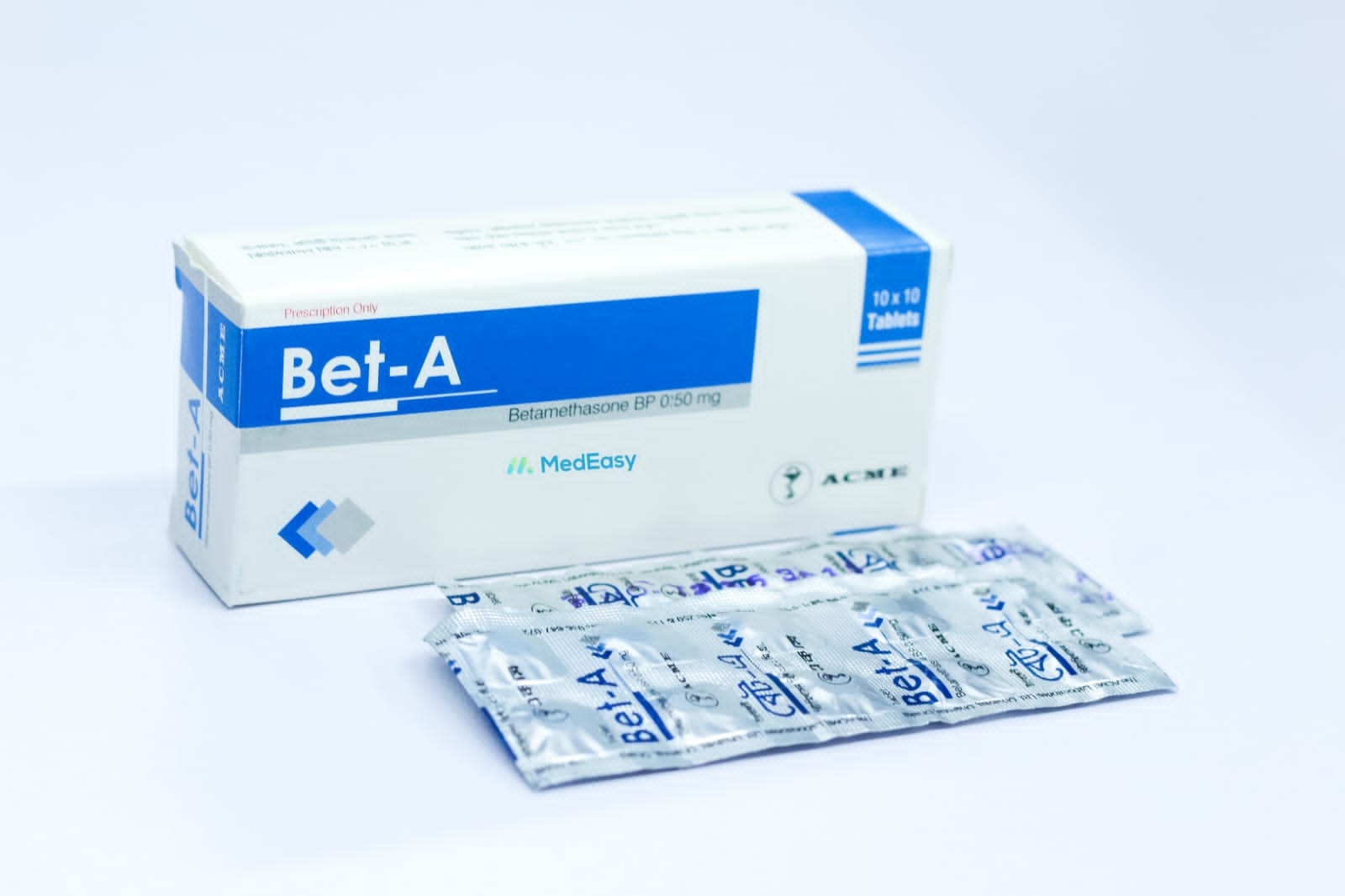
Bet-A0.5 mg
ACME Laboratories Ltd.
৳9.00
Add to cart


Betnelan is a potent synthetic corticosteroid used across three very different clinical contexts - topical, systemic, and obstetric. Indications are classified below by strength of evidence.
Indications and formulation (topical vs. oral vs. injectable) must always be matched carefully, as dosing and risk profile differ substantially between routes.
Betamethasone is formulated in several different preparations depending on the intended route of use:
Each preparation also contains pharmaceutical excipients appropriate to its dosage form (e.g., emulsifiers and preservatives in topical bases, buffering agents in injectable/ophthalmic solutions).
Betnelan is a potent synthetic glucocorticoid corticosteroid with minimal mineralocorticoid (salt-retaining) activity, chemically related to prednisolone but with substantially greater anti-inflammatory potency and a longer duration of action.
Depending on the formulation, Betnelan is used topically for corticosteroid-responsive skin conditions, systemically (oral or injectable) for a wide range of inflammatory, allergic, autoimmune, and hematologic conditions, and by intramuscular injection in a specific obstetric context - as an antenatal corticosteroid given to women at risk of preterm delivery to accelerate fetal lung maturation and reduce complications of prematurity.
Betnelan belongs to the therapeutic class of corticosteroids (glucocorticoids) - specifically a high-potency, long-acting synthetic glucocorticoid, available as topical, systemic, and ophthalmic/otic preparations.
Betamethasone diffuses across cell membranes and binds to cytoplasmic glucocorticoid receptors. The activated receptor-drug complex translocates to the nucleus and modulates gene transcription, inducing anti-inflammatory proteins (such as lipocortin-1/annexin A1, which inhibits phospholipase A2) while suppressing pro-inflammatory mediators (cytokines, prostaglandins via COX-2 inhibition, leukotrienes). This produces anti-inflammatory, immunosuppressive, anti-allergic, and antipruritic effects. In the specific obstetric indication, Betamethasone crosses the placenta and stimulates fetal lung surfactant production and structural lung maturation, reducing the risk of neonatal respiratory distress syndrome.
Apply a thin layer of Betnelan cream/ointment/lotion to the affected area, usually once or twice daily. Rub in gently. Avoid application to the face, groin, or axillae for prolonged periods, and avoid occlusive dressings unless specifically directed by a physician, as these increase systemic absorption and local skin atrophy. Use the lowest potency and shortest duration effective for the condition.
| Condition Severity | Typical Starting Dose | Notes |
|---|---|---|
| Mild-moderate inflammatory/allergic conditions | Approximately 0.6-1.2 mg/day | Adjusted to individual response |
| Severe inflammatory/autoimmune conditions | Up to approximately 4.8-7.2 mg/day (occasionally higher short-term) | Higher doses for acute, severe disease; taper as condition improves |
Once a therapeutic response is achieved, the dose should be reduced gradually to the lowest level that maintains an adequate clinical response. Treatment should not be stopped abruptly after more than a few days of use (see Precautions and Warnings).
Betnelan sodium phosphate/acetate suspension is given by intramuscular injection (typical adult dose approximately 0.5-9 mg, depending on condition and severity) or by intra-articular/intralesional/soft-tissue injection at doses individualized to the joint or lesion size, under direct medical supervision.
| Indication | Regimen |
|---|---|
| Acceleration of fetal lung maturation (women at 24-34 weeks' gestation at risk of preterm delivery within 7 days) | Betnelan (as the acetate/phosphate combination) 12 mg by intramuscular injection, repeated once 24 hours later (total of two doses) |
A single course is generally recommended; repeat "rescue" courses are only considered in specific circumstances under specialist obstetric guidance.
Topical Betnelan should be used with particular caution in children - lowest effective potency, shortest duration, and limited body surface area (see Use in Special Populations). Systemic pediatric dosing must be individualized by a physician based on weight and condition; safety and efficacy of some formulations/routes are not separately established in young children.
No formally established fixed dose-adjustment schedule exists for renal or hepatic impairment; Betnelan should be used cautiously in these populations with close clinical monitoring, as metabolism and fluid balance may be affected.
Betnelan may be administered by topical application to the skin, orally (tablets/solution), or by intramuscular, intra-articular, or intralesional injection, depending on the formulation and indication. Topical products should be applied as a thin film to clean, dry skin. Oral tablets may generally be taken with food to reduce gastrointestinal upset. Injections must be administered by a trained healthcare professional. After prolonged systemic use, the dose must be tapered gradually rather than stopped abruptly.
Other conditions sometimes listed with topical or systemic corticosteroid use (e.g., untreated local skin infection at the application site, active infection generally) represent important precautions rather than true absolute contraindications and are addressed under Precautions and Warnings.
The nature and frequency of side effects with Betnelan depend heavily on the route, dose, and duration of use.
Adrenal suppression, increased susceptibility to infection, osteoporosis, growth suppression in children, and psychiatric disturbances can occur with prolonged or high-dose systemic use - see Precautions and Warnings for full detail and monitoring guidance.
For routine (non-obstetric) systemic or extensive topical use, Betnelan should be used during pregnancy only if clearly needed and if the potential benefit to the mother justifies the potential risk to the fetus; a physician should always be consulted, as animal studies and corticosteroid class data suggest a potential for fetal effects with prolonged high-dose exposure.
In the specific, guideline-supported context of anticipated preterm delivery between approximately 24 and 34 weeks' gestation, a single course of intramuscular Betnelan is recommended by obstetric guidelines because the benefit (reduced neonatal respiratory distress syndrome, intraventricular hemorrhage, and mortality) has been well established to outweigh risk in this specific circumstance. This use should always be directed by an obstetric care provider.
Corticosteroids including Betnelan pass into breast milk in small amounts. Low to moderate doses are generally considered compatible with breastfeeding, but a physician should be consulted, particularly with higher systemic doses or prolonged treatment, and the breastfed infant should be monitored for growth and adrenal function if maternal use is prolonged.
Prolonged or high-dose systemic use of Betnelan can suppress the hypothalamic-pituitary-adrenal (HPA) axis. Systemic Betnelan should never be stopped abruptly after extended use; the dose must be tapered gradually under medical supervision to avoid acute adrenal insufficiency.
Betnelan can mask signs of infection and increase susceptibility to new or latent infections (including fungal, bacterial, viral, and parasitic). Patients on systemic therapy should avoid exposure to chickenpox or measles if non-immune, and any new infection should be promptly evaluated.
Betnelan can cause or worsen hyperglycemia/diabetes mellitus, and can cause fluid retention and hypertension; monitor blood glucose, blood pressure, and electrolytes during prolonged systemic use.
Long-term systemic use is associated with osteoporosis and increased fracture risk; calcium/vitamin D supplementation or bone-protective therapy may be considered for prolonged courses, per physician judgment.
Prolonged systemic (and to a lesser extent, extensive topical) use in children can suppress growth; growth should be monitored during long-term treatment.
Mood changes, insomnia, anxiety, and, rarely, more severe psychiatric reactions can occur, particularly with higher systemic doses; patients and caregivers should report significant mood or behavior changes.
Prolonged application, use of potent formulations, use on the face/groin/skin folds, or use under occlusion increases the risk of skin thinning, striae, telangiectasia, and increased systemic absorption (which can itself lead to HPA suppression, especially in children or with extensive body surface area treated).
Prolonged use (including periocular or extensive facial topical use) has been associated with cataracts and increased intraocular pressure/glaucoma; report visual changes promptly.
Acute overdose with a single excessive dose of Betnelan is unlikely to be immediately life-threatening. Repeated or prolonged excessive dosing can lead to features of hypercortisolism (Cushingoid effects), including weight gain, hypertension, hyperglycemia, and increased infection risk.
If overdose is suspected, seek immediate medical attention or contact emergency services or a poison control center right away. Treatment is supportive and symptomatic; there is no specific antidote. Do not attempt unsupervised home treatment of a suspected overdose.
Store at room temperature (below 30°C), away from light and moisture. Do not freeze injectable suspensions. Keep out of reach of children.
Elderly patients may be at greater risk of corticosteroid-related osteoporosis, hypertension, diabetes, skin fragility (with topical use), and psychiatric effects; use the lowest effective dose and monitor closely.
No fixed dose adjustment is formally established; use cautiously with monitoring of fluid balance and electrolytes.
Use with caution; impaired hepatic metabolism may increase systemic corticosteroid exposure and effects.
Betnelan can worsen glycemic control; blood glucose should be monitored closely and antidiabetic therapy adjusted as needed.
Additional immunosuppression from Betnelan increases infection risk; use only when clearly needed and monitor closely for infection.
Duration of Betnelan treatment depends on the indication and route. Topical use is generally intended for short courses (commonly up to 2-4 weeks continuously, less for potent formulations on sensitive areas), with reassessment before continuing longer. Systemic use should be for the shortest duration and lowest dose that controls the condition, with gradual tapering rather than abrupt cessation after more than a few days of therapy. The antenatal (obstetric) indication is a single short course of two intramuscular doses 24 hours apart, not a continuous or repeated regimen except in specific circumstances directed by an obstetric specialist.
Betamethasone belongs to the drug class of corticosteroids, specifically the synthetic glucocorticoids, characterized by high anti-inflammatory potency and minimal mineralocorticoid activity.
Betamethasone binds to intracellular glucocorticoid receptors, and the resulting complex modulates gene transcription to increase anti-inflammatory protein synthesis and decrease production of inflammatory mediators (cytokines, prostaglandins, leukotrienes), producing anti-inflammatory, immunosuppressive, and antiallergic effects. In its obstetric use, Betamethasone crosses the placenta and promotes fetal lung surfactant synthesis and structural maturation, reducing the risk of neonatal respiratory distress syndrome.
C
Betnelan is used in children for corticosteroid-responsive skin conditions (topical) and for selected severe inflammatory, allergic, or autoimmune conditions (systemic), but requires particular caution. Children have a larger skin-surface-to-body-weight ratio than adults, increasing systemic absorption and the risk of HPA-axis suppression and growth retardation with topical use, especially with potent formulations, occlusion, or use over large areas. Topical use in infants and young children should be limited to the lowest effective potency and shortest duration necessary. Systemic use in children should be individualized by a physician, with growth monitored during prolonged treatment. Safety and efficacy of certain specific formulations/routes have not been separately established in neonates and very young infants outside specialist obstetric/neonatal protocols.
Q: What is Betnelan 0.5 mg Tablet used for?
A: Betnelan 0.5 mg Tablet is a potent corticosteroid used topically for skin conditions like eczema and psoriasis, systemically (oral or injectable) for a range of inflammatory, allergic, and autoimmune conditions, and by injection in pregnant women at risk of preterm delivery to help mature the baby's lungs before birth.
Q: How should I apply topical Betnelan 0.5 mg Tablet?
A: Apply a thin layer to the affected skin area, usually once or twice daily as directed by your physician. Avoid using it on the face, groin, or skin folds for prolonged periods, and do not cover the area with an airtight dressing unless your physician specifically instructs you to, since this increases absorption and the risk of skin thinning.
Q: Can I stop taking Betnelan 0.5 mg Tablet suddenly?
A: No. If you have been taking systemic (oral or injectable) Betnelan 0.5 mg Tablet for more than a few days, stopping suddenly can cause adrenal insufficiency because your body's own cortisol production may be suppressed. Your physician will guide you on gradually tapering the dose.
Q: Is Betnelan 0.5 mg Tablet safe during pregnancy?
A: For general medical conditions, Betnelan 0.5 mg Tablet should be used in pregnancy only if clearly needed, as your physician believes the benefit outweighs potential risk to the fetus. However, in a specific situation - when preterm delivery is expected between about 24 and 34 weeks of pregnancy - doctors commonly give a short course of Betnelan 0.5 mg Tablet injections specifically to help the baby's lungs mature faster, which is a well-established and recommended practice in that circumstance.
Q: What side effects should I watch for with Betnelan 0.5 mg Tablet?
A: With topical use, watch for skin thinning, stretch marks, or irritation at the application site. With systemic use, watch for increased appetite/weight gain, mood changes, trouble sleeping, high blood sugar, and signs of infection (since Betnelan 0.5 mg Tablet can mask infection symptoms). Contact your physician if you notice any of these.
Q: Can Betnelan 0.5 mg Tablet interact with other medicines?
A: Yes. Betnelan 0.5 mg Tablet can interact with certain antibiotics/antifungals, seizure medicines (like phenytoin or carbamazepine), NSAIDs/aspirin, blood thinners like warfarin, diuretics, diabetes medicines, and live vaccines. Always tell your physician and pharmacist about all medicines, supplements, and vaccines before starting Betnelan 0.5 mg Tablet.
Disclaimer
The information provided is accurate to the best of our knowledge, but it does not replace professional medical advice. We cannot guarantee its completeness or accuracy, and the absence of specific information about a drug should not be taken as an endorsement. We are not responsible for any consequences arising from this information, so please consult a healthcare professional for any concerns or questions.
