
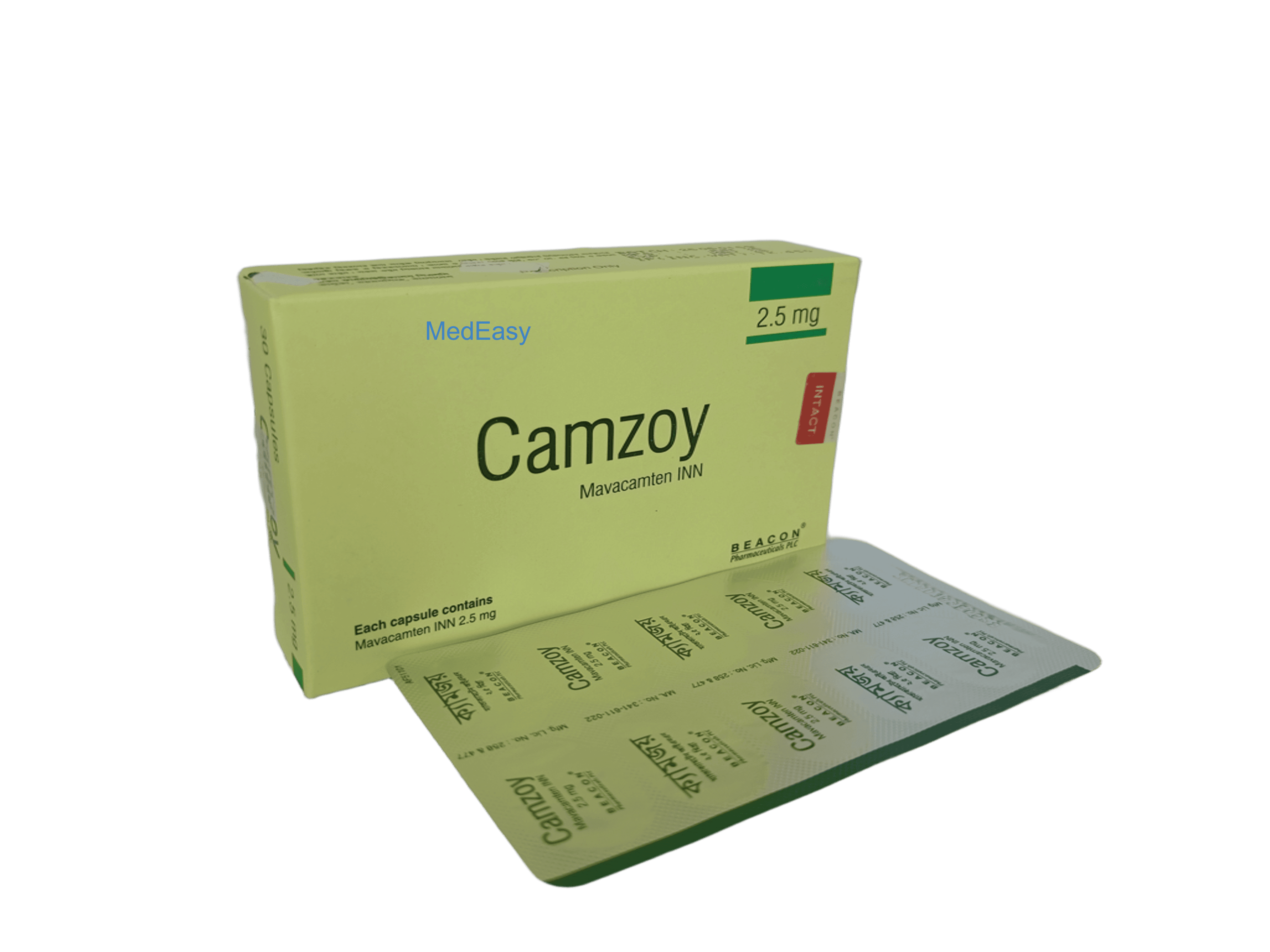

Medicine overview
Indications of Camzoy
Established / FDA-Approved Indication
- Camzoy is indicated for the treatment of adults with symptomatic New York Heart Association (NYHA) class II-III obstructive hypertrophic cardiomyopathy (HCM), to improve functional capacity and reduce symptoms such as exertional dyspnoea, chest discomfort, palpitations, and pre-syncope/syncope.
Evidence Basis
Efficacy of Camzoy in this population is based on randomized, double-blind, placebo-controlled trials (e.g. EXPLORER-HCM) demonstrating improvement in peak oxygen uptake, post-exercise left ventricular outflow tract (LVOT) gradient, NYHA functional class, and patient-reported symptom burden.
Not Indicated / Off-Label
Camzoy is not indicated for non-obstructive HCM, for HCM in children, or for other forms of heart failure. It is a first-in-class, highly specialised agent intended only for use within a restricted access program by physicians experienced in the management of HCM; it is not a general-practice medication.
Composition
Each capsule contains Mavacamten as the active pharmaceutical ingredient, available in strengths of 2.5 mg, 5 mg, 10 mg, and 15 mg, along with standard pharmaceutical excipients used in oral capsule formulations.
Description
Camzoy is a first-in-class, oral, allosteric and reversible inhibitor of cardiac myosin. It is used to treat symptomatic obstructive hypertrophic cardiomyopathy, a genetic heart-muscle disease in which thickened heart muscle obstructs blood flow out of the heart.
Camzoy is currently available only through a restricted distribution program and requires specialist cardiology prescribing and monitoring; it is not marketed as a routinely stocked retail product in Bangladesh at this time, and availability should be confirmed with a treating cardiology centre.
Therapeutic Class
Camzoy belongs to the therapeutic class of cardiac myosin inhibitors, a novel first-in-class category of drugs used specifically in the management of obstructive hypertrophic cardiomyopathy.
Pharmacology
Mechanism of Action
Mavacamten is a selective, allosteric, and reversible inhibitor of cardiac myosin ATPase. By reducing the number of active actin-myosin cross-bridges, it decreases excessive cardiac muscle contractility, improves left ventricular relaxation, and reduces the dynamic left ventricular outflow tract (LVOT) obstruction that characterizes obstructive HCM.
Pharmacokinetics
Mavacamten is well absorbed orally, is extensively metabolized in the liver predominantly via CYP2C19 (with a smaller contribution from CYP3A4), and its metabolism is markedly affected by CYP2C19 genotype (poor metabolizers achieve higher exposure). Its long elimination half-life supports once-daily dosing.
Dosage & Administration of Camzoy
Adult Dosing (Obstructive HCM)
| Step | Dose | Notes |
|---|---|---|
| Starting dose | 5 mg orally once daily | Confirm LVEF ≥55% and absence of pregnancy before starting |
| Available strengths | 2.5 mg, 5 mg, 10 mg, 15 mg capsules | Dose is individually titrated |
| Titration | Adjusted at scheduled visits (approx. every 4 weeks initially, then every 12 weeks) | Based on echocardiographic LVEF and Valsalva LVOT gradient, and symptoms |
| Maximum dose | 15 mg once daily | Do not exceed without specialist guidance |
Pediatric Dosing
Not established; Camzoy is not approved for use in children (see Use in Special Populations).
Renal Impairment
No dose adjustment is required for mild-to-moderate renal impairment. Data in severe renal impairment are limited; use with caution.
Hepatic Impairment
A lower starting dose and slower titration are recommended in moderate hepatic impairment; Camzoy has not been studied in severe hepatic impairment and is not recommended.
Administration Instructions
Take Camzoy exactly as prescribed by a cardiology specialist, at the same time each day, on an empty stomach (at least 2 hours before or 2 hours after a meal), because food increases absorption. Do not stop, skip doses, share this medicine, or change the dose without direct instruction from the prescribing physician, since abrupt changes can affect heart function.
Administration of Camzoy
Camzoy capsules should be swallowed whole with water, taken on an empty stomach at a consistent time each day, at least 2 hours before or after food. See Dosage and Administration for full instructions.
Interaction of Camzoy
CYP2C19 and CYP3A4 Interactions (Clinically Significant)
Camzoy is metabolized primarily by CYP2C19 and, to a lesser extent, CYP3A4. Concomitant use with drugs that alter these enzymes significantly changes Camzoy exposure and cardiac risk:
- Moderate-to-strong CYP3A4 inhibitors (e.g. diltiazem, verapamil, certain azole antifungals, some macrolides) increase Camzoy levels and heart-failure risk; dose reduction and closer echocardiographic monitoring are required.
- Strong CYP2C19 inhibitors (e.g. fluconazole, fluvoxamine) and moderate-to-strong CYP2C19 or CYP3A4 inducers (e.g. rifampin, St. John's wort, carbamazepine) are contraindicated (see Contraindications) because they cause clinically important changes in Camzoy exposure.
- Weak-to-moderate CYP2C19 inhibitors require dose adjustment and increased monitoring frequency.
Negative Inotropes
Concurrent use with other negative inotropic agents (e.g. verapamil, diltiazem, disopyramide) may have additive effects on cardiac contractility and requires cautious specialist co-management.
CYP2C19 Genotype
Genotype-guided dosing may be used in some protocols, as CYP2C19 poor metabolizers are at higher risk of elevated exposure and reduced LVEF.
Always disclose all prescription, over-the-counter, and herbal products to the prescribing cardiologist before starting Camzoy.
Contraindications
- Known hypersensitivity to Mavacamten or any component of the formulation.
- Concomitant use with moderate-to-strong CYP3A4 inducers (e.g. rifampin, St. John's wort).
- Concomitant use with moderate-to-strong CYP2C19 inducers (e.g. carbamazepine).
- Concomitant use with strong CYP2C19 inhibitors (e.g. fluconazole), because of the risk of markedly increased Mavacamten exposure and heart failure.
Mavacamten should not be initiated in patients with a left ventricular ejection fraction (LVEF) below 55% (see Precautions and Warnings).
Side Effects of Camzoy
Common
- Dizziness (reported in roughly a quarter of patients)
- Syncope (fainting)
- Fatigue
- Palpitations
Serious
- Reduced left ventricular ejection fraction and heart failure due to systolic dysfunction — the principal safety concern with Camzoy; see Precautions and Warnings for the boxed warning and required monitoring.
Report any new or worsening shortness of breath, swelling of the legs/ankles, fatigue, dizziness, or fainting to the prescribing physician immediately.
Pregnancy & Lactation
Pregnancy
Camzoy can cause fetal harm based on animal reproduction studies. A formal FDA pregnancy category has not been assigned. Pregnancy must be excluded before starting treatment, and females of reproductive potential must use effective, non-hormonal contraception during treatment and for 4 months after the final dose (hormonal contraceptive efficacy may be reduced by Camzoy). Camzoy should be used in pregnancy only if clearly needed, and only after the treating physician has weighed the potential benefit against the potential risk to the fetus.
Lactation
There is no data on the presence of Camzoy in human milk or its effects on the breastfed infant. Because of the potential for serious adverse effects in a nursing infant, a decision should be made, in consultation with a physician, whether to discontinue breastfeeding or discontinue Camzoy, taking into account the importance of treatment to the mother.
Precautions & Warnings
Boxed Warning: Risk of Heart Failure
Camzoy can cause dose-dependent reductions in left ventricular ejection fraction (LVEF) and has been associated with heart failure due to systolic dysfunction. For this reason, Camzoy is available only through a restricted Risk Evaluation and Mitigation Strategy (REMS)-type program that mandates:
- Baseline echocardiogram to confirm LVEF ≥55% before starting therapy.
- Periodic echocardiographic monitoring of LVEF throughout treatment (initially every 4 weeks, then every 12 weeks, or more frequently with dose changes or interacting medications).
- Interruption of treatment if LVEF falls below 50%, or if the patient develops signs/symptoms of heart failure, with dose adjustment or discontinuation as directed by the specialist.
Specialist Prescribing Requirement
Camzoy must be prescribed and monitored only by cardiologists experienced in the management of hypertrophic cardiomyopathy, within the restricted access program; it is not intended for general-practice initiation given its novel mechanism, narrow therapeutic considerations, and complex CYP2C19/CYP3A4-mediated interaction profile.
Concurrent Illness
Temporarily interrupt Camzoy in patients who develop a concurrent illness affecting cardiac function (e.g. infection with fever, arrhythmia) until the illness resolves, under physician guidance.
Drug Interaction Caution
Careful review of all concurrent medications is required before and during therapy because of significant CYP2C19/CYP3A4-mediated interactions (see Interactions).
Overdose Effects of Camzoy
Overdose of Camzoy may cause excessive reduction in left ventricular ejection fraction and precipitate heart failure. There is no specific antidote. In case of suspected overdose, seek immediate medical attention or contact a poison control center/emergency services right away; the patient should be monitored, including echocardiographic assessment of cardiac function, and managed supportively under specialist care.
Storage Conditions
Store at room temperature (below 30°C), away from light and moisture. Keep out of reach of children.
Use In Special Populations
Pediatric Use
Safety and efficacy of Camzoy have not been established in patients under 18 years of age.
Geriatric Use
No overall dosing differences are required based on age alone; elderly patients should be monitored with the same echocardiographic protocol, with attention to concurrent medications and comorbidities.
Hepatic Impairment
Lower starting dose and slower titration in moderate hepatic impairment; not recommended in severe hepatic impairment (see Dosage and Administration).
Renal Impairment
No adjustment needed for mild-to-moderate impairment; use with caution and limited data in severe renal impairment.
CYP2C19 Poor Metabolizers
Patients who are CYP2C19 poor metabolizers may require a lower starting dose because of higher expected Camzoy exposure.
Duration Of Treatment
Camzoy is intended for long-term, continuous use in obstructive HCM, for as long as clinical benefit is demonstrated and monitoring remains favourable. The need for continued therapy, dose, and monitoring interval is reassessed periodically by the treating cardiologist; treatment is not intended for short courses.
Drug Classes
Mavacamten is classified as a cardiac myosin inhibitor, the first agent in this novel drug class.
Mode Of Action
Mavacamten works as a selective, reversible, allosteric inhibitor of cardiac myosin ATPase, reducing the number of myosin heads able to bind actin. This decreases excessive cardiac contractility and dynamic left ventricular outflow tract obstruction, and improves diastolic (relaxation) function in obstructive hypertrophic cardiomyopathy.
Pediatric Uses
Camzoy is not approved for use in children or adolescents; safety and efficacy in patients under 18 years have not been established, and it should not be used in this population outside of a clinical trial.
Frequently Asked Questions
Q: What is Camzoy 2.5 mg Capsule used for?
A: Camzoy 2.5 mg Capsule is used in adults with symptomatic obstructive hypertrophic cardiomyopathy (a thickened heart muscle condition that obstructs blood flow) to reduce symptoms such as breathlessness, chest discomfort, and fainting spells, and to improve exercise capacity.
Q: Why does Camzoy 2.5 mg Capsule require special monitoring?
A: Camzoy 2.5 mg Capsule carries a boxed warning because it can reduce the heart's pumping function (ejection fraction) and cause heart failure. Patients need echocardiograms before starting and regularly during treatment, and Camzoy 2.5 mg Capsule is only available through a restricted program managed by a specialist cardiologist.
Q: Can I take Camzoy 2.5 mg Capsule with other medicines?
A: Only under close specialist supervision. Camzoy 2.5 mg Capsule interacts significantly with drugs that affect the liver enzymes CYP2C19 and CYP3A4; some combinations (such as strong CYP2C19 inhibitors like fluconazole, or strong CYP3A4/CYP2C19 inducers like rifampin) are contraindicated, while others require dose changes. Always tell your doctor about every medicine, supplement, or herbal product you take.
Q: Is Camzoy 2.5 mg Capsule safe in pregnancy?
A: Camzoy 2.5 mg Capsule can harm a developing fetus and should be used in pregnancy only if clearly needed and the potential benefit outweighs the potential risk, as judged by your physician. Pregnancy must be ruled out before starting, and effective non-hormonal contraception is required during treatment and for 4 months afterward.
Q: What should I do if I miss a dose or want to stop Camzoy 2.5 mg Capsule?
A: Do not stop, skip, or change your Camzoy 2.5 mg Capsule dose without talking to your cardiologist first, as sudden changes can affect heart function. If you miss a dose, contact your treating physician or follow the specific instructions they have given you.
Q: What if I take too much Camzoy 2.5 mg Capsule?
A: An overdose can seriously reduce heart pumping function. Seek immediate medical attention or contact emergency services/poison control right away if an overdose is suspected; do not attempt to manage it at home.
Disclaimer
The information provided is accurate to the best of our knowledge, but it does not replace professional medical advice. We cannot guarantee its completeness or accuracy, and the absence of specific information about a drug should not be taken as an endorsement. We are not responsible for any consequences arising from this information, so please consult a healthcare professional for any concerns or questions.
