
10% Off
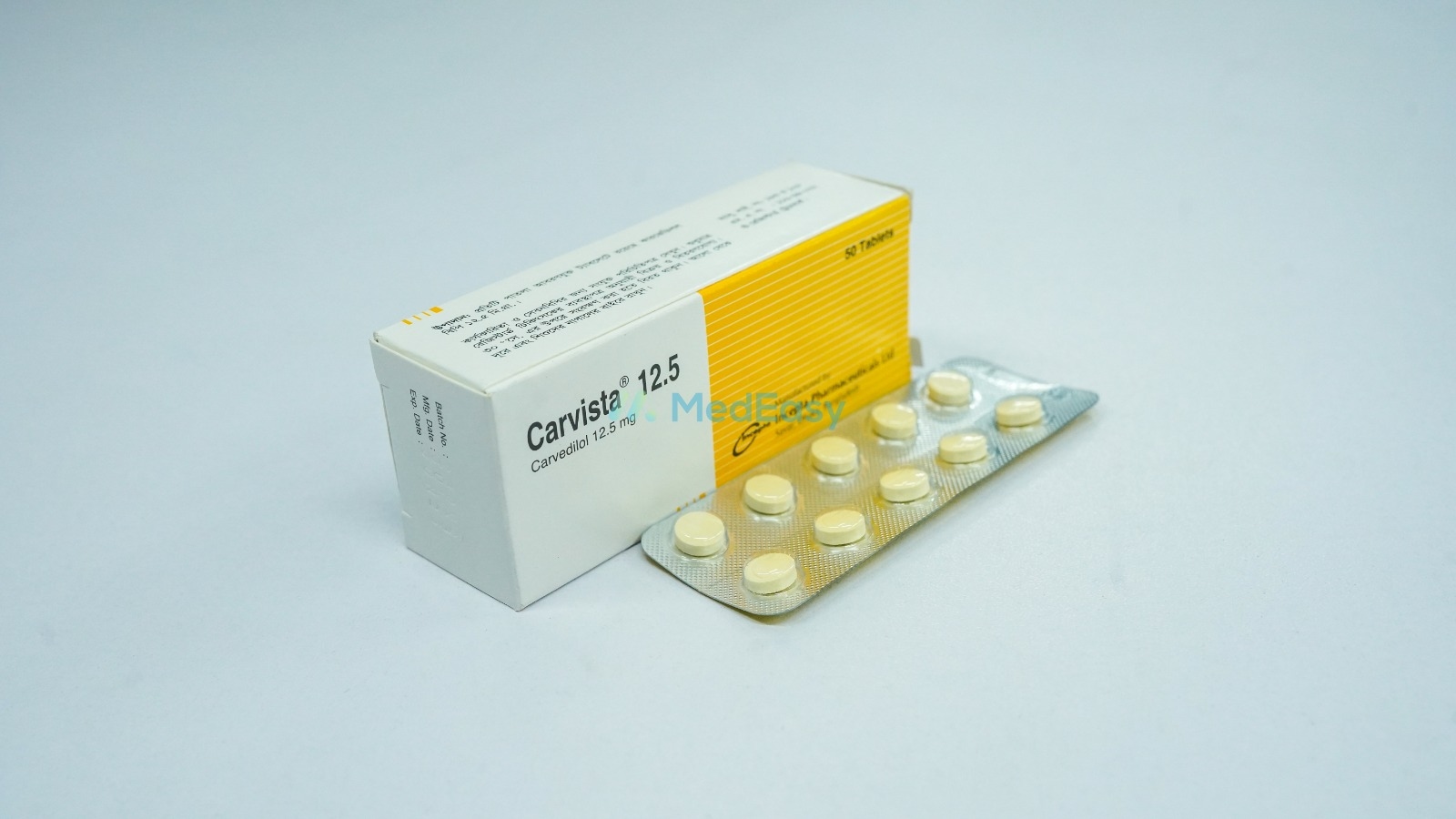
Carvista12.5 mg
Incepta Pharmaceuticals Ltd.
৳45.00
Add to cart


Cardivas is indicated for the following conditions, with evidence strength noted for each:
Cardivas should always be used exactly as prescribed by a physician, and any change in dose or indication should be made only under medical supervision.
Each tablet of Carvedilol contains Carvedilol as the active ingredient, commonly available in strengths of 3.125 mg, 6.25 mg, 12.5 mg, and 25 mg. Tablets also contain standard pharmaceutical excipients such as fillers, binders, and coating agents that do not have independent pharmacological activity. Patients should check the product label or ask their pharmacist for the exact strength and inactive ingredients of the specific brand dispensed.
Cardivas is a non-selective beta-adrenergic blocking agent that also possesses alpha-1 adrenergic blocking activity, making it a combined alpha/beta-blocker. It is used primarily in the long-term management of chronic heart failure, hypertension, and left ventricular dysfunction following a heart attack. By blocking beta-1 and beta-2 receptors, Cardivas reduces heart rate and cardiac workload, while its alpha-1 blocking action produces peripheral vasodilation, helping to lower blood pressure and reduce the strain on a weakened heart. Cardivas has been used in clinical practice since the 1990s and remains a well-established therapy in cardiovascular medicine.
Cardivas belongs to the therapeutic class of non-selective beta-blockers with alpha-1 blocking activity (combined alpha/beta-adrenergic antagonists). It is used in the broader categories of antihypertensive agents and heart failure therapy.
Carvedilol is a non-selective competitive antagonist at beta-1 and beta-2 adrenergic receptors, and a selective antagonist at alpha-1 adrenergic receptors. This dual mechanism distinguishes Carvedilol from purely beta-selective agents.
Carvedilol has no intrinsic sympathomimetic activity. It is well absorbed orally, undergoes significant first-pass hepatic metabolism (largely via CYP2D6 and CYP2C9), and is highly protein bound. Its elimination half-life is approximately 7-10 hours, generally supporting twice-daily dosing.
| Indication | Adult Starting Dose | Titration | Maximum Dose |
|---|---|---|---|
| Chronic Heart Failure | 3.125 mg twice daily | Double the dose every 2 weeks as tolerated (6.25 mg, then 12.5 mg, then 25 mg twice daily) | 25 mg twice daily (body weight <85 kg) or 50 mg twice daily (body weight ≥85 kg) |
| LV Dysfunction after Heart Attack | 6.25 mg twice daily | Increase to 12.5 mg then 25 mg twice daily over 3-10 days, as tolerated | 25 mg twice daily |
| Hypertension | 6.25 mg twice daily (or 12.5 mg once daily per some regional labeling) | Increase at intervals of 1-2 weeks as needed | 50 mg per day (in divided doses) |
All doses of Cardivas should be taken with food to slow the rate of absorption and reduce the risk of orthostatic hypotension and dizziness. Tablets should be swallowed whole with water; they should not be crushed or chewed unless the specific formulation permits it. Blood pressure, heart rate, and clinical status (signs of worsening heart failure or excessive bradycardia/hypotension) should be checked before each dose increase. Cardivas must never be stopped abruptly — see Precautions and Warnings for details.
Cardivas should be taken by mouth, consistently with food, to minimize the risk of dizziness and low blood pressure on standing. It is usually given twice daily, at approximately the same times each day. Tablets should be swallowed whole with a glass of water. Patients should rise slowly from sitting or lying positions, especially when starting therapy or after a dose increase, to reduce the risk of falls from orthostatic hypotension.
Cardivas has several clinically significant drug interactions:
Patients should inform their physician or pharmacist about all prescription medicines, over-the-counter drugs, and herbal supplements they are taking before starting Cardivas.
Carvedilol is contraindicated (must not be used) in patients with any of the following conditions:
Carvedilol should only be used in these settings, or in patients with other significant cardiac or hepatic disease, if a physician has explicitly determined the benefit outweighs the risk.
Side effects of Cardivas vary somewhat by indication but commonly include:
Patients should seek prompt medical attention for fainting, very slow heart rate, severe dizziness, difficulty breathing, chest pain, signs of liver problems (yellowing of the skin/eyes, dark urine), or any signs of a severe allergic or skin reaction while taking Cardivas.
Pregnancy: Data on the use of Cardivas in pregnant women are limited. Beta-blockers as a class have been associated with fetal growth restriction, bradycardia, and hypoglycemia in the newborn when used in pregnancy, particularly in the third trimester. Cardivas should be used during pregnancy only if the potential benefit to the mother clearly justifies the potential risk to the fetus, and only under close specialist supervision.
Lactation: It is not known whether Cardivas passes into human breast milk in clinically significant amounts. Because of the potential for serious adverse effects in a nursing infant (such as low heart rate or low blood sugar), a decision should be made, in consultation with a physician, whether to discontinue breastfeeding or discontinue Cardivas, taking into account the importance of the medicine to the mother.
Any use of Cardivas during pregnancy or while breastfeeding must be discussed with and supervised by a qualified physician.
Do not stop Cardivas abruptly. Sudden discontinuation of Cardivas, particularly in patients with underlying coronary artery disease, can precipitate rebound angina, worsening heart rhythm problems (arrhythmia), or even a heart attack (myocardial infarction). If discontinuation is necessary, the dose must be gradually reduced (tapered) over one to two weeks under close medical supervision, and the patient should be advised to limit physical activity during this period.
Bronchospastic disease: Even though Cardivas is contraindicated in bronchial asthma, patients with other bronchospastic conditions such as chronic bronchitis or emphysema who do not respond to or cannot tolerate other treatment may use Cardivas only under specialist supervision, generally at the lowest effective dose, because beta-blockade can worsen airway constriction.
Diabetes mellitus: Cardivas can mask important warning signs of low blood sugar (hypoglycemia), such as a fast heart rate, and may affect blood glucose control. Diabetic patients should monitor their blood sugar closely, especially when starting or adjusting Cardivas.
Peripheral vascular disease and Prinzmetal's (variant) angina: Cardivas should be used with caution, as beta-blockade may worsen symptoms of peripheral arterial insufficiency, and unopposed alpha-adrenergic activity from beta-blockade could theoretically worsen coronary artery spasm.
Heart block and bradycardia: Cardivas should be used cautiously in patients with first-degree AV block or a tendency toward slow heart rates; the dose should be reduced or the medicine stopped if the heart rate falls too low.
Hepatic impairment: Cardivas should be avoided in patients with severe liver disease and used cautiously, with monitoring, in those with mild to moderate hepatic impairment.
Surgery/anesthesia: Patients undergoing major surgery should inform their anesthetist that they are taking Cardivas, as it may enhance the effects of certain anesthetic agents on blood pressure and heart rate.
Take with food to reduce the risk of dizziness or fainting from a sudden drop in blood pressure upon standing.
Overdose of Cardivas is a medical emergency. Symptoms can include severe low blood pressure, very slow heart rate (bradycardia), heart failure, cardiogenic shock, difficulty breathing or bronchospasm, loss of consciousness, and generalized seizures. In case of a suspected overdose of Cardivas, seek immediate medical attention or contact emergency services/poison control right away. Do not wait for symptoms to appear. Treatment is generally supportive and may include close monitoring of heart rhythm and blood pressure in a hospital setting; general measures should be initiated by trained medical personnel and may include agents to raise heart rate and blood pressure, given the prolonged effects of Cardivas after overdose. Do not attempt to manage a Cardivas overdose at home.
Store Cardivas at room temperature (below 30°C), away from light and moisture. Keep out of reach of children.
Elderly: Older adults may be more sensitive to the blood-pressure-lowering effects of Cardivas; a lower starting dose and slower titration may be appropriate, with close monitoring for dizziness and falls.
Renal impairment: No specific dose adjustment of Cardivas is generally required for patients with kidney impairment, but such patients should be monitored, particularly at initiation of therapy.
Hepatic impairment: Cardivas is largely metabolized by the liver; it is contraindicated in severe hepatic impairment and should be used with caution and close monitoring in mild to moderate hepatic impairment.
Diabetic patients: Cardivas may mask symptoms of hypoglycemia and can affect blood glucose control; closer monitoring of blood sugar is recommended.
Patients with peripheral vascular disease: Cardivas should be used cautiously, as beta-blockade may aggravate symptoms of arterial insufficiency in the limbs.
Pediatric patients: Safety and effectiveness of Cardivas have not been well established in children; use in this population is generally not recommended outside of specialist pediatric cardiology supervision (see Pediatric Uses).
Cardivas is typically used as a long-term, often lifelong, maintenance therapy for chronic heart failure, hypertension, and left ventricular dysfunction after a heart attack, since these are chronic conditions requiring ongoing treatment. The duration of treatment should be determined by the prescribing physician based on the individual's condition and response to therapy. Cardivas should be continued as prescribed even if the patient feels well, and should never be stopped or the dose changed without first consulting the physician, given the risk of rebound cardiac events with abrupt discontinuation.
Carvedilol is classified as a non-selective beta-adrenergic receptor blocker with additional alpha-1 adrenergic receptor blocking activity. It belongs to the broader pharmacological group of antihypertensive and anti-heart-failure agents known as combined alpha/beta-blockers.
Carvedilol works by blocking beta-1 and beta-2 adrenergic receptors, which reduces heart rate, cardiac contractility, and renin release, thereby lowering the workload on the heart and helping to control blood pressure. At the same time, Carvedilol blocks alpha-1 adrenergic receptors located in blood vessel walls, causing the blood vessels to relax (vasodilation) and further reducing blood pressure and the resistance the heart must pump against. This combined alpha/beta-blocking action, along with possible antioxidant effects, contributes to the cardioprotective benefits of Carvedilol in heart failure and after a heart attack.
The safety and effectiveness of Cardivas in pediatric patients have not been well established by robust controlled trials, and Cardivas is generally not approved for routine use in children. Some specialist pediatric cardiology centers have used Cardivas off-label in children with heart failure due to congenital or acquired heart disease, under close specialist supervision, but this is not a standard or FDA-approved indication. Cardivas should be given to a child only if a pediatric specialist has specifically prescribed it, with careful weight-based dosing and close monitoring for low blood pressure, slow heart rate, and low blood sugar. Parents/caregivers should never give Cardivas to a child without explicit medical direction.
Q: 1. What is Cardivas 12.5 mg Tablet used for?
A: Cardivas 12.5 mg Tablet is used to treat chronic heart failure, high blood pressure (hypertension), and to improve survival in people who have left ventricular dysfunction (a weakened heart pumping ability) after a heart attack. Cardivas 12.5 mg Tablet works by relaxing blood vessels and slowing the heart rate, which reduces the workload on the heart.
Q: 2. Can I stop taking Cardivas 12.5 mg Tablet suddenly if I feel better?
A: No. You must never stop taking Cardivas 12.5 mg Tablet suddenly without your doctor's advice. Abruptly stopping Cardivas 12.5 mg Tablet can cause a dangerous rebound effect, including worsening chest pain (angina), abnormal heart rhythms, or even a heart attack. If your doctor decides you should stop Cardivas 12.5 mg Tablet, the dose will be reduced gradually over one to two weeks.
Q: 3. Can people with asthma take Cardivas 12.5 mg Tablet?
A: No. Cardivas 12.5 mg Tablet is contraindicated in people with bronchial asthma or a history of severe bronchospastic (airway-narrowing) disease, because it can trigger dangerous breathing difficulties. Patients with other lung conditions such as chronic bronchitis or emphysema should only use Cardivas 12.5 mg Tablet under close specialist supervision if no safer alternative is suitable.
Q: 4. Is Cardivas 12.5 mg Tablet safe for people with diabetes?
A: Cardivas 12.5 mg Tablet can be used in many people with diabetes, but it requires caution. Cardivas 12.5 mg Tablet can mask some of the early warning signs of low blood sugar (hypoglycemia), such as a fast heartbeat, and it may affect overall blood sugar control. People with diabetes taking Cardivas 12.5 mg Tablet should monitor their blood glucose more closely, especially when starting the medicine or changing the dose.
Q: 5. How should I take Cardivas 12.5 mg Tablet, and does it need to be taken with food?
A: Yes, Cardivas 12.5 mg Tablet should be taken with food. Taking Cardivas 12.5 mg Tablet with a meal slows its absorption and reduces the risk of dizziness or fainting caused by a sudden drop in blood pressure when standing up. Cardivas 12.5 mg Tablet is usually taken twice daily at evenly spaced times, exactly as prescribed by your physician.
Q: 6. What should I do if I think I have taken too much Cardivas 12.5 mg Tablet?
A: An overdose of Cardivas 12.5 mg Tablet is a medical emergency. Signs may include severe dizziness, fainting, very slow heartbeat, difficulty breathing, or seizures. If you or someone else has taken too much Cardivas 12.5 mg Tablet, seek immediate medical attention or contact emergency services or a poison control center right away — do not wait for symptoms to worsen.
Disclaimer
The information provided is accurate to the best of our knowledge, but it does not replace professional medical advice. We cannot guarantee its completeness or accuracy, and the absence of specific information about a drug should not be taken as an endorsement. We are not responsible for any consequences arising from this information, so please consult a healthcare professional for any concerns or questions.

