
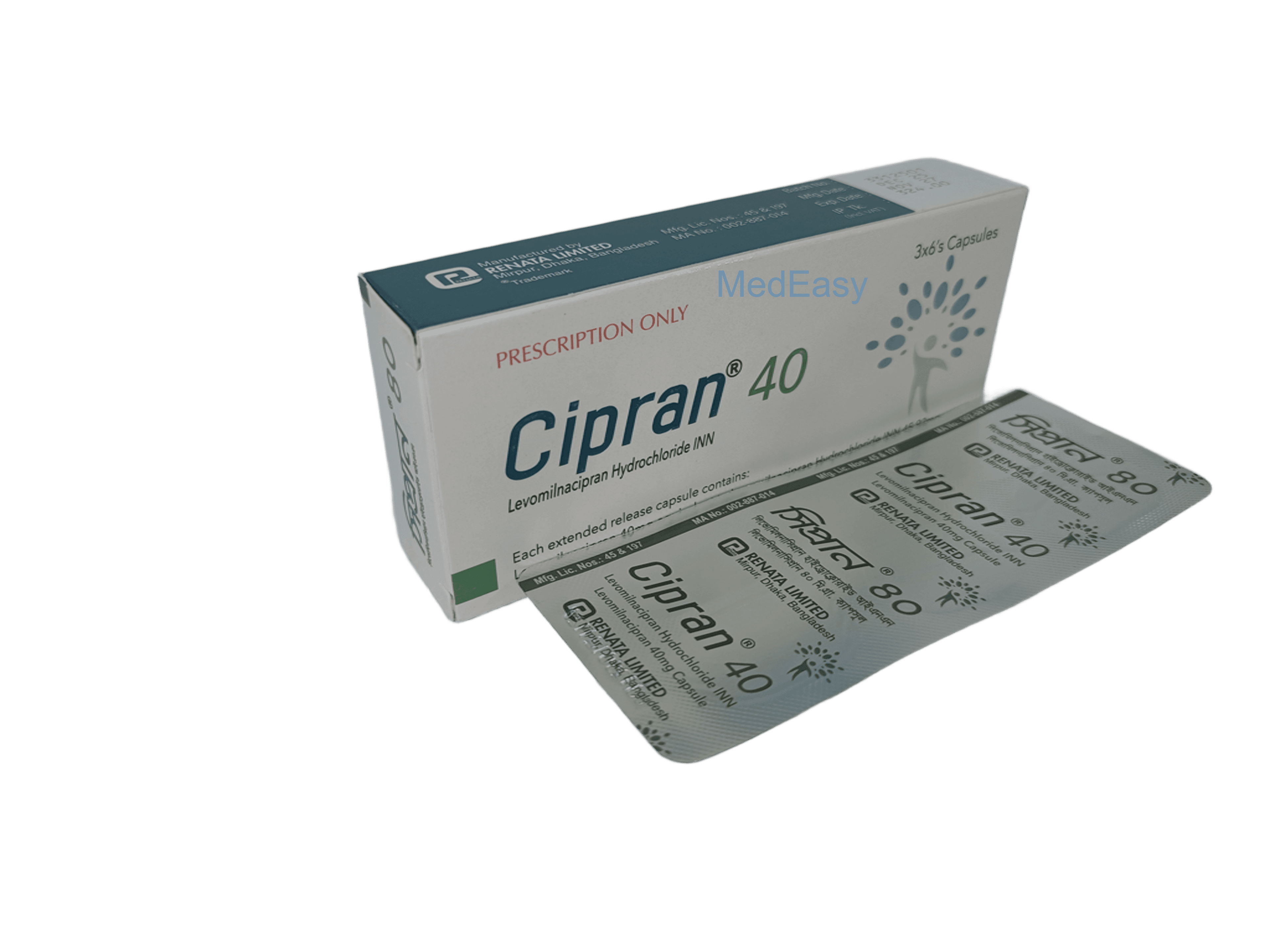

Medicine overview
Indications of Cipran
Cipran is a serotonin-norepinephrine reuptake inhibitor (SNRI) indicated for the following use:
Established / FDA-Approved Use
- Treatment of major depressive disorder (MDD) in adults.
Not Approved / Off-Label
Cipran is not approved for fibromyalgia or other pain syndromes, and is not approved for use in children or adolescents. Any use outside major depressive disorder in adults should only be under direct physician guidance.
Composition
Each capsule contains Levomilnacipran Hydrochloride equivalent to the labelled strength of levomilnacipran base, along with pharmaceutically acceptable excipients.
Description
Cipran is the hydrochloride salt of levomilnacipran, the more active enantiomer of milnacipran. It belongs to the serotonin-norepinephrine reuptake inhibitor (SNRI) class of antidepressants and is used to treat major depressive disorder in adults. It is typically formulated as an extended-release oral capsule taken once daily.
Therapeutic Class
Pharmacology
Levomilnacipran Hydrochloride works by inhibiting the reuptake of both serotonin (5-HT) and norepinephrine (NE) at the neuronal synapse, increasing the availability of these neurotransmitters in the central nervous system. It shows greater potency for norepinephrine reuptake inhibition relative to serotonin compared to some other SNRIs, which contributes to its noradrenergic side-effect profile (e.g., increased heart rate, blood pressure, and urinary hesitancy).
Levomilnacipran is well absorbed orally, undergoes minimal first-pass metabolism, is partly metabolized via CYP3A4, and is eliminated mainly by the kidneys, with a plasma half-life of approximately 12 hours, supporting once-daily extended-release dosing.
Dosage & Administration of Cipran
| Indication | Population | Dosage |
|---|---|---|
| Major depressive disorder | Adults | Start at 20 mg once daily for 2 days, then increase to 40 mg once daily. May be further titrated in increments of 40 mg at intervals of 2 or more days, up to a maximum of 120 mg once daily, based on response and tolerability. |
| Renal impairment (moderate, CrCl 30-59 mL/min) | Adults | Maximum recommended dose 80 mg once daily. |
| Renal impairment (severe, CrCl 15-29 mL/min) | Adults | Maximum recommended dose 40 mg once daily. |
| End-stage renal disease | Adults | Use is not recommended. |
| Hepatic impairment (severe) | Adults | Use is not recommended. |
Cipran extended-release capsules should be swallowed whole with water, once daily, at the same time each day, with or without food. Capsules must not be opened, chewed, or crushed. When discontinuing, the dose should be tapered gradually rather than stopped abruptly, to reduce the risk of discontinuation symptoms.
Administration of Cipran
Cipran extended-release capsules should be taken orally, once daily at the same time each day, with or without food, and swallowed whole without opening, chewing, or crushing.
Interaction of Cipran
The following are well-established, clinically significant interactions with Cipran:
- Monoamine oxidase inhibitors (MAOIs): Concurrent use, or use within 14 days of stopping an MAOI, is contraindicated due to a serious risk of serotonin syndrome. At least 7 days should elapse after stopping Cipran before starting an MAOI.
- Linezolid or intravenous methylene blue: These have MAOI activity and are contraindicated with Cipran due to serotonin syndrome risk.
- Other serotonergic drugs (e.g., other SNRIs/SSRIs, triptans, tramadol, St. John's Wort): Increased risk of serotonin syndrome when combined with Cipran; combine cautiously and monitor closely.
- Drugs affecting blood pressure/heart rate: Cipran can increase blood pressure and heart rate; caution is warranted with other agents that have similar effects.
- Anticoagulants/antiplatelets/NSAIDs: Concurrent use may increase risk of bleeding due to the effect of serotonergic drugs on platelet function.
- CYP3A4 inhibitors/inducers: Strong CYP3A4 inhibitors may increase levomilnacipran levels; dose adjustment may be needed with strong inhibitors in renal impairment.
Contraindications
Levomilnacipran Hydrochloride is contraindicated in:
- Patients with known hypersensitivity to levomilnacipran, milnacipran, or any component of the formulation.
- Patients taking, or within 14 days of stopping, monoamine oxidase inhibitors (MAOIs), due to the risk of serotonin syndrome.
- Concomitant use with linezolid or intravenous methylene blue.
Side Effects of Cipran
Common side effects of Cipran (occurring in approximately 5% or more of patients and at a rate greater than placebo) include:
- Nausea and vomiting
- Constipation
- Excessive sweating (hyperhidrosis)
- Increased heart rate (tachycardia) and palpitations
- Erectile dysfunction and ejaculation disorders
- Dizziness, headache, and insomnia
- Urinary hesitancy
Less common but serious effects include increased blood pressure, serotonin syndrome, activation of mania/hypomania, and abnormal bleeding. See Precautions and Warnings for details.
Pregnancy & Lactation
Cipran should be used during pregnancy only if the potential benefit justifies the potential risk to the fetus. Use of serotonergic antidepressants, including Cipran, during the third trimester has been associated with a risk of neonatal complications (poor adaptation syndrome) requiring extended hospitalization, respiratory support, and tube feeding in some newborns. There is no adequate data on whether Cipran is excreted in human breast milk; a decision should be made whether to discontinue breastfeeding or discontinue the drug, taking into account the benefit of breastfeeding and the importance of the drug to the mother. Use only under medical supervision and consult a physician before use during pregnancy or breastfeeding.
Precautions & Warnings
Boxed Warning: Cipran, like other antidepressants, increases the risk of suicidal thinking and behavior in children, adolescents, and young adults (up to age 24), particularly during the initial months of treatment or after dose changes; it is not approved for use in pediatric patients. Close monitoring for clinical worsening and suicidality is required in all patients, especially at treatment initiation.
- Serotonin syndrome: Risk increases with concomitant serotonergic drugs; watch for agitation, hallucinations, tachycardia, fever, and muscle rigidity (see Interactions and Contraindications).
- Elevated blood pressure and heart rate: Blood pressure and pulse should be monitored before and during treatment, particularly in patients with pre-existing hypertension or cardiovascular disease.
- Urinary hesitancy/retention: Due to noradrenergic activity; caution in patients with predisposing conditions.
- Activation of mania/hypomania: Screen for bipolar disorder before starting; use with caution in patients with a personal or family history of bipolar disorder.
- Angle-closure glaucoma: Pupillary dilation can occur; avoid use in patients with uncontrolled angle-closure glaucoma.
- Abnormal bleeding: Increased risk of bruising or bleeding, especially when combined with NSAIDs, aspirin, or anticoagulants.
- Discontinuation symptoms: Abrupt discontinuation can cause dizziness, nausea, headache, and irritability; taper gradually under medical supervision.
- Use with caution in patients with a history of seizure disorder or severe hepatic/renal impairment.
Overdose Effects of Cipran
Overdose with Cipran may cause symptoms such as tachycardia, dizziness, vomiting, and altered mental status. Seek immediate medical attention or contact a poison control center / emergency services right away if overdose is suspected. Treatment is supportive and should be provided in a healthcare facility; there is no specific antidote. Do not attempt home treatment for a suspected overdose.
Storage Conditions
Store at room temperature (below 30°C), away from light and moisture. Keep out of reach of children.
Use In Special Populations
Pediatric use: Safety and efficacy of Cipran have not been established in patients under 18 years of age; it is not approved for pediatric use and carries a boxed warning regarding suicidality risk in this age group.
Elderly: No overall differences in safety or effectiveness were observed relative to younger adults, but elderly patients should be monitored for hyponatremia, cardiovascular effects, and falls risk.
Renal impairment: Dose adjustment is required in moderate and severe renal impairment; use is not recommended in end-stage renal disease (see Dosage and Administration).
Hepatic impairment: Use is not recommended in patients with severe hepatic impairment.
Duration Of Treatment
Duration of treatment with Cipran is individualized based on clinical response, typically continued for several months after remission of depressive symptoms to prevent relapse, as advised by the prescribing physician. Long-term use should be periodically reassessed.
Drug Classes
Serotonin-Norepinephrine Reuptake Inhibitor (SNRI) antidepressant
Mode Of Action
Levomilnacipran Hydrochloride acts by inhibiting the reuptake of serotonin and norepinephrine in the central nervous system, with relatively greater potency for norepinephrine reuptake inhibition, thereby increasing synaptic levels of these neurotransmitters and improving depressive symptoms.
Pediatric Uses
Cipran is not approved for use in children or adolescents; safety and efficacy in patients under 18 years of age have not been established. It carries a boxed warning for increased risk of suicidal thinking and behavior in pediatric and young adult patients.
Frequently Asked Questions
Q: What is Cipran 40 mg Capsule (Extended Release) used for?
A: Cipran 40 mg Capsule (Extended Release) is an SNRI antidepressant used to treat major depressive disorder (MDD) in adults.
Q: How should I take Cipran 40 mg Capsule (Extended Release)?
A: Take Cipran 40 mg Capsule (Extended Release) exactly as prescribed, once daily at the same time, swallowing the capsule whole with water. Do not open, chew, or crush it. Do not stop taking it suddenly without consulting your physician, as this can cause discontinuation symptoms.
Q: Can I take Cipran 40 mg Capsule (Extended Release) with other antidepressants or migraine medicines?
A: Cipran 40 mg Capsule (Extended Release) must not be combined with MAOIs, linezolid, or intravenous methylene blue due to a serious risk of serotonin syndrome, and should be used cautiously with other serotonergic drugs such as triptans, tramadol, or other SNRIs/SSRIs. Always inform your doctor of all medicines you take.
Q: Is Cipran 40 mg Capsule (Extended Release) safe during pregnancy or breastfeeding?
A: Cipran 40 mg Capsule (Extended Release) should be used in pregnancy only if clearly needed, as third-trimester use has been linked to neonatal complications. It is not known whether it passes into breast milk, so use during breastfeeding should be discussed with your physician, weighing benefits and risks.
Q: What are the common side effects of Cipran 40 mg Capsule (Extended Release)?
A: Common side effects include nausea, constipation, excessive sweating, increased heart rate, dizziness, insomnia, and sexual side effects such as erectile dysfunction or ejaculation disorders. Contact your doctor if side effects are severe or persistent.
Q: Can children take Cipran 40 mg Capsule (Extended Release)?
A: No, Cipran 40 mg Capsule (Extended Release) is not approved for use in children or adolescents. It carries a warning about increased risk of suicidal thoughts and behavior in young people, so it is restricted to adult use under medical supervision.
Disclaimer
The information provided is accurate to the best of our knowledge, but it does not replace professional medical advice. We cannot guarantee its completeness or accuracy, and the absence of specific information about a drug should not be taken as an endorsement. We are not responsible for any consequences arising from this information, so please consult a healthcare professional for any concerns or questions.
