

Medicine overview
Indications of Clinail
Established uses
- Onychomycosis (fungal nail infection) — Clinail 5% nail lacquer is indicated for onychomycosis of the fingernails and toenails caused by dermatophytes, yeasts, and moulds, when no more than 2-3 nails are affected and infection is limited to the distal portion of the nail (without involvement of the nail matrix/lunula).
- Fungal skin infections — Clinail 0.25% cream is indicated for dermatophyte skin infections including tinea pedis (athlete's foot), tinea cruris, tinea corporis, tinea manuum, and for pityriasis (tinea) versicolor and cutaneous candidiasis.
Notes on evidence and scope
Extensive onychomycosis (more than 2-3 nails affected, or a single nail with more than 50% involvement, or matrix involvement) generally requires specialist evaluation and often benefits from combination with, or referral for, systemic antifungal therapy rather than Clinail lacquer alone. Clinail is not indicated for scalp (tinea capitis) fungal infections.
Composition
Amorolfine Hydrochloride is available in two topical formulations:
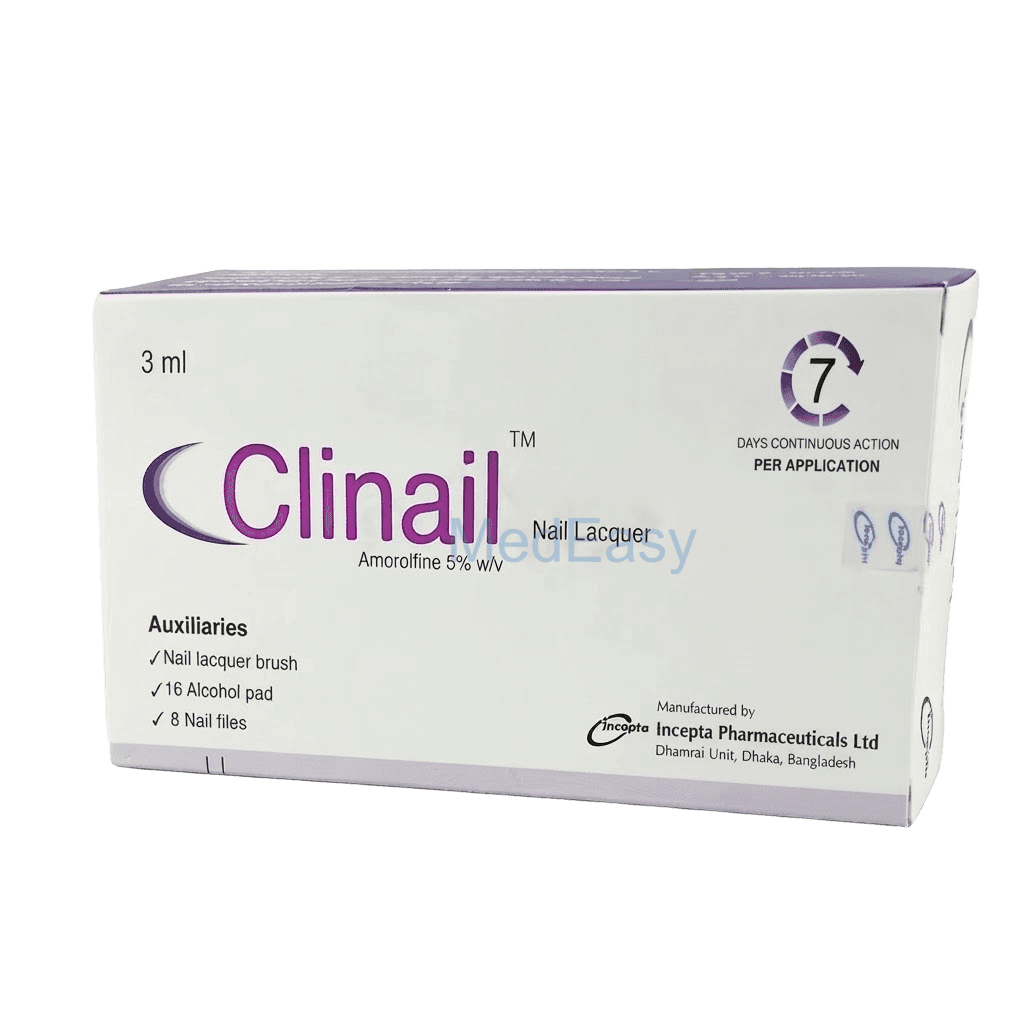
- Nail lacquer: Amorolfine Hydrochloride 5% w/v (each mL contains 50 mg amorolfine, equivalent to amorolfine hydrochloride), supplied with nail files, cleansing swabs, and spatulas for application.
- Cream: Amorolfine Hydrochloride 0.25% w/w for application to skin.
Description
Clinail is a topical antifungal agent belonging to the morpholine class. It is formulated as a medicated nail lacquer for the treatment of fungal nail infections (onychomycosis) and as a cream for fungal infections of the skin. Clinail works locally at the site of application and has a broad spectrum of activity against dermatophytes, yeasts, and moulds. Because systemic absorption after topical application is minimal, Clinail is generally well tolerated, with local application-site reactions being the most commonly reported effects.
Therapeutic Class
Topical antifungal agent (morpholine derivative). Clinail is classified as a topical antimycotic used in nail lacquer and cream/dermatological cream preparations.
Pharmacology
Amorolfine Hydrochloride exerts its antifungal effect by interfering with fungal cell membrane sterol biosynthesis. It inhibits two key enzymes in the ergosterol synthesis pathway — Δ14-reductase and Δ7-Δ8 isomerase. This dual inhibition depletes ergosterol (an essential component of the fungal cell membrane) and causes accumulation of abnormal sterols, leading to disruption of membrane structure and function.
Depending on the organism and concentration achieved, Amorolfine Hydrochloride can be fungistatic or fungicidal. It has a broad spectrum of activity covering dermatophytes (e.g. Trichophyton, Microsporum, Epidermophyton species), yeasts (e.g. Candida, Malassezia), moulds, and dematiaceous fungi. When applied as a nail lacquer, Amorolfine Hydrochloride penetrates the nail plate and diffuses through to the nail bed, reaching fungicidal concentrations within the nail; systemic absorption is negligible.
Dosage & Administration of Clinail
Nail lacquer (onychomycosis)
| Step | Instructions |
|---|---|
| Preparation | File the surface of the affected nail(s) using the file provided, then clean with the cleansing swab/alcohol pad and allow to dry. |
| Application | Apply Clinail nail lacquer evenly over the entire nail surface using the applicator provided, once or twice weekly as directed by the physician. |
| Drying | Allow the lacquer to dry for approximately 3 minutes before covering with socks or footwear; avoid washing the treated nail for at least 6 hours. |
| Re-application | Before each new application, remove residual lacquer with the cleansing swab and re-file the nail surface. |
| Duration | Continue treatment until the nail has fully regrown and is clinically normal — typically 6 months for fingernails and 9-12 months for toenails (see Duration of Treatment). |
Cream (skin infections)
| Indication | Dosing |
|---|---|
| Tinea pedis, tinea cruris, tinea corporis, tinea manuum, pityriasis versicolor | Apply a thin layer of Clinail cream once daily to the cleansed and dried affected skin area, preferably in the evening, for 2-3 weeks (up to 6 weeks for tinea pedis of the soles/heels) or as directed by the physician, continuing for a few days after clinical cure. |
Important: Complete the full prescribed duration of Clinail treatment as directed by your physician; stopping early — especially with the nail lacquer, given slow nail growth — is a common cause of treatment failure or relapse.
Administration of Clinail
Clinail is for external/topical use only.
- Nail lacquer: file, cleanse, and dry the nail before each application; apply evenly with the applicator brush and let dry fully before covering.
- Cream: apply to clean, dry skin, gently rubbing in a thin layer; wash hands after application unless the hands are the treated area.
- Avoid contact with eyes, ears, and mucous membranes. Do not apply to broken or inflamed skin unless directed by a physician.
- Do not use occlusive dressings over the application site unless instructed.
Interaction of Clinail
Because systemic absorption of Clinail after topical/nail application is negligible, clinically significant systemic drug interactions have not been established.
- No specific interaction studies exist for concomitant use of Clinail with other topical medicinal products applied to the same site; simultaneous application of other topical agents (e.g. other nail treatments) to the same nail is not recommended without medical advice, as it may affect efficacy or local tolerability.
Contraindications
Amorolfine Hydrochloride is contraindicated in patients with known hypersensitivity to amorolfine or to any excipient of the nail lacquer or cream formulation.
Side Effects of Clinail
Clinail is generally well tolerated locally. Reported adverse effects include:
- Common/transient: mild burning sensation and local skin/nail irritation at the application site, usually transient and resolving without stopping treatment.
- Uncommon: nail discoloration, nail fragility/brittleness (with nail lacquer).
- Rare: contact dermatitis, redness, itching, or blistering at the application site.
- Rare (allergic): hypersensitivity reactions such as rash or hives — discontinue and seek medical advice if these occur.
Pregnancy & Lactation
Data on the use of Clinail in pregnant women are limited. Although systemic absorption after topical nail or skin application is minimal, Clinail is not recommended during pregnancy unless the treating physician determines the potential benefit justifies the potential risk. Use only if clearly needed and under medical supervision.
It is not known whether topically applied Clinail is excreted in human milk. As a precaution, Clinail should not be applied to the breast/nipple area during breastfeeding, and use elsewhere on the body during lactation should be discussed with a physician before use.
Precautions & Warnings
Complete the full course: Clinail nail lacquer treatment for onychomycosis is often prolonged (many months) because of slow nail growth. Stopping treatment early is a common cause of relapse or treatment failure — continue exactly as prescribed and for the full recommended duration, even if the nail appears improved.
Avoid mucosal/eye contact: Avoid contact with eyes, ears, and mucous membranes; if accidental contact occurs, rinse thoroughly with water and seek medical advice if irritation persists.
Local skin care: Avoid excessive application to the periungual skin/cuticles or skin folds, as this may increase the risk of local irritation.
Diagnosis: A fungal infection should be confirmed (e.g. by microscopy/culture) before starting treatment, and diabetic or immunocompromised patients with nail infections should be evaluated by a physician before self-treating.
Not for children: Use in children is not recommended due to insufficient clinical data (see Use in Special Populations).
Overdose Effects of Clinail
Because Clinail is applied topically with minimal systemic absorption, systemic overdose is unlikely. No specific cases of systemic toxicity from topical overuse have been well documented.
If Clinail is accidentally ingested (e.g. by a child) or if excessive/widespread application occurs, seek immediate medical attention or contact a poison control center. Do not attempt unsupervised home treatment for suspected ingestion.
Storage Conditions
Store at room temperature (below 30°C), away from light and moisture. Keep the container tightly closed and out of reach of children.
Use In Special Populations
Pediatric use
Safety and efficacy of Clinail in children have not been well established; it is generally not recommended for use in children due to insufficient clinical data. Use only if specifically advised by a pediatrician.
Elderly
No specific dose adjustment is required in elderly patients; efficacy and safety are similar to younger adults.
Renal/hepatic impairment
Because systemic absorption of topical Clinail is negligible, no specific dose adjustment is expected to be necessary in renal or hepatic impairment; however, caution and physician guidance are advised.
Pregnancy and lactation
See Pregnancy and Lactation section — use only if clearly needed and under medical advice.
Duration Of Treatment
Duration of Clinail treatment depends on the indication and the site being treated:
- Onychomycosis (nail lacquer): approximately 6 months for fingernails and 9-12 months for toenails, or until the infected nail has fully grown out and appears clinically normal — treatment may take longer given slow nail growth rate.
- Skin infections (cream): generally 2-3 weeks, extending up to 6 weeks for tinea pedis affecting the soles/heels, continuing for a few days after visible clearing of the infection to reduce risk of relapse.
Do not discontinue Clinail early even if symptoms improve, as premature discontinuation is a common cause of relapse.
Drug Classes
Topical antifungal, Morpholine derivative
Mode Of Action
Amorolfine Hydrochloride inhibits fungal Δ14-reductase and Δ7-Δ8 isomerase, blocking ergosterol biosynthesis in the fungal cell membrane. Loss of ergosterol together with accumulation of abnormal sterols compromises membrane integrity, resulting in fungal growth inhibition (fungistatic effect) or fungal cell death (fungicidal effect), depending on the pathogen and drug concentration at the site of infection.
Pediatric Uses
The safety and efficacy of Clinail in pediatric patients have not been established through adequate clinical studies. Clinail is therefore generally not recommended for use in children unless specifically directed by a physician after weighing potential benefits against the lack of pediatric safety data.
Frequently Asked Questions
Q: What is Clinail 3 ml Nail Lacquer used for?
A: Clinail 3 ml Nail Lacquer is a topical antifungal used as a nail lacquer to treat fungal nail infections (onychomycosis) and as a cream to treat fungal skin infections such as athlete's foot, ringworm (tinea), and pityriasis versicolor.
Q: How long does it take Clinail 3 ml Nail Lacquer nail lacquer to work?
A: Because nails grow slowly, visible improvement can take months. Full treatment typically continues for about 6 months for fingernails and 9-12 months for toenails. It is important to keep using Clinail 3 ml Nail Lacquer for the entire recommended duration, even if the nail looks better, since stopping early is a common cause of the infection coming back.
Q: Can I use Clinail 3 ml Nail Lacquer during pregnancy or while breastfeeding?
A: Data are limited, so Clinail 3 ml Nail Lacquer is not generally recommended during pregnancy unless your doctor decides the benefit outweighs the risk. During breastfeeding, avoid applying Clinail 3 ml Nail Lacquer to the breast/nipple area, and check with your doctor before using it elsewhere on the body.
Q: What are the common side effects of Clinail 3 ml Nail Lacquer?
A: The most common effects are a mild, usually temporary burning sensation or local irritation at the application site. Less commonly, nail discoloration or brittleness (with the nail lacquer) or skin redness/itching (with the cream) can occur. Stop use and consult a doctor if you notice a rash, blistering, or signs of an allergic reaction.
Q: Who should not use Clinail 3 ml Nail Lacquer?
A: Clinail 3 ml Nail Lacquer should not be used by anyone with a known allergy (hypersensitivity) to amorolfine or to any ingredient in the nail lacquer or cream. It is also generally not recommended for young children due to limited safety data.
Q: How should I apply Clinail 3 ml Nail Lacquer nail lacquer?
A: File the surface of the infected nail, clean it with the swab provided, then apply Clinail 3 ml Nail Lacquer evenly over the whole nail with the applicator. Let it dry for about 3 minutes before covering with socks or shoes. Before your next application, remove the old lacquer layer and re-file the nail. Apply once or twice weekly, as directed by your physician.
Disclaimer
The information provided is accurate to the best of our knowledge, but it does not replace professional medical advice. We cannot guarantee its completeness or accuracy, and the absence of specific information about a drug should not be taken as an endorsement. We are not responsible for any consequences arising from this information, so please consult a healthcare professional for any concerns or questions.
