10% Off
Sulprex(100 mcg+2
Square Pharmaceuticals PLC.
৳225.68
Add to cart
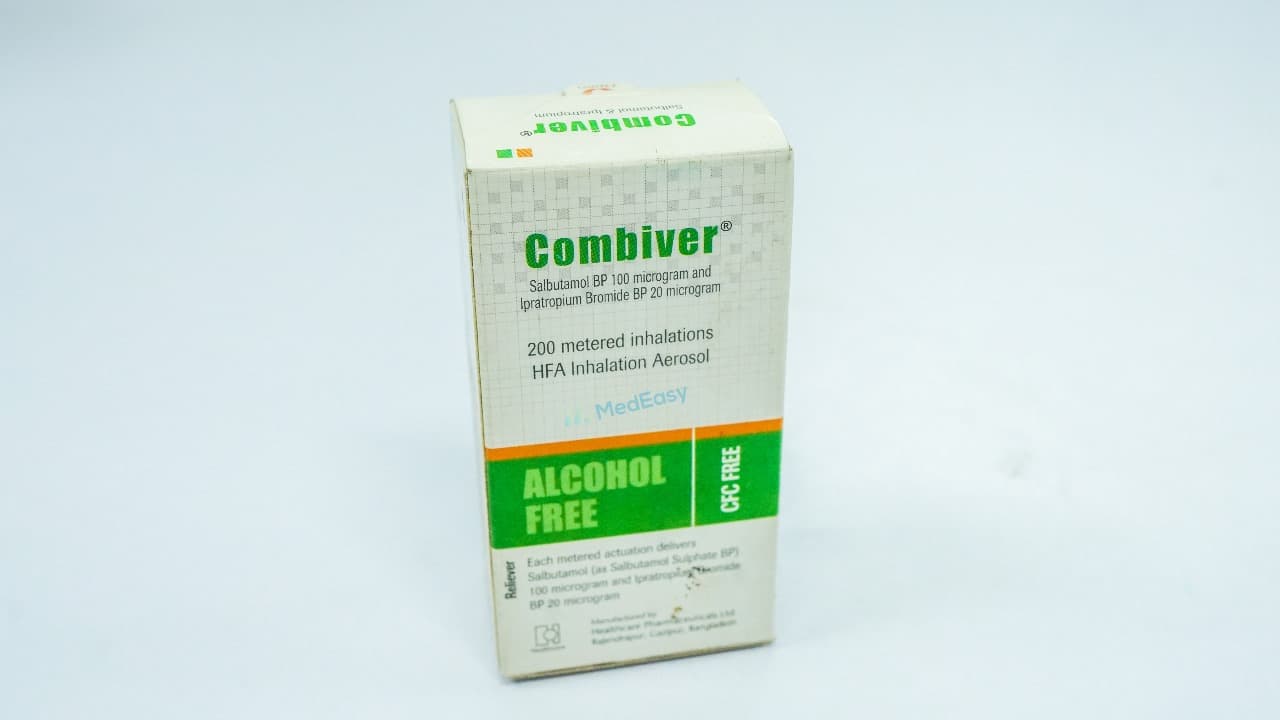

Combiver is a combination bronchodilator used to relieve bronchospasm (airway narrowing) in patients with obstructive airway disease. It combines a short-acting beta2-agonist (salbutamol) with a short-acting anticholinergic (ipratropium bromide) that work by complementary mechanisms to produce greater bronchodilation than either agent alone.
Combiver is not a rescue medication for sudden, severe shortness of breath outside of medical supervision unless specifically prescribed for that purpose by a physician.
Each formulation of Salbutamol + Ipratropium Bromide combines two active ingredients:
Common strengths include nebulizer solution containing salbutamol 2.5 mg (as sulfate) with ipratropium bromide 0.5 mg per 2.5-3 mL unit-dose vial, and metered-dose inhaler formulations delivering a fixed dose of each component per actuation. Exact strengths vary by brand and dosage form; refer to the specific product label.
Combiver is a fixed-dose combination bronchodilator supplied as a nebulizer solution and/or metered-dose inhaler (MDI) for oral inhalation. It is used in the management of reversible bronchospasm associated with obstructive airway disease, most commonly chronic obstructive pulmonary disease (COPD).
The combination pairs a beta2-agonist bronchodilator that relaxes bronchial smooth muscle with an anticholinergic bronchodilator that blocks vagally-mediated bronchoconstriction, giving a broader and often more effective bronchodilator response than either drug alone, particularly in COPD.
Combiver belongs to the therapeutic class of combination bronchodilators, specifically a short-acting beta2-adrenergic agonist (SABA) combined with a short-acting anticholinergic/antimuscarinic agent (SAMA), used in respiratory medicine for obstructive airway disease.
Salbutamol + Ipratropium Bromide produces bronchodilation through two complementary and independent mechanisms:
Used together, Salbutamol + Ipratropium Bromide provides additive bronchodilation with a broader therapeutic effect than either component individually, which is particularly useful in COPD, where both cholinergic tone and beta-adrenergic responsiveness contribute to airway obstruction.
| Indication | Typical Adult Dose |
|---|---|
| COPD maintenance/relief of bronchospasm | One unit-dose vial (salbutamol 2.5 mg/ipratropium bromide 0.5 mg) nebulized 3-4 times daily via mouthpiece or facemask, as directed by physician |
| Acute exacerbation (asthma or COPD), adjunct therapy | One unit-dose vial nebulized, may be repeated every 20-30 minutes for up to 3 doses under medical supervision, then as needed, not exceeding the maximum daily dose advised by the physician |
Typically 1-2 inhalations four times daily, not exceeding the maximum number of inhalations per 24 hours specified on the product label. Use a spacer device if advised by the physician.
Safety and efficacy of fixed-dose Combiver have not been formally established in children for routine outpatient use. In hospital/emergency settings, weight-based nebulized dosing may be used under direct physician supervision for acute severe asthma; this must always be individualized by a pediatrician.
Combiver is administered by oral inhalation only, either via a jet nebulizer (nebulizer solution) or a metered-dose inhaler. It must not be swallowed or injected. Patients should be shown correct inhaler/nebulizer technique by a healthcare provider or pharmacist to ensure adequate drug delivery to the lungs. Care should be taken to avoid spraying or nebulizing the mist directly into the eyes, as this can precipitate acute eye problems (see Precautions).
The following clinically significant interactions have been established for Combiver:
Salbutamol + Ipratropium Bromide is contraindicated in:
Reported side effects of Combiver include those attributable to each component:
Pregnancy: There are no adequate and well-controlled studies of Combiver in pregnant women. It should be used during pregnancy only if the potential benefit to the mother clearly justifies the potential risk to the fetus. Salbutamol may theoretically inhibit uterine contractions if used near term; use during labor should be under close medical supervision. Consult a physician before use in pregnancy.
Lactation: It is not known whether the components of Combiver are excreted in human breast milk. Because many drugs are excreted in breast milk, caution should be exercised and a physician consulted before use while breastfeeding, weighing the benefit of treatment against potential risk to the infant.
The following precautions apply to the use of Combiver:
Overdose with Combiver may produce exaggerated effects of its components, including tachycardia, palpitations, tremor, nervousness, hypertension or hypotension, arrhythmias, seizures, hypokalemia, dry mouth, blurred vision, and urinary retention.
If an overdose is suspected, seek immediate medical attention or contact a poison control center right away. Treatment is supportive and symptomatic; a physician may consider a cardioselective beta-blocker with extreme caution in life-threatening situations, bearing in mind the risk of inducing bronchospasm. Do not attempt to manage a suspected overdose at home without medical guidance.
Store at room temperature (below 30°C), protected from light and moisture. Do not freeze. Keep nebules in their foil pouch until immediately before use, and discard any unused solution. Keep out of reach of children.
Elderly: No dose adjustment is generally required, but elderly patients, particularly those with cardiovascular disease, prostatic hyperplasia, or glaucoma, should use Combiver with caution and closer monitoring (see Precautions).
Renal impairment: No specific dose adjustment is established; use with the usual caution applicable to inhaled bronchodilators.
Hepatic impairment: No specific dose adjustment is established for Combiver, as it is administered by inhalation with minimal systemic metabolism.
Pediatric: Safety and efficacy of the fixed-dose combination have not been formally established for routine outpatient pediatric use; use in children, when required for acute severe exacerbations, should be directed and supervised by a pediatrician.
In COPD, Combiver is often used long-term as part of ongoing maintenance therapy, as prescribed by a physician, with periodic reassessment of respiratory status. In acute exacerbations of asthma or COPD, it is used short-term, typically over hours to a few days, until the exacerbation resolves, per physician guidance. Treatment duration should always be individualized and not exceed what is prescribed.
Salbutamol + Ipratropium Bromide belongs to the drug class of combination respiratory bronchodilators: a short-acting beta2-adrenergic agonist (SABA) combined with a short-acting muscarinic antagonist (SAMA/anticholinergic bronchodilator).
Salbutamol + Ipratropium Bromide works via two complementary mechanisms: salbutamol stimulates beta2-adrenergic receptors on bronchial smooth muscle to increase cAMP and cause bronchodilation, while ipratropium bromide blocks muscarinic acetylcholine receptors to inhibit vagally-mediated bronchoconstriction. Together they produce more complete bronchodilation than either agent alone, particularly beneficial in COPD.
C
The fixed-dose combination Combiver has not been formally established as safe and effective for routine outpatient use in children. In emergency settings, nebulized combination therapy is sometimes used off-label for severe pediatric asthma exacerbations under direct physician supervision, with dosing individualized by weight and age. Parents/caregivers should never use Combiver in a child without explicit medical direction.
Q: What is Combiver (100 mcg+20 mcg)/puff Inhaler used for?
A: Combiver (100 mcg+20 mcg)/puff Inhaler is a combination inhaled bronchodilator used to relieve and prevent bronchospasm (airway narrowing) in people with COPD, and as an adjunct treatment during acute asthma exacerbations alongside other prescribed therapy.
Q: How is Combiver (100 mcg+20 mcg)/puff Inhaler taken?
A: It is given by oral inhalation only, either through a nebulizer (as a solution) or a metered-dose inhaler, following the dose and frequency your physician prescribes. It should never be swallowed or injected.
Q: Can Combiver (100 mcg+20 mcg)/puff Inhaler be used during pregnancy?
A: Combiver (100 mcg+20 mcg)/puff Inhaler should be used during pregnancy only if the potential benefit clearly outweighs the potential risk, and only under a physician's guidance, since adequate safety studies in pregnant women are lacking.
Q: What are the common side effects of Combiver (100 mcg+20 mcg)/puff Inhaler?
A: Common side effects include tremor, headache, fast heartbeat (tachycardia), palpitations, dry mouth, throat irritation, and dizziness. Contact your physician if these are severe or persistent.
Q: Who should not use Combiver (100 mcg+20 mcg)/puff Inhaler?
A: People with a known hypersensitivity to salbutamol, ipratropium bromide, atropine-related compounds, or (for some formulations) soya lecithin/peanut products should not use Combiver (100 mcg+20 mcg)/puff Inhaler.
Q: What should I do if I accidentally use too much Combiver (100 mcg+20 mcg)/puff Inhaler?
A: Seek immediate medical attention or contact a poison control center. Overdose can cause a fast or irregular heartbeat, tremor, and low blood potassium, and needs prompt medical evaluation.
Disclaimer
The information provided is accurate to the best of our knowledge, but it does not replace professional medical advice. We cannot guarantee its completeness or accuracy, and the absence of specific information about a drug should not be taken as an endorsement. We are not responsible for any consequences arising from this information, so please consult a healthcare professional for any concerns or questions.