

10% Off
Intasone10 mg
Incepta Pharmaceuticals Ltd.
৳3.15
Add to cart
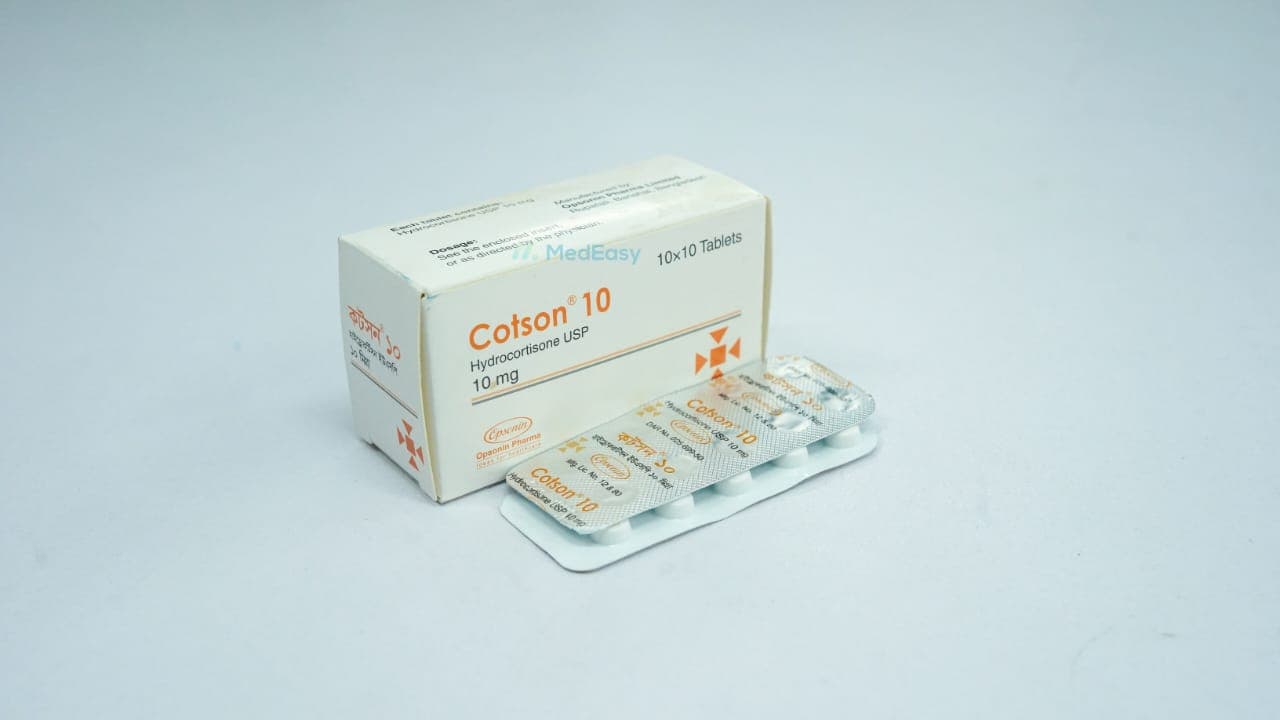
Cotson 10 mg Tablet is available on MedEasy for ৳23.18 per 10's Strip, with home delivery anywhere in Bangladesh. It is manufactured by Opsonin Pharma Ltd. Its generic name is Hydrocortisone.

Cotson is a corticosteroid (glucocorticoid) used in both topical and systemic forms, depending on the condition being treated.
The specific formulation, strength, and route are selected by the prescriber according to the condition being treated.
Hydrocortisone is available in Bangladesh and internationally in several dosage forms and strengths, including:
Formulation and strength availability may vary by manufacturer and market; always check the product label for the exact composition of the specific brand dispensed.
Cotson is a synthetic form of cortisol, the glucocorticoid hormone naturally produced by the adrenal cortex. It belongs to the corticosteroid class of medicines and has anti-inflammatory, immunosuppressive, and anti-allergic properties.
Applied topically, Cotson reduces local skin inflammation, redness, and itching. Given systemically (orally or by injection), it is used both as hormone replacement in adrenal insufficiency and, at higher doses, to suppress inflammation and immune activity in a range of acute and chronic conditions.
Cotson is considered a short-acting (low-potency, short-duration) corticosteroid relative to synthetic derivatives such as prednisolone or dexamethasone, which makes it particularly suited to physiologic replacement dosing.
Corticosteroid (Glucocorticoid) — topical and systemic Cotson preparations
Hydrocortisone binds to intracellular glucocorticoid receptors, and the hormone-receptor complex translocates to the cell nucleus, where it regulates the transcription of genes involved in inflammation and immune function.
This results in:
Topically applied Hydrocortisone acts locally on skin tissue with limited systemic absorption at recommended doses, though absorption increases with higher potency formulations, occlusion, broken skin, and use in infants and young children.
Dosing of Cotson is individualized according to the condition treated, the formulation used, and patient factors such as age and organ function. General guidance is summarized below; the treating physician's prescription should always be followed.
| Indication | Typical Adult Dosing | Typical Pediatric Dosing |
|---|---|---|
| Topical (eczema, dermatitis, insect bites) | Apply a thin layer of 0.5–2.5% cream/ointment to the affected area 2–4 times daily, for the shortest effective duration (usually up to 1–2 weeks) | Apply the lowest effective strength (typically 0.5–1%) sparingly, 1–2 times daily; limit duration and area treated, especially under 2 years of age |
| Adrenal insufficiency (replacement therapy) | Oral: approximately 15–25 mg/day in 2–3 divided doses (higher dose in the morning), individualized to clinical response | Weight-based dosing (approximately 8–10 mg/m²/day), determined and monitored by a pediatric endocrinologist |
| Severe allergic reaction / anaphylaxis (adjunct), acute inflammatory flare | IV/IM: 100–500 mg initially, then repeated every 2–6 hours as needed, guided by response and tapered as soon as clinically appropriate | Weight-based IV/IM dosing under direct physician supervision |
| Adrenal crisis / major surgical stress | IV: 100 mg immediately, then 100–200 mg/day in divided doses, tapering as the acute stress resolves | Weight-based stress dosing under specialist supervision |
| Ulcerative proctitis / hemorrhoids (rectal) | 1 suppository or applicatorful once or twice daily for a limited course as directed | Not generally recommended without specialist guidance |
Systemic Cotson therapy that has been used for more than a few days to weeks should never be stopped abruptly; the dose must be tapered gradually under medical supervision to avoid adrenal crisis (see Precautions).
Do not use more Cotson, more often, or for longer than prescribed. Complete the course as directed by the physician and do not stop systemic therapy abruptly.
Cotson, particularly at systemic doses, has several clinically significant drug interactions:
Always inform the physician or pharmacist of all other medicines, including over-the-counter drugs, vaccines, and herbal supplements, before starting Cotson.
Hydrocortisone is contraindicated in:
Hydrocortisone used as physiologic replacement therapy for adrenal insufficiency is generally continued even in the presence of infection, with dose adjustment as directed by the physician, since abrupt discontinuation can be life-threatening in these patients.
Side effects of Cotson depend on the route, dose, and duration of use.
Patients should seek medical attention for severe or persistent side effects, signs of infection, or mood/behavioral changes while on systemic Cotson.
Cotson should be used in pregnancy only if clearly needed, at the lowest effective dose and for the shortest duration, and only after the potential benefit to the mother has been weighed against potential risk to the fetus by the treating physician. Corticosteroids can cross the placenta; prolonged or high-dose systemic use in pregnancy has been associated with a small increased risk of oral clefts (first trimester) and effects on fetal growth or neonatal adrenal function with third-trimester exposure.
Cotson passes into breast milk in small amounts. Low-dose topical use and short courses of systemic therapy are generally considered compatible with breastfeeding when medically necessary, but a physician should be consulted, and if applied topically to the breast area, the area should be cleaned before nursing.
Pregnant or breastfeeding women should always consult their physician before starting or continuing Cotson.
Always take Cotson exactly as prescribed and inform the physician of the full medical history, including infections, diabetes, hypertension, osteoporosis, glaucoma, or psychiatric illness, before starting treatment.
Acute overdose with a single excessive dose of Cotson is rarely immediately life-threatening, but chronic excessive use can lead to significant Cushingoid effects (see Side Effects). Suspected overdose or accidental ingestion of a large amount, especially in a child, should be treated as a medical emergency.
If overdose is suspected, seek immediate medical attention or contact a poison control center/emergency services. Do not attempt to manage a suspected overdose at home; treatment is supportive and directed by medical professionals based on the amount taken and the patient's symptoms.
Store at room temperature (below 30°C), away from light and moisture. Keep out of reach of children. Do not freeze injectable solutions unless the product label specifically permits it.
Cotson is used in children for approved indications (e.g., adrenal insufficiency, congenital adrenal hyperplasia replacement, short-course topical treatment of dermatitis), with dosing individualized by weight or body-surface area under specialist supervision. Children are more susceptible to skin thinning with topical use and to growth suppression with prolonged systemic use; treatment should use the lowest effective dose for the shortest duration, with growth monitored during prolonged courses.
Elderly patients may be more susceptible to corticosteroid-related side effects such as osteoporosis, hypertension, glucose intolerance, skin fragility, and infection; use the lowest effective dose and monitor closely.
No specific dose adjustment is generally required, but fluid retention and electrolyte effects should be monitored, as renal impairment may worsen fluid/electrolyte disturbances caused by systemic Cotson.
Cotson does not require hepatic activation (unlike prednisone), so it may be preferred in significant hepatic impairment; nonetheless, monitor for enhanced corticosteroid effect since metabolism may still be reduced.
Duration of Cotson therapy is individualized by indication:
Do not extend or shorten the prescribed duration of systemic Cotson without consulting the physician, particularly after prolonged use, due to the risk of adrenal suppression.
Cotson sodium succinate powder for injection must be reconstituted immediately before use. Add the diluent supplied with, or specified for, the product (typically Bacteriostatic Water for Injection or 0.9% Sodium Chloride Injection) to the vial and gently swirl until the powder is fully dissolved and the solution is clear. Do not use if the reconstituted solution is cloudy or contains particulate matter. Use the reconstituted solution promptly and discard any unused portion according to the product's specific stability information; reconstitution and administration should be performed by a trained healthcare professional.
Corticosteroids; Glucocorticoids; Adrenal cortical steroids
Hydrocortisone exerts its effect by binding cytoplasmic glucocorticoid receptors; the activated receptor complex enters the cell nucleus and modulates transcription of genes controlling inflammatory and immune pathways. This suppresses the production of pro-inflammatory mediators (cytokines, prostaglandins, leukotrienes), reduces immune cell migration and activity, and, through induction of lipocortin-1, inhibits phospholipase A2 to limit the inflammatory cascade. Hydrocortisone also has mineralocorticoid activity, contributing to sodium and water retention and potassium excretion, which underlies part of its role in maintaining cardiovascular tone during physiologic replacement.
C
Cotson is used in pediatric patients for approved indications, including replacement therapy in adrenal insufficiency and congenital adrenal hyperplasia, and short courses of low-potency topical treatment for corticosteroid-responsive dermatoses. Dosing is weight- or body-surface-area-based and should be determined and monitored by a physician, ideally a pediatric specialist for endocrine indications.
Safety and efficacy of specific formulations and strengths in infants and young children should follow product labeling; for many higher-potency topical products and for prolonged systemic use, safety and efficacy in very young children have not been fully established, and use should be limited to the lowest effective dose for the shortest necessary duration, with monitoring of growth during prolonged systemic therapy.
Q: What is Cotson 10 mg Tablet used for?
A: Cotson 10 mg Tablet is a corticosteroid used topically to reduce inflammation and itching in skin conditions such as eczema and dermatitis, and systemically to replace deficient cortisol in adrenal insufficiency or to control severe allergic, inflammatory, or autoimmune flares, as directed by a physician.
Q: Can I stop taking Cotson 10 mg Tablet suddenly?
A: No. If you have been taking systemic Cotson 10 mg Tablet for more than a few days to weeks, you should not stop it suddenly. Doing so can cause a life-threatening adrenal crisis. Your physician will taper the dose gradually.
Q: Is Cotson 10 mg Tablet safe to use during pregnancy?
A: Cotson 10 mg Tablet should be used in pregnancy only if clearly needed, at the lowest effective dose for the shortest time, after your physician weighs the potential benefits against potential risks to the baby. Always consult your physician before use in pregnancy.
Q: Can Cotson 10 mg Tablet be used in children?
A: Yes, for specific approved indications such as adrenal insufficiency replacement or short-course topical treatment of dermatitis, but dosing must be determined by a physician, since children are more prone to skin thinning and, with prolonged systemic use, growth suppression.
Q: What should I do if I miss a dose of Cotson 10 mg Tablet?
A: Take the missed dose as soon as you remember unless it is almost time for the next dose; do not double the dose. If you are on replacement therapy and miss a dose, especially during illness, contact your physician, as adjustment or an extra dose may be needed.
Q: What are the main side effects to watch for with Cotson 10 mg Tablet?
A: Topical use may cause local burning, thinning, or stretch marks with prolonged use. Systemic use may cause increased appetite, weight gain, high blood sugar, high blood pressure, mood changes, weakened bones, and increased infection risk with prolonged use. Report severe or persistent side effects to your physician.
Disclaimer
The information provided is accurate to the best of our knowledge, but it does not replace professional medical advice. We cannot guarantee its completeness or accuracy, and the absence of specific information about a drug should not be taken as an endorsement. We are not responsible for any consequences arising from this information, so please consult a healthcare professional for any concerns or questions.