
10% Off
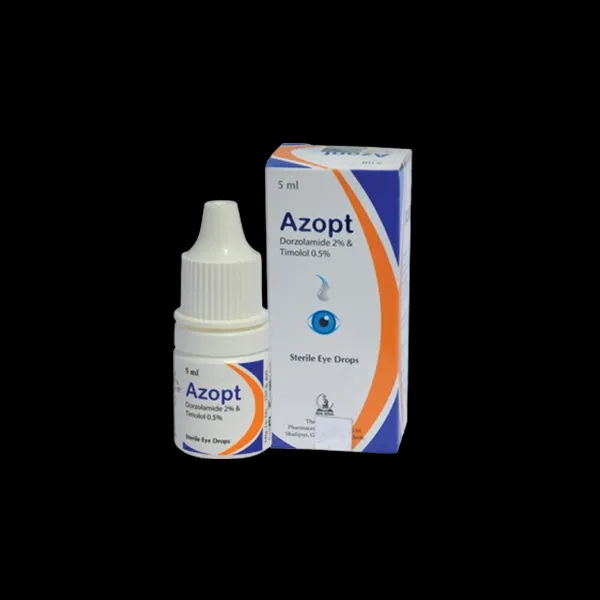
Azopt2%+0.5%
Ibn-Sina Pharmaceuticals Ltd.
৳540.00
Add to cart
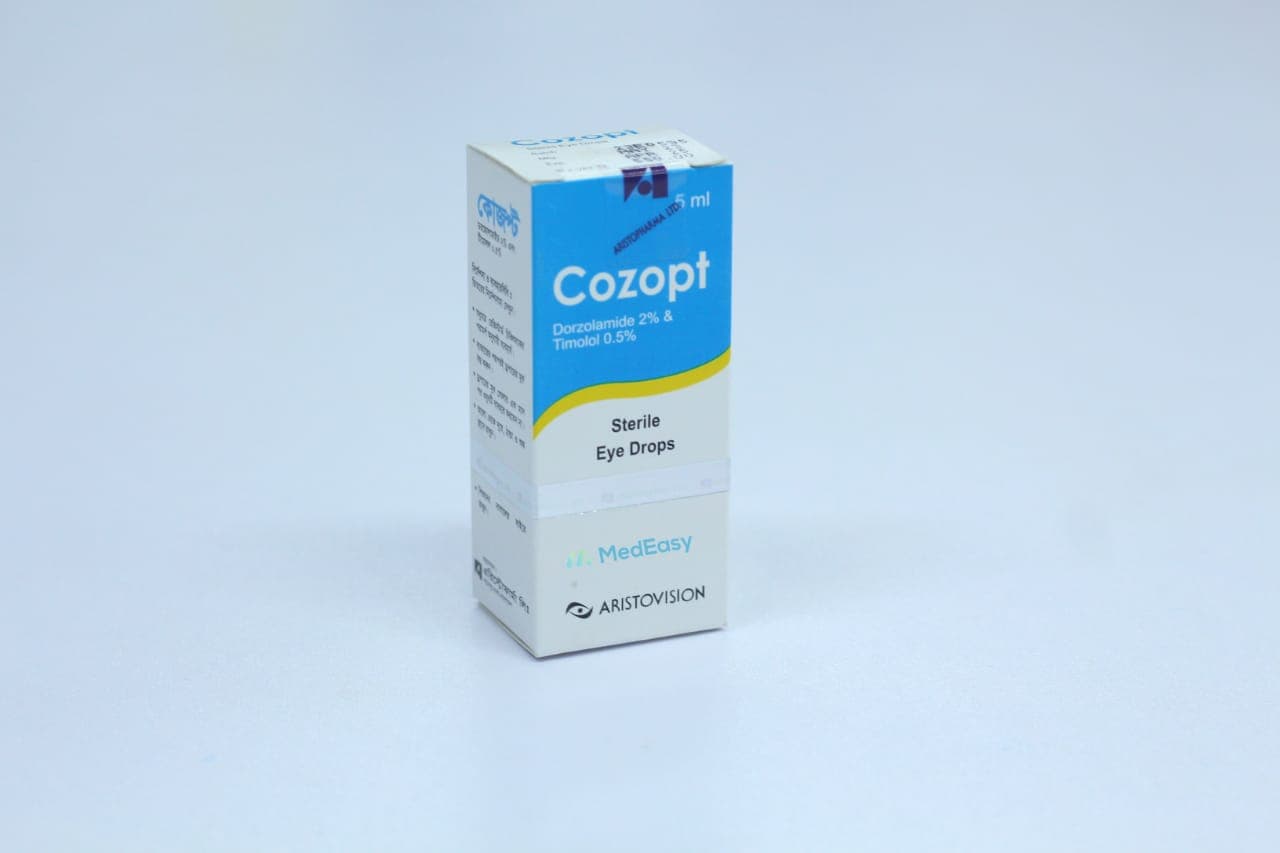

Cozopt is a fixed-dose topical ophthalmic combination approved for the following use:
Cozopt is not intended as first-line, single-agent therapy for patients who have not already been tried on other topical IOP-lowering agents; it is a combination product for patients already requiring multi-drug topical therapy.
Each mL of Dorzolamide + Timolol sterile ophthalmic solution contains Dorzolamide (as dorzolamide hydrochloride) 20 mg (2% w/v) and Timolol (as timolol maleate) 5 mg (0.5% w/v), along with benzalkonium chloride as preservative and other inactive ingredients.
Cozopt is a sterile, fixed-dose ophthalmic solution combining a carbonic anhydrase inhibitor (dorzolamide) with a non-selective beta-adrenergic blocking agent (timolol). It is used topically in the eye to reduce elevated intraocular pressure in patients with open-angle glaucoma or ocular hypertension who require therapy with both drug classes. By combining two complementary mechanisms of aqueous humor suppression into a single drop, Cozopt simplifies dosing compared with using the two agents separately.
Cozopt belongs to the therapeutic class of fixed-dose anti-glaucoma / ocular hypotensive combinations, combining a topical carbonic anhydrase inhibitor with a non-selective beta-adrenergic blocking agent.
Dorzolamide + Timolol lowers intraocular pressure (IOP) through two complementary mechanisms that both reduce the rate of aqueous humor formation in the ciliary body, without a significant additive effect on outflow.
The onset of IOP-lowering effect with Dorzolamide + Timolol is seen within about an hour, with maximal effect typically achieved within 2 hours.
| Indication | Population | Recommended Dose |
|---|---|---|
| Open-angle glaucoma / ocular hypertension requiring combination therapy | Adults | One drop of Cozopt in the affected eye(s) twice daily |
| Same indication | Elderly | No dosage adjustment required; standard adult dose applies |
| Same indication | Pediatric patients | Safety and efficacy not established (see Pediatric Uses) |
| Renal impairment | Adults | No formal renal dose adjustment established for topical use; use with caution in significant renal impairment due to dorzolamide's systemic elimination pathway |
| Hepatic impairment | Adults | No specific dose adjustment established; not specifically studied |
If another topical ophthalmic drug is also being used, it should be administered at least 10 minutes before or after Cozopt.
Cozopt is for topical ophthalmic use only (in the eye), not for injection or oral use.
Cozopt has the following clinically significant interactions, mainly related to its timolol component:
Dorzolamide + Timolol is contraindicated in patients with:
Adverse effects reported with Cozopt are mostly local/ocular; systemic effects can occur due to absorption of the timolol component.
There are no adequate and well-controlled studies of Cozopt in pregnant women. Cozopt should be used during pregnancy only if the potential benefit to the mother clearly justifies the potential risk to the fetus, and only under direct medical supervision.
Cozopt should be used with caution in nursing mothers, as it is not known whether topical ophthalmic dorzolamide or timolol is excreted in human milk in clinically significant amounts; systemically administered beta-blockers do appear in breast milk. A physician should be consulted before use during breastfeeding, and the infant should be monitored for signs of beta-blockade if the mother uses this medicine.
The following precautions apply to Cozopt, largely reflecting the possibility of systemic absorption even with topical ocular use:
No specific information on human overdosage with Cozopt ophthalmic solution is available. Accidental ingestion of the timolol component may produce symptoms of systemic beta-blockade such as bradycardia, hypotension, bronchospasm, and acute cardiac failure. Overdose of the dorzolamide component may theoretically produce electrolyte imbalance, development of an acidotic state, and possible central nervous system effects. If overdose or accidental ingestion is suspected, seek immediate medical attention or contact a poison control center; treatment should be symptomatic and supportive, guided by a physician, and should not rely on unsupervised home remedies.
Store at 2°C–25°C (36°F–77°F), away from light and moisture. Keep the bottle tightly closed and upright when not in use, and keep out of reach of children. Discard any unused solution 4 weeks after first opening the bottle.
Renal impairment: No formal dose adjustment has been established for topical Cozopt; because dorzolamide and its metabolite are eliminated primarily by the kidney, use with caution in patients with significant renal impairment.
Hepatic impairment: No specific dosage adjustment data are available; use with caution.
Elderly: No overall differences in safety or effectiveness have been observed between elderly and younger patients; standard adult dosing applies.
Pediatric patients: Safety and efficacy have not been established (see Pediatric Uses).
Cozopt is typically used long-term as chronic maintenance therapy for glaucoma or ocular hypertension, for as long as the treating ophthalmologist determines it is needed to control intraocular pressure. Intraocular pressure and ocular surface health should be monitored periodically during long-term use, and treatment should not be stopped abruptly without medical advice.
Carbonic anhydrase inhibitor (dorzolamide) combined with a non-selective beta-adrenergic blocking agent (timolol); anti-glaucoma / ocular hypotensive combination.
Dorzolamide + Timolol lowers intraocular pressure through two complementary, non-overlapping mechanisms that each reduce aqueous humor production: dorzolamide inhibits ciliary body carbonic anhydrase II, while timolol blocks beta-adrenergic stimulation of the ciliary epithelium. See Pharmacology for full mechanistic detail.
C
The safety and effectiveness of Cozopt in pediatric patients have not been established. Use in children should only be considered under direct specialist (pediatric ophthalmologist) supervision, with close monitoring for systemic beta-blockade effects, given children's greater relative systemic drug exposure from topical eye drops.
Q: What is Cozopt 2%+0.5% Ophthalmic Solution used for?
A: Cozopt 2%+0.5% Ophthalmic Solution is used to lower elevated eye pressure in people with open-angle glaucoma or ocular hypertension who need combination treatment with both a beta-blocker and a carbonic anhydrase inhibitor eye drop.
Q: How should I use Cozopt 2%+0.5% Ophthalmic Solution eye drops?
A: The usual dose is one drop of Cozopt 2%+0.5% Ophthalmic Solution in the affected eye(s) twice daily. Wash your hands, avoid touching the dropper tip to your eye, and press gently on the inner corner of your eye for 1–2 minutes after each drop to reduce absorption into the rest of your body.
Q: Who should not use Cozopt 2%+0.5% Ophthalmic Solution?
A: People with asthma or severe COPD, slow heart rate (sinus bradycardia), certain heart conduction blocks, overt heart failure, cardiogenic shock, or a known allergy to sulfonamide medicines or any component of Cozopt 2%+0.5% Ophthalmic Solution should not use it. Always tell your doctor about your full medical history before starting treatment.
Q: Can Cozopt 2%+0.5% Ophthalmic Solution be used during pregnancy or breastfeeding?
A: Cozopt 2%+0.5% Ophthalmic Solution should be used in pregnancy only if clearly needed and if your doctor decides the benefit outweighs the potential risk to the baby. If you are breastfeeding, consult your physician first, as it is not fully known whether the medicine passes into breast milk in significant amounts.
Q: What are the common side effects of Cozopt 2%+0.5% Ophthalmic Solution?
A: Common side effects include burning or stinging in the eye, a bitter taste in the mouth, blurred vision, and eye redness or irritation. Contact your doctor if you notice signs of a slow heartbeat, difficulty breathing, or severe eye pain.
Q: What should I do if I accidentally swallow Cozopt 2%+0.5% Ophthalmic Solution?
A: Seek immediate medical attention or contact a poison control center right away, since swallowing Cozopt 2%+0.5% Ophthalmic Solution can cause slow heart rate, low blood pressure, or breathing difficulty; do not attempt home treatment on your own.
Disclaimer
The information provided is accurate to the best of our knowledge, but it does not replace professional medical advice. We cannot guarantee its completeness or accuracy, and the absence of specific information about a drug should not be taken as an endorsement. We are not responsible for any consequences arising from this information, so please consult a healthcare professional for any concerns or questions.
