
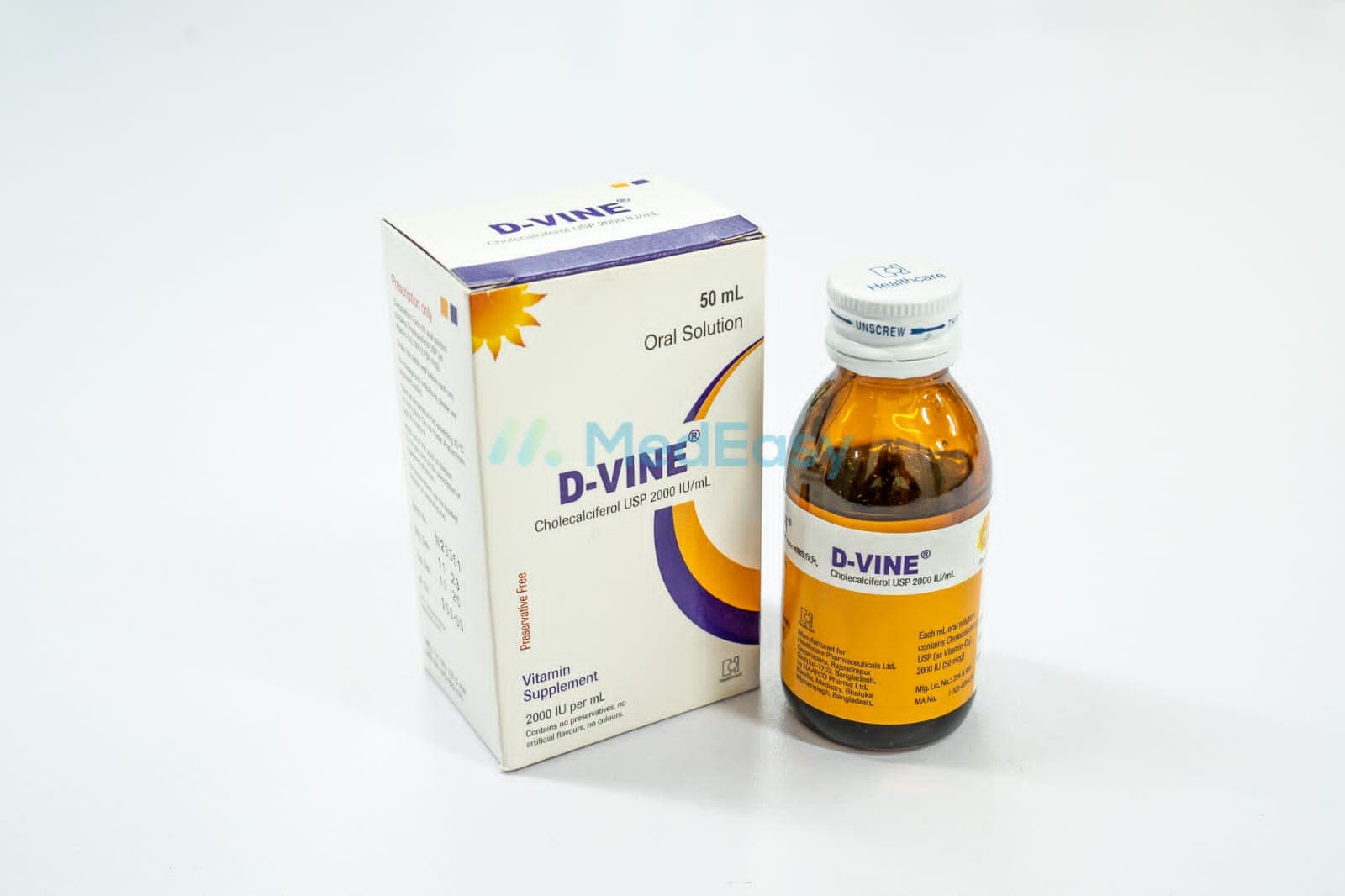

Medicine overview
Indications of D-Vine
D-Vine is a concentrated oral liquid formulation of vitamin D3 (cholecalciferol) used for the following indications:
Established / FDA-recognized uses
- Prevention of vitamin D deficiency in individuals with inadequate dietary intake, limited sun exposure, malabsorption syndromes, or increased requirements (e.g. exclusively breastfed infants, older adults, individuals with darker skin, obesity, or those on long-term anticonvulsant or corticosteroid therapy).
- Treatment of diagnosed vitamin D deficiency (low serum 25-hydroxyvitamin D), used at higher, physician-directed doses until levels normalize, followed by maintenance dosing.
Guideline-supported adjunct uses
- Adjunct in the management of osteoporosis, given together with adequate calcium intake, to support bone mineralization and reduce fracture risk in at-risk populations.
- Adjunct therapy in hypoparathyroidism and certain conditions of impaired calcium/vitamin D metabolism, under specialist supervision.
D-Vine is not a substitute for calcium supplementation, weight-bearing exercise, or other components of a comprehensive bone-health or deficiency-correction plan, and should be used only on medical advice for indications beyond routine dietary supplementation.
Composition
Each mL of Colecalciferol USP 2000 IU/ml oral solution contains Cholecalciferol (Vitamin D3) USP equivalent to 2000 IU (50 micrograms), in an oil-based or water-dispersible liquid vehicle suitable for drop-wise oral administration.
Description
D-Vine is a fat-soluble vitamin preparation containing cholecalciferol (vitamin D3), the naturally occurring form of vitamin D synthesized in human skin on exposure to ultraviolet light and obtained from certain dietary sources. It is formulated as a concentrated oral liquid (drops) providing 2000 IU of vitamin D3 per mL, allowing flexible, accurately titratable dosing.
Vitamin D plays a central role in calcium and phosphate homeostasis, bone mineralization, and neuromuscular function. D-Vine is used to prevent and correct vitamin D deficiency and to support bone health as part of a broader treatment plan.
Therapeutic Class
D-Vine belongs to the therapeutic class of Vitamin D and its analogues, specifically fat-soluble vitamin supplements used in the prevention and treatment of vitamin D deficiency and metabolic bone disorders.
Pharmacology
Colecalciferol USP 2000 IU/ml supplies cholecalciferol, which is biologically inactive until metabolized. It undergoes hydroxylation in the liver to 25-hydroxyvitamin D (calcidiol), the major circulating and storage form, and subsequently in the kidney to 1,25-dihydroxyvitamin D (calcitriol), the biologically active hormone.
Active vitamin D increases intestinal absorption of calcium and phosphate, promotes renal tubular reabsorption of calcium, and works with parathyroid hormone to regulate serum calcium and support normal bone mineralization and remodeling. It also has effects on neuromuscular function, immune modulation, and cell differentiation.
After oral administration, cholecalciferol from Colecalciferol USP 2000 IU/ml is absorbed in the small intestine (absorption is enhanced by dietary fat) and stored in adipose tissue and muscle, giving it a long biological half-life measured in weeks.
Dosage & Administration of D-Vine
Dosage
| Indication | Population | Typical Dose |
|---|---|---|
| Prevention of deficiency (maintenance) | Adults | 400–2000 IU (0.2–1 mL) once daily, or as advised by physician |
| Prevention of deficiency | Infants and children | 400–1000 IU (0.2–0.5 mL) once daily, per pediatric guidance |
| Treatment of diagnosed deficiency | Adults | 1000–4000 IU (0.5–2 mL) once daily, or an equivalent higher intermittent regimen, for 8–12 weeks, then reassess and switch to maintenance dose |
| Treatment of diagnosed deficiency | Children | Weight- and severity-based dosing as determined by the treating physician |
| Adjunct in osteoporosis | Adults, especially elderly | 800–2000 IU (0.4–1 mL) daily with adequate calcium intake |
Administration
- Administer D-Vine using the calibrated dropper or measuring device supplied with the product; do not estimate doses by eye given the concentrated potency of this formulation.
- May be taken directly by mouth, mixed with a small amount of food, milk, or juice, or placed onto an infant's tongue or into a bottle feed as advised.
- Take with a meal containing some fat to enhance absorption, if practical.
- Doses should be exactly as prescribed; do not increase the dose or frequency without medical advice, as this is a concentrated liquid and small volume errors can lead to significant dose changes.
Administration of D-Vine
D-Vine is for oral use only. Always use the accompanying dropper or measuring device to withdraw and administer the exact prescribed volume. Store the dropper clean and dry between uses. Do not administer directly from an un-calibrated spoon.
Interaction of D-Vine
Clinically significant interactions with D-Vine include:
- Thiazide diuretics: Concurrent use may increase the risk of hypercalcemia by reducing renal calcium excretion; calcium levels should be monitored.
- Corticosteroids: May reduce vitamin D absorption and impair its effect on calcium metabolism, potentially requiring dose adjustment.
- Cholestyramine, colestipol, orlistat, and mineral oil: May reduce intestinal absorption of vitamin D; separate dosing times where possible.
- Phenytoin and phenobarbital: May accelerate hepatic metabolism of vitamin D, reducing its effectiveness.
- Digoxin: Hypercalcemia resulting from excessive vitamin D intake increases the risk of digoxin toxicity and cardiac arrhythmia; caution is advised in patients on digoxin.
- Magnesium-containing antacids: In patients with chronic kidney disease, concurrent use with vitamin D may risk hypermagnesemia.
Inform the prescriber of all other vitamin D-containing supplements, multivitamins, or calcium products being used to avoid inadvertent excessive total intake.
Contraindications
Colecalciferol USP 2000 IU/ml is contraindicated in patients with:
- Known hypersensitivity to cholecalciferol or any excipient in the formulation.
- Hypercalcemia.
- Hypervitaminosis D.
Side Effects of D-Vine
At recommended doses, D-Vine is generally well tolerated and adverse effects are uncommon. Side effects are primarily associated with excessive intake leading to hypercalcemia (see Overdose and Precautions), and may include:
- Nausea, vomiting, constipation, or decreased appetite
- Weakness, fatigue, or headache
- Increased thirst and urination
- Rarely, allergic reactions such as rash or itching
Pregnancy & Lactation
D-Vine should be used in pregnancy and lactation only at doses that do not exceed the recommended dietary allowance unless a physician has specifically diagnosed deficiency and prescribed a higher, monitored dose. Use only if clearly needed, and only under medical supervision, as excessive vitamin D intake during pregnancy has been associated with risk to the fetus (including hypercalcemia). Cholecalciferol is excreted in breast milk; breastfeeding mothers should follow the physician's recommended dose and not exceed it. Consult a physician before use during pregnancy or breastfeeding.
Precautions & Warnings
The following precautions apply to the use of D-Vine:
- Renal impairment: Calcium and vitamin D handling is altered in renal disease; use D-Vine under close medical guidance, as dose adjustment and monitoring may be needed.
- Avoid excessive total intake: Do not exceed the recommended daily vitamin D intake from all combined dietary and supplement sources; cumulative excess intake can cause hypercalcemia (see Side Effects and Overdose).
- Concurrent thiazide diuretic use: Increases the risk of hypercalcemia (see Interactions).
- Accurate liquid dosing is essential: Because of the concentrated potency of this formulation, always measure doses with the provided dropper or measuring device to avoid inadvertent overdose. This is particularly important in infants and young children, in whom dosing errors with concentrated liquid vitamin D formulations are a recognized safety concern.
- Monitoring: Periodic monitoring of serum vitamin D and calcium levels may be reasonable with higher-dose or prolonged supplementation, per clinical judgment.
- Sarcoidosis, hyperparathyroidism, or other granulomatous disease: Use with caution, as these conditions increase sensitivity to vitamin D and risk of hypercalcemia.
Overdose Effects of D-Vine
Overdose of D-Vine can cause vitamin D toxicity and hypercalcemia, with symptoms such as persistent nausea and vomiting, constipation, weakness, confusion, excessive thirst, frequent urination, and in severe or prolonged cases, kidney damage or abnormal heart rhythm.
If overdose is suspected, discontinue the product immediately and seek immediate medical attention or contact a poison control center/emergency services. Do not attempt to manage a suspected overdose at home; treatment requires medical evaluation and may involve fluids and other supportive measures under professional care.
Storage Conditions
Store at room temperature (below 30°C), away from light and moisture. Do not freeze. Keep the bottle tightly closed and out of reach of children.
Use In Special Populations
- Pediatric use: D-Vine may be used in infants and children for prevention and treatment of vitamin D deficiency at weight- and age-appropriate doses (see Dosage and Administration). Extra care is needed to measure the exact volume using the provided dropper, given documented cases of dosing errors with concentrated liquid vitamin D products in this age group.
- Elderly: Generally safe at recommended doses; elderly patients may have reduced cutaneous vitamin D synthesis and benefit from supplementation, but renal function and calcium levels should be considered.
- Renal impairment: Use under close medical supervision with monitoring, as impaired renal activation and clearance of vitamin D metabolites can predispose to abnormal calcium handling (see Precautions).
- Hepatic impairment: Impaired hepatic hydroxylation may reduce conversion to active metabolites; dose adjustment or use of an active vitamin D analogue may be considered by the physician.
Duration Of Treatment
Duration of treatment with D-Vine depends on the indication. Deficiency-correction regimens are typically continued for 8–12 weeks, after which vitamin D status is reassessed and therapy is transitioned to a lower maintenance dose. For prevention or adjunct bone-health use, maintenance dosing may continue long-term under periodic medical review. Do not continue high-dose treatment beyond the prescribed course without physician reassessment.
Drug Classes
Fat-soluble vitamins; Vitamin D and analogues
Mode Of Action
Colecalciferol USP 2000 IU/ml provides cholecalciferol (vitamin D3), which is sequentially hydroxylated in the liver to calcidiol (25-hydroxyvitamin D) and then in the kidney to calcitriol (1,25-dihydroxyvitamin D), the active hormonal form. Calcitriol binds vitamin D receptors in the intestine, bone, kidney, and parathyroid gland to increase intestinal calcium and phosphate absorption, regulate renal calcium reabsorption, and support normal bone mineralization in coordination with parathyroid hormone.
Pediatric Uses
D-Vine is used in infants and children for the prevention and treatment of vitamin D deficiency, including in exclusively breastfed infants who are at higher risk of inadequate vitamin D intake. Dosing is weight- and age-based and should follow pediatrician guidance (see Dosage and Administration). Because this is a concentrated liquid formulation, caregivers must use the supplied calibrated dropper for every dose; inaccurate measurement (e.g. using household spoons) can lead to underdosing or, more concerningly, toxic overdosing, which has been a recognized safety issue with concentrated liquid vitamin D products in infants. Safety and efficacy of doses above those recommended for age have not been established, and any dose escalation should occur only under physician supervision.
Frequently Asked Questions
Q: What is D-Vine 50 ml Oral Solution used for?
A: D-Vine 50 ml Oral Solution is used to prevent and treat vitamin D deficiency and, together with adequate calcium intake, as an adjunct in supporting bone health, including in osteoporosis management.
Q: How should I measure and give the correct dose?
A: Always use the dropper or measuring device supplied with D-Vine 50 ml Oral Solution to measure the exact prescribed dose. Because this is a concentrated liquid, do not estimate the dose by eye or use an ordinary spoon, as small volume errors can lead to significant overdosing, especially in infants and young children.
Q: Can I take D-Vine 50 ml Oral Solution during pregnancy or while breastfeeding?
A: D-Vine 50 ml Oral Solution should be used in pregnancy or lactation only at doses that do not exceed the recommended daily allowance, unless a physician has diagnosed deficiency and prescribed a higher, monitored dose. Use only if clearly needed and always under medical supervision, since excessive vitamin D intake can pose risks.
Q: What happens if I take too much D-Vine 50 ml Oral Solution?
A: Excessive or prolonged high-dose intake of D-Vine 50 ml Oral Solution can cause vitamin D toxicity and hypercalcemia, with symptoms such as nausea, vomiting, weakness, excessive thirst, and, in severe cases, kidney problems. If overdose is suspected, stop the product and seek immediate medical attention or contact emergency/poison control services.
Q: Who should not use D-Vine 50 ml Oral Solution?
A: D-Vine 50 ml Oral Solution should not be used by anyone with known hypersensitivity to cholecalciferol or any ingredient in the product, or by patients with hypercalcemia or hypervitaminosis D.
Q: Are there any medicines that interact with D-Vine 50 ml Oral Solution?
A: Yes. Thiazide diuretics can increase the risk of hypercalcemia when taken with D-Vine 50 ml Oral Solution; corticosteroids, cholestyramine, orlistat, phenytoin, and phenobarbital may reduce its effectiveness; and hypercalcemia from excess vitamin D can increase the risk of digoxin toxicity. Tell your doctor about all medicines and supplements you use.
Disclaimer
The information provided is accurate to the best of our knowledge, but it does not replace professional medical advice. We cannot guarantee its completeness or accuracy, and the absence of specific information about a drug should not be taken as an endorsement. We are not responsible for any consequences arising from this information, so please consult a healthcare professional for any concerns or questions.
