
5% Off
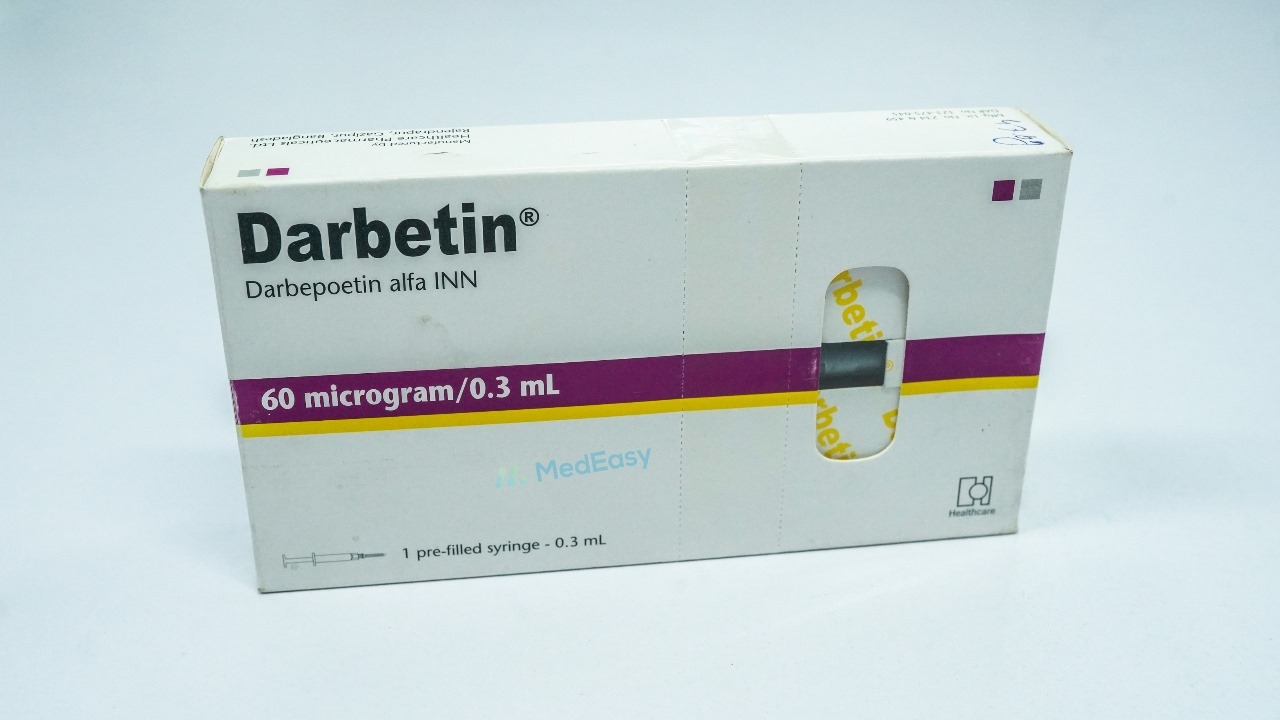
Darbetin60 mcg/0.3
Healthcare Pharmaceuticals Ltd.
৳5230.04
Add to cart


Darbesis is a long-acting, recombinant erythropoiesis-stimulating agent (ESA) indicated for the treatment of anemia in the following FDA-approved, evidence-supported settings:
Darbesis has not been shown to improve quality of life, fatigue, or patient well-being, and its use requires careful evaluation of the risks and benefits described under Precautions and Warnings.
Each pre-filled syringe or single-use vial contains Darbepoetin Alfa as the active ingredient, a hyperglycosylated analogue of recombinant human erythropoietin produced by recombinant DNA technology in mammalian (Chinese hamster ovary) cells.
Available strengths typically include 25, 40, 60, 100, 150, 200, 300, and 500 mcg per vial/syringe as a sterile, preservative-free or preservative-containing solution for injection, formulated with polysorbate 80 or albumin-based stabilizers depending on the formulation.
Darbesis is a synthetic, hyperglycosylated protein that stimulates erythropoiesis (red blood cell production) by the same mechanism as endogenous erythropoietin, but with a longer terminal half-life due to its increased sialic acid content. This allows for less frequent dosing compared to shorter-acting erythropoiesis-stimulating agents.
It is supplied as a clear, colorless, sterile solution for subcutaneous or intravenous injection and is used under medical supervision to manage anemia in chronic kidney disease and chemotherapy-induced anemia.
Darbesis belongs to the therapeutic class of Erythropoiesis-Stimulating Agents (ESAs), a subclass of hematologic/anti-anemic agents.
Darbepoetin Alfa stimulates erythropoiesis by binding to and activating the erythropoietin receptor on erythroid progenitor cells in the bone marrow, promoting their proliferation, differentiation, and maturation into mature red blood cells, thereby increasing hemoglobin and hematocrit levels.
The goal of treatment with Darbesis is to use the lowest dose sufficient to reduce the need for red blood cell transfusions; hemoglobin should not be targeted above 11 g/dL. Doses should be individualized and adjusted based on hemoglobin response, rate of hemoglobin rise, and clinical circumstances, with dose reductions or temporary interruption when hemoglobin approaches or exceeds target levels or rises too rapidly.
| Indication | Typical Starting Dose | Route/Frequency |
|---|---|---|
| CKD on dialysis (adult) | 0.45 mcg/kg | IV or subcutaneous, once weekly; or 0.75 mcg/kg once every 2 weeks |
| CKD not on dialysis (adult) | 0.45 mcg/kg | IV or subcutaneous, once every 4 weeks |
| Chemotherapy-induced anemia (adult) | 2.25 mcg/kg weekly, or 500 mcg | Subcutaneous, weekly or once every 3 weeks |
| Pediatric CKD (on dialysis) | 0.45 mcg/kg | Subcutaneous or IV, once weekly |
Iron status (transferrin saturation and ferritin) should be evaluated before and periodically during treatment; supplemental iron is often needed to support and maintain response (see Interactions). Discontinue if response is not achieved after an appropriate dose escalation, per current hemoglobin targets described under Precautions and Warnings.
Darbesis is administered by subcutaneous or intravenous injection only, by or under the supervision of a qualified healthcare professional, or by a properly trained patient/caregiver for subcutaneous self-injection where appropriate.
Darbesis is a large protein molecule and has minimal potential for classic pharmacokinetic (cytochrome P450-mediated) drug-drug interactions.
No clinically significant interactions with common antihypertensives, anticoagulants, or other routinely co-administered medications have been well established, though blood pressure should be monitored closely as described under Precautions and Warnings.
Darbepoetin Alfa is contraindicated in patients with:
Adverse effects of Darbesis are generally related to increases in hemoglobin/hematocrit and blood pressure, or to injection-related reactions.
Data on the use of Darbesis in human pregnancy are limited. Animal reproduction studies have shown adverse effects (increased post-implantation loss) at maternal exposures approximating recommended human doses. Darbesis should be used during pregnancy only if the potential benefit justifies the potential risk to the fetus, and only under close physician supervision.
It is not known whether Darbesis is excreted in human milk. Because many drugs are excreted in human milk and the effects on a nursing infant are unknown, caution should be exercised, and a decision should be made whether to discontinue nursing or discontinue the drug, taking into account the importance of the drug to the mother. Consult a physician before use during breastfeeding.
Erythropoiesis-stimulating agents, including Darbesis, increase the risk of death, myocardial infarction, stroke, venous thromboembolism, thrombosis of vascular access, and tumor progression or recurrence when administered to target a hemoglobin level greater than 11 g/dL.
Darbesis can cause or worsen hypertension. Blood pressure must be adequately controlled prior to initiation and monitored closely throughout treatment; uncontrolled hypertension is a contraindication (see Contraindications).
Seizures have been reported in patients receiving Darbesis, particularly during the first several months of therapy in CKD patients; monitor for premonitory neurological symptoms.
If a patient develops loss of response, evaluate for neutralizing antibody-mediated pure red cell aplasia and discontinue Darbesis if PRCA is confirmed; do not switch to another ESA.
Evaluate for causes of inadequate response (e.g., iron, vitamin B12, or folate deficiency, infection, inflammation, bleeding, hemolysis, bone marrow fibrosis, underlying disease) before increasing the dose.
Overdosage of Darbesis can cause excessive erythropoietic response with hemoglobin/hematocrit levels above the desired range, which may be associated with serious cardiovascular events including hypertensive crisis. There is no specific antidote.
If overdose is suspected, seek immediate medical attention or contact emergency services/a poison control center. Management includes withholding the drug, close clinical and hemoglobin monitoring, and supportive care (including phlebotomy if clinically indicated) as directed by a physician.
Store refrigerated at 2°C to 8°C (36°F to 46°F). Do not freeze; discard if the product has been frozen. Protect from light by keeping the vial/syringe in its original carton until the time of use. Do not shake; vigorous shaking may damage the protein and reduce its effectiveness. Keep out of reach of children.
Darbesis is specifically indicated for anemia of chronic kidney disease; dosing is individualized to hemoglobin response regardless of dialysis status, as described under Dosage and Administration.
No formal dose adjustment has been established; use with routine hemoglobin monitoring.
No overall differences in safety or effectiveness have been observed between elderly and younger patients, but greater sensitivity in some older individuals cannot be ruled out; use the lowest effective dose with careful monitoring.
See Pediatric Uses.
Duration of treatment with Darbesis depends on the underlying indication:
Do not extend, shorten, or restart therapy without consulting the prescribing physician.
Erythropoiesis-Stimulating Agent (ESA); Recombinant Human Erythropoietin Analogue; Antianemic Agent.
Darbepoetin Alfa acts as an analogue of endogenous erythropoietin. It binds to the erythropoietin receptor on committed erythroid progenitor cells in the bone marrow, triggering intracellular signaling (via the JAK2/STAT5 pathway) that stimulates their proliferation and differentiation into mature erythrocytes, ultimately increasing circulating red blood cell mass and hemoglobin concentration. Its additional sialic acid residues (compared to endogenous erythropoietin and epoetin alfa) reduce receptor-mediated clearance, prolonging its serum half-life and permitting extended dosing intervals.
Darbesis is indicated for the treatment of anemia associated with chronic kidney disease in pediatric patients, with dosing individualized on a weight (mcg/kg) basis and adjusted according to hemoglobin response, similar to adult dosing principles.
Safety and effectiveness of Darbesis for chemotherapy-induced anemia in pediatric patients have not been established. Use in children requires close pediatric specialist supervision, with careful attention to blood pressure and hemoglobin monitoring given the same class-level cardiovascular and thrombotic risks that apply to adults.
Q: What is Darbesis 60 mcg/0.3 ml SC Injection used for?
A: Darbesis 60 mcg/0.3 ml SC Injection is used to treat anemia (low red blood cell count) caused by chronic kidney disease and by certain types of chemotherapy given for non-myeloid cancers. It works by stimulating the bone marrow to produce more red blood cells, reducing the need for blood transfusions.
Q: How is Darbesis 60 mcg/0.3 ml SC Injection given?
A: Darbesis 60 mcg/0.3 ml SC Injection is given as an injection under the skin (subcutaneous) or into a vein (intravenous), usually once weekly, every 2 weeks, or every 4 weeks depending on the condition being treated. It should only be administered by, or under the guidance of, a healthcare professional or a properly trained caregiver.
Q: What are the most serious risks of Darbesis 60 mcg/0.3 ml SC Injection?
A: Darbesis 60 mcg/0.3 ml SC Injection carries a boxed warning because it can increase the risk of death, heart attack, stroke, blood clots, and, in cancer patients, tumor progression or recurrence, especially if the hemoglobin level rises too high. Doctors use the lowest dose needed and monitor hemoglobin and blood pressure closely to reduce this risk.
Q: Can Darbesis 60 mcg/0.3 ml SC Injection be used during pregnancy or breastfeeding?
A: Information on Darbesis 60 mcg/0.3 ml SC Injection use during pregnancy is limited, and animal studies suggest possible risk to the fetus at typical doses. It should be used in pregnancy only if the potential benefit clearly justifies the potential risk, and only under close physician supervision. It is not known whether it passes into breast milk, so a doctor should be consulted before use while breastfeeding.
Q: Why do I need iron supplements while taking Darbesis 60 mcg/0.3 ml SC Injection?
A: Darbesis 60 mcg/0.3 ml SC Injection works by stimulating red blood cell production, which requires adequate iron stores. If iron levels are low, the medicine may not work as well. Your doctor will check your iron status before and during treatment and may prescribe iron supplements to help you respond properly.
Q: What should I do if I miss a dose or suspect an overdose of Darbesis 60 mcg/0.3 ml SC Injection?
A: If you miss a scheduled dose of Darbesis 60 mcg/0.3 ml SC Injection, contact your healthcare provider for guidance rather than doubling the next dose. If an overdose is suspected, seek immediate medical attention or contact emergency services, since excessive doses can push hemoglobin too high and raise the risk of serious cardiovascular complications.
Disclaimer
The information provided is accurate to the best of our knowledge, but it does not replace professional medical advice. We cannot guarantee its completeness or accuracy, and the absence of specific information about a drug should not be taken as an endorsement. We are not responsible for any consequences arising from this information, so please consult a healthcare professional for any concerns or questions.
