
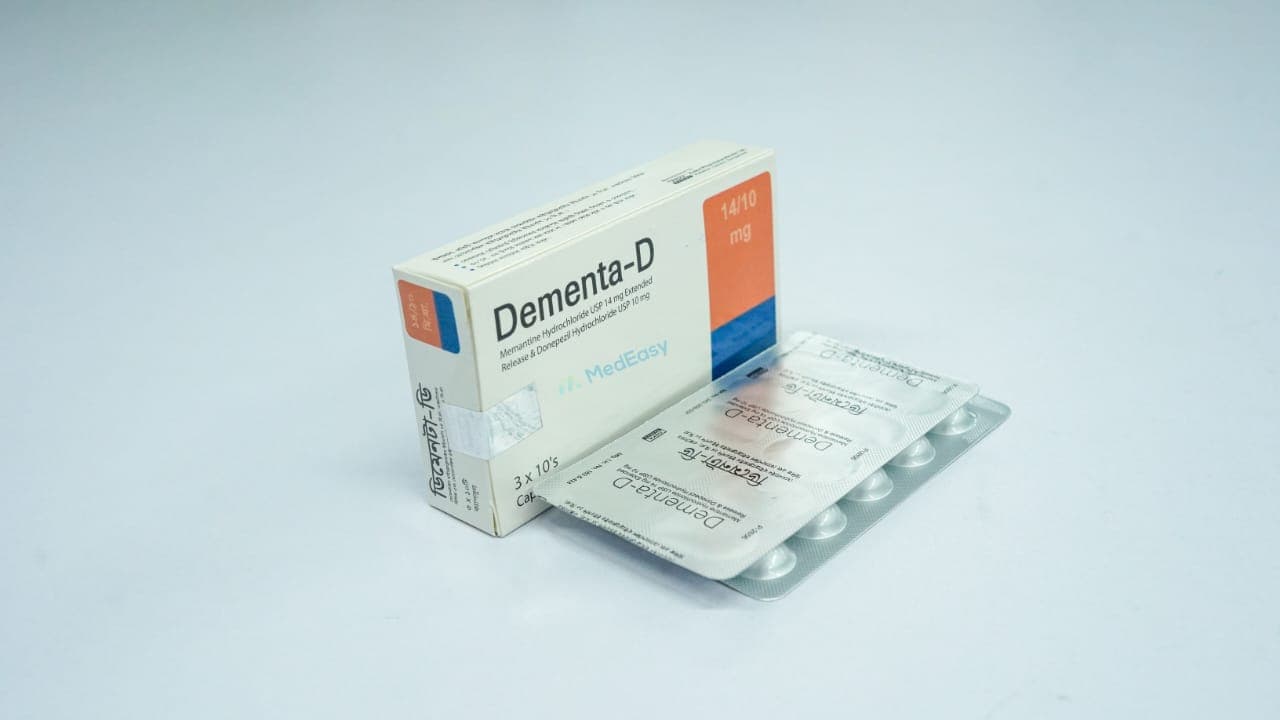

Medicine overview
Indications of Dementa-D
Established / FDA-Approved Use
Dementa-D is a fixed-dose combination indicated for the treatment of moderate to severe dementia of the Alzheimer's type in patients who are already stabilized on both individual components (donepezil 10 mg once daily and memantine at a maintenance dose).
Nature of Treatment
- Dementa-D provides symptomatic benefit (improvement or stabilization of cognition and function) — it does not stop or reverse the underlying neurodegenerative disease process.
- It combines two complementary mechanisms (an NMDA-receptor antagonist and a cholinesterase inhibitor) that are guideline-supported as combination therapy specifically in moderate-to-severe Alzheimer's disease, once a patient has already tolerated and responded to each component separately.
Not indicated for mild Alzheimer's disease, other forms of dementia (e.g., vascular dementia, Lewy body dementia) as a first-line approved use, or for any condition outside Alzheimer's dementia; such uses would be off-label and are not recommended without specialist guidance.
Composition
Memantine + Donepezil is a fixed-dose combination oral capsule containing memantine hydrochloride (as an extended-release component) together with donepezil hydrochloride, formulated so that both active ingredients are released to match the established maintenance dosing of each drug when used separately.
Typical fixed-dose strength combinations pair a memantine extended-release dose (e.g., 14 mg or 28 mg) with a fixed 10 mg dose of donepezil in a single once-daily capsule; exact available strengths should be confirmed on the product label/pack insert.
Description
Dementa-D is a combination anti-dementia medicine that brings together two agents with different, complementary mechanisms of action used in Alzheimer's disease:
- Memantine — a low-to-moderate affinity, uncompetitive N-methyl-D-aspartate (NMDA) receptor antagonist that modulates the effects of pathologically elevated glutamate.
- Donepezil — a reversible, centrally acting acetylcholinesterase inhibitor that increases the availability of acetylcholine at cholinergic synapses.
The fixed-dose combination is intended to simplify the medication regimen for patients with moderate to severe Alzheimer's disease who are already established on both individual medicines, and is a symptomatic — not disease-modifying — treatment.
Therapeutic Class
Dementa-D belongs to the therapeutic class of anti-dementia agents, specifically a fixed-dose combination of an NMDA-receptor antagonist (memantine) and a cholinesterase inhibitor (donepezil).
Pharmacology
Mechanism of Action
Memantine + Donepezil exerts its effect through two distinct, complementary pharmacological pathways relevant to Alzheimer's disease:
- Memantine component: acts as an uncompetitive, moderate-affinity NMDA receptor antagonist. In Alzheimer's disease, chronic low-level activation of NMDA receptors by excess glutamate is thought to contribute to neuronal dysfunction and cell death (excitotoxicity). Memantine blocks this pathological, low-magnitude glutamatergic tone while allowing normal, physiological NMDA-receptor-mediated synaptic transmission (needed for learning and memory) to continue relatively unimpeded.
- Donepezil component: a piperidine-derivative, reversible and specific inhibitor of acetylcholinesterase, the enzyme responsible for breaking down acetylcholine in the synaptic cleft. By inhibiting this enzyme, donepezil increases the concentration and duration of action of acetylcholine at central cholinergic synapses, partially compensating for the cholinergic deficit seen in Alzheimer's disease.
Pharmacokinetics (overview)
- Both components are well absorbed orally; donepezil has an elimination half-life of roughly 70 hours (supporting once-daily dosing) and undergoes hepatic metabolism via CYP2D6/CYP3A4; memantine is largely excreted unchanged renally, with elimination influenced by urinary pH.
- The extended-release formulation of the memantine component is designed to allow once-daily administration matching the once-daily dosing of donepezil.
Dosage & Administration of Dementa-D
Adult Dosing (Moderate to Severe Alzheimer's Disease)
| Situation | Recommended dose of Dementa-D |
|---|---|
| Standard maintenance (normal renal function) | One capsule (memantine extended-release 28 mg / donepezil 10 mg) once daily in the evening, generally at bedtime |
| Severe renal impairment | Reduced-strength capsule (memantine extended-release 14 mg / donepezil 10 mg) once daily — see Use in Special Populations |
Starting Therapy
Dementa-D is intended for patients already stabilized on donepezil 10 mg once daily and on an effective maintenance dose of memantine (individually titrated, typically over several weeks, to minimize NMDA-related side effects). Patients are usually switched to the fixed-dose combination capsule once both individual target doses are reached and tolerated; the fixed-dose product is not generally used to initiate therapy in a treatment-naive patient.
Administration Instructions
- Take by mouth once daily in the evening, with or without food.
- Swallow the capsule whole, or carefully open it and sprinkle the entire contents on a small amount of soft food (e.g., applesauce) and consume immediately without chewing; do not divide, crush, or chew the extended-release pellets.
- If a dose is missed, do not double the next dose — take the next scheduled dose at the usual time, and consult a physician if several doses are missed.
Renal and Hepatic Adjustment
- Severe renal impairment: use the lower-strength combination (memantine 14 mg / donepezil 10 mg); not recommended in end-stage renal disease without close physician supervision.
- Hepatic impairment: use with caution, particularly in moderate-to-severe hepatic impairment, as donepezil clearance may be reduced; dose adjustment should be individualized by the treating physician.
Administration of Dementa-D
Dementa-D should be taken orally, once daily, in the evening, with or without food. The capsule may be swallowed whole or opened and sprinkled on soft food (not chewed or crushed). Do not stop or change the dose without consulting a physician.
Interaction of Dementa-D
Clinically Significant Interactions
| Interacting agent/class | Mechanism | Clinical consequence |
|---|---|---|
| Other NMDA-receptor antagonists (e.g., amantadine, ketamine, dextromethorphan) | Additive NMDA-receptor blockade (memantine component) | Increased risk of CNS adverse effects (confusion, hallucinations); avoid combined use of Dementa-D with these agents. |
| Other cholinesterase inhibitors or cholinergic agonists (e.g., bethanechol) | Additive cholinergic stimulation (donepezil component) | Synergistic/additive cholinergic effects; use with caution. |
| Anticholinergic drugs | Opposing pharmacodynamic effect | May reduce the effectiveness of the donepezil component of Dementa-D. |
| NSAIDs | Additive cholinergic effect on gastric acid secretion | Increased risk of gastrointestinal bleeding/peptic ulceration — see Precautions and Warnings. |
| Succinylcholine and similar neuromuscular blockers | Cholinesterase inhibition (donepezil component) prolongs neuromuscular blockade | Exaggerated muscle relaxation during anesthesia — inform the anesthetist that the patient is taking Dementa-D before any surgery. |
| Strong CYP2D6/CYP3A4 inhibitors or inducers (e.g., ketoconazole, quinidine, rifampicin, carbamazepine, phenytoin) | Altered hepatic metabolism of the donepezil component | May increase or decrease donepezil exposure and its effects/side effects. |
| Carbonic anhydrase inhibitors, sodium bicarbonate, and other agents that alkalinize urine | Reduced renal clearance of the memantine component | Increased memantine plasma levels and risk of adverse effects. |
Contraindications
Memantine + Donepezil is contraindicated in patients with a known hypersensitivity to memantine, donepezil, piperidine derivatives, or any excipient of the formulation.
Side Effects of Dementa-D
Common Side Effects
| System | Effects |
|---|---|
| Gastrointestinal | Nausea, vomiting, diarrhea, decreased appetite, constipation |
| Nervous system | Dizziness, headache, confusion, insomnia, abnormal dreams/nightmares, drowsiness |
| Musculoskeletal | Muscle cramps |
| General | Fatigue, weight change |
Less Common but Serious Side Effects
- Bradycardia, syncope, or other conduction abnormalities (from the donepezil component's vagotonic effect) — see Precautions and Warnings.
- Gastrointestinal bleeding/peptic ulceration, particularly with concurrent NSAID use.
- Seizures (rare).
- Hepatic dysfunction (rare, including reports of liver injury with donepezil).
- Severe skin reactions (rare).
Patients or caregivers should seek prompt medical attention for fainting, very slow or irregular heartbeat, black/tarry stools, or seizures while taking Dementa-D.
Pregnancy & Lactation
Pregnancy
Dementa-D is intended for a patient population (adults with Alzheimer's disease) in whom pregnancy is not typically a clinical consideration; however, if pregnancy occurs or is suspected, this combination should be used only if clearly needed and if the potential benefit justifies the potential risk to the fetus, since adequate, well-controlled human studies are lacking. A physician must be consulted before use in pregnancy.
Lactation
It is not known whether the components of Dementa-D pass into human breast milk in clinically significant amounts. As this medicine is not indicated in women of reproductive/lactating age for its approved use, breastfeeding is not a typical clinical scenario; if it arises, a physician should be consulted to weigh the benefits of treatment against any potential risk to a nursing infant.
Precautions & Warnings
Cardiac Conduction Abnormalities
The donepezil component of Dementa-D has vagotonic (cholinergic) effects on the sinoatrial and atrioventricular nodes, which can cause or worsen bradycardia, syncope, or heart block. Use with caution in patients with sick sinus syndrome or other supraventricular conduction abnormalities, and in those taking other drugs that slow cardiac conduction (e.g., beta-blockers, digoxin).
Gastrointestinal Bleeding Risk
Increased cholinergic activity from the donepezil component can increase gastric acid secretion. Use with caution in patients with a history of active or recurrent peptic ulcer disease, or in those receiving concurrent NSAIDs, due to an increased risk of gastrointestinal bleeding.
Seizure Disorders
Cholinesterase inhibitors such as the donepezil component are thought to have some potential to cause generalized convulsions; use with caution in patients with a history of seizure disorder, as Alzheimer's disease itself can also predispose to seizures.
Respiratory Conditions
The cholinergic effect of the donepezil component may cause bronchoconstriction; use with caution in patients with asthma or chronic obstructive pulmonary disease (COPD).
Anesthesia and Surgery
Because donepezil inhibits cholinesterase, it may exaggerate succinylcholine-type muscle relaxation during anesthesia. Inform the anesthesiology team that the patient is taking Dementa-D before any surgical procedure.
Genitourinary
Although not observed with memantine/donepezil specifically in a well-established manner, cholinergic agents can cause bladder outflow obstruction; use with caution in patients with a predisposition to urinary retention.
Not Disease-Modifying
Dementa-D provides symptomatic treatment only and does not stop, cure, or reverse the underlying progression of Alzheimer's disease.
Overdose Effects of Dementa-D
Overdose with Dementa-D is a medical emergency. Excess donepezil may cause a cholinergic crisis (severe nausea, vomiting, salivation, sweating, bradycardia, hypotension, respiratory depression, muscle weakness, seizures, and collapse), while excess memantine may cause agitation, psychosis, visual hallucinations, drowsiness, or coma.
If an overdose is suspected, seek immediate medical attention or contact emergency services/a poison control center right away. Do not attempt to manage an overdose at home; treatment requires supportive care and monitoring in a medical facility, and may include airway/cardiorespiratory support as directed by a physician.
Storage Conditions
Store at room temperature (below 30°C), away from light and moisture. Keep out of reach of children.
Use In Special Populations
Renal Impairment
In patients with severe renal impairment, the lower-strength combination (memantine 14 mg / donepezil 10 mg) of Dementa-D should be used; it is not recommended in end-stage renal disease without close physician supervision. No dose adjustment is generally required for mild-to-moderate renal impairment.
Hepatic Impairment
Use with caution in patients with hepatic impairment, particularly moderate-to-severe impairment, as clearance of the donepezil component may be reduced; dosing should be individualized.
Elderly
Dementa-D is specifically intended for use in the elderly population with moderate-to-severe Alzheimer's disease, and has been studied predominantly in this age group; standard adult dosing applies unless renal/hepatic adjustment is needed.
Pediatric Use
Not indicated for use in children. Safety and efficacy have not been established in the pediatric population — see Pediatric Uses.
Duration Of Treatment
Treatment with Dementa-D is generally long-term, intended to be continued for as long as it provides symptomatic benefit, as determined by periodic clinical reassessment by the treating physician. Abrupt discontinuation should be avoided without medical advice, as this can lead to a noticeable worsening of cognitive or behavioral symptoms; any decision to stop or switch therapy should be individualized by the physician.
Drug Classes
NMDA-receptor antagonist; Acetylcholinesterase inhibitor; Anti-dementia agent (fixed-dose combination)
Mode Of Action
Memantine + Donepezil works via two complementary mechanisms: the memantine component blocks pathological, low-level overactivation of NMDA-type glutamate receptors implicated in neuronal excitotoxicity in Alzheimer's disease, while the donepezil component reversibly inhibits acetylcholinesterase, increasing synaptic acetylcholine levels to help compensate for the cholinergic deficit characteristic of the disease. Together, these actions provide symptomatic improvement in cognition and function without altering the underlying disease course.
Pediatric Uses
Dementa-D is indicated only for adults with moderate-to-severe Alzheimer's disease. It is not approved for use in children or adolescents, and the safety and efficacy of Dementa-D in the pediatric population have not been established. It should not be used in children.
Frequently Asked Questions
Q: What is Dementa-D 14 mg+10 mg Capsule used for?
A: Dementa-D 14 mg+10 mg Capsule is used to treat moderate to severe dementia of the Alzheimer's type in patients who are already stabilized on both individual medicines; it helps manage symptoms of memory and cognitive decline but does not cure Alzheimer's disease.
Q: Can Dementa-D 14 mg+10 mg Capsule stop Alzheimer's disease from getting worse?
A: No. Dementa-D 14 mg+10 mg Capsule is a symptomatic treatment only — it may help improve or stabilize memory, thinking, and daily functioning for a period of time, but it does not stop, cure, or reverse the underlying progression of Alzheimer's disease.
Q: How should I take Dementa-D 14 mg+10 mg Capsule?
A: Dementa-D 14 mg+10 mg Capsule is usually taken once daily in the evening, with or without food. Swallow the capsule whole, or open it and sprinkle the contents on a small amount of soft food without chewing. Do not change the dose or stop taking it without consulting your physician.
Q: Who should not take Dementa-D 14 mg+10 mg Capsule?
A: Patients with a known hypersensitivity/allergy to memantine, donepezil, piperidine derivatives, or any ingredient of Dementa-D 14 mg+10 mg Capsule should not take it. Physicians will also use caution in patients with certain heart rhythm problems, active stomach ulcers, seizure disorders, asthma/COPD, or severe kidney impairment.
Q: What are the common side effects of Dementa-D 14 mg+10 mg Capsule?
A: Common side effects of Dementa-D 14 mg+10 mg Capsule include nausea, diarrhea, dizziness, headache, confusion, insomnia, and muscle cramps. Seek urgent medical attention for fainting, a very slow or irregular heartbeat, black/tarry stools, or seizures.
Q: Is Dementa-D 14 mg+10 mg Capsule safe during pregnancy or breastfeeding?
A: Dementa-D 14 mg+10 mg Capsule is intended for adults with Alzheimer's disease, a population in which pregnancy/breastfeeding is uncommon. If either situation arises, it should be used only if clearly needed, with the potential benefit weighed against potential risk, and only under a physician's guidance.
Disclaimer
The information provided is accurate to the best of our knowledge, but it does not replace professional medical advice. We cannot guarantee its completeness or accuracy, and the absence of specific information about a drug should not be taken as an endorsement. We are not responsible for any consequences arising from this information, so please consult a healthcare professional for any concerns or questions.
