
10% Off
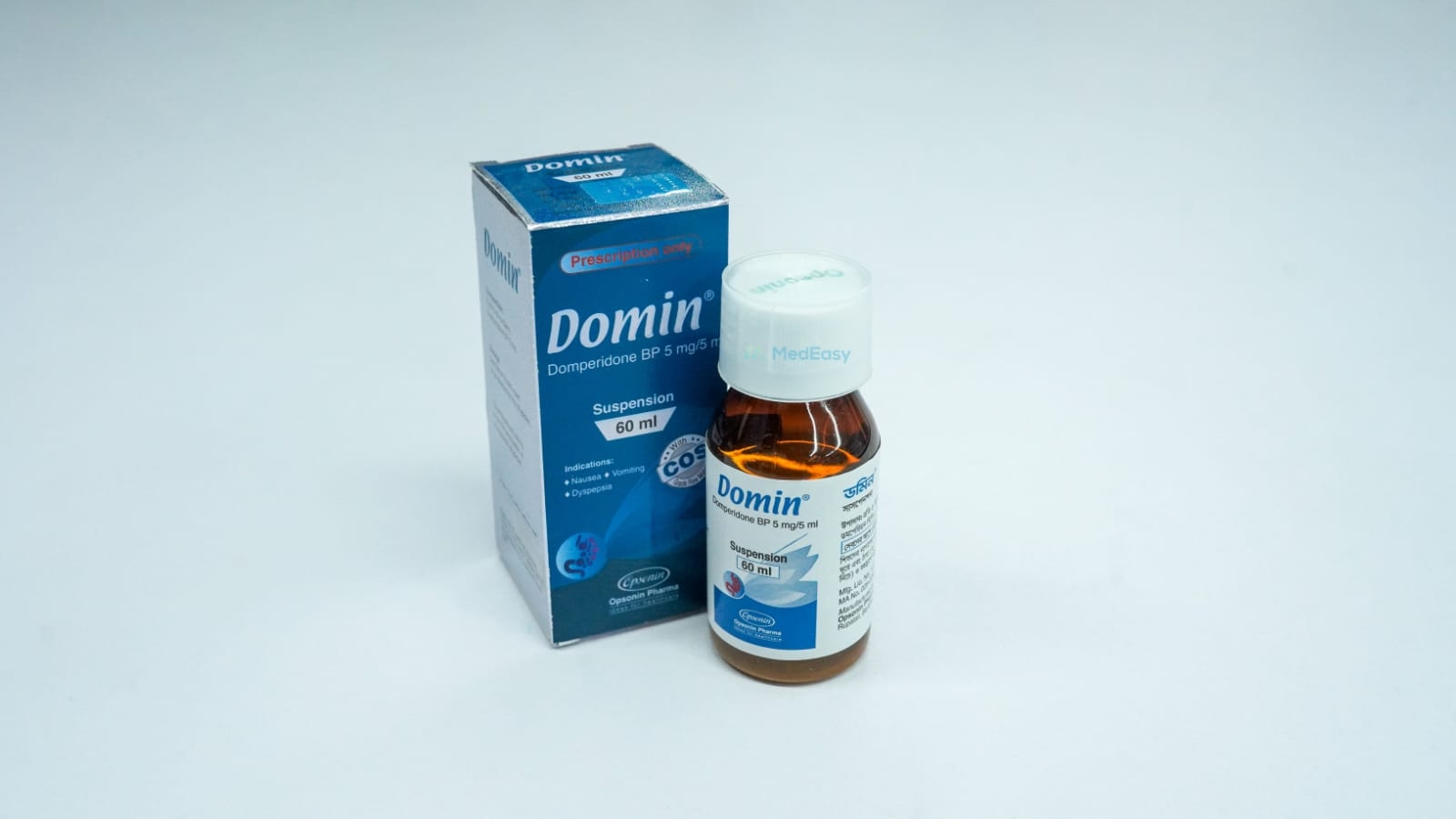
Domin5 mg/5 ml
Opsonin Pharma Ltd.
৳31.50
Add to cart


Domaid is not an antibiotic and has no role in treating infections.
Each film-coated tablet contains Domperidone Maleate equivalent to 10 mg domperidone base. Oral suspension is also available, typically containing domperidone equivalent to 5 mg/5 mL. Strength and available dosage forms (tablet, oral suspension, orodispersible tablet, suppository) vary by manufacturer and market; check the product label for the exact strength.
Domaid is a peripherally-acting dopamine D2-receptor antagonist used to relieve nausea, vomiting, and symptoms associated with delayed gastric emptying (functional dyspepsia). It works mainly outside the central nervous system, at the chemoreceptor trigger zone and on the stomach and upper small intestine, which is why it produces fewer of the movement-related (extrapyramidal) side effects seen with centrally-acting antiemetics such as metoclopramide, when used at recommended doses.
Domaid is widely used in Bangladesh and many other countries as a short-term treatment for nausea, vomiting, bloating, and early fullness after meals, and is available in tablet, orodispersible, and oral suspension formulations.
Domperidone Maleate is a dopamine D2-receptor antagonist that blocks dopamine receptors both in the chemoreceptor trigger zone (an area outside the blood-brain barrier that triggers nausea and vomiting) and in the wall of the stomach and duodenum.
Because Domperidone Maleate has limited ability to cross an intact blood-brain barrier at normal doses, its central nervous system penetration is minimal, resulting in a lower risk of drowsiness and extrapyramidal movement side effects compared with centrally-acting agents; however, it does raise circulating prolactin by blocking D2 receptors in the pituitary gland (outside the blood-brain barrier), and it can affect the heart’s electrical activity (QT interval) as described under Precautions and Warnings.
Domaid should be used at the lowest effective dose for the shortest duration necessary to control symptoms, reflecting current safety guidance on cardiac risk (see Precautions and Warnings). Treatment courses for acute nausea/vomiting or dyspepsia are generally limited to about one week unless a physician determines that continued use is necessary after reassessing the benefit-risk balance.
| Indication | Adult Dose | Pediatric Dose |
|---|---|---|
| Nausea, vomiting, dyspepsia / delayed gastric emptying | 10 mg orally up to three times daily before meals; maximum 30 mg/day. Some markets and formulations allow up to 20 mg three to four times daily (maximum 80 mg/day) under close medical supervision for short courses — follow the prescribing physician’s instructions and local product labeling. | Children ≥12 years and ≥35 kg: same as adult dose. Children <12 years or <35 kg: approximately 0.25–0.4 mg/kg body weight up to three times daily, not exceeding recommended maximum daily weight-based dose; use only under medical supervision (see Pediatric Uses). |
| Nausea/vomiting with dopaminergic anti-Parkinson’s therapy | 10–20 mg up to three times daily as directed by the treating physician, for the shortest period needed. | Not applicable (Parkinson’s disease is not a pediatric condition). |
Tablets and orodispersible tablets/meltabs should be taken 15–30 minutes before meals and, if needed, before bedtime; swallow tablets with water, or allow orodispersible forms to dissolve on the tongue. Oral suspension should be measured with the supplied measuring device. Rectal suppositories (where available) are dosed differently and should be used strictly as directed by the prescriber; injectable domperidone has been withdrawn in many markets because of cardiac safety concerns and should not be used.
Take Domaid by mouth 15–30 minutes before meals (and before bedtime if a fourth dose is prescribed). Swallow tablets whole with water; let orodispersible tablets dissolve on the tongue without chewing; shake oral suspension before measuring the dose with the enclosed measuring cup or syringe. Do not exceed the dose or duration advised by your physician.
Always tell your physician or pharmacist about all prescription drugs, over-the-counter medicines, and herbal products you are taking before starting Domaid.
Domperidone Maleate is contraindicated in the following situations:
Most side effects of Domaid are uncommon at recommended doses. Reported adverse effects include:
Seek prompt medical attention for palpitations, fainting, irregular heartbeat, or any severe or persistent reaction while taking Domaid.
Pregnancy: Data on the use of Domaid in human pregnancy are limited. Animal studies have not shown clear teratogenic effects, but human safety data are insufficient to establish safety with confidence. Domaid should be used during pregnancy only if clearly needed and if the anticipated benefit justifies the potential risk to the fetus; a physician should always be consulted before use in pregnancy.
Lactation: Domperidone passes into breast milk in small amounts (milk concentrations are reported to be substantially lower than maternal plasma levels), but because of the cardiac safety signal associated with Domaid (see Precautions and Warnings), routine use to increase milk supply is not officially recommended. If a physician judges that use during breastfeeding is necessary for approved indications, the lowest effective dose for the shortest time should be used, with monitoring of the mother for cardiac symptoms.
Domaid carries a recognized, dose-related risk of QT-interval prolongation and serious ventricular arrhythmia, including rare reports of sudden cardiac death. This risk is a key reason many regulatory authorities have restricted the approved dose, duration, and route of Domaid in recent years. To minimize this risk:
Symptoms of Domaid overdose may include drowsiness, disorientation, and extrapyramidal reactions (abnormal, involuntary muscle movements), particularly in children; cardiac effects such as QT prolongation and arrhythmia are also a concern in overdose, given the drug’s known cardiac safety signal.
If an overdose of Domaid is suspected, seek immediate medical attention or contact emergency services / a poison control center. Do not attempt to manage a suspected overdose at home. Management is supportive and should be carried out in a medical facility, which may include close cardiac monitoring, gastric decontamination measures (e.g., activated charcoal) if appropriate and administered promptly by trained personnel, and treatment of extrapyramidal symptoms if they occur; there is no specific antidote.
Store at room temperature (below 30°C), away from light and moisture. Keep out of reach of children.
Domaid should generally be used for the shortest period needed to control symptoms, typically up to about one week for acute nausea, vomiting, or dyspepsia. Longer courses (used historically for chronic dyspepsia or Parkinson’s-related nausea) should only continue if a physician has reassessed the benefit-risk balance, particularly the cardiac risk described under Precautions and Warnings, and determined that continued treatment is warranted; periodic medical review is recommended for any extended use.
Antiemetics; Gastroprokinetic agents; Peripherally-acting dopamine D2-receptor antagonists.
Domperidone Maleate blocks dopamine D2 receptors at the chemoreceptor trigger zone (reducing nausea and vomiting) and in the stomach and duodenal wall (increasing gastric and duodenal motility and lower esophageal sphincter tone, and accelerating gastric emptying). Because it penetrates the intact blood-brain barrier only minimally at normal doses, its effects are largely confined to the periphery, giving it an antiemetic/prokinetic profile with fewer central movement-related side effects than older, centrally-acting dopamine antagonists, at the cost of a recognized cardiac (QT-prolongation) risk that must be actively managed (see Precautions and Warnings).
Domaid may be used in children for nausea, vomiting, and dyspeptic symptoms, but only under medical supervision and at carefully calculated, weight-based doses (see Dosage and Administration), because:
Safety and efficacy of Domaid for indications and durations outside those specifically studied and labeled in children have not been established; use in children should always follow a physician’s explicit direction rather than self-medication.
Q: What is Domaid 5 mg/5 ml Oral Suspension used for?
A: Domaid 5 mg/5 ml Oral Suspension is used to relieve nausea, vomiting, and symptoms of delayed gastric emptying such as bloating, early fullness, and upper abdominal discomfort. It is also used, under medical supervision, to control nausea caused by dopamine-agonist medicines used in Parkinson’s disease.
Q: How should I take Domaid 5 mg/5 ml Oral Suspension?
A: Take Domaid 5 mg/5 ml Oral Suspension exactly as prescribed, usually 15–30 minutes before meals and, if directed, before bedtime. Do not exceed the dose or duration recommended by your physician — current safety guidance recommends using the lowest effective dose for the shortest time needed, generally not more than about a week for acute symptoms unless your doctor advises otherwise.
Q: Is Domaid 5 mg/5 ml Oral Suspension safe for the heart?
A: Domaid 5 mg/5 ml Oral Suspension carries a recognized risk of QT-interval prolongation and, rarely, serious irregular heart rhythms, especially at higher doses, in people over 60, and in those with existing heart disease, electrolyte imbalances, or who take certain interacting medicines. Tell your doctor about any heart problems or other medicines you take before starting Domaid 5 mg/5 ml Oral Suspension, and seek urgent medical care if you develop palpitations, dizziness, or fainting while taking it.
Q: Can Domaid 5 mg/5 ml Oral Suspension be used during pregnancy or breastfeeding?
A: Data on Domaid 5 mg/5 ml Oral Suspension in human pregnancy are limited, so it should be used in pregnancy only if clearly needed and your doctor believes the benefit outweighs the potential risk to the baby. Small amounts pass into breast milk; because of the cardiac safety signal associated with Domaid 5 mg/5 ml Oral Suspension, it is not routinely recommended simply to increase milk supply, and any use while breastfeeding should be directed by a physician.
Q: Who should not take Domaid 5 mg/5 ml Oral Suspension?
A: Domaid 5 mg/5 ml Oral Suspension should not be used by people with a known allergy to domperidone, a prolactin-secreting pituitary tumor, gastrointestinal bleeding, obstruction, or perforation, moderate-to-severe liver impairment, significant heart disease or electrolyte disturbances, or by anyone taking QT-prolonging medicines or potent CYP3A4 inhibitors. It is also contraindicated in newborn infants. See the Contraindications section for the full list.
Q: What should I do if I take too much Domaid 5 mg/5 ml Oral Suspension?
A: If you or someone else may have taken too much Domaid 5 mg/5 ml Oral Suspension, seek immediate medical attention or contact emergency services or a poison control center right away. Do not try to treat a suspected overdose at home, as it can cause drowsiness, abnormal movements, and heart rhythm problems that need medical monitoring.
Disclaimer
The information provided is accurate to the best of our knowledge, but it does not replace professional medical advice. We cannot guarantee its completeness or accuracy, and the absence of specific information about a drug should not be taken as an endorsement. We are not responsible for any consequences arising from this information, so please consult a healthcare professional for any concerns or questions.

