
8% Off
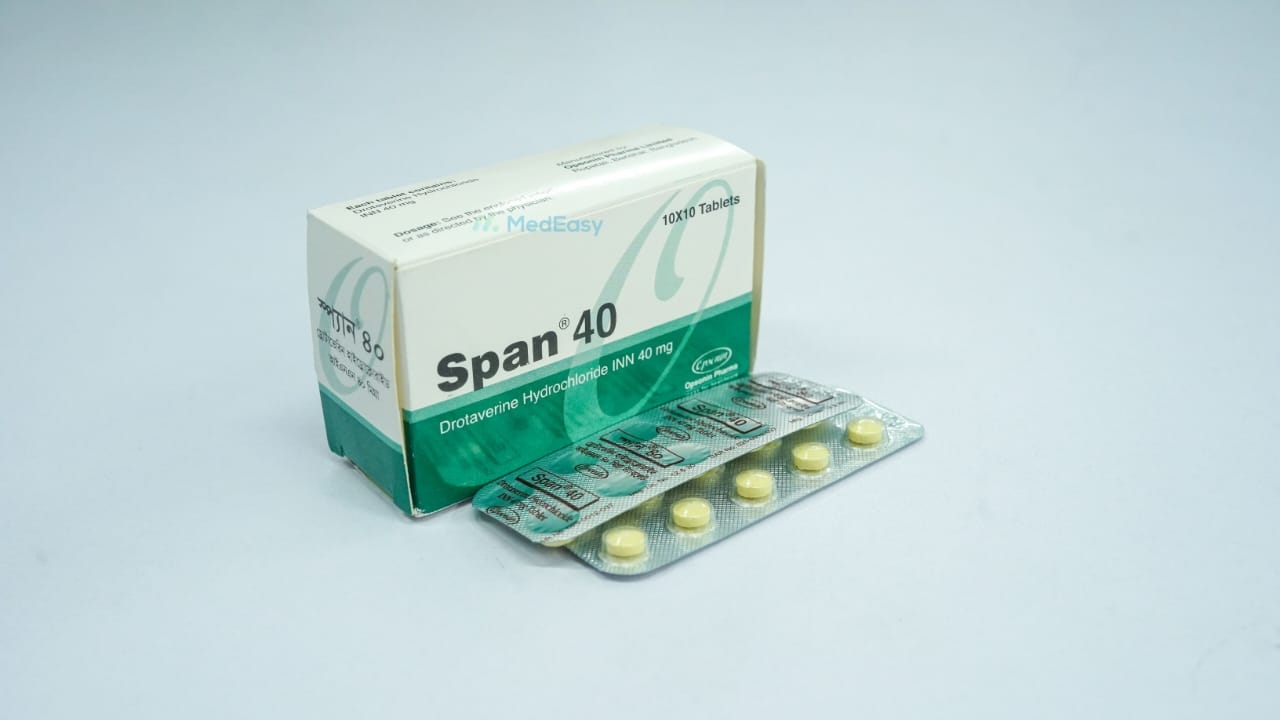
Span40 mg
Opsonin Pharma Ltd.
৳1.62
Add to cart


Dot is indicated for the symptomatic relief of smooth muscle spasm. Evidence and regulatory support vary by indication:
Dot relieves spasm-related pain symptomatically but does not treat the underlying cause; a physician should evaluate persistent, severe, or atypical pain.
Each tablet contains Drotaverine Hydrochloride INN 40 mg or 80 mg. Drotaverine is also available as an injectable solution containing Drotaverine Hydrochloride 40 mg/2 mL ampoule for intramuscular or intravenous use, as per locally marketed formulations.
Dot is a musculotropic antispasmodic agent chemically related to papaverine. Unlike anticholinergic antispasmodics, Dot acts directly on smooth muscle to relieve spasm without significant effects on the autonomic nervous system, resulting in a favorable side-effect profile with fewer anticholinergic effects (such as dry mouth or blurred vision).
Dot is widely used across South Asia, Eastern Europe, and the Middle East for the symptomatic management of smooth muscle spasm affecting the gastrointestinal, urinary, and gynecological/obstetric systems.
Dot belongs to the antispasmodic drug class, specifically classified as a musculotropic (direct-acting) smooth muscle relaxant and a selective phosphodiesterase-4 (PDE4) inhibitor. It is chemically an isoquinoline derivative related to papaverine.
Drotaverine exerts its antispasmodic effect by selectively inhibiting phosphodiesterase-4 (PDE4), the enzyme responsible for breaking down cyclic adenosine monophosphate (cAMP) in smooth muscle cells. Inhibition of PDE4 by Drotaverine leads to increased intracellular cAMP concentration, which in turn reduces intracellular calcium levels and produces relaxation of smooth muscle in the gastrointestinal, biliary, urinary, and uterine tracts.
Unlike atropine-like antispasmodics, Drotaverine does not significantly affect autonomic (cholinergic) nerve transmission, so it produces smooth muscle relaxation without prominent anticholinergic side effects.
Dosing of Dot should be individualized based on indication, severity of symptoms, and route of administration.
| Indication | Adult Dose | Route |
|---|---|---|
| GI spasm, biliary colic, IBS-related spasm | 40-80 mg, 2-3 times daily (max 240 mg/day) | Oral |
| Renal colic (acute) | 40-80 mg | Slow IV or IM injection, may repeat as directed by physician |
| Dysmenorrhea | 40-80 mg, 1-3 times daily as needed during symptomatic days | Oral |
| Adjunct in labor (cervical dilation) | As determined by attending obstetrician; not standardized | Oral or IM, under direct medical supervision only |
Pediatric dose: See Use in Special Populations.
Renal/hepatic impairment: Use with caution and at the lower end of the dosing range in patients with hepatic or renal impairment; avoid in severe hepatic, renal, or cardiac failure (see Contraindications).
Dot tablets may be taken with or without food, swallowed whole with water. The injectable form of Dot should be administered by a healthcare professional via slow intravenous or intramuscular injection; rapid IV administration should be avoided as it may cause hypotension and collapse.
Dot has the following clinically significant drug interactions:
Drotaverine is contraindicated in:
Dot is generally well tolerated at recommended doses. Reported side effects include:
Dot should be used during pregnancy only if clearly needed and if the potential benefit justifies the potential risk to the fetus; consult a physician before use. In some regional obstetric practices, Dot is used during labor under direct medical supervision to facilitate cervical dilation; however, the quality of supporting evidence for this specific use is debated, and it is not universally endorsed by all regulatory bodies. Dot should not be used during early pregnancy without medical advice.
Limited data exist on the excretion of Dot in breast milk; use during breastfeeding should be avoided unless a physician determines the benefit outweighs the potential risk to the infant.
Use Dot with caution in patients with hypotension or cardiovascular instability, as its smooth-muscle-relaxant action may lower blood pressure further (see Contraindications for severe cases). Dot provides symptomatic relief of spasm-related pain and is not a substitute for definitive diagnosis or treatment of the underlying cause; patients with severe, persistent, or atypical abdominal or pelvic pain should seek prompt medical evaluation. Use caution when driving or operating machinery until individual response to Dot is known, as dizziness may occur.
Overdose of Dot may cause pronounced hypotension, cardiac conduction disturbances (including AV block), and arrhythmia. If overdose of Dot is suspected, seek immediate medical attention or contact a poison control center/emergency services. Treatment is supportive and symptomatic, to be managed by medical professionals; no specific antidote is available.
Store Dot at room temperature (below 30°C), protected from light and moisture. Keep out of reach of children.
Renal/Hepatic impairment: Use Dot with caution and at reduced doses in mild-to-moderate impairment; avoid in severe hepatic, renal, or cardiac failure (see Contraindications).
Elderly: No specific dose adjustment is generally required, but use with caution given potential for hypotension and cardiovascular comorbidities.
Pediatric: See Pediatric Uses.
Pregnancy/Lactation: See Pregnancy and Lactation.
Dot is generally used for short-term symptomatic relief of acute smooth muscle spasm. Treatment duration should be guided by symptom resolution and a physician's advice; if symptoms persist beyond a few days or worsen, medical review is required to identify and treat the underlying cause.
Antispasmodics; Musculotropic smooth muscle relaxants; Phosphodiesterase-4 (PDE4) inhibitors
Drotaverine selectively inhibits phosphodiesterase-4 (PDE4), increasing intracellular cAMP and reducing intracellular calcium in smooth muscle cells, thereby producing direct relaxation of gastrointestinal, biliary, urinary, and uterine smooth muscle without significant anticholinergic activity.
The safety and efficacy of Dot in children have not been as extensively established as in adults, and use in young children (particularly under 6 years) is generally not recommended without specific pediatric labeling or physician guidance. Where Dot is used in children (typically above 6 years) for indications such as abdominal spasm, lower weight-based doses are used under strict medical supervision. Parents/caregivers should consult a pediatrician before giving Dot to a child.
Q: What is Dot 40 mg Tablet used for?
A: Dot 40 mg Tablet is used to relieve pain caused by smooth muscle spasm, such as gastrointestinal spasm, biliary colic, renal colic, and painful menstrual cramps (dysmenorrhea). It is also used in some regions as an adjunct during labor, under medical supervision.
Q: Can I take Dot 40 mg Tablet during pregnancy?
A: Dot 40 mg Tablet should only be used during pregnancy if clearly needed and a physician determines that the potential benefit outweighs the potential risk to the fetus. While Dot 40 mg Tablet is used in some obstetric practices during labor, this use is debated and not universally endorsed, so it should never be self-administered during pregnancy without medical advice.
Q: What are the common side effects of Dot 40 mg Tablet?
A: Common side effects of Dot 40 mg Tablet include dizziness, low blood pressure (hypotension), headache, palpitations, and mild gastrointestinal upset such as nausea or constipation. These are usually mild and resolve without stopping treatment, but you should tell your doctor if they persist or worsen.
Q: Who should not take Dot 40 mg Tablet?
A: Dot 40 mg Tablet should not be taken by people who are hypersensitive to it, or who have severe liver failure, severe kidney failure, severe heart failure, or low blood pressure (hypotension). Tell your doctor about your full medical history before starting Dot 40 mg Tablet.
Q: Does Dot 40 mg Tablet interact with other medicines?
A: Yes. Dot 40 mg Tablet may reduce the effectiveness of levodopa (used for Parkinson's disease) and can worsen tremor or stiffness. It may also add to the blood-pressure-lowering effect of antihypertensive medicines. Always tell your doctor or pharmacist about all medicines you are taking before starting Dot 40 mg Tablet.
Q: What should I do if I miss a dose or take too much Dot 40 mg Tablet?
A: If you miss a dose of Dot 40 mg Tablet, take it as soon as you remember unless it is close to the next dose. If you suspect an overdose of Dot 40 mg Tablet, which can cause severe low blood pressure or heart rhythm problems, seek immediate medical attention or contact a poison control center.
Disclaimer
The information provided is accurate to the best of our knowledge, but it does not replace professional medical advice. We cannot guarantee its completeness or accuracy, and the absence of specific information about a drug should not be taken as an endorsement. We are not responsible for any consequences arising from this information, so please consult a healthcare professional for any concerns or questions.

