
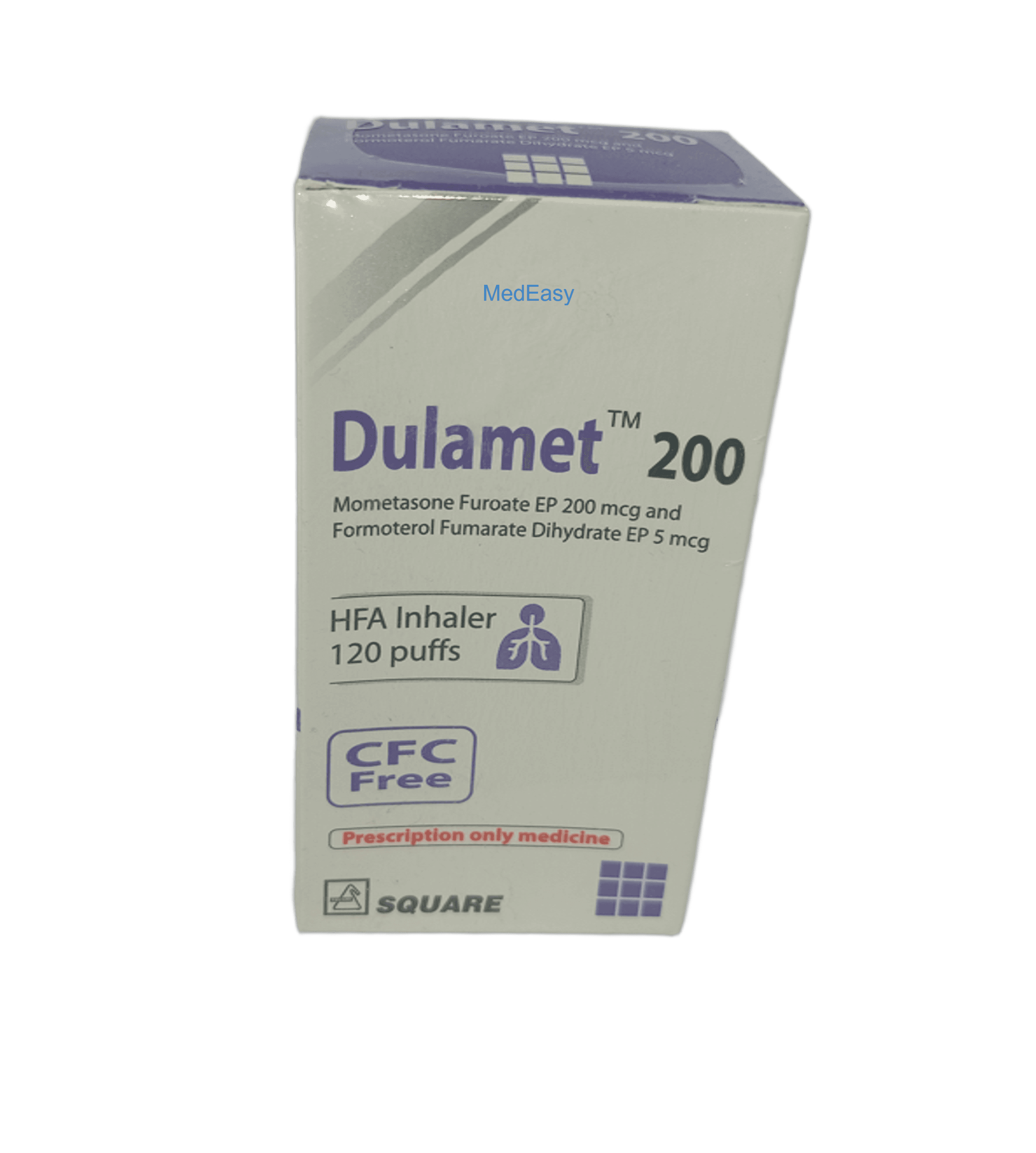
Dulamet(200 mcg+5 mcg)/puff

Medicine overview
Indications of Dulamet
Dulamet is indicated for:
FDA-approved indication
- Maintenance treatment of asthma in patients 5 years of age and older whose asthma is not adequately controlled on an inhaled corticosteroid alone, or whose disease severity clearly warrants initiation of treatment with both an inhaled corticosteroid and a long-acting beta2-agonist (LABA).
Guideline-supported / regionally approved use
- In some countries (including Bangladesh), fixed-dose ICS/LABA combinations such as Dulamet are also used as maintenance bronchodilator therapy in chronic obstructive pulmonary disease (COPD), per local regulatory labeling; confirm the approved indication on the local product label before use.
Important: Dulamet is not indicated for relief of acute bronchospasm or status asthmaticus and must not be used as a rescue inhaler; a separate short-acting bronchodilator should always be available for acute symptoms.
Composition
Each actuation of the Mometasone Furoate + Formoterol Fumarate pressurized inhalation aerosol delivers a fixed-dose combination of mometasone furoate (an inhaled corticosteroid) and formoterol fumarate dihydrate (a long-acting beta2-adrenergic agonist, LABA). It is commonly available in strengths such as 100 mcg/5 mcg and 200 mcg/5 mcg per actuation, delivered via a metered-dose inhaler (MDI) device.
Description
Dulamet is a fixed-dose combination inhaler containing an inhaled corticosteroid (ICS) and a long-acting beta2-agonist (LABA), used for long-term, twice-daily maintenance treatment of asthma. It combines the anti-inflammatory action of mometasone furoate with the bronchodilator action of formoterol fumarate to improve lung function and reduce asthma exacerbations. It is not a rescue inhaler and does not relieve sudden asthma attacks.
Therapeutic Class
Dulamet belongs to the therapeutic class of fixed-dose combination inhaled corticosteroid (ICS) + long-acting beta2-agonist (LABA) bronchodilators used in the maintenance management of asthma.
Pharmacology
Pharmacodynamics
Mometasone Furoate + Formoterol Fumarate combines an inhaled corticosteroid and a long-acting beta2-agonist to provide both anti-inflammatory control and sustained bronchodilation; see Mode of Action for mechanistic detail.
Pharmacokinetics
Following inhalation, the mometasone furoate component of Mometasone Furoate + Formoterol Fumarate is largely deposited in the lungs, and the swallowed portion undergoes extensive first-pass hepatic metabolism (via CYP3A4) with low systemic bioavailability. The formoterol fumarate component is absorbed from the lung and gut, metabolized mainly by direct glucuronidation and by O-demethylation via CYP2D6 and CYP2C19, and eliminated primarily in urine and feces as metabolites and unchanged drug.
Dosage & Administration of Dulamet
Adult and pediatric dosing (asthma)
| Population | Recommended dose |
|---|---|
| Adults and adolescents 12 years and older | 2 inhalations of Dulamet (100 mcg/5 mcg or 200 mcg/5 mcg strength, based on prior asthma therapy and severity) twice daily, morning and evening, approximately 12 hours apart. Maximum recommended dose: 2 inhalations of the 200 mcg/5 mcg strength twice daily. |
| Children 5 to 11 years | 2 inhalations of the lower (100 mcg/5 mcg) strength of Dulamet twice daily; the higher strength is not established as safe/effective in this age group. |
Dose selection
The starting strength of Dulamet is chosen based on the patient's current asthma controller therapy and disease severity; the dose should be titrated to the lowest effective strength once control is achieved, with periodic re-evaluation. Once-daily use or use as a rescue inhaler is not appropriate.
Renal/hepatic impairment
No dedicated dose adjustment of Dulamet has been established for renal or hepatic impairment; use with caution and clinical monitoring, particularly in hepatic impairment where systemic corticosteroid exposure may be increased.
Administration of Dulamet
Dulamet is administered by oral inhalation using the supplied metered-dose inhaler only. Shake the inhaler well before each use, prime it before first use or if not used for more than 5 days, and rinse the mouth with water (without swallowing) after each dose to reduce the risk of oral candidiasis and hoarseness. Do not exceed the prescribed number of inhalations, and do not use this inhaler to treat sudden breathing problems.
Interaction of Dulamet
Dulamet has the following clinically significant drug interactions:
- Strong CYP3A4 inhibitors (e.g. ketoconazole, itraconazole, ritonavir, clarithromycin): may increase systemic exposure to the mometasone component of Dulamet, raising the risk of systemic corticosteroid effects including adrenal suppression; concurrent use should be avoided or monitored closely.
- Other long-acting beta2-agonists (LABAs): should not be used concurrently with Dulamet because of additive beta-agonist adverse effects (e.g. tachycardia, tremor).
- Beta-blockers (including ophthalmic): may block the bronchodilator effect of the formoterol component and can produce severe bronchospasm; use only if no alternative is available.
- Monoamine oxidase inhibitors, tricyclic antidepressants, and drugs that prolong the QTc interval: may potentiate the cardiovascular effects of formoterol; use with caution.
- Non-potassium-sparing diuretics (e.g. loop or thiazide diuretics): may worsen ECG changes and/or hypokalemia associated with beta-agonists; monitor potassium levels.
Contraindications
Mometasone Furoate + Formoterol Fumarate is contraindicated in:
- Known hypersensitivity to mometasone furoate, formoterol fumarate, or any excipient of the formulation.
- Primary treatment of status asthmaticus or other acute episodes of asthma requiring intensive intervention; this product is not a rescue inhaler.
Side Effects of Dulamet
Common side effects of Dulamet include:
- Nasopharyngitis, headache, and upper respiratory tract infection
- Oral candidiasis (thrush) and hoarseness/dysphonia
- Sinusitis and throat irritation
- Back pain and musculoskeletal pain
- Palpitations, tremor, and nervousness (beta-agonist effects)
Less common but serious effects can include paradoxical bronchospasm, hypersensitivity reactions, immunosuppression with increased infection risk, adrenal suppression/hypercorticism, cardiovascular effects (increased heart rate, blood pressure changes, arrhythmia), hypokalemia, hyperglycemia, reduced bone mineral density with long-term use, and effects on growth in children (see Precautions and Warnings, and Use in Special Populations).
Pregnancy & Lactation
Pregnancy: Data on the use of Dulamet in pregnant women are limited. As with other asthma medications, uncontrolled asthma poses risks to both mother and fetus, so Dulamet should be used during pregnancy only if the potential benefit justifies the potential risk to the fetus, and only under a physician's guidance.
Lactation: It is not known whether the components of Dulamet are excreted in human milk in clinically significant amounts. Caution should be exercised, and a physician should be consulted, when considering use of Dulamet in a breastfeeding woman.
Precautions & Warnings
Boxed warning: LABA-associated risk
Long-acting beta2-agonists (LABA) such as the formoterol component of Dulamet may increase the risk of asthma-related death. Available data show that this risk is reduced when a LABA is used in a fixed-dose combination with an inhaled corticosteroid, as in Dulamet, compared with LABA monotherapy; however, this product should be used only in patients whose asthma is not adequately controlled on an inhaled corticosteroid alone or whose severity clearly warrants combination therapy.
Not for acute symptoms
Dulamet is not a rescue inhaler and must not be used to treat acute bronchospasm; patients should have a separate fast-acting bronchodilator available at all times.
Local and systemic corticosteroid effects
Use of Dulamet can cause oropharyngeal candidiasis (rinse mouth after each use), increased susceptibility to infections (chickenpox, measles) especially in unvaccinated or immunosuppressed individuals, and, with prolonged use, hypothalamic-pituitary-adrenal (HPA) axis suppression, reduced bone mineral density, and effects on growth velocity in children.
Cardiovascular caution
The formoterol component of Dulamet can produce clinically significant cardiovascular effects (increased heart rate, blood pressure, ECG changes) in some patients; use with caution in patients with cardiovascular disease, convulsive disorders, thyrotoxicosis, or diabetes mellitus.
Do not stop abruptly
Dulamet should not be stopped abruptly without medical advice, even if symptoms improve, as this may worsen asthma control.
Overdose Effects of Dulamet
Overdose of Dulamet is likely to produce exaggerated beta-agonist effects (from the formoterol component), such as tachycardia, tremor, headache, nervousness, palpitations, nausea, dizziness, fatigue, insomnia, hypokalemia, hyperglycemia, and metabolic acidosis; seizures and cardiac arrhythmias may occur in severe cases. There is no specific antidote. Anyone who has taken more than the prescribed dose of Dulamet should seek immediate medical attention or contact a poison control center/emergency services; cardiac and electrolyte monitoring is recommended, and supportive care should be provided under medical supervision.
Storage Conditions
Store the Dulamet inhaler at room temperature (below 30°C), away from direct sunlight, heat, and moisture. Do not puncture, break, or throw the pressurized canister into a fire or incinerator, even when apparently empty. Keep out of reach and sight of children.
Use In Special Populations
Pediatric
Safety and efficacy of Dulamet have been established for the lower approved strength in children 5 years and older; the higher strength is approved only from 12 years of age. See Pediatric Uses.
Geriatric
Clinical studies of Dulamet have not identified differences in response between elderly and younger patients; use with the usual caution given the increased likelihood of comorbid cardiovascular disease.
Hepatic/renal impairment
No specific dose adjustment of Dulamet has been established; use with caution and monitoring, particularly in significant hepatic impairment.
Immunosuppressed patients
Because of the corticosteroid component, Dulamet should be used with particular caution in patients with active or quiescent tuberculosis, untreated fungal/bacterial/viral/parasitic infections, or ocular herpes simplex.
Duration Of Treatment
Dulamet is intended for long-term, regular maintenance use, not intermittent or short-course therapy. Treatment duration should be determined by a physician based on asthma control, with periodic reassessment (e.g. every 3-6 months) to step down to the lowest effective dose or step up therapy if control is inadequate; abrupt discontinuation should be avoided.
Drug Classes
Mometasone Furoate + Formoterol Fumarate is classified as an Inhaled Corticosteroid (ICS) + Long-Acting Beta2-Adrenergic Agonist (LABA) fixed-dose combination respiratory/anti-asthmatic agent.
Mode Of Action
Mometasone Furoate + Formoterol Fumarate works through two complementary mechanisms. Mometasone furoate is a synthetic corticosteroid with potent local anti-inflammatory activity; it binds to glucocorticoid receptors in airway tissue, reducing production of pro-inflammatory mediators, cytokines, and inflammatory cell infiltration, thereby decreasing airway hyperresponsiveness and mucosal edema. Formoterol fumarate is a long-acting, selective beta2-adrenergic receptor agonist; it stimulates intracellular adenylate cyclase, increasing cyclic AMP and producing relaxation of bronchial smooth muscle, with an onset of bronchodilation within minutes and a duration of effect of approximately 12 hours.
Pregnancy
C (legacy FDA pregnancy category)
Pediatric Uses
Safety and efficacy of Dulamet (100 mcg/5 mcg strength) have been established in children 5 years of age and older for maintenance treatment of asthma; the 200 mcg/5 mcg strength is approved only for patients 12 years of age and older. Safety and efficacy in children younger than 5 years have not been established. Long-term use of inhaled corticosteroid-containing products such as Dulamet may cause a small reduction in growth velocity in children; growth should be monitored routinely, and the lowest effective dose should be used.
Frequently Asked Questions
Q: What is Dulamet (200 mcg+5 mcg)/puff Inhaler used for?
A: Dulamet (200 mcg+5 mcg)/puff Inhaler is used for the regular, twice-daily maintenance treatment of asthma in patients 5 years of age and older who need both an inhaled corticosteroid and a long-acting bronchodilator to control their symptoms; in some countries it is also used as maintenance therapy for COPD per local labeling.
Q: Can I use Dulamet (200 mcg+5 mcg)/puff Inhaler to stop a sudden asthma attack?
A: No. Dulamet (200 mcg+5 mcg)/puff Inhaler is not a rescue inhaler and does not work fast enough to relieve sudden breathing difficulty. You should always carry a separate fast-acting (rescue) bronchodilator inhaler for acute symptoms.
Q: What are the most common side effects of Dulamet (200 mcg+5 mcg)/puff Inhaler?
A: The most common side effects of Dulamet (200 mcg+5 mcg)/puff Inhaler include headache, throat irritation, sinus infection, oral thrush, and hoarseness. Rinsing your mouth with water after each dose and not swallowing it can reduce the risk of thrush and hoarseness.
Q: Is Dulamet (200 mcg+5 mcg)/puff Inhaler safe during pregnancy?
A: Dulamet (200 mcg+5 mcg)/puff Inhaler should be used during pregnancy only if clearly needed and if the potential benefit to the mother justifies the potential risk to the fetus; uncontrolled asthma itself can be harmful in pregnancy, so you should never stop this medicine without first consulting your physician.
Q: Can Dulamet (200 mcg+5 mcg)/puff Inhaler increase the risk of death from asthma?
A: Long-acting beta-agonists, one of the two components of Dulamet (200 mcg+5 mcg)/puff Inhaler, carry a boxed warning for a possible increased risk of asthma-related death when used alone; this risk appears lower when combined with an inhaled corticosteroid as in this product, but Dulamet (200 mcg+5 mcg)/puff Inhaler should still only be used exactly as prescribed by your physician.
Q: What happens if I miss or double a dose of Dulamet (200 mcg+5 mcg)/puff Inhaler?
A: If you miss a dose of Dulamet (200 mcg+5 mcg)/puff Inhaler, take it as soon as you remember, then continue your regular twice-daily schedule; do not take a double dose to make up for a missed one, and contact your physician if you have missed several doses or your asthma symptoms worsen.
Disclaimer
The information provided is accurate to the best of our knowledge, but it does not replace professional medical advice. We cannot guarantee its completeness or accuracy, and the absence of specific information about a drug should not be taken as an endorsement. We are not responsible for any consequences arising from this information, so please consult a healthcare professional for any concerns or questions.
