
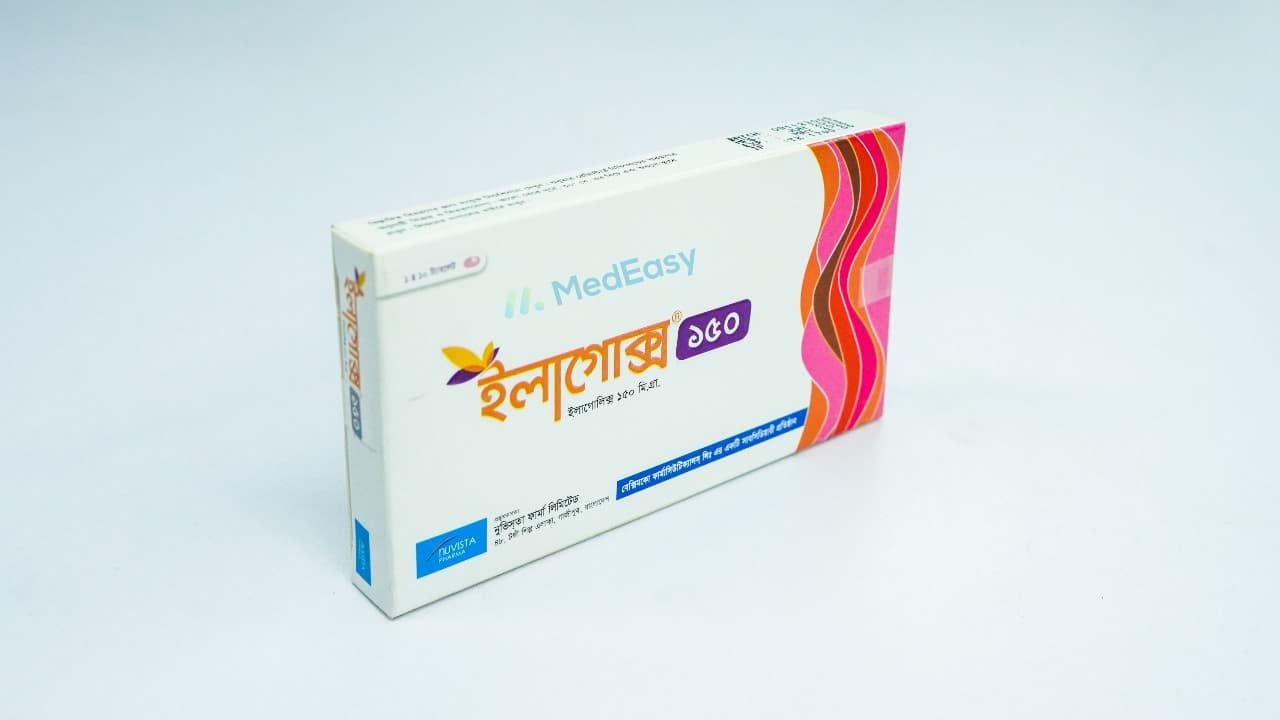

Medicine overview
Indications of Elagox
Elagox is an oral gonadotropin-releasing hormone (GnRH) antagonist indicated for the following use:
- FDA-approved/established use: Management of moderate to severe pain associated with endometriosis in adult women of reproductive age.
Elagox is not approved or indicated for use in men, in pediatric patients, as a contraceptive, or for any condition other than endometriosis-associated pain.
Composition
Each film-coated tablet contains Elagolix (as elagolix) 150 mg or 200 mg, along with pharmaceutically acceptable excipients.
Description
Elagox is an orally active, non-peptide, small-molecule gonadotropin-releasing hormone (GnRH) receptor antagonist developed for the medical management of endometriosis-related pelvic pain. It works by suppressing ovarian estrogen production in a dose-dependent manner, reducing the hormonal stimulation that drives endometriosis-associated pain.
Therapeutic Class
Elagox belongs to the therapeutic class of Gonadotropin-Releasing Hormone (GnRH) receptor antagonists, specifically an oral, non-peptide GnRH antagonist used in gynecological disorders.
Pharmacology
Elagolix is a competitive antagonist at pituitary GnRH receptors. By binding to and blocking these receptors, Elagolix produces a rapid, dose-dependent suppression of luteinizing hormone (LH) and follicle-stimulating hormone (FSH), leading to reduced ovarian estradiol and progesterone production.
Unlike GnRH agonists, Elagolix does not cause an initial hormonal flare and produces a rapid, reversible, dose-dependent estrogen suppression, allowing partial estrogen levels intended to reduce hypoestrogenic effects such as bone loss, although bone loss still occurs with increasing dose and duration.
Pharmacokinetics: Elagolix is absorbed rapidly, reaching peak plasma concentration within about 1 hour; it is metabolized mainly via hepatic CYP3A4 and eliminated predominantly through the biliary/fecal route.
Dosage & Administration of Elagox
Dosing of Elagox depends on treatment duration and use of other medications:
| Regimen | Dose | Maximum Duration |
|---|---|---|
| Standard dose | 150 mg orally once daily | Up to 24 months |
| Higher dose (more severe pain) | 200 mg orally twice daily | Up to 6 months |
Elagox should be taken at approximately the same time each day, with or without food, swallowed whole with water, and initiated within the first 5 days of the onset of menses.
See Duration of Treatment and Use in Special Populations for dose adjustment in hepatic impairment.
Administration of Elagox
Elagox tablets should be swallowed whole with water, at the same time each day, with or without food. Do not crush, split, or chew the tablet.
Interaction of Elagox
Elagox has the following clinically significant interactions:
- Strong OATP1B1 inhibitors (e.g., cyclosporine, gemfibrozil): markedly increase Elagox plasma concentrations; concomitant use is contraindicated.
- Strong CYP3A4 inhibitors (e.g., ketoconazole, clarithromycin): increase Elagox exposure; avoid or adjust per label.
- Strong or moderate CYP3A4 inducers (e.g., rifampin, carbamazepine, St. John's Wort): reduce Elagox efficacy; avoid concomitant use, particularly with the 200 mg twice-daily regimen.
- Hormonal contraceptives: Elagox may reduce the effectiveness of combined hormonal contraceptives; a non-hormonal contraceptive method is recommended during treatment unless a physician specifies otherwise.
Contraindications
Elagolix is contraindicated in:
- Known hypersensitivity to Elagolix or any component of the formulation.
- Pregnancy.
- Known osteoporosis.
- Severe hepatic impairment.
- Concomitant use with strong OATP1B1 inhibitors (e.g., cyclosporine, gemfibrozil).
Side Effects of Elagox
Common side effects reported with Elagox include:
- Hot flashes/flushes
- Headache
- Nausea
- Insomnia and mood changes, including anxiety
- Amenorrhea and menstrual irregularities
- Arthralgia
- Changes in cholesterol/lipid levels
See Precautions and Warnings for information on bone mineral density (BMD) loss associated with Elagox.
Pregnancy & Lactation
Elagox is contraindicated in pregnancy because of the risk of early pregnancy loss and potential fetal harm, including bone-related risk. Pregnancy should be excluded before starting therapy, and an effective non-hormonal contraceptive method is recommended during treatment.
There is insufficient data on the presence of Elagox in human milk. Because of the potential for adverse effects on infant bone development, a decision on whether to discontinue breastfeeding or discontinue Elagox should be made only after consulting a physician, weighing the benefit of therapy against potential risk.
Precautions & Warnings
Bone mineral density (BMD) loss: Elagox causes a dose- and duration-dependent decrease in BMD, which may not be fully reversible after stopping treatment. Use should be limited to the maximum recommended duration for each dose, and bone density assessment should be considered if treatment beyond the labeled duration is contemplated.
Mood changes: New or worsening mood symptoms, including anxiety, depression, and rarely suicidal ideation, have been reported; patients should be monitored and advised to report mood changes promptly.
Lipid changes: Elagox may increase total cholesterol, LDL-C, and HDL-C; monitoring may be warranted in patients with pre-existing dyslipidemia.
Hepatic impairment: Use with caution and adjusted dosing in mild-to-moderate hepatic impairment; contraindicated in severe hepatic impairment (see Contraindications).
Contraception: Because Elagox can cause fetal harm, effective non-hormonal contraception is recommended during use; concurrent use with other hormonal contraceptives is not recommended except as specifically directed by a physician.
Overdose Effects of Elagox
Clinical experience with Elagox overdose is limited. In case of suspected overdose, seek immediate medical attention or contact emergency services or a poison control center. Management should be symptomatic and supportive, as there is no specific antidote.
Storage Conditions
Store at room temperature (below 30°C), away from light and moisture. Keep out of reach of children.
Use In Special Populations
Renal impairment: No dose adjustment is required in mild-to-severe renal impairment; Elagox has not been studied in end-stage renal disease.
Hepatic impairment: Dose adjustment is recommended in moderate hepatic impairment; Elagox is contraindicated in severe hepatic impairment.
Postmenopausal/elderly women: Elagox is intended for women of reproductive age with endometriosis; it is not indicated in postmenopausal women.
Pediatric use: Safety and efficacy of Elagox have not been established in patients under 18 years of age.
Duration Of Treatment
Treatment duration with Elagox is dose-dependent: up to 24 months with the 150 mg once-daily dose, and up to 6 months with the 200 mg twice-daily dose, due to the risk of bone mineral density loss with longer use. Extending treatment beyond these limits requires careful physician reassessment of bone health.
Drug Classes
Gonadotropin-Releasing Hormone (GnRH) receptor antagonist (oral, non-peptide).
Mode Of Action
Elagolix competitively binds to and blocks pituitary GnRH receptors, suppressing LH and FSH secretion and producing a dose-dependent reduction in ovarian estradiol and progesterone production, thereby reducing the hormonal drive behind endometriosis-associated pain.
Pediatric Uses
Safety and efficacy of Elagox have not been established in pediatric patients. Elagox is not approved for use in individuals under 18 years of age.
Frequently Asked Questions
Q: What is Elagox 150 mg Tablet used for?
A: Elagox 150 mg Tablet is used to manage moderate to severe pain associated with endometriosis in adult women.
Q: How should I take Elagox 150 mg Tablet?
A: Take Elagox 150 mg Tablet exactly as prescribed, at the same time each day, with or without food, swallowing the tablet whole with water. Do not stop or change your dose without consulting your physician.
Q: Can Elagox 150 mg Tablet be used during pregnancy?
A: No. Elagox 150 mg Tablet is contraindicated during pregnancy because it may cause fetal harm, including bone-related risks. Pregnancy should be excluded before starting treatment, and a non-hormonal contraceptive method should be used during therapy.
Q: What is the most important safety concern with Elagox 150 mg Tablet?
A: Elagox 150 mg Tablet can cause a dose- and duration-dependent loss of bone mineral density, which may not be fully reversible. For this reason, treatment duration is limited to up to 24 months at the lower dose or up to 6 months at the higher dose, and your physician may monitor your bone health.
Q: Can I take hormonal birth control with Elagox 150 mg Tablet?
A: Elagox 150 mg Tablet may reduce the effectiveness of combined hormonal contraceptives, so a non-hormonal contraceptive method is generally recommended during treatment unless your physician directs otherwise.
Q: Is Elagox 150 mg Tablet safe for children?
A: Elagox 150 mg Tablet is not approved for use in children or adolescents under 18 years of age; safety and efficacy have not been established in this population.
Disclaimer
The information provided is accurate to the best of our knowledge, but it does not replace professional medical advice. We cannot guarantee its completeness or accuracy, and the absence of specific information about a drug should not be taken as an endorsement. We are not responsible for any consequences arising from this information, so please consult a healthcare professional for any concerns or questions.
