

8% Off
Anapril5 mg
Eskayef Bangladesh Ltd.
৳1.39
Add to cart
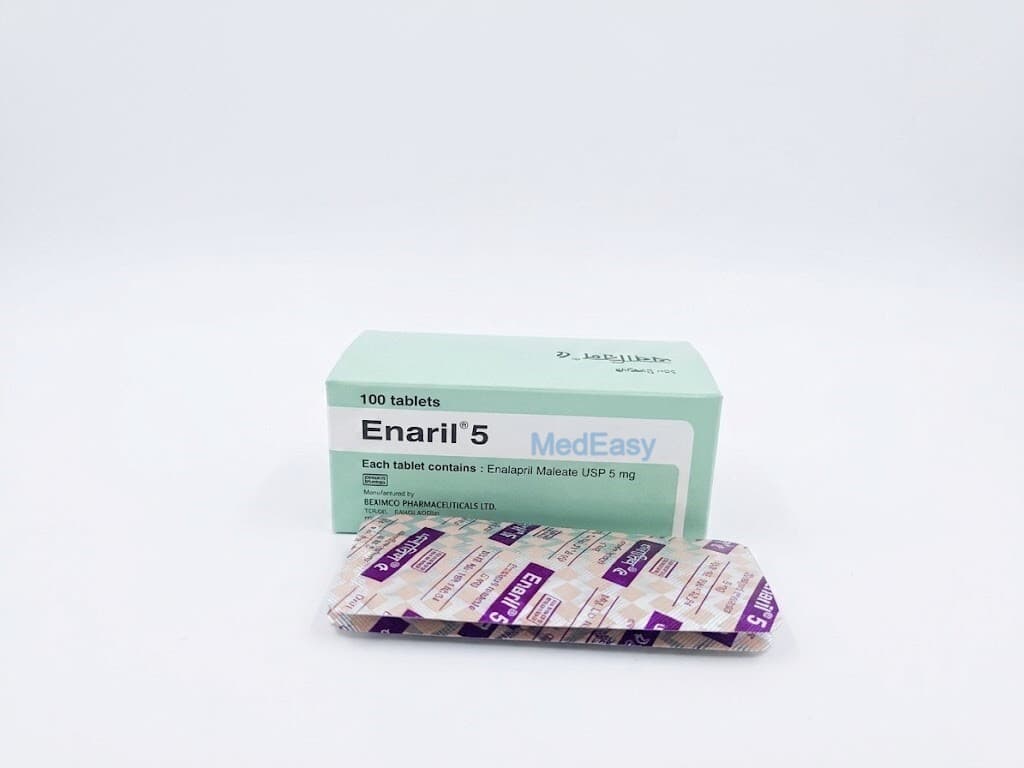

Enaril is an angiotensin-converting enzyme (ACE) inhibitor indicated for the following:
Use of Enaril for any indication should be individualized and directed by a physician.
Enalapril Maleate is available as oral tablets, commonly in strengths of 2.5 mg, 5 mg, 10 mg, and 20 mg. Each tablet contains Enalapril Maleate as the active pharmaceutical ingredient, along with standard pharmaceutical excipients such as diluents, binders, and lubricants used in tablet manufacturing.
Enaril is a synthetic angiotensin-converting enzyme (ACE) inhibitor used to manage high blood pressure and certain forms of heart failure. Chemically, Enaril is a prodrug: after oral absorption it is hydrolyzed in the liver to enalaprilat, its active metabolite, which is responsible for its pharmacological effect.
Enaril has been used clinically for several decades and is one of the most extensively studied members of the ACE inhibitor class, with a well-characterized efficacy and safety profile in adults and children.
Enaril belongs to the therapeutic class of Angiotensin-Converting Enzyme (ACE) Inhibitors, a group of antihypertensive and cardioprotective agents.
Enalapril Maleate is a prodrug that is de-esterified in the liver to its active diacid metabolite, enalaprilat. Enalaprilat competitively inhibits angiotensin-converting enzyme (ACE), which is responsible for converting angiotensin I to the potent vasoconstrictor angiotensin II.
By blocking this conversion, Enalapril Maleate produces the following effects:
Onset of antihypertensive effect typically occurs within an hour, with peak effect at 4-6 hours after oral dosing of Enalapril Maleate; the antihypertensive effect generally persists for 24 hours, supporting once- or twice-daily dosing.
Dosage of Enaril must be individualized by a physician based on indication, blood pressure response, renal function, and concurrent diuretic use.
| Indication | Adult dose | Notes |
|---|---|---|
| Hypertension | Initial 5 mg once daily (2.5 mg if on a diuretic); usual maintenance range 10-40 mg/day as a single dose or in two divided doses | Titrate at intervals of at least 1-2 weeks based on response |
| Heart failure (adjunct) | Initial 2.5 mg once or twice daily; titrate as tolerated to a target of 20 mg/day in two divided doses | Start under close medical supervision, especially if hyponatremic or on diuretics |
| Asymptomatic LV dysfunction | Initial 2.5 mg twice daily, titrated as tolerated up to 20 mg/day in divided doses | Titrate over several weeks |
For patients with creatinine clearance ≤30 mL/min, a lower initial dose of 2.5 mg once daily is recommended, with careful titration and monitoring of renal function and potassium.
See Pediatric Uses for weight-based pediatric dosing of Enaril.
If a dose of Enaril is missed, it should be taken as soon as remembered unless it is almost time for the next dose, in which case the missed dose should be skipped. Doses should not be doubled.
Enaril tablets may be taken with or without food, at approximately the same time each day to maintain consistent blood levels. Tablets should be swallowed with a glass of water. Enaril should not be stopped abruptly without medical advice, and any dose changes should be made only under a physician's guidance.
The following clinically significant interactions have been reported with Enaril:
Enalapril Maleate is contraindicated in the following situations:
Side effects reported with Enaril include:
Patients should seek prompt medical attention for swelling of the face/tongue/throat, difficulty breathing, or signs of liver problems while taking Enaril.
Pregnancy: Enaril is contraindicated in pregnancy. Drugs that act directly on the renin-angiotensin system, including Enaril, can cause fetal and neonatal morbidity and death when used in the second and third trimesters, including oligohydramnios, fetal growth restriction, renal failure, and skull hypoplasia. When pregnancy is detected, Enaril should be discontinued as soon as possible and the patient switched to an alternative antihypertensive under physician guidance, unless continued use is considered lifesaving.
Lactation: Enaril and its active metabolite pass into breast milk in small amounts. Because of the potential for adverse effects in a nursing infant, Enaril should be used during breastfeeding only if clearly needed and the potential benefit justifies the potential risk to the infant; caution is advised particularly when nursing a newborn or premature infant, and a physician should be consulted.
The following precautions apply to the use of Enaril:
The most likely manifestation of Enaril overdose is significant hypotension, which may present as dizziness, lightheadedness, or fainting; other features may include electrolyte disturbances and renal impairment.
If overdose is suspected, seek immediate medical attention or contact a poison control center/emergency services without delay. Management is supportive and should be provided in a medical facility; it may include intravenous normal saline for volume expansion and close monitoring of blood pressure, renal function, and electrolytes. Enalaprilat, the active metabolite of Enaril, can be removed by hemodialysis in severe cases. Do not attempt to manage a suspected overdose of Enaril at home.
Store at room temperature (below 30°C), away from light and moisture. Keep out of reach of children.
Renal impairment: lower starting doses and careful titration of Enaril are recommended, with monitoring of renal function and serum potassium (see Dosage and Administration).
Hepatic impairment: Enaril should be used with caution, as conversion of the prodrug to its active metabolite may be reduced; patients should be monitored for reduced efficacy and for hepatic adverse effects (see Precautions and Warnings).
Elderly: no overall differences in safety or effectiveness have been observed compared to younger patients, but elderly patients, who often have reduced renal function, may be more sensitive to hypotension and hyperkalemia; dose titration should be cautious.
Black patients: ACE inhibitors, including Enaril, have been associated with a higher rate of angioedema in Black patients compared with non-Black patients, and antihypertensive response as monotherapy may be reduced in this population.
Pediatric and pregnant/lactating patients: see Pediatric Uses and Pregnancy and Lactation.
Enaril is generally used as a long-term, often lifelong, maintenance therapy for chronic conditions such as hypertension and heart failure, since these conditions typically require ongoing blood pressure and cardiac support rather than short courses of treatment. The duration of therapy should be determined by the prescribing physician based on the patient's condition, response, and tolerability, with periodic clinical review. Enaril should not be stopped abruptly without medical advice.
Angiotensin-Converting Enzyme (ACE) Inhibitor; Antihypertensive agent
Enalapril Maleate is hydrolyzed to enalaprilat, which inhibits angiotensin-converting enzyme, blocking the conversion of angiotensin I to angiotensin II. This lowers circulating angiotensin II and aldosterone, reduces vasoconstriction and sodium/water retention, and increases bradykinin-mediated vasodilation, resulting in lowered blood pressure and reduced cardiac workload.
D
Enaril is approved for the treatment of hypertension in pediatric patients 1 month of age and older. It is not recommended for neonates (infants younger than 1 month), particularly premature neonates, because of insufficient data on safety in this age group and their vulnerability to profound and unpredictable decreases in blood pressure and urine output.
Enaril has not been studied in pediatric patients with a glomerular filtration rate less than 30 mL/min/1.73 m², and is not recommended in this population.
Safety and effectiveness of Enaril for indications other than hypertension (such as heart failure) have not been established in pediatric patients.
Pediatric dosing (hypertension), when used, is weight-based and initiated at a low dose with careful titration by a physician experienced in treating pediatric hypertension; oral solutions or crushed-tablet suspensions of Enaril may be used where an appropriate pediatric strength or formulation is not commercially available, under pharmacist/physician guidance.
Q: What is Enaril 5 mg Tablet used for?
A: Enaril 5 mg Tablet is an ACE inhibitor used to treat high blood pressure (hypertension) and, together with diuretics, to manage heart failure. It is also used in some patients with reduced heart pumping function (asymptomatic left ventricular dysfunction) to help prevent progression to overt heart failure.
Q: How should I take Enaril 5 mg Tablet?
A: Enaril 5 mg Tablet is usually taken once or twice daily, with or without food, at the same time(s) each day. Swallow the tablet with water and do not stop taking it suddenly without consulting your physician, as your blood pressure or heart condition could worsen.
Q: Can I take Enaril 5 mg Tablet during pregnancy?
A: No. Enaril 5 mg Tablet is contraindicated during pregnancy because it can seriously harm or be fatal to the developing baby, especially in the second and third trimesters. If you become pregnant while taking Enaril 5 mg Tablet, contact your physician immediately so treatment can be changed.
Q: What are the most important side effects of Enaril 5 mg Tablet to watch for?
A: Report immediately any swelling of the face, lips, tongue, or throat, or difficulty breathing or swallowing, as this may be angioedema, a rare but serious reaction to Enaril 5 mg Tablet. A persistent dry cough, dizziness (especially on standing), and unusual tiredness are more common and should be discussed with your doctor if bothersome.
Q: Can Enaril 5 mg Tablet be taken with painkillers or potassium supplements?
A: Regular use of NSAID painkillers (like ibuprofen) with Enaril 5 mg Tablet can reduce its blood-pressure-lowering effect and increase the risk of kidney problems. Potassium supplements, salt substitutes, and potassium-sparing diuretics can raise potassium to unsafe levels when combined with Enaril 5 mg Tablet. Always tell your doctor or pharmacist about all medicines and supplements you take.
Q: What should I do if I take too much Enaril 5 mg Tablet?
A: An overdose of Enaril 5 mg Tablet can cause significant low blood pressure, dizziness, or fainting. Seek immediate medical attention or contact a poison control center/emergency services; do not try to treat an overdose at home.
Disclaimer
The information provided is accurate to the best of our knowledge, but it does not replace professional medical advice. We cannot guarantee its completeness or accuracy, and the absence of specific information about a drug should not be taken as an endorsement. We are not responsible for any consequences arising from this information, so please consult a healthcare professional for any concerns or questions.
