
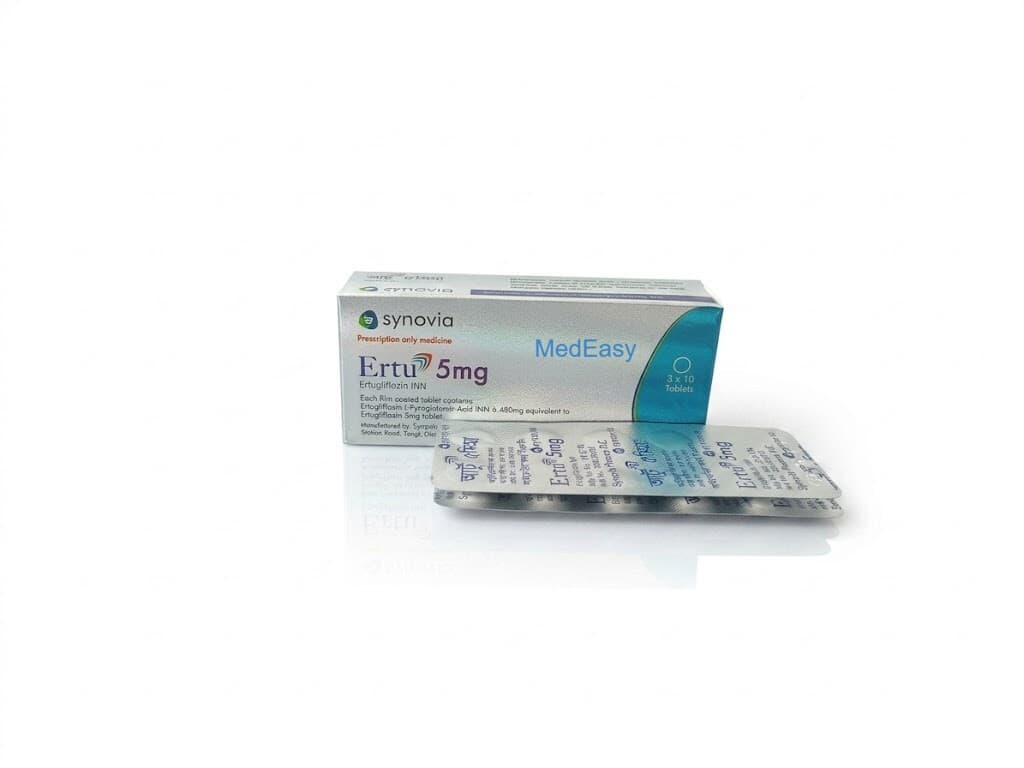

Medicine overview
Indications of Ertu
Ertu is a sodium-glucose cotransporter-2 (SGLT2) inhibitor used in the management of type 2 diabetes mellitus.
Established / FDA-approved indication
- As an adjunct to diet and exercise to improve glycemic control in adults with type 2 diabetes mellitus.
Combination use
Ertu may be used alone or in combination with other antidiabetic agents such as metformin, sulfonylureas, DPP-4 inhibitors, or insulin, when glycemic control is not achieved with a single agent, under physician supervision.
Not indicated for
- Type 1 diabetes mellitus
- Treatment of diabetic ketoacidosis
Cardiovascular outcomes
In a large cardiovascular outcomes trial, Ertu showed cardiovascular safety (non-inferiority for major adverse cardiovascular events) in patients with type 2 diabetes and established atherosclerotic cardiovascular disease, but a cardiovascular risk-reduction benefit has not been established; Ertu is therefore not indicated specifically for cardiovascular risk reduction.
Off-label use: Ertu is not commonly prescribed off-label. Any use outside the above should be individualized by a physician.
Composition
Each film-coated tablet contains Ertugliflozin (as ertugliflozin L-pyroglutamic acid) equivalent to 5 mg or 15 mg of Ertugliflozin as the active ingredient, together with pharmaceutically acceptable excipients.
Description
Ertu is an oral, selective inhibitor of sodium-glucose cotransporter-2 (SGLT2), a protein responsible for the majority of glucose reabsorption in the kidney. By blocking this transporter, Ertu lowers blood glucose levels through an insulin-independent mechanism. It is used as part of a comprehensive treatment plan that includes diet, exercise, and glucose monitoring in adults with type 2 diabetes mellitus.
Therapeutic Class
Sodium-Glucose Cotransporter-2 (SGLT2) Inhibitor; oral antihyperglycemic (antidiabetic) agent. Ertu belongs to this class of medicines.
Pharmacology
Ertugliflozin selectively and reversibly inhibits SGLT2, the transporter responsible for reabsorbing the majority of glucose filtered by the kidney's proximal renal tubules.
Mechanism
- Inhibition of SGLT2 reduces renal reabsorption of filtered glucose and lowers the renal threshold for glucose, increasing urinary glucose excretion.
- This action is independent of insulin secretion or insulin action, so Ertugliflozin can be used at any stage of beta-cell function.
- The glucose-lowering effect also produces a mild osmotic diuresis and modest reductions in body weight and blood pressure.
Pharmacokinetics
Ertugliflozin is rapidly absorbed after oral administration, is highly bound to plasma proteins, undergoes hepatic metabolism primarily via glucuronidation (UGT1A9 and UGT2B7), and is eliminated mainly in feces and urine. Its elimination half-life supports once-daily dosing.
Dosage & Administration of Ertu
Adults
| Indication | Starting Dose | Maintenance / Maximum Dose |
|---|---|---|
| Type 2 diabetes mellitus (adjunct to diet and exercise) | 5 mg orally once daily in the morning | May be increased to 15 mg once daily if additional glycemic control is needed and the dose is tolerated. Maximum dose: 15 mg/day. |
Renal impairment
Assess renal function before starting Ertu and periodically thereafter. Ertu is not recommended for use in patients with an eGFR persistently below 45 mL/min/1.73m² and is contraindicated in severe renal impairment, end-stage renal disease, or in patients on dialysis (see Contraindications).
Hepatic impairment
No dose adjustment is required in mild-to-moderate hepatic impairment. Ertu has not been studied in severe hepatic impairment and is not recommended in this population.
Pediatric dosing
Safety and efficacy of Ertu in patients under 18 years have not been established; pediatric dosing is not defined.
Missed dose
If a dose of Ertu is missed, it should be taken as soon as remembered on the same day; the missed dose should be skipped if it is almost time for the next dose. Doses should not be doubled.
Administration of Ertu
Ertu is taken orally, once daily in the morning, with or without food. Tablets should be swallowed whole and not crushed or chewed.
Interaction of Ertu
Insulin and insulin secretagogues
Concomitant use of Ertu with insulin or insulin secretagogues (e.g., sulfonylureas) increases the risk of hypoglycemia. A lower dose of the insulin or secretagogue may be required.
Diuretics
Ertu causes an osmotic diuresis, which may add to the effect of loop or thiazide diuretics and increase the risk of volume depletion, dehydration, and hypotension, particularly in the elderly and in patients with renal impairment.
UGT enzyme inducers
Strong inducers of UDP-glucuronosyltransferase (UGT) enzymes, such as rifampin, may reduce the exposure and glucose-lowering efficacy of Ertu; consider monitoring glycemic control if co-administered.
Digoxin
A modest increase in digoxin exposure has been observed with concomitant Ertu use; patients on digoxin should be monitored appropriately.
Contraindications
- Known hypersensitivity to Ertugliflozin or any component of the formulation (e.g., anaphylaxis or angioedema has been reported).
- Severe renal impairment, end-stage renal disease, or patients on dialysis.
Side Effects of Ertu
Common side effects
- Genital mycotic (yeast) infections
- Urinary tract infections
- Headache
- Vaginal pruritus
- Increased urination
- Mild increase in LDL cholesterol
Serious side effects (seek prompt medical attention)
- Euglycemic diabetic ketoacidosis — can occur even with normal or near-normal blood glucose; symptoms include nausea, vomiting, abdominal pain, fatigue, and difficulty breathing.
- Necrotizing fasciitis of the perineum (Fournier's gangrene) — a rare but life-threatening infection; seek emergency care for perineal/genital pain, swelling, redness, or fever.
- Lower limb amputation risk associated with the SGLT2 inhibitor class (see Precautions and Warnings).
- Volume depletion, dehydration, and hypotension.
- Hypersensitivity reactions.
- Urosepsis and pyelonephritis.
Pregnancy & Lactation
Pregnancy: Ertu is not recommended during pregnancy, particularly in the second and third trimesters, as SGLT2 inhibitors are believed to affect fetal renal development based on animal data and mechanism of action. Ertu should be used only if clearly needed and if the potential benefit justifies the potential risk to the fetus; a physician should be consulted before use in pregnancy, and an alternative antidiabetic regimen should generally be considered if pregnancy is planned or confirmed.
Lactation: It is not known whether Ertu is present in human milk. Because of the potential for adverse effects on renal development in the nursing infant, Ertu is not recommended while breastfeeding; a physician should be consulted to weigh the benefits of breastfeeding against the theoretical risk.
Precautions & Warnings
Diabetic ketoacidosis
Ertu has been associated with cases of euglycemic diabetic ketoacidosis, sometimes fatal, in which blood glucose may be only mildly elevated. Maintain a high index of suspicion in patients presenting with nausea, vomiting, abdominal pain, malaise, or dyspnea, even if glucose levels appear near-normal. Discontinue Ertu promptly if ketoacidosis is suspected or confirmed.
Lower limb amputation
An increased risk of lower limb amputation has been observed with SGLT2 inhibitors as a class (most strongly established for canagliflozin, but caution is advised with Ertu). Monitor patients, particularly those with a history of amputation, peripheral vascular disease, neuropathy, or diabetic foot ulcers, for signs of infection, new pain, or tenderness in the lower limbs.
Necrotizing fasciitis of the perineum (Fournier's gangrene)
Rare but serious and life-threatening cases have been reported across the SGLT2 inhibitor class, including with Ertu. Advise patients to seek immediate medical attention for severe pain, tenderness, erythema, or swelling in the genital or perineal area, with or without fever or malaise. Discontinue Ertu if this condition is suspected.
Volume depletion
Ertu can cause intravascular volume contraction. Symptomatic hypotension may occur, particularly in the elderly, in patients with renal impairment, low systolic blood pressure, or those on diuretics or other antihypertensives. Assess and correct volume status before initiating Ertu.
Genital mycotic infections and urinary tract infections
Increased risk of genital mycotic infections and urinary tract infections, including serious cases such as urosepsis and pyelonephritis, has been reported.
Hypoglycemia
Risk of hypoglycemia is increased when Ertu is combined with insulin or insulin secretagogues (see Interactions).
Surgery and prolonged fasting
Consider temporarily discontinuing Ertu before scheduled major surgery or in situations of prolonged fasting or acute serious illness, due to the risk of ketoacidosis; resume once the patient's condition has stabilized.
Hypersensitivity
Serious hypersensitivity reactions, including anaphylaxis and angioedema, have been reported; discontinue Ertu and institute appropriate treatment if such a reaction occurs.
Overdose Effects of Ertu
There is limited clinical experience with Ertu overdose. In the event of a suspected overdose, seek immediate medical attention or contact emergency services or a poison control center. Management should include general supportive measures, close monitoring of clinical status, blood glucose, electrolytes, renal function, and volume status, as clinically indicated. There is no specific antidote for Ertu.
Storage Conditions
Store at room temperature (below 30°C), away from light and moisture. Keep out of reach of children.
Use In Special Populations
Renal impairment
Ertu is not recommended in patients with an eGFR persistently below 45 mL/min/1.73m² and is contraindicated in severe renal impairment, end-stage renal disease, or dialysis (see Contraindications).
Hepatic impairment
No dosage adjustment is needed in mild-to-moderate hepatic impairment; use in severe hepatic impairment has not been studied and is not recommended.
Elderly patients
Elderly patients, especially those aged 65 years and older, are at greater risk of volume depletion; monitor renal function and volume status closely.
Pediatric patients
Safety and efficacy of Ertu in patients under 18 years of age have not been established; use in this population is not recommended.
Pregnancy and lactation
See Pregnancy and Lactation section above.
Duration Of Treatment
Ertu is generally used long-term as part of chronic management of type 2 diabetes mellitus. Duration of treatment should be individualized by the treating physician based on glycemic response, tolerability, and periodic reassessment of renal function and overall diabetes control.
Drug Classes
SGLT2 inhibitors (Sodium-Glucose Cotransporter-2 inhibitors); oral antidiabetic agents
Mode Of Action
Ertugliflozin works by selectively inhibiting SGLT2 in the proximal renal tubule, the transporter responsible for reabsorbing most of the glucose filtered by the kidney. Blocking SGLT2 reduces glucose reabsorption and lowers the renal glucose threshold, leading to increased urinary excretion of glucose and a corresponding reduction in plasma glucose levels. This glucose-lowering effect is independent of insulin secretion or insulin sensitivity.
Pediatric Uses
Safety and efficacy of Ertu have not been established in pediatric patients under 18 years of age. Ertu is therefore not recommended for use in children and adolescents until further data become available.
Frequently Asked Questions
Q: What is Ertu 5 mg Tablet used for?
A: Ertu 5 mg Tablet is used along with diet and exercise to help control blood sugar levels in adults with type 2 diabetes mellitus. It is not used for type 1 diabetes or diabetic ketoacidosis.
Q: How should I take Ertu 5 mg Tablet?
A: Ertu 5 mg Tablet is usually taken once daily in the morning, with or without food. It should be swallowed whole and taken at the same time each day for best results.
Q: What are the most serious risks of Ertu 5 mg Tablet?
A: Ertu 5 mg Tablet can rarely cause a serious condition called euglycemic diabetic ketoacidosis, in which blood glucose may not be very high but the body becomes acidic; it can also rarely cause a severe genital/perineal infection called Fournier's gangrene, and may increase the risk of lower limb amputation. Seek immediate medical attention for symptoms such as severe abdominal pain, nausea, vomiting, unusual tiredness, or severe genital/perineal pain, swelling, or redness with fever.
Q: Can Ertu 5 mg Tablet cause low blood sugar (hypoglycemia)?
A: Ertu 5 mg Tablet alone has a low risk of causing hypoglycemia, but the risk increases when it is combined with insulin or sulfonylurea medicines. Your doctor may lower the dose of those medicines when starting Ertu 5 mg Tablet.
Q: Is Ertu 5 mg Tablet safe during pregnancy or breastfeeding?
A: Ertu 5 mg Tablet is not recommended during pregnancy, especially in the second and third trimesters, or during breastfeeding, because of potential effects on the developing kidneys of the fetus or infant. It should be used in pregnancy only if clearly needed and after consulting a physician.
Q: Who should not take Ertu 5 mg Tablet?
A: Ertu 5 mg Tablet should not be used by people with a known hypersensitivity to it, or by people with severe kidney impairment, end-stage renal disease, or those on dialysis.
Disclaimer
The information provided is accurate to the best of our knowledge, but it does not replace professional medical advice. We cannot guarantee its completeness or accuracy, and the absence of specific information about a drug should not be taken as an endorsement. We are not responsible for any consequences arising from this information, so please consult a healthcare professional for any concerns or questions.
