
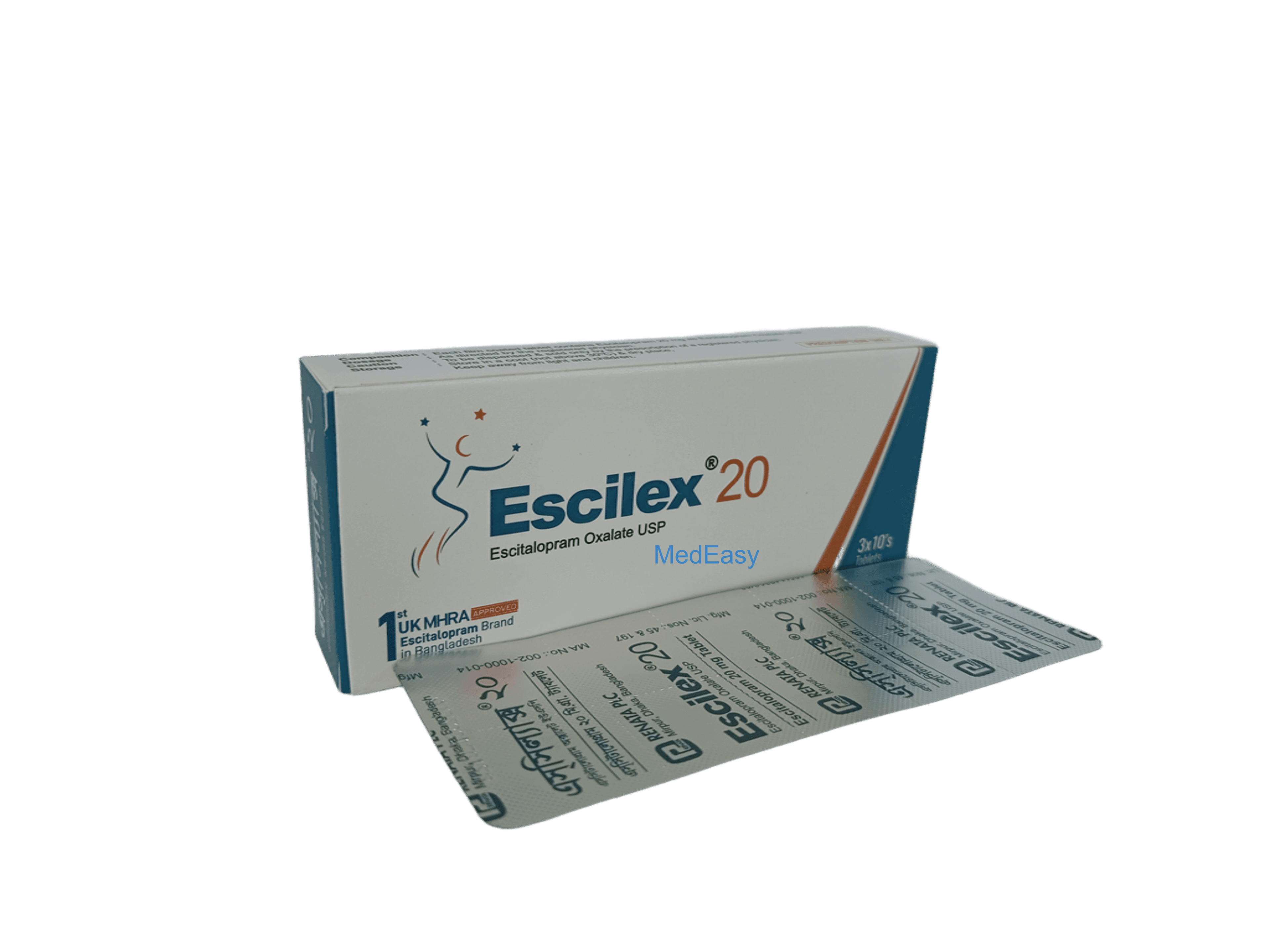

Medicine overview
Indications of Escilex
Escitalopram oxalate is a selective serotonin reuptake inhibitor (SSRI) used for the following indications:
Established / FDA-approved uses
- Major Depressive Disorder (MDD) in adults, and in adolescents aged 12–17 years, for acute and maintenance treatment.
- Generalized Anxiety Disorder (GAD) in adults.
Guideline-supported / commonly used off-label uses
- Panic disorder, with or without agoraphobia.
- Obsessive-compulsive disorder (OCD).
- Social anxiety disorder (social phobia).
- Post-traumatic stress disorder (PTSD).
- Premenstrual dysphoric disorder (PMDD).
Off-label uses should only be undertaken on the advice and supervision of a qualified physician.
Composition
Each tablet/capsule contains Escitalopram oxalate equivalent to escitalopram base, commonly available as 5 mg, 10 mg, and 20 mg oral tablets, and as an oral solution in some markets. Excipient composition varies by manufacturer; refer to the specific product label for full excipient details.
Description
Escitalopram oxalate is the oxalate salt of escitalopram, the pharmacologically active S-enantiomer of the racemic antidepressant citalopram. It belongs to the selective serotonin reuptake inhibitor (SSRI) class of antidepressants and is widely used for the management of depressive and anxiety disorders.
Escitalopram oxalate works by selectively inhibiting the reuptake of serotonin (5-HT) in the central nervous system, increasing serotonergic neurotransmission at the synaptic cleft, which is believed to underlie its antidepressant and anxiolytic effects.
Therapeutic Class
Escitalopram oxalate belongs to the Selective Serotonin Reuptake Inhibitor (SSRI) class of antidepressant medications.
Pharmacology
Mechanism of action
Escitalopram oxalate selectively inhibits the neuronal reuptake of serotonin (5-hydroxytryptamine, 5-HT) at the presynaptic membrane, increasing serotonin availability in the synaptic cleft. It has minimal to no significant affinity for serotonin, dopamine, norepinephrine, or other neurotransmitter receptors and transporters at therapeutic doses.
Pharmacokinetics
- Absorption: Well absorbed orally; peak plasma concentration reached in about 5 hours; absorption is not significantly affected by food.
- Distribution: Volume of distribution approximately 12 L/kg; plasma protein binding about 56%.
- Metabolism: Extensively metabolized in the liver, primarily via CYP2C19, with minor contributions from CYP3A4 and CYP2D6, to less active metabolites.
- Elimination: Elimination half-life is approximately 27–32 hours, supporting once-daily dosing; excreted mainly via the kidneys and, to a lesser extent, feces.
Dosage & Administration of Escilex
Adult dosing
| Indication | Starting dose | Usual/maximum dose |
|---|---|---|
| Major Depressive Disorder | 10 mg once daily | May increase to 20 mg once daily after a minimum of 1 week |
| Generalized Anxiety Disorder | 10 mg once daily | May increase to 20 mg once daily after a minimum of 1 week |
Adolescent dosing (12–17 years, MDD)
Starting dose 10 mg once daily; may be increased to 20 mg once daily after a minimum of 3 weeks, based on clinical response and tolerability.
Elderly and CYP2C19 poor metabolizers
Recommended dose is 10 mg once daily; doses above 10 mg/day are generally not recommended due to an increased risk of dose-dependent QTc prolongation (see Precautions and Warnings).
Hepatic impairment
10 mg once daily is recommended for patients with hepatic impairment.
Renal impairment
No dosage adjustment is generally needed in mild to moderate renal impairment; use with caution in severe renal impairment due to limited data.
Administration
Escitalopram oxalate may be taken with or without food, at approximately the same time each day, usually in the morning or evening. Tablets should be swallowed whole with water; do not stop treatment abruptly (see Precautions and Warnings regarding discontinuation).
Administration of Escilex
Escitalopram oxalate tablets are for oral use only. They may be taken with or without food, once daily, preferably at the same time each day to maintain consistent blood levels. Swallow the tablet whole with a glass of water; do not crush or chew unless the product is specifically formulated for that purpose.
Interaction of Escilex
The following clinically significant drug interactions have been established for Escitalopram oxalate:
Contraindicated combinations
- Monoamine oxidase inhibitors (MAOIs): Concomitant use, or use within 14 days of stopping an MAOI, may precipitate serotonin syndrome. See Contraindications.
- Pimozide: Escitalopram oxalate increases pimozide plasma levels and both drugs prolong the QT interval, increasing the risk of serious arrhythmia. See Contraindications.
Use with caution
- Other serotonergic drugs (other SSRIs/SNRIs, triptans, tramadol, fentanyl, lithium, St. John's Wort, linezolid, intravenous methylene blue): increased risk of serotonin syndrome when combined with Escitalopram oxalate.
- Drugs that prolong the QT interval (certain antiarrhythmics, antipsychotics, some antibiotics): additive risk of QT prolongation and torsades de pointes with Escitalopram oxalate.
- NSAIDs, aspirin, warfarin, and other anticoagulants/antiplatelets: increased risk of bleeding when used with Escitalopram oxalate, due to impaired platelet aggregation.
- Strong CYP2C19 inhibitors (e.g., omeprazole): may increase plasma concentrations of Escitalopram oxalate, warranting dose caution.
- Alcohol: not specifically recommended in combination with Escitalopram oxalate, although it does not potentiate the cognitive/motor effects of Escitalopram oxalate in the way it does with sedatives; caution is still advised.
Contraindications
Escitalopram oxalate is contraindicated in the following situations:
- Known hypersensitivity to escitalopram, citalopram, or any excipient of the formulation.
- Concomitant use with, or use within 14 days of discontinuing, a monoamine oxidase inhibitor (MAOI), due to the risk of serious, potentially fatal serotonin syndrome.
- Concomitant use with pimozide, due to the risk of additive QT interval prolongation and serious cardiac arrhythmia.
- Patients with known congenital long QT syndrome, due to the risk of dose-dependent QTc prolongation and torsades de pointes.
Side Effects of Escilex
Side effects reported with Escitalopram oxalate are generally dose-related and most common during the first weeks of treatment.
Common side effects
- Nausea
- Insomnia or somnolence
- Dry mouth
- Increased sweating
- Fatigue, dizziness
- Diarrhea or constipation
- Decreased libido, delayed ejaculation, and other sexual dysfunction
Serious side effects (seek prompt medical attention)
- Serotonin syndrome (agitation, hallucinations, rapid heart rate, fever, muscle rigidity, loss of coordination).
- Hyponatremia/SIADH, particularly in elderly patients.
- QT interval prolongation and abnormal heart rhythm.
- Activation of mania or hypomania.
- Abnormal bleeding.
- Angle-closure glaucoma.
- Increased risk of suicidal thoughts and behavior, particularly in children, adolescents, and young adults (see Precautions and Warnings).
Pregnancy & Lactation
Pregnancy
Escitalopram oxalate should be used during pregnancy only if the potential benefit justifies the potential risk to the fetus. Use of SSRIs, including Escitalopram oxalate, late in pregnancy has been associated with neonatal complications requiring prolonged hospitalization, respiratory support, and tube feeding, as well as a possible increased risk of persistent pulmonary hypertension of the newborn. Any decision to use Escitalopram oxalate during pregnancy should be made in consultation with a physician, weighing the risks of untreated depression/anxiety against potential fetal risk.
Lactation
Escitalopram oxalate is excreted into human breast milk. A decision should be made whether to discontinue breastfeeding or discontinue Escitalopram oxalate, taking into account the importance of the drug to the mother; a physician should be consulted before use while breastfeeding.
Precautions & Warnings
Boxed warning: Suicidality risk
Escitalopram oxalate and other antidepressants increase the risk of suicidal thinking and behavior in children, adolescents, and young adults (up to age 24), especially during the first few months of treatment and after dose changes. Patients of all ages should be monitored closely for worsening depression, unusual behavior changes, or suicidality, particularly at treatment initiation.
Serotonin syndrome
Concomitant use with other serotonergic agents increases the risk of serotonin syndrome; see Interactions.
QT prolongation
Escitalopram oxalate causes dose-dependent prolongation of the QT interval, which can lead to torsades de pointes and sudden death. This risk is greater at doses above 20 mg/day, in elderly patients, and in those with underlying cardiac conditions, electrolyte abnormalities, or use of other QT-prolonging drugs; ECG monitoring may be warranted in at-risk patients.
Discontinuation syndrome
Abrupt discontinuation of Escitalopram oxalate can cause dizziness, sensory disturbances, sleep disturbance, agitation, and other symptoms. The dose should be tapered gradually under physician guidance rather than stopped abruptly.
Hyponatremia
Escitalopram oxalate can cause hyponatremia, including from the syndrome of inappropriate antidiuretic hormone secretion (SIADH), particularly in elderly patients, those on diuretics, and volume-depleted patients.
Other precautions
- Risk of activation of mania/hypomania; use caution in patients with bipolar disorder or a family history of bipolar disorder.
- Risk of abnormal bleeding, particularly with concomitant NSAIDs, aspirin, or anticoagulants.
- May precipitate angle-closure glaucoma in susceptible individuals.
- Use with caution in patients with a history of seizures.
Overdose Effects of Escilex
Overdose of Escitalopram oxalate, alone or with other substances, may cause dizziness, tremor, agitation, nausea, vomiting, drowsiness, and in more severe cases, seizures, ECG changes (including QT prolongation), serotonin syndrome, coma, or rarely death, especially when combined with other CNS-active drugs or alcohol.
There is no specific antidote. In case of suspected overdose, seek immediate medical attention or contact a poison control center/emergency services right away. Treatment is supportive and should be provided in a facility capable of appropriate cardiac and vital sign monitoring.
Storage Conditions
Store at room temperature (below 30°C), away from light and moisture. Keep out of reach of children.
Use In Special Populations
Pediatric use
Escitalopram oxalate is approved for Major Depressive Disorder in adolescents aged 12–17 years. Safety and efficacy have not been established in children under 12 years of age, and it is not approved for Generalized Anxiety Disorder in the pediatric population.
Elderly (geriatric use)
Elderly patients are at increased risk of QT prolongation and hyponatremia; the recommended dose in this population is 10 mg once daily, and doses above this are generally not recommended.
Hepatic impairment
A maximum dose of 10 mg once daily is recommended in patients with hepatic impairment.
Renal impairment
No dose adjustment is typically required in mild to moderate renal impairment; caution is advised in severe renal impairment.
Pregnancy and lactation
See Pregnancy and Lactation section for detailed guidance.
Duration Of Treatment
The duration of treatment with Escitalopram oxalate depends on the indication and individual clinical response. For an initial episode of major depressive disorder, treatment is typically continued for at least 6 months after symptom remission to reduce the risk of relapse. For generalized anxiety disorder and other approved/off-label indications, duration should be individualized by the treating physician based on response and risk of relapse. Treatment should not be stopped abruptly; any change or discontinuation should be done gradually under medical supervision.
Drug Classes
Selective Serotonin Reuptake Inhibitor (SSRI); Antidepressant
Mode Of Action
Escitalopram oxalate selectively inhibits the presynaptic reuptake of serotonin (5-HT) in the central nervous system, thereby increasing the concentration of serotonin available at the synaptic cleft. This enhanced serotonergic neurotransmission is believed to be responsible for the antidepressant and anxiolytic effects of Escitalopram oxalate. Unlike older antidepressants, Escitalopram oxalate has minimal affinity for histaminergic, cholinergic, and adrenergic receptors, which accounts for its relatively favorable tolerability profile.
Pregnancy
C
Pediatric Uses
Escitalopram oxalate is approved by regulatory authorities for the treatment of Major Depressive Disorder in adolescents aged 12 to 17 years, at a starting dose of 10 mg once daily, which may be increased to 20 mg once daily after at least 3 weeks based on response and tolerability. Safety and efficacy of Escitalopram oxalate have not been established in children below 12 years of age, and it is not approved for use in Generalized Anxiety Disorder in patients under 18 years of age. As with adults, adolescents should be closely monitored for worsening depression and emergence of suicidal thoughts or behavior, particularly during the initial months of therapy (see Precautions and Warnings, Boxed Warning).
Frequently Asked Questions
Q: What is Escitalopram oxalate used for?
A: Escitalopram oxalate is a selective serotonin reuptake inhibitor (SSRI) primarily used to treat major depressive disorder and generalized anxiety disorder in adults, and major depressive disorder in adolescents aged 12–17. It is also sometimes used off-label for panic disorder, OCD, social anxiety, PTSD, and PMDD under medical supervision.
Q: How long does it take for Escitalopram oxalate to work?
A: Some improvement in anxiety symptoms may be noticed within 1–2 weeks, but the full antidepressant effect of Escitalopram oxalate usually takes 4–6 weeks of consistent daily use. Do not stop taking it early even if you do not feel an immediate difference; discuss with your physician if there is no improvement after this period.
Q: Can I stop taking Escitalopram oxalate suddenly?
A: No. Stopping Escitalopram oxalate abruptly can cause discontinuation symptoms such as dizziness, sensory disturbances, sleep problems, and agitation. The dose should be gradually tapered down under a physician's guidance rather than stopped suddenly.
Q: Is Escitalopram oxalate safe during pregnancy or breastfeeding?
A: Escitalopram oxalate should only be used during pregnancy or while breastfeeding if a physician determines the potential benefit outweighs the potential risk to the baby, since SSRIs including Escitalopram oxalate have been associated with neonatal complications when used late in pregnancy, and the drug passes into breast milk. Always consult your physician before use in these situations.
Q: What should I avoid while taking Escitalopram oxalate?
A: Avoid taking Escitalopram oxalate together with monoamine oxidase inhibitors (MAOIs) or pimozide, as these combinations are contraindicated due to risks of serotonin syndrome and dangerous heart rhythm changes respectively. Use caution with other serotonergic medicines, NSAIDs/blood thinners (bleeding risk), and alcohol, and inform your doctor of all medicines you take.
Q: What are the warning signs of a serious reaction to Escitalopram oxalate?
A: Seek immediate medical attention if you experience symptoms of serotonin syndrome (agitation, rapid heartbeat, fever, muscle rigidity), signs of an irregular or fast heartbeat (which can indicate QT prolongation), unusual bleeding, or any new or worsening suicidal thoughts, especially in the first few months of treatment or after a dose change.
Disclaimer
The information provided is accurate to the best of our knowledge, but it does not replace professional medical advice. We cannot guarantee its completeness or accuracy, and the absence of specific information about a drug should not be taken as an endorsement. We are not responsible for any consequences arising from this information, so please consult a healthcare professional for any concerns or questions.
