

8% Off
AFM-T0.1%+0.025
Aristopharma Ltd.
৳92.00
Add to cart
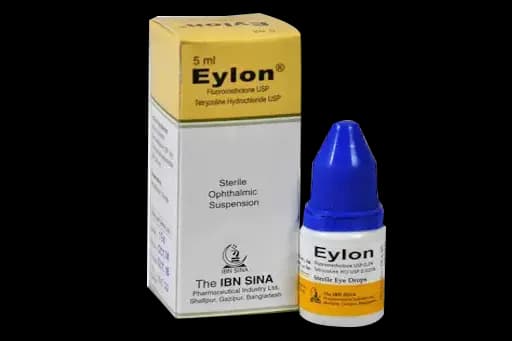

Eylon ophthalmic solution is indicated for the short-term symptomatic relief of ocular inflammation accompanied by conjunctival redness (hyperemia), where a corticosteroid is indicated and where the reduction of hyperemia is also desired.
Eylon is not indicated for infectious (bacterial, viral, fungal, or mycobacterial) conjunctivitis or keratitis, or for chronic, unsupervised use to simply "whiten" the eyes, since this can mask a more serious underlying condition (see Contraindications).
Each mL of Fluorometholone + Tetrahydrozoline ophthalmic solution contains Fluorometholone 1 mg (0.1% w/v) and Tetrahydrozoline Hydrochloride 0.25 mg (0.025% w/v), in a sterile ophthalmic vehicle with preservative.
Eylon is a fixed-dose ophthalmic (eye drop) combination of two active ingredients that work together to relieve inflamed, red eyes:
Eylon is supplied as a sterile ophthalmic suspension/solution for topical instillation into the eye and is intended for short, physician-directed courses of treatment rather than continuous long-term use.
Ophthalmic corticosteroid–decongestant (vasoconstrictor) combination; Eylon belongs to the class of topical anti-inflammatory eye preparations combined with an ocular decongestant.
Fluorometholone + Tetrahydrozoline combines a corticosteroid with a decongestant, giving it a dual mechanism of action:
Fluorometholone inhibits phospholipase A2, thereby suppressing the release of arachidonic acid and downstream inflammatory mediators (prostaglandins, leukotrienes). This reduces capillary permeability, leukocyte infiltration, fibrin deposition, and edema in ocular tissue. Compared with more potent ophthalmic steroids (e.g., dexamethasone, prednisolone), fluorometholone has relatively limited penetration into the anterior chamber, which is associated with a comparatively lower — though not negligible — tendency to raise intraocular pressure (IOP) with short-term use.
Tetrahydrozoline is an imidazoline-derivative, direct-acting alpha-adrenergic agonist. Applied topically, it constricts the small blood vessels of the conjunctiva, producing rapid but temporary whitening of the eye and reducing associated hyperemia.
Together in Fluorometholone + Tetrahydrozoline, these components provide both anti-inflammatory action and cosmetic/symptomatic reduction of redness.
| Indication | Dose |
|---|---|
| Allergic conjunctivitis / steroid-responsive inflammation with redness | Instill 1 drop of Eylon into the affected conjunctival sac(s) 2–3 times daily. |
| Severe inflammation (initial phase) | Frequency may be increased to hourly during the first 24–48 hours under close medical supervision, then tapered as inflammation improves. |
Safety and efficacy of Eylon have not been established in children under 2 years of age. In older children, use only under direct medical supervision at the lowest effective frequency (see Use in Special Populations).
Eylon is intended for short-course use as directed by a physician; do not use continuously beyond the prescribed duration without medical review (see Duration of Treatment and Precautions).
For topical ophthalmic (eye) use only. Instill Eylon into the conjunctival sac using proper aseptic technique; do not inject, ingest, or apply to other body sites. Not for use with contact lenses in place.
No extensive formal drug-interaction studies exist for the fixed combination, but the following are recognized as clinically relevant based on the individual components of Eylon:
Fluorometholone + Tetrahydrozoline is contraindicated in:
Reported adverse effects of Eylon include:
There are no adequate and well-controlled studies of Eylon in pregnant women. Although systemic absorption from topical ophthalmic use is expected to be low, Eylon should be used during pregnancy only if clearly needed and if the potential benefit justifies the potential risk to the fetus; consult a physician before use.
It is not known whether topically applied fluorometholone or tetrahydrozoline are excreted in human breast milk in clinically significant amounts. Caution is advised, and a physician should be consulted before using Eylon while breastfeeding.
Eylon is for topical ophthalmic use only and should not be injected or ingested.
Topical ophthalmic overdose of Eylon is unlikely to cause serious harm, but excessive or overly frequent instillation may worsen local side effects such as stinging, mydriasis, or rebound redness — rinse the eye with water and contact a physician if this occurs.
Accidental oral ingestion of Eylon, particularly by young children, is a medical emergency: imidazoline decongestants such as tetrahydrozoline can cause serious systemic toxicity (drowsiness, low body temperature, slow heart rate, low blood pressure, and even coma) when swallowed. If ingestion is suspected, seek immediate medical attention or contact emergency services/poison control without delay; do not attempt unsupervised home treatment.
Store at room temperature (below 30°C), away from light and moisture. Keep out of reach of children. Do not use the solution if it has changed color or become cloudy, and discard any remaining product after the period advised on the label/by the pharmacist once opened.
Eylon is intended for short-term use, typically guided by the treating physician and generally not exceeding 7–10 days without re-evaluation. Treatment should not be continued or repeated for prolonged, uninterrupted periods without ophthalmologic review, because of the risks of raised intraocular pressure, cataract, and rebound hyperemia with extended use.
Fluorometholone + Tetrahydrozoline is classified as an ophthalmic corticosteroid combined with a topical ocular decongestant (sympathomimetic vasoconstrictor).
Fluorometholone + Tetrahydrozoline acts through two complementary mechanisms: fluorometholone suppresses the inflammatory cascade by inhibiting phospholipase A2 and reducing prostaglandin/leukotriene production, capillary permeability, and leukocyte migration in ocular tissues; tetrahydrozoline directly stimulates alpha-adrenergic receptors on conjunctival vascular smooth muscle, producing local vasoconstriction that reduces visible redness and associated congestion.
Safety and efficacy of Eylon have not been established in children under 2 years of age. In children 2 years and older, Eylon should be used only under the direct supervision of a physician, at the lowest effective dose and frequency, due to the potential for systemic sympathomimetic effects and corticosteroid-related ocular effects with prolonged use.
Q: What is Eylon 0.1%+0.025% Ophthalmic Solution eye drop used for?
A: Eylon 0.1%+0.025% Ophthalmic Solution is used for short-term relief of eye inflammation associated with redness, such as allergic conjunctivitis and certain steroid-responsive inflammatory conditions of the eye, including after some types of eye surgery. It combines an anti-inflammatory corticosteroid (fluorometholone) with a decongestant (tetrahydrozoline) that reduces redness.
Q: How should I use Eylon 0.1%+0.025% Ophthalmic Solution?
A: Instill 1 drop of Eylon 0.1%+0.025% Ophthalmic Solution into the affected eye 2–3 times daily, or as directed by your physician; in severe cases the frequency may be increased temporarily and then tapered. Wash your hands first, avoid touching the dropper tip to your eye, and do not use it for longer than your doctor has advised.
Q: Can I use Eylon 0.1%+0.025% Ophthalmic Solution if I wear contact lenses?
A: Remove soft contact lenses before instilling Eylon 0.1%+0.025% Ophthalmic Solution and ask your prescriber when it is safe to reinsert them, since the preservative in the solution can be absorbed by soft lenses.
Q: Is Eylon 0.1%+0.025% Ophthalmic Solution safe during pregnancy or breastfeeding?
A: There are no adequate studies of Eylon 0.1%+0.025% Ophthalmic Solution in pregnant or breastfeeding women. Although absorption into the bloodstream from eye drops is generally low, Eylon 0.1%+0.025% Ophthalmic Solution should be used during pregnancy or breastfeeding only if your physician decides it is clearly needed, weighing the potential benefit against any potential risk.
Q: What if my eyes become redder after using Eylon 0.1%+0.025% Ophthalmic Solution for a while?
A: Worsening redness after repeated or prolonged use of Eylon 0.1%+0.025% Ophthalmic Solution may be a sign of rebound hyperemia caused by the decongestant component, or a sign of raised eye pressure from the corticosteroid component. Stop using Eylon 0.1%+0.025% Ophthalmic Solution and contact your physician promptly rather than using it more frequently.
Q: What happens if Eylon 0.1%+0.025% Ophthalmic Solution is accidentally swallowed?
A: Accidental ingestion of Eylon 0.1%+0.025% Ophthalmic Solution, especially by a child, can be dangerous because the decongestant component can cause serious effects such as drowsiness, low body temperature, slowed heart rate, and low blood pressure. Seek immediate medical attention or contact emergency services/poison control right away if this happens.
Disclaimer
The information provided is accurate to the best of our knowledge, but it does not replace professional medical advice. We cannot guarantee its completeness or accuracy, and the absence of specific information about a drug should not be taken as an endorsement. We are not responsible for any consequences arising from this information, so please consult a healthcare professional for any concerns or questions.
