10% Off
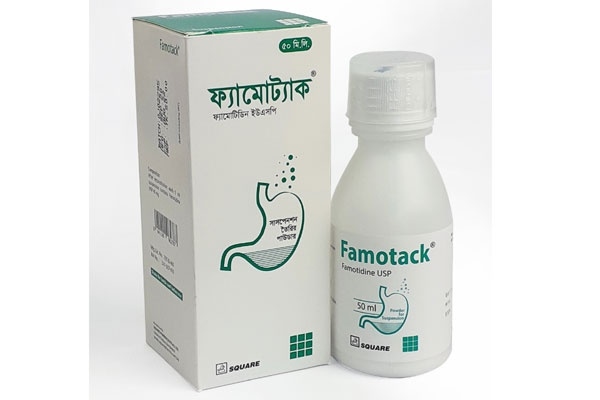
Famotack50 ml
Square Pharmaceuticals PLC.
৳49.50
Add to cart
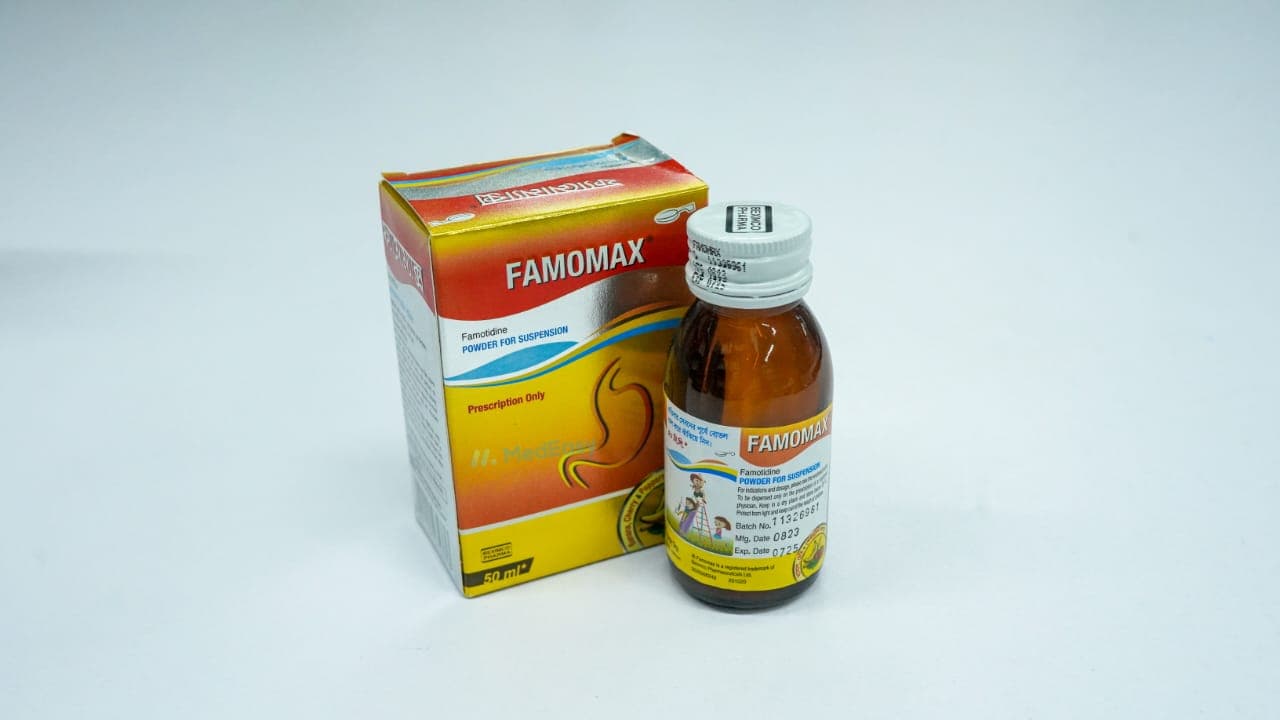

Famomax is a histamine H2-receptor antagonist used to reduce gastric acid secretion. Its established, evidence-based uses include:
Famomax does not cure the underlying acid-related disorder; it controls symptoms and promotes healing while the underlying condition is managed.
Each tablet/dose typically contains Famotidine as the active pharmaceutical ingredient, commonly available in strengths of 10 mg, 20 mg, and 40 mg tablets, as an oral suspension (e.g., 40 mg/5 mL after reconstitution), and as an injectable solution (e.g., 10 mg/mL or 20 mg/2 mL) for intravenous use. Tablets and suspensions also contain standard inactive excipients such as binders, fillers, and coating agents, which vary by manufacturer and formulation.
Famomax is a competitive, reversible histamine H2-receptor antagonist that decreases the amount of acid produced by the stomach. It belongs to the same pharmacological class as cimetidine, ranitidine, and nizatidine, but is more potent on a milligram basis and has a longer duration of action.
Famomax is used both as a prescription medicine for peptic ulcer disease and GERD, and in lower-strength over-the-counter formulations for the relief of heartburn and acid indigestion. It is available as oral tablets, oral suspension, and intravenous injection for patients who cannot take oral medication.
Famomax belongs to the therapeutic class of Histamine H2-receptor antagonists (H2 blockers), a group of medicines used to reduce gastric acid secretion in the treatment of acid-related disorders of the upper gastrointestinal tract.
Famotidine is a competitive antagonist at histamine H2-receptors located on the basolateral membrane of gastric parietal cells. By blocking these receptors, Famotidine inhibits histamine-stimulated gastric acid secretion, and also reduces basal, nocturnal, and food-, caffeine-, and pentagastrin-stimulated acid secretion, with a lesser effect on gastric acid volume and pepsin output.
Famotidine is rapidly but incompletely absorbed after oral administration (bioavailability approximately 40-45%), with an onset of action within 1 hour and a duration of action of 10-12 hours after a single dose. It undergoes minimal hepatic metabolism, is primarily eliminated renally (both by glomerular filtration and tubular secretion), and has a plasma elimination half-life of approximately 2.5-4 hours in patients with normal renal function; this half-life is prolonged in renal impairment.
The dose and duration of Famomax therapy depend on the indication being treated. It can be taken with or without food. Doses should be adjusted in patients with renal impairment (see below).
| Indication | Usual adult dose | Typical duration |
|---|---|---|
| Active duodenal ulcer | 40 mg once daily at bedtime, or 20 mg twice daily | Up to 8 weeks |
| Maintenance therapy (duodenal ulcer) | 20 mg once daily at bedtime | As directed by physician |
| Active benign gastric ulcer | 40 mg once daily at bedtime | Up to 8 weeks |
| Symptomatic non-erosive GERD | 20 mg twice daily | Up to 6 weeks |
| Erosive esophagitis (GERD) | 20-40 mg twice daily | Up to 12 weeks |
| Pathological hypersecretory conditions (e.g. Zollinger-Ellison syndrome) | Starting 20 mg every 6 hours; adjusted individually (may require higher doses) | As clinically indicated |
| Heartburn / acid indigestion (OTC-strength use) | 10 mg, taken 15-60 minutes before symptoms expected or at onset of symptoms; do not exceed 2 doses in 24 hours | Short-term, symptomatic |
Dosage reduction or extended dosing intervals are required when creatinine clearance is below 60 mL/min, since Famomax is primarily renally excreted. In patients with severe renal impairment, doses are typically reduced by half or the interval extended (e.g., every other day dosing), under physician supervision.
No specific dosage adjustment is generally required for hepatic impairment alone, as Famomax undergoes minimal hepatic metabolism, but caution is advised.
Famomax tablets and oral suspension may be taken with or without food. For once-daily dosing, it is generally taken at bedtime; for twice-daily dosing, it is taken in the morning and at bedtime. The oral suspension should be shaken well before each use and measured with an accurate measuring device. The injectable form is administered by a healthcare professional via slow intravenous injection or infusion, generally reserved for patients unable to take oral medication.
Famomax does not significantly interact with the cytochrome P450 hepatic enzyme system, so it has fewer clinically significant drug interactions than some other acid-reducing agents. However, the following interactions are clinically relevant:
Famotidine is contraindicated in patients with a known history of hypersensitivity (including serious hypersensitivity reactions such as anaphylaxis) to Famotidine or to any other H2-receptor antagonist, since cross-sensitivity within this drug class has been reported.
Famomax is generally well tolerated. Most side effects are mild and transient.
Patients should seek prompt medical attention for signs of a severe allergic reaction (swelling of the face/throat, difficulty breathing, severe rash) or unusual symptoms such as severe confusion.
Pregnancy: Animal reproduction studies have not shown evidence of harm to the fetus, but there are no adequate and well-controlled studies in pregnant women. Famomax should be used during pregnancy only if clearly needed and if the potential benefit justifies the potential risk to the fetus. A physician should always be consulted before use during pregnancy.
Lactation: Famomax is excreted in human breast milk. Because of the potential for effects on the nursing infant, a decision should be made whether to discontinue nursing or discontinue Famomax, taking into account the importance of the drug to the mother, in consultation with a physician.
Symptoms of Famomax overdose may include confusion, drowsiness, dizziness, hypotension, and transient adverse effects similar to those seen at therapeutic doses, though they are typically not life-threatening. In case of a suspected overdose, seek immediate medical attention or contact a poison control center. Treatment is generally symptomatic and supportive; unabsorbed material may be removed from the gastrointestinal tract by standard measures under medical supervision, and hemodialysis may be considered in severe cases, particularly with renal impairment, since Famomax is efficiently removed by dialysis. Do not attempt to manage an overdose at home without medical guidance.
Store at room temperature (below 30°C), away from light and moisture. Keep out of reach of children. Reconstituted oral suspension should be stored as directed on the label (typically at room temperature) and discarded after 30 days.
Duration of Famomax therapy depends on the condition being treated: typically up to 6-8 weeks for active ulcers and non-erosive GERD, and up to 12 weeks for erosive esophagitis. Maintenance therapy at a lower dose may be continued longer term for prevention of ulcer recurrence, as directed by a physician. For self-treatment of occasional heartburn (OTC use), Famomax should not be used continuously for more than 2 weeks without consulting a doctor.
The oral powder for suspension formulation of Famomax (40 mg/5 mL) must be reconstituted with purified water before use, according to the manufacturer's instructions printed on the bottle label. After adding the specified amount of water, the bottle should be shaken vigorously to ensure the powder is fully suspended. The reconstituted suspension should be shaken well before each dose, stored as directed (typically at room temperature, protected from light), and any unused portion discarded after 30 days.
Histamine H2-receptor antagonist (H2 blocker); Anti-ulcer / gastric acid secretion inhibitor.
Famotidine works by selectively and competitively blocking histamine at the H2-receptors of gastric parietal cells. Since histamine is a key mediator that stimulates acid secretion (via the enzyme H+/K+-ATPase pathway indirectly through cyclic AMP), blocking the H2-receptor reduces both the volume and acid concentration of gastric secretions, including basal (fasting) acid output and acid stimulated by food, caffeine, insulin, and pentagastrin. This leads to a sustained rise in intragastric pH, allowing healing of acid-related mucosal damage and symptom relief.
Category B (legacy FDA pregnancy classification, prior to the 2015 Pregnancy and Lactation Labeling Rule)
Famomax is approved for use in pediatric patients for GERD and related acid-related conditions, with dosing based on age and body weight:
| Age group | Typical dosing (as established/guideline-based) |
|---|---|
| Neonates (0-3 months) | Safety and efficacy not well established; used cautiously under specialist supervision only if clearly needed, with reduced/adjusted doses |
| 3 months to under 1 year | Approximately 0.5 mg/kg/dose, once or twice daily, for GERD, under medical supervision |
| 1 to 16 years | Approximately 0.5-1 mg/kg/dose twice daily (weight-based, per indication), not to exceed adult maximum doses |
| ≥40 kg or ≥12 years | May generally follow adult dosing recommendations |
Pediatric doses of Famomax should always be determined and supervised by a pediatrician, as safety and efficacy have not been established for all indications and all age groups.
Q: What is Famomax 50 ml Powder for Suspension used for?
A: Famomax 50 ml Powder for Suspension is used to treat and prevent acid-related conditions of the stomach and esophagus, including duodenal and gastric ulcers, gastroesophageal reflux disease (GERD), erosive esophagitis, and heartburn/acid indigestion. It works by reducing the amount of acid the stomach produces.
Q: How quickly does Famomax 50 ml Powder for Suspension start working?
A: Famomax 50 ml Powder for Suspension typically begins reducing stomach acid within about 1 hour of taking a dose, with effects lasting 10-12 hours. For relief of occasional heartburn, it is usually taken 15-60 minutes before eating or at the onset of symptoms.
Q: Can Famomax 50 ml Powder for Suspension be taken during pregnancy or while breastfeeding?
A: Famomax 50 ml Powder for Suspension should be used during pregnancy only if clearly needed, as there are no adequate well-controlled studies in pregnant women, and the potential benefit must be weighed against potential risk to the fetus. Famomax 50 ml Powder for Suspension also passes into breast milk, so a doctor should be consulted to decide whether to continue breastfeeding or continue the medicine while nursing.
Q: Is Famomax 50 ml Powder for Suspension safe for elderly patients?
A: Famomax 50 ml Powder for Suspension can be used in elderly patients, but they are at increased risk of central nervous system side effects such as confusion, agitation, or hallucinations, especially if kidney function is reduced. Dose adjustment and monitoring by a physician are recommended in this group.
Q: Does Famomax 50 ml Powder for Suspension require a dose adjustment for kidney problems?
A: Yes. Since Famomax 50 ml Powder for Suspension is mainly eliminated by the kidneys, patients with reduced kidney function (creatinine clearance below 60 mL/min) require a lower dose or a longer interval between doses to avoid drug accumulation and increased risk of side effects, particularly confusion and other CNS effects.
Q: What should I do if I miss a dose or take too much Famomax 50 ml Powder for Suspension?
A: If a dose is missed, take it as soon as remembered unless it is almost time for the next dose - do not double up doses. If an overdose is suspected, seek immediate medical attention or contact a poison control center, since overdose can cause confusion, drowsiness, and low blood pressure requiring medical evaluation.
Disclaimer
The information provided is accurate to the best of our knowledge, but it does not replace professional medical advice. We cannot guarantee its completeness or accuracy, and the absence of specific information about a drug should not be taken as an endorsement. We are not responsible for any consequences arising from this information, so please consult a healthcare professional for any concerns or questions.