
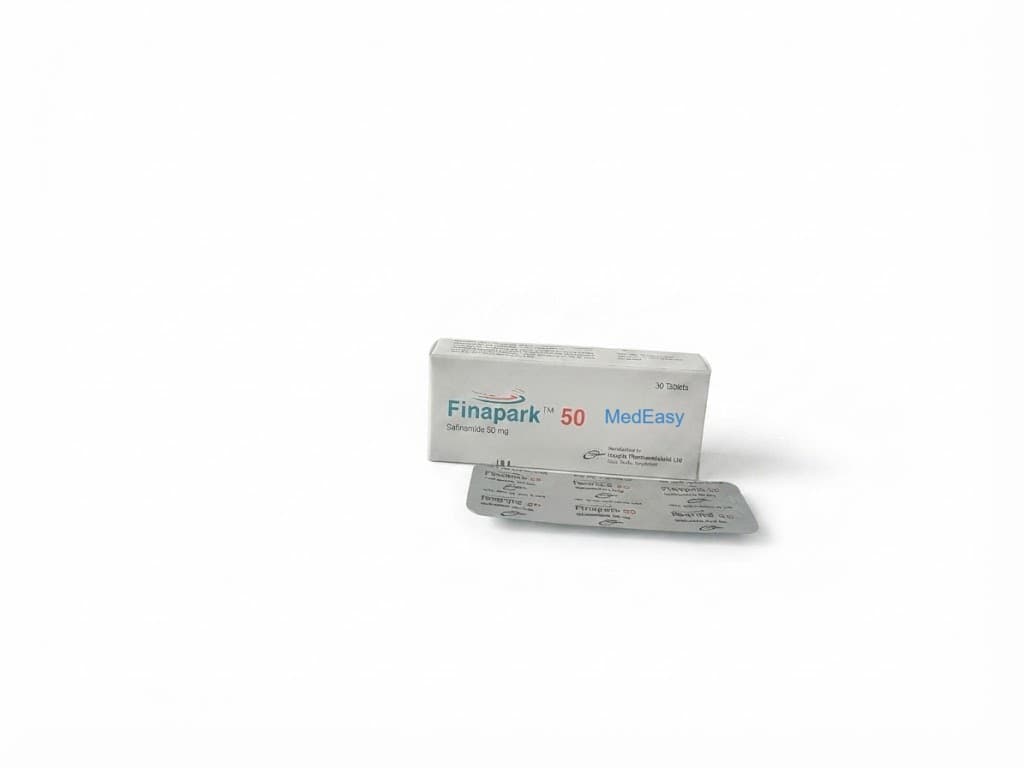

Medicine overview
Indications of Finapark
Finapark is indicated as an adjunctive (add-on) treatment to levodopa/carbidopain adult patients with Parkinson's disease who are experiencing "off" episodes (periods when levodopa's effectwears off and Parkinsonian symptoms return).
- FDA-approved use: Add-on therapy to levodopa/carbidopa for Parkinson's disease patients with motor fluctuations ("off" time), used to help reduce the amount of daily "off" time and increase "on" time without troublesome dyskinesia.
- Requires combination therapy: Finapark is not used as a standalone (monotherapy) treatment for Parkinson's disease; it must be given together with levodopa/carbidopa.
Finapark is not approved and should not be used for other neurological or psychiatric conditions unless specifically directed by a physician.
Composition
Each tablet contains Safinamide Mesylate equivalent to safinamide base, commonly available in strengths of50 mg and 100 mg, along with pharmaceutically acceptable excipients.
Description
Finapark is an oral antiparkinsonian agent that acts as a selective, reversible inhibitor ofmonoamine oxidase type B (MAO-B), with additional glutamate-modulating activity. It is used together withlevodopa/carbidopa to manage motor fluctuations in Parkinson's disease.
By reversibly and selectively blocking MAO-B, Finapark slows the breakdown of dopamine in the brain, prolongingand enhancing the effect of levodopa. It also blocks voltage-dependent sodium channels and modulates abnormalrelease of glutamate, a mechanism thought to contribute to its effect on "off" episodes independent of dopamine.
Therapeutic Class
Finapark belongs to the antiparkinsonian drug class, specifically the monoamine oxidase type B (MAO-B) inhibitors, used as adjunctive therapy in Parkinson's disease.
Pharmacology
Mechanism
Safinamide Mesylate is a highly selective and reversible inhibitor of MAO-B, the enzyme primarily responsiblefor breaking down dopamine in the brain. By inhibiting MAO-B, Safinamide Mesylate increases extracellular dopamine levels andprolongs the therapeutic effect of levodopa.
Unlike older MAO-B inhibitors, Safinamide Mesylate also has a distinct, non-dopaminergic mechanism: it blocks voltage-dependentsodium channels and modulates excessive glutamate release, which may contribute to control of motor fluctuationsand reduce excitotoxicity.
Pharmacokinetics
Safinamide Mesylate is well absorbed orally, undergoes hepatic metabolism (not primarily via cytochrome P450 enzymes), and iseliminated mainly via the kidneys. It has a long elimination half-life, supporting once-daily dosing, and reachessteady state after about two weeks of continued use.
Dosage & Administration of Finapark
Adult Dose (Parkinson's disease, adjunct to levodopa/carbidopa)
| Step | Dose | Notes |
|---|---|---|
| Starting dose | 50 mg orally once daily | Given in addition to the patient's existing levodopa/carbidopa regimen |
| Maintenance dose | May be increased to 100 mg orally once daily | After at least 2 weeks, based on individual tolerability and response |
Administration
- Take Finapark by mouth once daily, at approximately the same time each day, with or without food.
- Swallow the tablet whole; do not crush or chew unless advised otherwise by a physician.
- If a dose is missed, take it as soon as remembered unless it is almost time for the next dose; do not double the dose.
- Do not stop Finapark abruptly without consulting a physician, as sudden discontinuation may cause withdrawal-type symptoms (see Precautions).
Dose Adjustment in Hepatic Impairment
- Mild hepatic impairment: No dose adjustment generally required.
- Moderate hepatic impairment: Maximum recommended dose is 50 mg once daily.
- Severe hepatic impairment: Finapark is contraindicated (see Contraindications).
Dose Adjustment in Renal Impairment
No dose adjustment is generally required in mild-to-moderate renal impairment. Finapark has not been well studiedin severe renal impairment; use with caution and under close physician supervision if prescribed in this setting.
Administration of Finapark
Finapark is administered orally, once daily at a consistent time, with or without food. Tablets should be swallowed whole with water. Do not discontinue abruptly; any change in dose or stopping treatment should be done under physician guidance.
Interaction of Finapark
The following are well-established, clinically significant interactions with Finapark:
- Other MAO inhibitors (e.g., selegiline, rasagiline, phenelzine, linezolid, intravenous methylene blue):concomitant use is contraindicated due to risk of hypertensive crisis and serotonin syndrome. An adequate washoutperiod is required before switching.
- Opioid analgesics (particularly methadone, meperidine/pethidine and related agents, tramadol):concomitant use is contraindicated because of the risk of serious, potentially fatal reactions including serotoninsyndrome.
- Serotonergic drugs (SSRIs, SNRIs, tricyclic/tetracyclic antidepressants, cyclobenzaprine,dextromethorphan, St. John's Wort): increased risk of serotonin syndrome; combination should generally be avoidedor used only with close monitoring under specialist advice.
- Sympathomimetics (e.g., decongestants, amphetamines, certain stimulants): may increase bloodpressure; use with caution due to added hypertensive risk.
- Levodopa/carbidopa: Finapark is intended to be combined with this therapy, but dyskinesia mayworsen when Finapark is added; a reduction in levodopa dose may be required (see Precautions).
- Alcohol and CNS depressants: may increase drowsiness/somnolence; caution advised, especiallywhen driving or operating machinery.
Always inform the physician of all prescription, over-the-counter, and herbal products being used beforestarting Finapark.
Contraindications
Safinamide Mesylate is contraindicated in the following situations:
- Known hypersensitivity to Safinamide Mesylate or any component of the formulation.
- Concomitant use with other monoamine oxidase (MAO) inhibitors, including selegiline, rasagiline, linezolid,and intravenous methylene blue (risk of hypertensive crisis/serotonin syndrome).
- Concomitant use with certain opioid drugs, specifically methadone, meperidine/pethidine and related opioids,and tramadol (risk of serious, potentially fatal serotonin syndrome).
- Concomitant use with other agents specifically contraindicated per labeling due to serotonergic risk, such ascyclobenzaprine, dextromethorphan, and St. John's Wort.
- Severe hepatic impairment (Child-Pugh Class C).
Side Effects of Finapark
Most side effects of Finapark are mild to moderate. Common and serious effects include:
Common
- Dyskinesia (involuntary movements, often an exacerbation of existing levodopa-induced dyskinesia)
- Falls
- Nausea
- Insomnia
- Headache
Serious (seek prompt medical attention)
- Hypertensive crisis (severe headache, chest pain, visual disturbance, confusion)
- Serotonin syndrome (agitation, hallucinations, rapid heart rate, fever, muscle rigidity/twitching, loss of coordination)
- Sudden onset of sleep during daily activities, including driving
- New or worsening hallucinations or psychotic-like behavior
- New or worsening compulsive/impulse-control behaviors (e.g., gambling, hypersexuality, compulsive eating or shopping)
Patients should report any new or worsening symptoms to their physician promptly.
Pregnancy & Lactation
Pregnancy
Data on the use of Finapark in pregnant women are limited. Animal studies have shown fetal harm atclinically relevant exposures. Finapark should be used during pregnancy only if clearly needed and if the potentialbenefit justifies the potential risk to the fetus; a physician must be consulted before use.
Lactation
It is not known whether Finapark passes into human breast milk. Because of the potential for adverse effects in anursing infant, a decision should be made, in consultation with a physician, whether to discontinue breastfeedingor discontinue Finapark, taking into account the importance of treatment to the mother.
Precautions & Warnings
- Hypertension: Finapark may cause or worsen high blood pressure, including hypertensive crisis inrare cases; blood pressure should be monitored, especially at treatment initiation and dose increases.
- Serotonin syndrome: risk increases with concomitant serotonergic medications (see Interactions);watch for agitation, fever, rapid heartbeat, or muscle rigidity.
- Dyskinesia: Finapark may exacerbate pre-existing levodopa-induced dyskinesia; a reduction inlevodopa dose may be needed.
- Hallucinations/psychotic-like behavior: new or worsening hallucinations, delusions, orconfusion may occur, particularly in elderly patients.
- Impulse control disorders: compulsive behaviors (gambling, hypersexuality, binge eating,compulsive shopping) have been reported with dopaminergic Parkinson's disease therapies as a class; patients andcaregivers should be monitored and advised to report such symptoms.
- Falling asleep during activities/somnolence: some patients have experienced sudden sleeponset without warning; caution with driving or operating machinery is advised.
- Retinal pathology: preclinical studies showed retinal degeneration in some animal species;Finapark should be used with caution in patients with pre-existing retinal disease, and periodic eye examination maybe advised.
- Withdrawal-emergent symptoms: abrupt discontinuation may cause fever, confusion, or worseningof Parkinsonian symptoms (a syndrome resembling neuroleptic malignant syndrome); Finapark should be tapered off undermedical supervision rather than stopped suddenly.
- Hepatic impairment: dose adjustment is required in moderate hepatic impairment, and Finapark iscontraindicated in severe hepatic impairment (see Dosage and Contraindications).
Overdose Effects of Finapark
Limited clinical experience with overdose of Finapark is available. Based on its mechanism, overdosemay be expected to cause exaggerated pharmacologic effects such as marked hypertension, agitation, confusion,hallucinations, serotonin syndrome, or excessive sedation.
If an overdose is suspected, seek immediate medical attention or contact a poison control centerright away. Treatment is supportive and symptomatic and should be carried out under medical/hospital supervision;there is no specific antidote. Do not attempt home treatment for a suspected overdose.
Storage Conditions
Store at room temperature (below 30°C), away from light and moisture. Keep out of reach of children.
Use In Special Populations
- Elderly: No specific dose adjustment is required based on age alone; elderly patients may bemore susceptible to hallucinations, confusion, and dizziness, so monitor closely.
- Renal impairment: No adjustment generally needed in mild-to-moderate impairment; use withcaution in severe renal impairment (limited data).
- Hepatic impairment: No adjustment in mild impairment; maximum 50 mg once daily in moderateimpairment; contraindicated in severe impairment (see Contraindications).
- Pediatric patients: Safety and efficacy of Finapark have not been established in children, asParkinson's disease is predominantly an adult condition.
Duration Of Treatment
Finapark is intended for long-term, chronic use as adjunctive Parkinson's disease therapy, for aslong as the physician determines that the benefits outweigh the risks. Treatment response and side effects shouldbe reassessed periodically. Finapark should not be discontinued abruptly; if treatment needs to stop, the physicianwill generally taper the dose to reduce the risk of withdrawal-emergent symptoms.
Drug Classes
Antiparkinsonian agents; Monoamine oxidase type B (MAO-B) inhibitors
Mode Of Action
Safinamide Mesylate works through a dual mechanism. First, as a highly selective, reversible inhibitor ofmonoamine oxidase type B (MAO-B), it reduces the breakdown of dopamine in the brain, increasing dopaminergicactivity and prolonging the benefit of levodopa. Second, independent of MAO-B inhibition, it blocksvoltage-dependent sodium channels and modulates abnormal glutamate release, which is believed to help controlmotor fluctuations and may reduce glutamate-related excitotoxicity in Parkinson's disease.
Pediatric Uses
The safety and efficacy of Finapark in pediatric patients have not been established. Parkinson'sdisease is very rare in children, and Finapark is not indicated for use in this population. It should not be given tochildren or adolescents outside of a physician-directed, exceptional clinical circumstance.
Frequently Asked Questions
Q: What is Finapark 50 mg Tablet used for?
A: Finapark 50 mg Tablet is used as an add-on (adjunctive) medicine together with levodopa/carbidopa to treat adults with Parkinson's disease who experience "off" episodes, when the effect of levodopa wears off between doses.
Q: Can Finapark 50 mg Tablet be used alone, without levodopa?
A: No. Finapark 50 mg Tablet is only approved as an adjunct to levodopa/carbidopa therapy; it has not been studied and is not indicated as a standalone treatment for Parkinson's disease.
Q: What medicines should never be combined with Finapark 50 mg Tablet?
A: Finapark 50 mg Tablet must not be taken with other MAO inhibitors, or with certain opioid medicines such as methadone, meperidine/pethidine, or tramadol, because combining these can cause a dangerous reaction including hypertensive crisis or serotonin syndrome. Always tell your physician about every medicine, supplement, and herbal product you take before starting Finapark 50 mg Tablet.
Q: Is Finapark 50 mg Tablet safe during pregnancy?
A: Data are limited, and animal studies suggest possible fetal harm. Finapark 50 mg Tablet should be used in pregnancy only if clearly needed and if the potential benefit to the mother justifies the potential risk to the baby; this decision should always be made with a physician.
Q: What should I do if I miss a dose or want to stop taking Finapark 50 mg Tablet?
A: If you miss a dose, take it as soon as you remember unless it is almost time for the next dose - do not double up. Do not stop Finapark 50 mg Tablet suddenly on your own, as abrupt discontinuation can cause fever, confusion, or worsening of Parkinson's symptoms; any change in treatment should be guided by your physician, usually with a gradual dose reduction.
Q: What are the most important side effects to watch for with Finapark 50 mg Tablet?
A: Watch for signs of high blood pressure or hypertensive crisis (severe headache, chest pain), serotonin syndrome (agitation, fever, rapid heartbeat, muscle rigidity), sudden sleepiness during daily activities, new hallucinations or confusion, and new compulsive behaviors such as gambling or overeating. Report any of these to your physician promptly.
Disclaimer
The information provided is accurate to the best of our knowledge, but it does not replace professional medical advice. We cannot guarantee its completeness or accuracy, and the absence of specific information about a drug should not be taken as an endorsement. We are not responsible for any consequences arising from this information, so please consult a healthcare professional for any concerns or questions.
