
Key facts
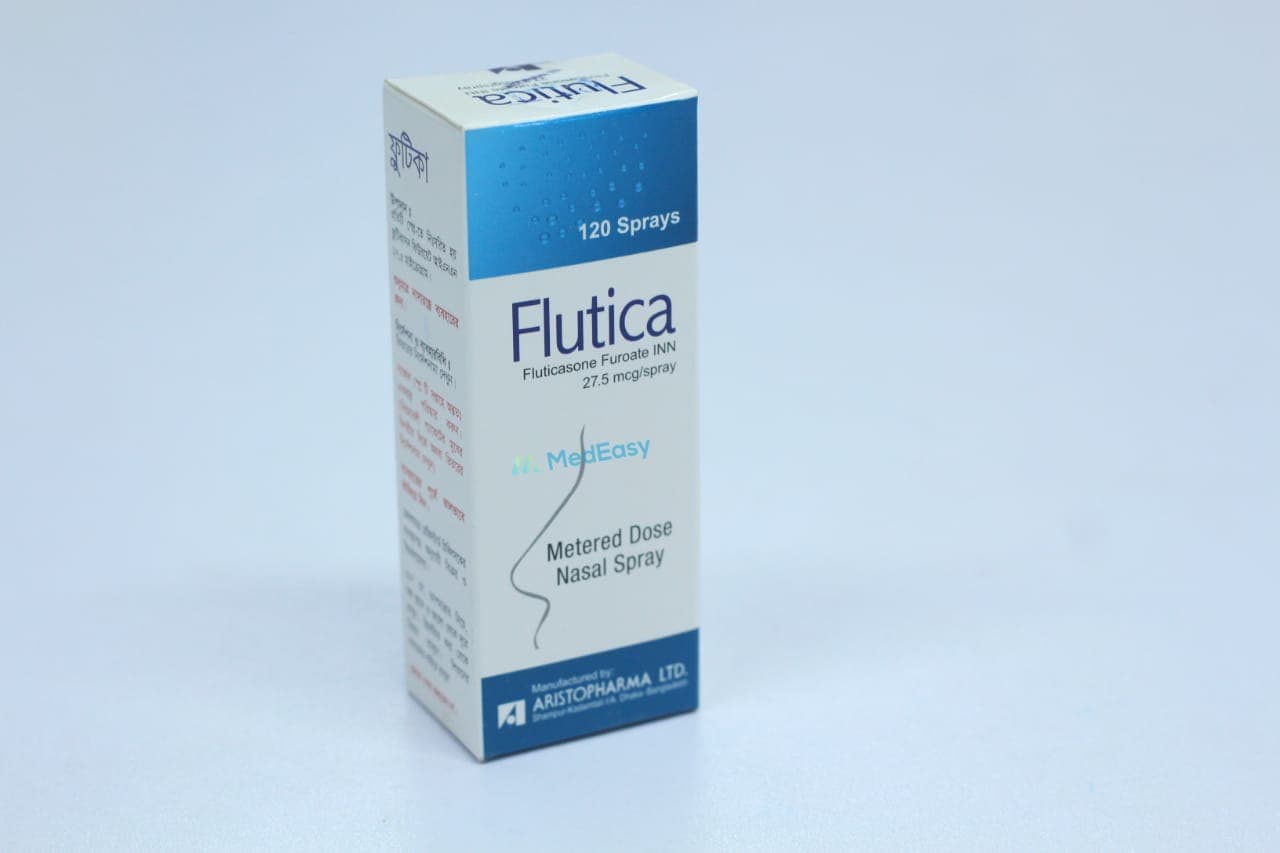
Flutica 27.5 spray Nasal Spray is available on MedEasy for ৳253.00 per 120 metered sprays, with home delivery anywhere in Bangladesh. It is manufactured by Aristopharma Ltd. Its generic name is Fluticasone Furoate.
- Pack sizes
- 120 metered sprays
- Prescription
- Not required (over-the-counter).
- Delivery
- Home delivery across Bangladesh. Same-day delivery in Dhaka, Chattogram, Sylhet and Bogura city areas; 2-3 days elsewhere.
- Payment
- Cash on delivery, bKash, cards and mobile banking.
- Brand
- Flutica
- Generic name
- Fluticasone Furoate
- Manufacturer
- Aristopharma Ltd.
- Form & strength
- Nasal Spray 27.5 spray
- Availability
- In stock
- Authenticity
- Sourced from licensed suppliers and the manufacturer's authorised distributors in Bangladesh.

Medicine overview
Indications of Flutica
Flutica is a synthetic trifluorinated corticosteroid used topically (intranasally and by oral inhalation) for its potent local anti-inflammatory effect. Its approved uses differ by dosage form and are classified below by strength of evidence.
FDA-Approved / Established Indications
- Allergic rhinitis (nasal spray): Treatment of nasal symptoms (congestion, rhinorrhea, sneezing, itching) and ocular symptoms of seasonal and perennial allergic rhinitis in adults and children aged 2 years and older.
- Maintenance treatment of asthma (oral inhalation powder): Once-daily maintenance treatment of asthma in patients aged 5 years and older, as monotherapy or, where prescribed, in combination with a long-acting beta-agonist (e.g. vilanterol) for patients not adequately controlled on an inhaled corticosteroid alone.
Important Limitation
Flutica inhalation powder is a maintenance medicine only and is not indicated for the relief of acute bronchospasm or acute asthma exacerbations; a separate fast-acting rescue inhaler must be used for acute symptoms.
Composition
Each formulation of Fluticasone Furoate contains the active ingredient fluticasone furoate as its sole corticosteroid component.
- Nasal spray: Aqueous suspension delivering 27.5 mcg of Fluticasone Furoate per metered spray, with excipients including microcrystalline cellulose, carboxymethylcellulose sodium, dextrose, and a preservative (benzalkonium chloride) in a purified water base.
- Inhalation powder: Dry powder for oral inhalation delivering 50 mcg, 100 mcg, or 200 mcg of Fluticasone Furoate per actuation, blended with lactose monohydrate (which contains milk proteins) as a carrier.
Description
Flutica is a synthetic, enhanced-affinity corticosteroid used as a topical anti-inflammatory agent in the treatment of allergic rhinitis (as an intranasal spray) and as maintenance therapy for asthma (as a dry-powder inhaler). It has high affinity for the glucocorticoid receptor and, at approved doses, exerts predominantly local anti-inflammatory action on the nasal mucosa or airway epithelium with low systemic bioavailability due to extensive first-pass hepatic metabolism.
Flutica is not a bronchodilator and does not relieve acute symptoms; it must be used regularly for its anti-inflammatory benefit to develop.
Therapeutic Class
Flutica belongs to the class of synthetic corticosteroids, specifically formulated as an intranasal corticosteroid (for allergic rhinitis) and an inhaled corticosteroid (ICS) (for asthma maintenance).
Pharmacology
Fluticasone Furoate is a trifluorinated synthetic corticosteroid with very high binding affinity for the glucocorticoid receptor. After binding, it modulates gene transcription to suppress multiple components of the inflammatory cascade, including reduction in the number and activation of inflammatory cells (eosinophils, mast cells, lymphocytes) and inhibition of release of inflammatory mediators (histamine, prostaglandins, leukotrienes, cytokines).
Applied intranasally, Fluticasone Furoate reduces mucosal edema, mucus secretion, and vascular permeability, relieving nasal congestion, rhinorrhea, sneezing, and itching. Applied by oral inhalation, it reduces airway inflammation, hyperresponsiveness, and mucus hypersecretion, improving asthma control over time.
Systemic bioavailability is low (nasal spray: essentially undetectable systemically at recommended doses; inhaled: absolute bioavailability approximately 15.2%) owing to minimal gastrointestinal absorption of swallowed drug and extensive first-pass hepatic metabolism via CYP3A4 to an inactive metabolite. Onset of symptom relief typically begins within hours to a day, with maximal benefit after several days to weeks of regular use.
Dosage & Administration of Flutica
Dosing of Flutica depends on the indication, dosage form, and patient age. It should be used regularly, not on an as-needed basis, for full benefit.
| Indication / Form | Age Group | Recommended Dose |
|---|---|---|
| Allergic rhinitis (nasal spray, 27.5 mcg/spray) | Adults & adolescents ≥12 years | 2 sprays (55 mcg total) in each nostril once daily; may reduce to 1 spray per nostril once daily after symptoms are controlled |
| Children 2–11 years | 1 spray in each nostril once daily; may increase to 2 sprays per nostril once daily if response is inadequate, then reduce once controlled | |
| Children <2 years | Safety and efficacy not established | |
| Asthma maintenance (oral inhalation powder) | Adults & adolescents ≥12 years | 100 mcg once daily; may increase to 200 mcg once daily if inadequately controlled (maximum 200 mcg/day) |
| Children 5–11 years | 50 mcg once daily | |
| Children <5 years | Safety and efficacy not established |
The inhalation form of Flutica must be taken with a separate fast-acting rescue bronchodilator available for acute symptoms; it is not a substitute for a rescue inhaler. See Administration for device-specific technique.
Administration of Flutica
Nasal Spray
- Shake gently before each use and prime before first use or after prolonged non-use, per the package leaflet.
- Blow the nose gently to clear nasal passages, then tilt the head slightly forward.
- Insert the nozzle into one nostril, point away from the nasal septum, and spray while breathing in gently through the nose; repeat in the other nostril as directed.
- Avoid spraying into the eyes. Do not use with the bottle upright shaken/stored improperly; store upright and do not freeze.
Inhalation Powder
- Administer by oral inhalation only, using the supplied inhaler device; do not use with a spacer.
- Open the device cover fully until it clicks (this readies the dose); do not shake.
- Exhale fully away from the device, place mouthpiece between lips, inhale one long, steady, deep breath, then hold breath for about 3–4 seconds.
- Rinse the mouth with water and spit out (do not swallow) after each inhalation to reduce the risk of oral candidiasis and hoarseness.
- Flutica inhalation powder is for maintenance use only; it does not relieve sudden breathing problems and a rescue inhaler should always be available.
Interaction of Flutica
The most clinically significant interaction involves strong CYP3A4 inhibitors (e.g., ritonavir, ketoconazole, itraconazole, voriconazole, clarithromycin, cobicistat-containing products). Because Flutica is metabolized primarily via hepatic CYP3A4, coadministration with strong CYP3A4 inhibitors can substantially increase systemic corticosteroid exposure, raising the risk of Cushing's syndrome and adrenal suppression. Concomitant use should generally be avoided; if unavoidable, the patient should be monitored closely for systemic corticosteroid effects.
Other corticosteroids (oral, inhaled, intranasal, or topical) used concurrently may have an additive effect on systemic corticosteroid exposure; the total corticosteroid burden should be considered.
Contraindications
- Known hypersensitivity to Fluticasone Furoate or to any excipient in the formulation.
- Severe hypersensitivity to milk proteins (relevant to the inhalation powder, which uses a lactose carrier containing trace milk proteins).
- Primary treatment of status asthmaticus or other acute asthma episodes requiring intensive measures — Fluticasone Furoate inhalation powder is not indicated for acute bronchospasm relief.
Side Effects of Flutica
| Formulation | Common Side Effects | Less Common / Serious |
|---|---|---|
| Nasal spray | Epistaxis (nosebleed), nasal irritation/ulceration, headache, nasopharyngitis, back pain | Nasal septal perforation, impaired wound healing, vision changes, signs of systemic corticosteroid effect (rare at recommended doses) |
| Inhalation powder | Nasopharyngitis, upper respiratory tract infection, headache, oropharyngeal (oral) candidiasis, hoarseness/dysphonia, bronchitis | Paradoxical bronchospasm, pneumonia (in COPD patients using combination products), adrenal suppression, decreased bone mineral density, growth suppression in children, cataracts, glaucoma |
Rinsing the mouth after each inhaled dose of Flutica reduces the risk of oral candidiasis and hoarseness. Patients should seek prompt medical advice for vision changes, signs of infection, or unusual bruising/weakness.
Pregnancy & Lactation
Pregnancy: Data on Flutica use in human pregnancy are limited. Intranasal and inhaled corticosteroids are generally considered to carry lower systemic exposure than oral corticosteroids, but Flutica should be used during pregnancy only if the potential benefit justifies the potential risk to the fetus. Uncontrolled asthma during pregnancy poses its own risks to mother and fetus, so therapy should not be stopped without medical advice. Consult a physician before use.
Lactation: It is not known whether Flutica is present in human milk in clinically significant amounts. Because many corticosteroids are excreted in breast milk in small quantities, caution is advised, and a physician should be consulted to weigh the benefits of treatment against any potential risk to the breastfed infant.
Precautions & Warnings
- Not for acute symptoms: Flutica inhalation powder does not relieve acute bronchospasm; a rescue bronchodilator must remain available.
- Infections: Use with caution in patients with active or quiescent tuberculosis, untreated fungal, bacterial, viral, or parasitic infections, or ocular herpes simplex. Avoid exposure to chickenpox or measles in patients not previously infected or vaccinated; seek medical advice promptly if exposed.
- Hypercorticism and adrenal suppression: May occur with higher-than-recommended doses or prolonged use, or when combined with strong CYP3A4 inhibitors (see Interactions). When transferring patients from systemic corticosteroids, taper slowly to avoid adrenal insufficiency.
- Growth effects: Long-term use in children may cause a small reduction in growth velocity; growth should be monitored routinely.
- Bone mineral density: Long-term, high-dose use may decrease bone mineral density; consider monitoring in patients with risk factors.
- Ocular effects: Long-term use may increase risk of glaucoma and posterior subcapsular cataracts; monitor patients with a history of increased intraocular pressure, glaucoma, or cataracts, and report visual changes promptly.
- Nasal effects: The nasal spray may cause septal perforation or delayed wound healing; avoid use in patients with recent nasal ulcers, surgery, or trauma until healed.
- Paradoxical bronchospasm: Discontinue the inhalation form immediately and treat with a fast-acting bronchodilator if paradoxical bronchospasm occurs.
- Hypersensitivity reactions: Rare cases of angioedema, urticaria, rash, and anaphylaxis have been reported; discontinue if these occur.
Overdose Effects of Flutica
Acute overdose with Flutica is unlikely to cause immediate life-threatening symptoms because of its low systemic bioavailability, but chronic use of doses higher than recommended may lead to systemic corticosteroid effects, including adrenal suppression, features of Cushing's syndrome, and, in children, growth suppression. There is no specific antidote.
If an overdose or excessive use of Flutica is suspected, seek immediate medical attention or contact a poison control center. Treatment is supportive, with monitoring of adrenal (hypothalamic-pituitary-adrenal axis) function as clinically indicated; the drug should be tapered rather than abruptly discontinued if used chronically at high doses.
Storage Conditions
Store at room temperature (20-25°C / 68-77°F), away from direct heat, light, and moisture. Store the nasal spray bottle in an upright position and do not freeze; discard after the labeled number of sprays has been used. Keep the inhalation powder device in its sealed, moisture-protective tray until ready for use, and discard 6 weeks after removal from the tray or when the dose counter reads "0", whichever comes first. Keep out of reach of children.
Use In Special Populations
Renal impairment: No dedicated studies; because systemic exposure to Flutica is low and elimination is primarily hepatic, dose adjustment is not generally required, but caution is advised in severe renal impairment.
Hepatic impairment: Flutica is extensively metabolized by the liver. Patients with moderate to severe hepatic impairment may have increased systemic exposure and higher risk of systemic corticosteroid effects; use the lowest effective dose and monitor closely.
Elderly: No overall differences in safety or effectiveness have been observed compared with younger adults; no dose adjustment is generally required, though age-related comorbidities (e.g., osteoporosis, glaucoma) warrant monitoring.
Pediatric: See Pediatric Uses for approved age ranges and growth monitoring recommendations.
Duration Of Treatment
For allergic rhinitis, Flutica nasal spray may be used for the duration of seasonal exposure or continuously for perennial symptoms, under medical guidance; if symptoms do not improve within a few days, or if they worsen, the patient should consult a physician.
For asthma maintenance, Flutica inhalation powder is intended for long-term, regular daily use as part of an ongoing asthma management plan; it is not a short-course therapy. Maximum benefit may take 1–2 weeks or longer to become apparent, and treatment should not be stopped abruptly without medical advice, even if symptoms improve.
Drug Classes
Corticosteroid — Intranasal Corticosteroid (INS) / Inhaled Corticosteroid (ICS)
Mode Of Action
Fluticasone Furoate binds with very high affinity to the intracellular glucocorticoid receptor. The activated receptor complex translocates to the cell nucleus, where it modulates the transcription of genes involved in inflammation — upregulating anti-inflammatory proteins and downregulating pro-inflammatory cytokines, chemokines, and enzymes (e.g., via inhibition of NF-κB and AP-1 pathways).
The net effect is suppression of eosinophilic and other inflammatory cell recruitment and activation, reduced vascular permeability and mucosal edema, and decreased mucus secretion — producing symptomatic relief in allergic rhinitis and improved airway inflammation control in asthma. Fluticasone Furoate has minimal mineralocorticoid activity and is designed for high local potency with low systemic availability when used at recommended doses.
Pregnancy
C
Pediatric Uses
Allergic rhinitis (nasal spray): Approved for children aged 2 years and older, at a lower starting dose (1 spray per nostril once daily) than adults. Safety and efficacy of Flutica nasal spray have not been established in children under 2 years of age.
Asthma maintenance (inhalation powder): Approved for children aged 5 years and older, at a lower dose (50 mcg once daily) than adolescents/adults. Safety and efficacy have not been established in children under 5 years of age.
As with other corticosteroids, long-term use of Flutica in children should be accompanied by routine monitoring of growth velocity, since inhaled and intranasal corticosteroids may cause a small reduction in growth rate. The lowest effective dose that maintains adequate control should always be used in pediatric patients.
Frequently Asked Questions
Q: What is Flutica 27.5 spray Nasal Spray used for?
A: Flutica 27.5 spray Nasal Spray is a corticosteroid used as a nasal spray to relieve symptoms of seasonal and perennial allergic rhinitis (such as congestion, sneezing, and runny nose), and as an inhaler for the once-daily maintenance treatment of asthma in appropriately selected patients.
Q: How quickly does Flutica 27.5 spray Nasal Spray work?
A: Some relief from Flutica 27.5 spray Nasal Spray nasal spray may be noticed within a few hours, but full benefit for allergic rhinitis can take several days of regular use. For asthma, Flutica 27.5 spray Nasal Spray inhalation powder requires regular daily use, with maximum benefit typically seen after 1–2 weeks or longer; it is not a fast-acting rescue medicine.
Q: Can I use Flutica 27.5 spray Nasal Spray inhaler for a sudden asthma attack?
A: No. Flutica 27.5 spray Nasal Spray inhalation powder is a maintenance medicine only and does not relieve sudden breathing difficulty or an acute asthma attack. A separate fast-acting rescue inhaler, as prescribed by your physician, must always be available for acute symptoms.
Q: What are the common side effects of Flutica 27.5 spray Nasal Spray?
A: With the nasal spray, common effects include nosebleed, nasal irritation, and headache. With the inhaler, common effects include sore throat, headache, and oral thrush (candidiasis) — rinsing the mouth with water after each inhaled dose of Flutica 27.5 spray Nasal Spray and spitting it out helps reduce this risk.
Q: Is Flutica 27.5 spray Nasal Spray safe to use during pregnancy or while breastfeeding?
A: Flutica 27.5 spray Nasal Spray should be used during pregnancy or breastfeeding only if clearly needed and if the potential benefit justifies the potential risk, since data in humans are limited. Do not start or stop Flutica 27.5 spray Nasal Spray without first consulting your physician, especially if you have asthma, as uncontrolled asthma itself carries risks in pregnancy.
Q: Can children use Flutica 27.5 spray Nasal Spray?
A: Yes, in approved age groups: the nasal spray is approved from age 2 years and the inhaler from age 5 years, both at lower doses than for adults. Children on long-term Flutica 27.5 spray Nasal Spray therapy should have their growth monitored periodically by a physician.
Disclaimer
The information provided is accurate to the best of our knowledge, but it does not replace professional medical advice. We cannot guarantee its completeness or accuracy, and the absence of specific information about a drug should not be taken as an endorsement. We are not responsible for any consequences arising from this information, so please consult a healthcare professional for any concerns or questions.