
10% Off
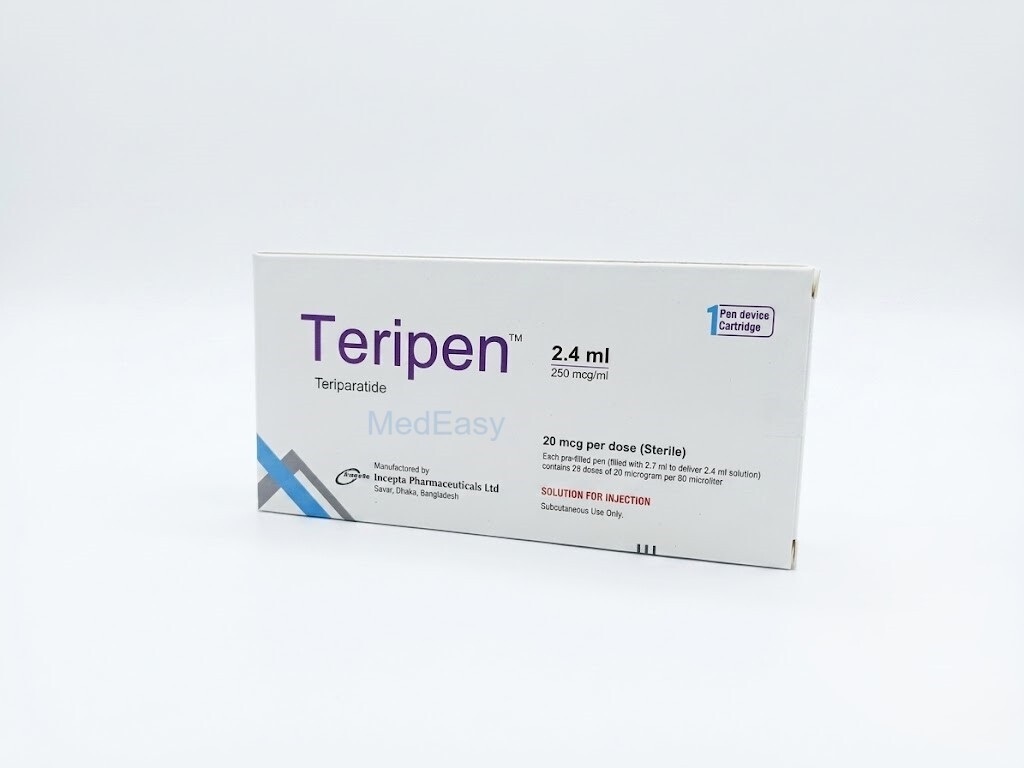
Teripen20 mcg/80
Incepta Pharmaceuticals Ltd.
৳8550.00
Add to cart


Forteo is indicated for the treatment of osteoporosis in specific high-risk patient groups where the goal is to increase bone mass and reduce fracture risk.
Forteo is an anabolic (bone-forming) agent and is generally reserved for patients with severe osteoporosis or those who have not responded adequately to antiresorptive therapy, based on specialist assessment.
Each pre-filled pen/cartridge contains Teriparatide (recombinant human parathyroid hormone, amino acid sequence 1-34) as the active ingredient, formulated as a sterile, clear, colorless solution for subcutaneous injection, along with excipients such as glacial acetic acid, sodium acetate, mannitol, metacresol (as a preservative), and water for injection.
Forteo is a recombinant form of human parathyroid hormone consisting of the biologically active 1-34 amino acid fragment. It is a bone-forming (anabolic) agent used for the treatment of osteoporosis, in contrast to antiresorptive agents (such as bisphosphonates) that work primarily by slowing bone breakdown. Forteo is administered as a once-daily subcutaneous injection using a pre-filled pen device, typically for a limited treatment duration.
Forteo belongs to the class of parathyroid hormone analogs, classified as an anabolic (bone-forming) agent used in the management of osteoporosis. It is distinct from antiresorptive drug classes such as bisphosphonates, selective estrogen receptor modulators (SERMs), and RANKL inhibitors.
Teriparatide is identical to the N-terminal 34-amino-acid fragment of endogenous human parathyroid hormone (PTH), which is the portion responsible for its biological activity.
Endogenous PTH, when secreted continuously (as in hyperparathyroidism), promotes bone resorption. When Teriparatide is administered once daily by injection, it produces an intermittent, pulsatile exposure that preferentially stimulates osteoblast (bone-forming cell) activity over osteoclast activity. This results in a net increase in bone formation, improved bone microarchitecture, and increased bone mineral density, particularly at the lumbar spine and femoral neck.
After subcutaneous injection, Teriparatide is rapidly absorbed, reaching peak plasma concentration within approximately 30 minutes, with an elimination half-life of about 1 hour. It is cleared by hepatic and peripheral metabolism, with renal excretion of metabolites.
| Indication | Dose |
|---|---|
| Osteoporosis in postmenopausal women, men, and glucocorticoid-induced osteoporosis | 20 micrograms (mcg) subcutaneously once daily, injected into the thigh or abdominal wall |
Forteo is administered as a subcutaneous injection using a pre-filled pen, typically self-administered by the patient at approximately the same time each day. The first one or more doses should be given where the patient can sit or lie down, in case of orthostatic hypotension. Rotate injection sites and follow the specific pen device instructions provided with the product.
Use with caution in patients with moderate renal impairment; not recommended in patients with severe renal impairment due to limited data.
No specific dose adjustment has been established; use with caution.
Inject Forteo subcutaneously into the thigh or abdominal wall once daily, at approximately the same time each day, using the pre-filled pen. Administer the first few doses in a setting where the patient can sit or lie down promptly if symptoms of dizziness or lightheadedness occur. Do not inject into a vein or muscle. Each pen should be used by only one patient.
Forteo causes transient increases in serum calcium, which may theoretically potentiate the effects of digoxin; caution is advised in patients taking digoxin.
Concomitant use of loop diuretics may increase the risk of hypercalcemia when combined with Forteo.
Concurrent use of Forteo with bisphosphonates is generally not recommended, as it may attenuate the bone-forming effect of Forteo.
Teriparatide is contraindicated in patients with known hypersensitivity to Teriparatide or any component of the formulation, and in patients with conditions associated with an increased baseline risk of osteosarcoma or other malignant bone conditions, including:
It is also contraindicated in patients with:
Common side effects associated with Forteo include:
Less common but clinically important effects include transient orthostatic hypotension shortly after dosing (see Precautions) and hypercalcemia. Seek prompt medical attention for signs of a severe allergic reaction (rash, swelling of the face or throat, severe dizziness, difficulty breathing).
Forteo is not indicated for use in women of childbearing potential, and there is limited data on its use during pregnancy or breastfeeding, since the approved population (postmenopausal women, men, and glucocorticoid-induced osteoporosis patients) does not typically include women who are or may become pregnant. If exposure occurs during pregnancy or lactation, Forteo should be used only if clearly needed and the potential benefit justifies the potential risk to the fetus or infant; a physician should be consulted before use in any such situation.
Forteo products have historically carried a boxed warning regarding a dose- and duration-dependent increase in osteosarcoma (a type of bone cancer) observed in rodent studies at systemic exposures relevantly higher than in humans; this signal has not been confirmed in extensive human post-marketing surveillance, and current labeling in many markets has updated this warning language accordingly, though precautionary measures are still followed.
Overdose of Forteo may result in hypercalcemia, nausea, vomiting, hypotension, and dizziness. There is no specific antidote. If overdose is suspected, seek immediate medical attention or contact a poison control center. Management is supportive, guided by the treating physician, and may include monitoring of serum calcium and symptomatic treatment as appropriate.
Store Forteo pens in a refrigerator (2°C to 8°C) at all times, including during use. Do not freeze. Always recap the pen after each use and keep it away from light. Discard the pen 28 days after first use, even if some solution remains. Keep out of reach of children.
Use with caution in mild to moderate renal impairment; not recommended in severe renal impairment due to limited safety data.
Limited data available; use Forteo with caution.
No overall differences in safety or efficacy have been observed in elderly patients compared to younger adults; no dose adjustment is required based on age alone.
Forteo is contraindicated in pediatric patients and young adults with open epiphyses due to the theoretical risk of osteosarcoma (see Contraindications and Pediatric Uses).
The maximum recommended lifetime duration of treatment with Forteo is limited per product labeling (commonly up to 24 months, cumulative across any courses of treatment), based on precautionary limits established due to the osteosarcoma signal observed in animal studies. Patients should not exceed this maximum cumulative exposure. The specific maximum duration should be confirmed with the prescribing physician based on the current approved labeling.
Parathyroid hormone analog; anabolic (bone-forming) agent; osteoporosis therapy.
Teriparatide, given as a once-daily intermittent subcutaneous dose, binds to PTH receptors on osteoblasts, stimulating new bone formation on both trabecular and cortical bone surfaces. This anabolic action increases bone mineral density and improves bone microarchitecture, which is believed to translate into reduced fracture risk, in contrast to the continuous PTH exposure seen in hyperparathyroidism, which favors bone resorption.
C
The safety and efficacy of Forteo have not been established in pediatric patients. Forteo is contraindicated in children and young adults with open epiphyses (open growth plates) due to a theoretical risk of osteosarcoma observed in animal studies, and should not be used in this population outside of specialist-directed care where benefit-risk has been individually assessed for a rare, specific indication.
Q: What is Forteo 20 mcg/80 mcl SC Injection used for?
A: Forteo 20 mcg/80 mcl SC Injection is used to treat osteoporosis in postmenopausal women and men at high risk of fracture, and in men and women with glucocorticoid-induced osteoporosis. It works by stimulating new bone formation.
Q: How is Forteo 20 mcg/80 mcl SC Injection given?
A: Forteo 20 mcg/80 mcl SC Injection is given as a subcutaneous (under the skin) injection once daily, usually in the thigh or abdominal wall, using a pre-filled pen device.
Q: How long can I use Forteo 20 mcg/80 mcl SC Injection?
A: Forteo 20 mcg/80 mcl SC Injection is used for a limited duration only. Lifetime cumulative exposure should not exceed the maximum duration specified in the product labeling (commonly up to 24 months), due to a bone cancer (osteosarcoma) signal seen in animal studies, which has not been confirmed in extensive human data. Your physician will advise on the exact duration appropriate for you.
Q: Can Forteo 20 mcg/80 mcl SC Injection cause bone cancer?
A: Forteo 20 mcg/80 mcl SC Injection carries a historical warning about osteosarcoma (a type of bone cancer) based on findings in rodent studies at high doses; this has not been confirmed in extensive human post-marketing data. As a precaution, Forteo 20 mcg/80 mcl SC Injection is not used in patients with conditions that already raise osteosarcoma risk, such as Paget's disease of bone, unexplained elevated alkaline phosphatase, open growth plates, or prior radiation therapy to the skeleton.
Q: What should I do if I feel dizzy after my Forteo 20 mcg/80 mcl SC Injection injection?
A: Some patients experience transient dizziness or lightheadedness (orthostatic hypotension) shortly after injection, especially with the first few doses. It is advisable to sit or lie down when injecting the first doses until you know how you respond. If dizziness persists or is severe, contact your physician.
Q: Can Forteo 20 mcg/80 mcl SC Injection be used during pregnancy?
A: Forteo 20 mcg/80 mcl SC Injection is not intended for use in women who are or may become pregnant, and there is limited data on its use in pregnancy or breastfeeding. It should only be used in pregnancy or lactation if clearly needed and after consulting a physician, since the potential benefit must be weighed against potential risk to the fetus or infant.
Disclaimer
The information provided is accurate to the best of our knowledge, but it does not replace professional medical advice. We cannot guarantee its completeness or accuracy, and the absence of specific information about a drug should not be taken as an endorsement. We are not responsible for any consequences arising from this information, so please consult a healthcare professional for any concerns or questions.
