
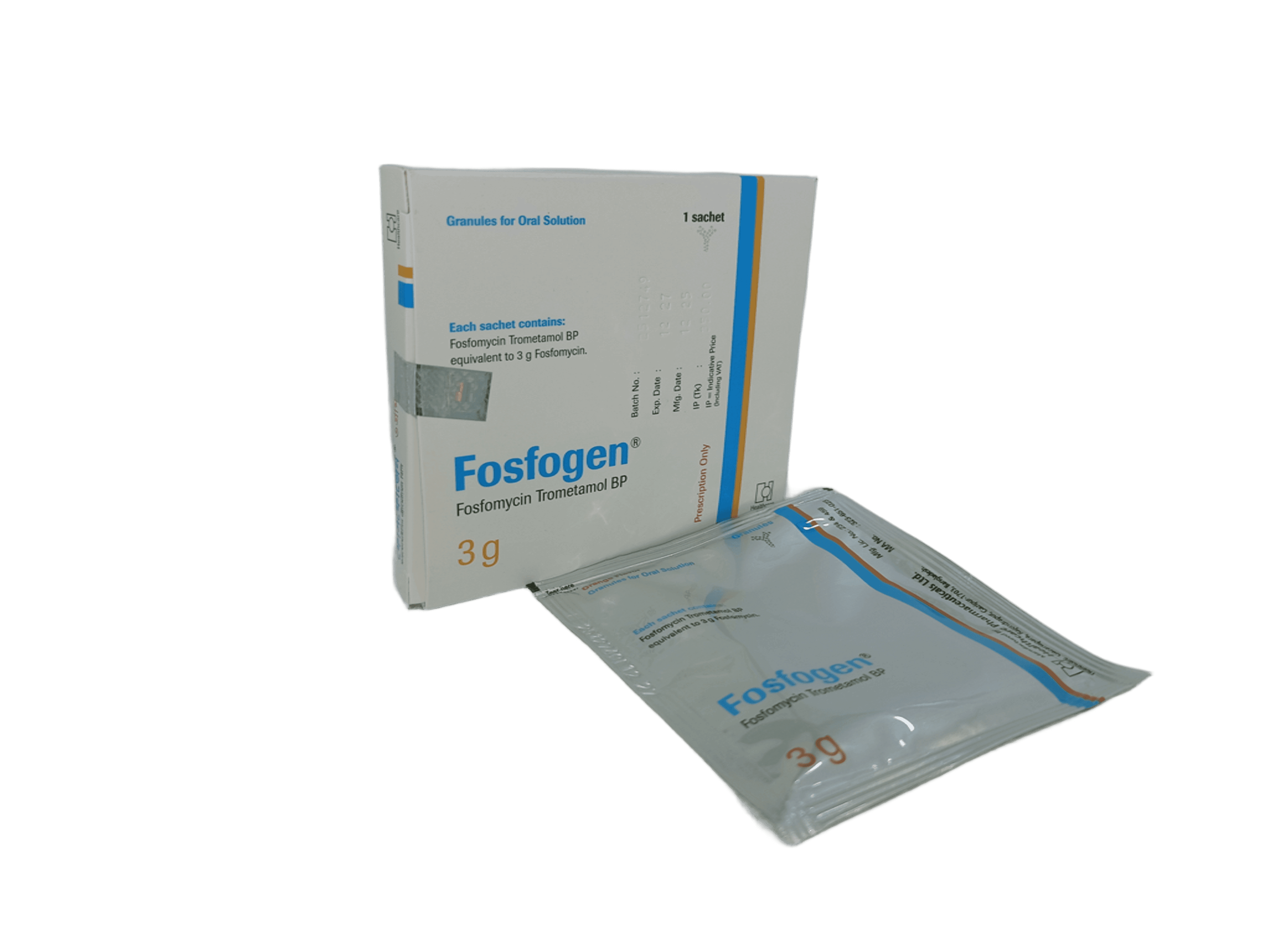

Medicine overview
Indications of Fosfogen
Fosfogen is indicated for the following use:
- Uncomplicated urinary tract infection (acute cystitis) in women: Fosfogen is FDA-approved as a single-dose oral treatment for acute cystitis caused by susceptible strains of Escherichia coli and Enterococcus faecalis in female patients 12 years of age and older. This is an established, guideline-supported indication.
Not indicated for: Fosfogen is not indicated for the treatment of pyelonephritis, perinephric abscess, or complicated urinary tract infections, as adequate drug levels for these conditions have not been established. It is also not approved for use in men, as efficacy in this population has not been demonstrated.
Use of Fosfogen outside of these established indications (e.g., for other Gram-negative or Gram-positive infections) is considered off-label and is not routinely recommended without specific susceptibility data and specialist guidance.
Composition
Each sachet contains Fosfomycin Trometamol equivalent to 3 g of fosfomycin, along with pharmaceutically acceptable flavoring and sweetening agents (such as orange flavor, saccharin sodium, and sucrose or mandarin flavor, depending on the manufacturer's formulation) to form a granular powder for oral solution.
Description
Fosfogen is a broad-spectrum, phosphonic acid-derivative antibacterial agent supplied as a white to off-white granular powder intended to be dissolved in water and taken orally as a single dose. It is chemically the tromethamine salt of fosfomycin, which improves the aqueous solubility and oral bioavailability of the parent compound.
Fosfogen was developed specifically for the single-dose outpatient treatment of uncomplicated lower urinary tract infections and achieves high, sustained concentrations in urine, which underlies its once-only dosing regimen.
Therapeutic Class
Fosfogen belongs to the phosphonic acid derivative antibiotics, a distinct structural class of antibacterial agents unrelated to beta-lactams, aminoglycosides, quinolones, or other common antibiotic classes.
Pharmacology
Fosfomycin Trometamol exerts its bactericidal effect through a mechanism distinct from other antibiotic classes.
Mechanism of Action
Fosfomycin Trometamol inhibits bacterial cell wall synthesis at an early step. It irreversibly inactivates the enzyme enolpyruvyl transferase (MurA), which normally catalyzes the condensation of uridine diphosphate-N-acetylglucosamine (UDP-GlcNAc) with phosphoenolpyruvate. By blocking this reaction, Fosfomycin Trometamol prevents formation of the peptidoglycan precursor required for bacterial cell wall assembly, leading to cell lysis and bacterial death.
Pharmacokinetics
After oral administration, Fosfomycin Trometamol is absorbed and rapidly converted to active fosfomycin. It is not significantly protein-bound and is eliminated almost entirely unchanged by the kidneys via glomerular filtration, achieving high concentrations in the urine that remain above the minimum inhibitory concentration for susceptible uropathogens for 24–48 hours after a single dose. The plasma elimination half-life is approximately 4 hours in patients with normal renal function.
Dosage & Administration of Fosfogen
Adult Dose (Female patients 12 years and older)
| Indication | Dose | Frequency |
|---|---|---|
| Uncomplicated urinary tract infection (acute cystitis) | One 3 g sachet dissolved in 90–120 mL (3–4 ounces) of cool water | Single dose only, taken once |
Administration Instructions
- Pour the entire contents of one sachet into a glass of cool water and stir well to dissolve; do not use hot water. Take immediately after dissolving; do not store the reconstituted solution for later use.
- May be taken with or without food, though taking it on an empty stomach or shortly before a meal, preferably in the evening after emptying the bladder, is often recommended to help optimize urinary concentrations.
- Do not take a second dose to treat the same episode of infection unless specifically directed by a physician, as repeat dosing does not improve efficacy in uncomplicated cystitis and is not part of the approved regimen.
Antibiotic Stewardship
Take Fosfogen exactly as prescribed by your physician; do not stop, extend, skip doses, or share this medicine with others without medical advice. Even though Fosfogen is given as a single dose, completing the full prescribed course and following the physician's instructions helps ensure effective treatment and reduces the risk of antibiotic resistance.
Administration of Fosfogen
Fosfogen powder must be dissolved completely in a glass of cool (not hot) water before drinking; it must never be taken as a dry powder or mixed with hot liquids, which can reduce its effectiveness. The dissolved solution should be consumed right away. It may be taken with or without food.
Interaction of Fosfogen
Fosfogen has a limited number of well-established, clinically significant drug interactions:
- Metoclopramide (and other agents that increase gastrointestinal motility): Concomitant use can reduce serum and urinary concentrations of fosfomycin by accelerating gastric emptying and reducing absorption, potentially decreasing efficacy. Concurrent use of metoclopramide with Fosfogen should generally be avoided.
- Cimetidine: May similarly reduce peak concentrations of fosfomycin; clinical significance appears limited but caution is reasonable.
No clinically significant interactions have been established with warfarin or other commonly co-administered medications, but patients should inform their physician of all medicines they are taking before starting Fosfogen.
Contraindications
Fosfomycin Trometamol is contraindicated in patients with a known hypersensitivity to fosfomycin, fosfomycin trometamol, or any component of the formulation.
Side Effects of Fosfogen
Most adverse effects associated with Fosfogen are mild and self-limited following the single-dose regimen.
Common
- Diarrhea
- Nausea
- Headache
- Vaginitis
- Dizziness
- Abdominal pain or dyspepsia
Less Common / Rare
- Rash or pruritus
- Asthenia (weakness)
- Rare reports of severe diarrhea associated with Clostridioides difficile (antibiotic-associated colitis), which can range from mild to life-threatening and may occur up to several weeks after treatment
- Rare hypersensitivity reactions, including angioedema
Pregnancy & Lactation
Pregnancy: Available data have not shown clear evidence of harm to the fetus with Fosfogen; however, as with most medicines, Fosfogen should be used during pregnancy only if clearly needed and if the potential benefit justifies the potential risk to the fetus. A physician should be consulted before use in pregnancy.
Lactation: Fosfomycin is excreted in low amounts in human breast milk. Fosfogen should be used with caution during breastfeeding, and a physician should be consulted to weigh the benefits of treatment against any potential risk to the nursing infant.
Precautions & Warnings
- Fosfogen is intended only for the treatment of uncomplicated cystitis in women; it should not be used for pyelonephritis, complicated UTI, or in men, since efficacy for these situations has not been established.
- Use with caution in patients with severe renal impairment (creatinine clearance less than approximately 10 mL/min), as reduced renal function can lower urinary concentrations of the drug and decrease clinical efficacy.
- If symptoms of urinary tract infection persist or worsen after 2–3 days, or recur shortly after treatment, patients should contact their physician, as this may indicate a more complicated infection requiring a different treatment approach.
- As with other antibiotics, prolonged or repeated use may result in overgrowth of non-susceptible organisms, including Clostridioides difficile; if severe or persistent diarrhea occurs, medical advice should be sought promptly.
- Take Fosfogen exactly as prescribed by your physician; do not stop, extend, skip doses, or share this medicine with others without medical advice.
Overdose Effects of Fosfogen
There is limited clinical experience with overdose of Fosfogen. Theoretically, overdose could be expected to produce exaggerated gastrointestinal effects such as nausea, vomiting, and diarrhea. There is no specific antidote.
In case of a suspected overdose, seek immediate medical attention or contact a poison control center. General supportive measures should be provided, and adequate hydration should be maintained to promote renal elimination of the drug. Do not attempt to manage a suspected overdose at home without medical guidance.
Storage Conditions
Store at room temperature (below 30°C), away from light and moisture. Keep out of reach of children. Do not store the solution after it has been dissolved in water; prepare and use immediately.
Use In Special Populations
Renal impairment: Fosfogen should be used with caution in patients with significant renal impairment, as reduced glomerular filtration lowers urinary drug concentrations and may reduce efficacy; it is generally not recommended for patients with creatinine clearance less than approximately 10 mL/min.
Hepatic impairment: No specific dose adjustment is established as required, since Fosfogen is eliminated primarily by the kidneys, but caution and physician guidance are advised.
Elderly: Age-related decline in renal function should be considered; renal function should be assessed before use in elderly patients.
Pediatric patients: See Pediatric Uses below.
Duration Of Treatment
Fosfogen is uniquely formulated for single-dose treatment. One 3 g sachet, taken as a single oral dose, constitutes the complete course of therapy for an uncomplicated urinary tract infection; no additional doses are required or recommended for the same episode unless a physician determines otherwise.
Reconstitution
Fosfogen granules must be dissolved in approximately 90–120 mL (3–4 ounces) of cool water immediately before use. Stir well until fully dissolved (a slightly cloudy solution is normal), and drink the entire solution right away. Do not use hot water, and do not prepare the solution in advance for later use, as stability after dissolution is limited.
Drug Classes
Phosphonic acid derivative antibiotic; antibacterial agent (Urinary anti-infective)
Mode Of Action
Fosfomycin Trometamol acts by irreversibly inhibiting the bacterial enzyme enolpyruvyl transferase (MurA), which catalyzes an essential early step in bacterial cell wall (peptidoglycan) biosynthesis. By blocking the addition of phosphoenolpyruvate to UDP-N-acetylglucosamine, Fosfomycin Trometamol prevents the formation of the peptidoglycan building blocks required for bacterial cell wall integrity, resulting in a bactericidal effect against susceptible organisms such as Escherichia coli and Enterococcus faecalis.
Pregnancy
B
Pediatric Uses
The safety and efficacy of Fosfogen have been established for female patients 12 years of age and older for the treatment of uncomplicated urinary tract infection (acute cystitis). Safety and efficacy in children younger than 12 years of age have not been established, and Fosfogen is not recommended for use in this younger age group. Use in male pediatric patients has also not been established.
Frequently Asked Questions
Q: What is Fosfogen 3 gm/sachet Oral Powder used for?
A: Fosfogen 3 gm/sachet Oral Powder is used as a single-dose oral antibiotic to treat uncomplicated urinary tract infections (acute cystitis) in women caused by susceptible bacteria such as Escherichia coli and Enterococcus faecalis. It is not used for kidney infections (pyelonephritis) or complicated UTIs.
Q: How do I take Fosfogen 3 gm/sachet Oral Powder?
A: Dissolve the entire contents of one sachet of Fosfogen 3 gm/sachet Oral Powder in a glass of cool water (about 90–120 mL), stir well, and drink it immediately as a single dose. Do not use hot water, and do not save the mixed solution for later use.
Q: Do I need to take more than one dose of Fosfogen 3 gm/sachet Oral Powder?
A: No. Fosfogen 3 gm/sachet Oral Powder is designed as a single-dose treatment for uncomplicated urinary tract infection. Taking an extra dose does not improve results and should only be done if specifically directed by your physician.
Q: Can Fosfogen 3 gm/sachet Oral Powder be used during pregnancy or breastfeeding?
A: Fosfogen 3 gm/sachet Oral Powder should be used during pregnancy only if clearly needed and if your physician determines the potential benefit outweighs the potential risk to the fetus. It is also excreted in small amounts in breast milk, so it should be used with caution while breastfeeding, under a physician's guidance.
Q: What are the common side effects of Fosfogen 3 gm/sachet Oral Powder?
A: The most common side effects of Fosfogen 3 gm/sachet Oral Powder include diarrhea, nausea, headache, dizziness, and vaginitis. These are usually mild and resolve on their own. Seek medical attention if you develop severe or persistent diarrhea.
Q: What should I do if my symptoms do not improve after taking Fosfogen 3 gm/sachet Oral Powder?
A: If symptoms of urinary tract infection persist or worsen after 2–3 days of taking Fosfogen 3 gm/sachet Oral Powder, or if they return shortly after treatment, contact your physician promptly, as this may indicate a more complicated infection needing a different treatment.
Disclaimer
The information provided is accurate to the best of our knowledge, but it does not replace professional medical advice. We cannot guarantee its completeness or accuracy, and the absence of specific information about a drug should not be taken as an endorsement. We are not responsible for any consequences arising from this information, so please consult a healthcare professional for any concerns or questions.
