10% Off
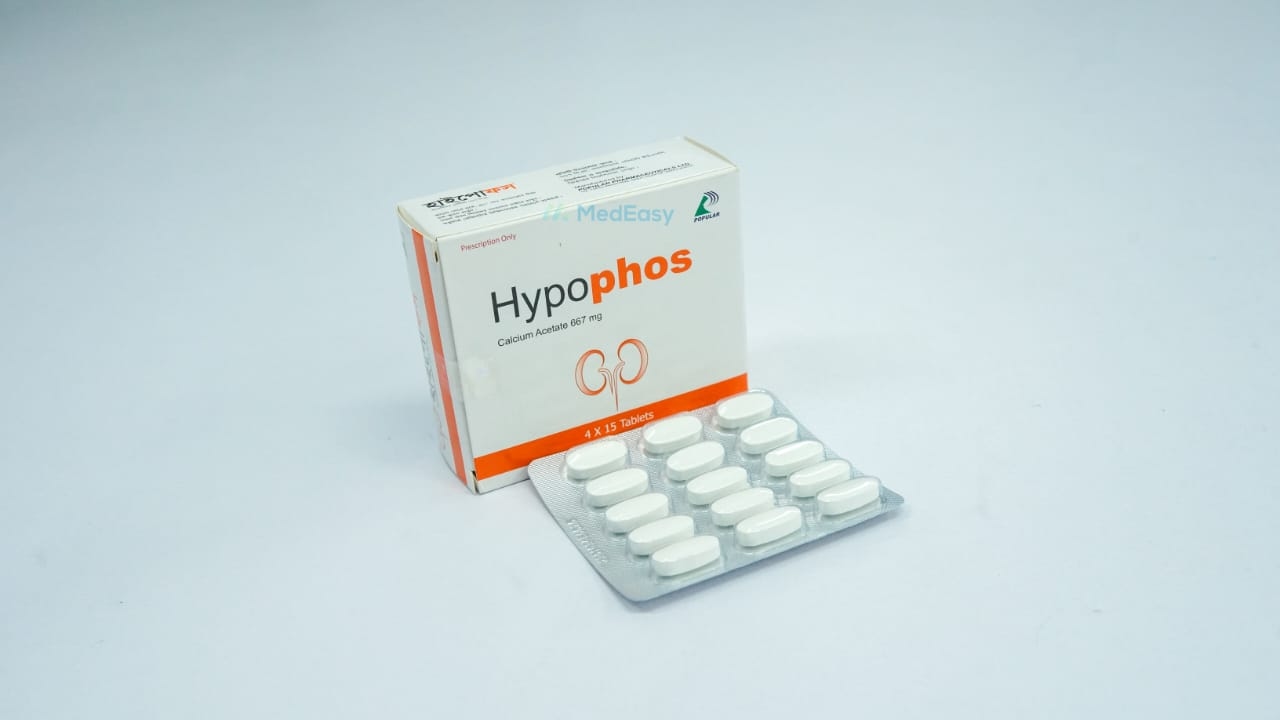
Hypophos667 mg
Popular Pharmaceuticals Ltd.
৳54.00
Add to cart


G-Hypophos is a calcium-based phosphate binder with the following evidence-based uses:
G-Hypophos is not intended for use as a general calcium or dietary supplement in patients with normal kidney function; its licensed indication is specific to phosphate control in renal impairment.
Each tablet contains Calcium Acetate USP, commonly available in a strength of 667 mg per tablet (providing approximately 169 mg or 8.45 mEq of elemental calcium per tablet). Oral solution/liquid forms of Calcium Acetate are available in some markets. Strength and available dosage forms may vary by manufacturer; check the product label for the exact composition of the specific brand dispensed.
G-Hypophos is a calcium salt of acetic acid used medically as a phosphate-binding agent. In patients with impaired kidney function, the kidneys are unable to adequately excrete dietary phosphate, leading to hyperphosphatemia, which over time contributes to secondary hyperparathyroidism, renal bone disease, and vascular calcification. G-Hypophos is taken with meals so that it binds dietary phosphate within the gastrointestinal tract, forming an insoluble complex that is eliminated in the stool rather than absorbed into the bloodstream. It is available as oral tablets (commonly 667 mg) and, in some markets, as an oral solution.
G-Hypophos belongs to the therapeutic class of phosphate binders (calcium-based), used in the management of chronic kidney disease-mineral and bone disorder (CKD-MBD).
When taken with meals, Calcium Acetate dissociates in the gastrointestinal tract and the calcium ion combines with dietary phosphate to form an insoluble calcium phosphate complex. This complex is not absorbed and is excreted in the feces, which lowers serum phosphorus concentration. Unlike aluminum-based binders, Calcium Acetate does not carry a risk of aluminum accumulation/toxicity.
Only a fraction of the calcium in Calcium Acetate is systemically absorbed — approximately 30-40% under fasting conditions and somewhat less when taken with food, though absorption is variable in patients with renal impairment and depends on concurrent vitamin D status and dietary calcium intake. The phosphate-binding action occurs locally in the gut and does not require systemic absorption to be effective.
| Phase | Typical Dose |
|---|---|
| Starting dose | Two tablets (approx. 1334 mg) with each meal |
| Maintenance dose | Three to four tablets (approx. 2001-2668 mg) with each meal, titrated to control serum phosphorus |
The dose of G-Hypophos is individualized and titrated upward gradually (e.g., every 2-3 weeks) based on serum phosphate response, aiming to keep serum phosphorus in the target range, while monitoring serum calcium to avoid hypercalcemia. Most patients require 3-4 tablets with each meal for adequate phosphate control.
G-Hypophos should always be taken with food/meals, never on an empty stomach, to achieve effective phosphate binding. See Dosage and Administration for complete instructions.
G-Hypophos can reduce the absorption of several oral medications by binding to them in the gastrointestinal tract or by altering gastric pH. Clinically significant interactions include:
Calcium Acetate is contraindicated in patients with:
The most common side effects of G-Hypophos are gastrointestinal and generally mild:
Hypercalcemia is the principal clinically significant risk associated with G-Hypophos, especially with excessive dosing or concurrent vitamin D therapy (see Precautions and Warnings). Symptoms of hypercalcemia can include nausea, vomiting, constipation, increased thirst or urination, muscle weakness, bone pain, confusion, and fatigue; these warrant prompt medical evaluation. Less commonly, edema and pruritus have been reported.
Pregnancy: There are limited controlled data on the use of G-Hypophos in pregnancy. It should be used during pregnancy only if clearly needed and if the potential benefit justifies the potential risk to the fetus. Uncontrolled hyperphosphatemia and hypercalcemia in a pregnant patient with renal disease each carry their own risks, so treatment decisions should be individualized by a physician managing the pregnancy.
Lactation: It is not well established whether G-Hypophos or its calcium load is excreted in human milk in a clinically significant way. Caution is advised, and a physician should be consulted before use of G-Hypophos while breastfeeding, weighing the mother's need for phosphate control against any potential infant exposure.
G-Hypophos can cause hypercalcemia, particularly if the dose is excessive or if it is used together with vitamin D compounds (including active vitamin D analogs). Serum calcium and phosphate should be monitored periodically during therapy, especially during dose titration, and the dose reduced or therapy interrupted if hypercalcemia develops (see Contraindications for absolute exclusion criteria).
In patients with chronic kidney disease, calcium-based phosphate binders such as G-Hypophos carry a theoretical concern for promoting vascular and soft-tissue calcification, particularly if hypercalcemia occurs. In patients with evidence of vascular calcification, adynamic bone disease, or persistently low parathyroid hormone levels, a non-calcium-based phosphate binder may be preferred by the treating nephrologist; the choice of binder should follow individualized nephrology guidance.
G-Hypophos reduces absorption of certain oral drugs; see Interactions for the specific medicines and required separation intervals.
G-Hypophos must be taken with meals to be effective as a phosphate binder; taking it apart from food substantially reduces its intended effect.
Overdose of G-Hypophos can cause hypercalcemia, with symptoms such as nausea, vomiting, constipation, loss of appetite, muscle weakness, confusion, bone pain, excessive thirst, and increased urination. Severe hypercalcemia can lead to cardiac arrhythmias and altered mental status. If overdose is suspected, seek immediate medical attention or contact a poison control center/emergency services; do not attempt to manage a suspected overdose at home. Management is guided by a physician and may include temporarily discontinuing G-Hypophos and any concurrent vitamin D therapy, and in severe cases, hemodialysis against a low- or no-calcium dialysate.
Store at room temperature (below 30°C), away from light and moisture. Keep out of reach of children.
G-Hypophos is specifically indicated for use in patients with significant renal impairment (CKD and ESRD); it is this population in which the drug is used therapeutically, with dosing individualized to serum phosphate response and calcium monitoring.
No specific dose adjustment of G-Hypophos has been established for hepatic impairment, as the drug acts locally in the gut with minimal systemic hepatic metabolism; use with routine clinical monitoring.
No specific dose adjustment is generally required for elderly patients beyond standard monitoring of serum calcium and phosphate, and general renal function status.
See Pediatric Uses section.
G-Hypophos is typically used long-term/chronically in patients with ongoing chronic kidney disease or ESRD requiring dialysis, for as long as phosphate control is needed. Duration of therapy is determined by the treating physician based on ongoing serum phosphate and calcium monitoring, and is not a fixed, short-term course.
Phosphate binder (calcium-based); mineral/electrolyte-regulating agent used in chronic kidney disease-mineral and bone disorder (CKD-MBD).
Calcium Acetate works by combining with dietary phosphate in the gastrointestinal tract when taken with meals, forming an insoluble calcium phosphate complex that is excreted in the stool instead of being absorbed, thereby lowering serum phosphate concentration.
The safety and efficacy of G-Hypophos for control of hyperphosphatemia have not been well established in pediatric patients through large controlled trials, and labeled use is primarily in adults with ESRD. Use in children with chronic kidney disease requiring phosphate control should only be undertaken under close pediatric nephrology supervision, with dosing individualized to body weight, dietary phosphate intake, and serum phosphate/calcium response, and with careful monitoring for hypercalcemia given the effect of excess calcium on growing bone.
Q: What is G-Hypophos 667 mg Tablet used for?
A: G-Hypophos 667 mg Tablet is used to control high blood phosphate levels (hyperphosphatemia) in patients with chronic kidney disease, especially those on dialysis. It works by binding phosphate from food in the gut so it is eliminated in the stool instead of being absorbed.
Q: How should I take G-Hypophos 667 mg Tablet?
A: G-Hypophos 667 mg Tablet should always be taken with meals or immediately after eating, since it needs to be present in the gut along with food for it to bind phosphate effectively. Taking it on an empty stomach will not work properly.
Q: What are the main side effects of G-Hypophos 667 mg Tablet?
A: The most common side effects are mild gastrointestinal symptoms such as nausea, constipation, or diarrhea. The most important risk to watch for is hypercalcemia (high blood calcium), which can cause nausea, vomiting, muscle weakness, confusion, and excessive thirst — contact your doctor if these occur.
Q: Can G-Hypophos 667 mg Tablet be taken with other medicines?
A: G-Hypophos 667 mg Tablet can reduce the absorption of certain drugs, including tetracycline and fluoroquinolone antibiotics and levothyroxine (thyroid medicine). These should generally be taken several hours apart from G-Hypophos 667 mg Tablet. Always tell your doctor or pharmacist about all medicines you take.
Q: Is G-Hypophos 667 mg Tablet safe during pregnancy or breastfeeding?
A: G-Hypophos 667 mg Tablet should be used during pregnancy or breastfeeding only if clearly needed, under a physician's guidance, since safety data are limited and the benefit must be weighed against potential risk.
Q: What should I do if I take too much G-Hypophos 667 mg Tablet?
A: Taking too much G-Hypophos 667 mg Tablet can cause hypercalcemia, which can be serious. If an overdose is suspected, seek immediate medical attention or contact emergency/poison control services rather than trying to manage it at home.
Disclaimer
The information provided is accurate to the best of our knowledge, but it does not replace professional medical advice. We cannot guarantee its completeness or accuracy, and the absence of specific information about a drug should not be taken as an endorsement. We are not responsible for any consequences arising from this information, so please consult a healthcare professional for any concerns or questions.