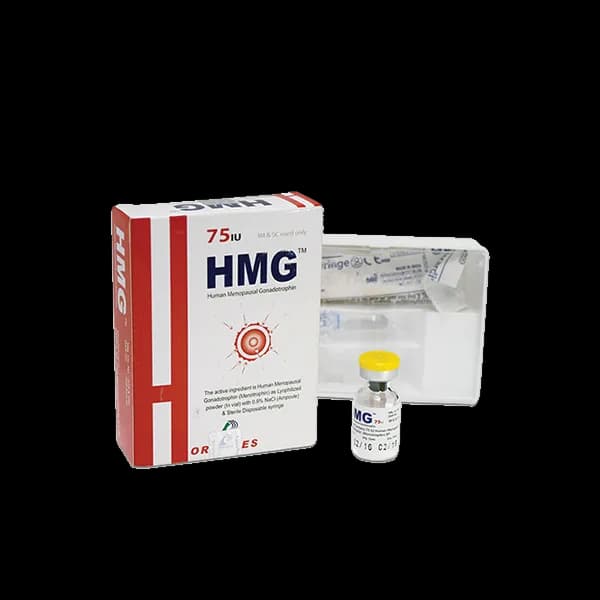
Sterility in females with hypo- or normogonadotropic ovarian insufficiency: Stimulation of follicle growth. Sterility in males with hypo- or normogonadotropic hypogonadism: In combination with HCG to stimulate spermatogenesis.
Theropeutic Class
Female Sex hormones
Pharmacology
Pharmacodynamic properties: HMG 75 IU/vial directly affects the ovaries and the testes. HMG 75 IU/vial has gametotropic and steroidogenic effect. In the ovaries, the FSH-component in HMG 75 IU/vial induces an increase in the number of growing follicles and stimulates their development. FSH increase the production of estradiol in the granulose cells by aromatizing androgens that originate in the Theca cells under the influence of the LH-component. In the testes, FSH induces the transformation of premature to mature Sertoli cells. It mainly causes the maturation of the seminal canals and development of the spermatozoa. However, a high concentration of androgens within the testes is necessary and can be attained by a prior treatment using HCG.Pharmacokinetic properties: HMG 75 IU/vial is not effective when taken orally and is injected i.m. or s.c. HMG 75 IU/vial's biological effectiveness is mainly due to its FSH and LH content. The pharmacokinetics of HMG 75 IU/vial following i.m. or s.c. administration were tested product specifically. The maximum serum level of FSH is reached 6-48 hours hours after i.m. injection and 6-36 hours after s.c. injection respectively. After that, the serum level decreases by a half-life of 56 hours (i.m.) and 51 hours (s.c.) respectively. Administered HMG 75 IU/vial is predominantly discharged renally.
Dosage of HMG 75 IU/vial
Sterility in females: The dosage of HMG 75 IU/vial for the induction of follicle growth in normo-or hypogonadotropic women varies according to the individual. The amount depends on ovarian reaction and should be checked by ultrasound examinations of the ovarian and measuring estradiol levels. If the HMG 75 IU/vial dosage is too high for the treated individual, multiple uni-and bilateral follicle growth can occur. HMG 75 IU/vial is administered intramuscularly or subcutaneously and in general, the therapy is begun with a daily dosage corresponding to 75-150 IU FSH. If the ovaries do not respond, the dosage can slowly be increased until a rise in estradiol secretion and follicle growth is evident. Treatment with the same dosage of HMG 75 IU/vial continues until the pre-ovulatory estradiol serum level is attained. If the level rises too quickly, the dosage should be reduced. To induce ovulation, 5000 or 10000 IU HCG are injected i.m. 1 to 2 days after the last HMG 75 IU/vial administration.Note: After a HMG 75 IU/vial dosage too high for the corresponding individual has been administered the following HCG administration can cause an unintentional hyperstimulation of the ovaries.Sterility in males: Initially, 2 X 5000 IU HCG a week are administered until a normal testosterone serum level is reached. Then, an additional dose of HMG 75 IU/vial (3 X 75-150 IU FSH + 75 - 150 IU LH) per week is administered for a few months.
Administration of HMG 75 IU/vial
Method of Administration: HMG 75 IU/vial is administered by intramuscular or subcutaneous injection.Selection of patients:Women:
Before treatment with HMG 75 IU/vial is instituted, a thorough gynecologic and endocrinologic evaluation must be performed. This should include a hysterosalpingogram (to rule out uterine and tubal pathology) and documentation of anovulation by means of basal body temperature, serial vaginal smears, examination of cervical mucus, and determination of serum (or urine) progesterone, urinary pregnanediol and endometrial biopsy.
Primary ovarian failure should be excluded by the determination of gonadotropin levels.
Careful examination should be made to rule out the presence of an early pregnancy.
Patients in late reproductive life have a greater predilection to endometrial carcinoma as well as a higher incidence of anovulatory disorders. Cervical dilation and curettage should always be done for abnormal uterine bleeding or other signs of endometrial abnormalities.
Men:
Patient selection should be made based on a documented lack of pituitary function. Prior to hormonal therapy, these patients will have low testosterone levels and low or absent gonadotropin levels. Patients with primary hypogonadotropic hypogonadism will have a subnormal development of masculinization, and those with secondary hypogonadotropic hypogonadism will have decreased masculinization.
Interaction of HMG 75 IU/vial
Interaction with other medicaments are unknown. HMG 75 IU/vial can be injected together with HCG when treating infertile males.
Contraindications
In females:
Pregnancy,
Enlargement of the ovaries or cysts that is not caused by polycystic ovarian syndrome,
Gynecological bleeding whose cause is unknown,
Tumors in the uterus, ovaries and breasts,
Prior hypersensitivity to Menotrophins or to any of the excipients,
A high FSH level indicating primary ovarian failure,
The presence of uncontrolled thyroid and adrenal dysfunction,
The presence of any cause of infertility other than anovulation.
In males:
Carcinoma of the prostate.
Tumors in the tests,
Normal gonadotrophin levels indicating normal pituitary function,
Elevated gonadotrophin levels indicating primary testicular failure,
Infertility disorders other than hypogonadotropic hypogonadism.
The following conditions should be properly treated before HMG 75 IU/vial therapy is begun:
Dysfunctions of the thyroid gland and cortex of the suprarenal gland,
Hyperprolactinemia,
Tumors in the pituitary or in the hypothalamic glands.
Pregnancy & Lactation
There is no indication for HMG 75 IU/vial to be used during pregnancy and lactation period
Precautions & Warnings
In pregnancies occurring after induction of ovulation with gonadotropic preparations, there is an increased risk of miscarriage, multiples and ectopic pregnancies. HMG 75 IU/vial should not be administered to induce ovulation in females whose ovaries have unintentionally been hyper-stimulated. When treating sterile women, ovarian activity should be checked (ultrasound and estradiol levels in serum respectively) prior to HMG administration. During treatment, these tests should be carried out every one to two days until stimulation occurs. Ovarian reaction can also be measured using a cervix index. Close supervision is imperative during treatment. Treatment should be immediately discontinued if unintentional hyper-stimulation occurs. This warning is particularly important with respect to patients with polycystic ovarian disease. The severe form of ovarian hyper-stimulation syndrome may be life-threatening and is characterized by large ovarian cysts (prone to rupture), ascites, very often hydrothorax and occasionally thromboembolic phenomena.
Overdose Effects of HMG 75 IU/vial
Treatment with HMG 75 IU/vial can lead to hyper-stimulation of the ovaries. This, however, mostly becomes clinically relevant only after HCG has been administered to induce ovulation (please see Undesirable effects paragraph). No therapy is necessary when a slight hyper-stimulation is present (Level I) accompanied by a slight enlargement of the ovaries (over size 5-7 cm), excessive steroid secretion, and abdominal pain. The patient should be informed, however, and carefully watched. Clinical supervision and symptomatic treatment, and perhaps an intravenous volume replacement in case of high hemoglobin concentration, is necessary if hyper-stimulation (Level II) with ovarian cysts (ovary size 8-10 cm) is present, accompanied by abdominal symptoms, nausea, and vomiting. Hospitalization is imperative when serious hyper-stimulation (Level III) with large ovarian cysts (ovary size more than 10 cm) is present accompanied by ascites, hydrothorax, enlarged abdomen, abdominal pain, dyspnea, salt retention, hemoglobin concentration, increased blood viscosity, and platelet aggregation with the danger of thromboembolisms. Undesirable effects Sensitivity to HMG 75 IU/vial - Febrile reaction which may be accompanied by chills, musculoskeletal aches or pain, malaise and fatigue have occurred after the administration of HMG 75 IU/vial. It is not clear whether or not these were pyrogenic responses or possible allergic reactions. In addition, reports of "flu-like symptoms" including fever, Chills, musculoskeletal aches, joint pains, nausea, headache and malaise have been received - Gastrointestinal symptoms (nausea, vomiting, diarrhea, abdominal cramps, bloating). - Pain, rash, swelling and/or irritation at the site of injection. - Body rashes. - Dizziness, tachycardia, dyspnea, tachypnea. The following medical events have been reported subsequent to pregnancies resulting from HMG 75 IU/vial therapy: - Ectopic pregnancy. - Congenital abnormalities
Storage Conditions
Store at 2°C to 8°C, Do not freeze. Store below 25°C for single period of not more than 3 months. Protect from light and keep in dry place. The reconstituted solution of the vial should be used immediately after piercing of the rubber stopper. Discard any remaining solution.
Drug Classes
Female Sex hormones
Mode Of Action
Pharmacodynamic properties: HMG 75 IU/vial directly affects the ovaries and the testes. HMG 75 IU/vial has gametotropic and steroidogenic effect. In the ovaries, the FSH-component in HMG 75 IU/vial induces an increase in the number of growing follicles and stimulates their development. FSH increase the production of estradiol in the granulose cells by aromatizing androgens that originate in the Theca cells under the influence of the LH-component. In the testes, FSH induces the transformation of premature to mature Sertoli cells. It mainly causes the maturation of the seminal canals and development of the spermatozoa. However, a high concentration of androgens within the testes is necessary and can be attained by a prior treatment using HCG.Pharmacokinetic properties: HMG 75 IU/vial is not effective when taken orally and is injected i.m. or s.c. HMG 75 IU/vial's biological effectiveness is mainly due to its FSH and LH content. The pharmacokinetics of HMG 75 IU/vial following i.m. or s.c. administration were tested product specifically. The maximum serum level of FSH is reached 6-48 hours hours after i.m. injection and 6-36 hours after s.c. injection respectively. After that, the serum level decreases by a half-life of 56 hours (i.m.) and 51 hours (s.c.) respectively. Administered HMG 75 IU/vial is predominantly discharged renally.
Pregnancy
There is no indication for HMG 75 IU/vial to be used during pregnancy and lactation period
Frequently Asked Questions
What is HMG 75 IU/vial used for?
Sterility in females with hypo- or normogonadotropic ovarian insufficiency: Stimulation of follicle growth. Sterility in males with hypo- or normogonadotropic hypogonadism: In combination with HCG to stimulate spermatogenesis.
What is the dosage of HMG 75 IU/vial?
Sterility in females: The dosage of HMG 75 IU/vial for the induction of follicle growth in normo-or hypogonadotropic women varies according to the individual. The amount depends on ovarian reaction and should be checked by ultrasound examinations of the ovarian and measuring estradiol levels. If the HMG 75 IU/vial dosage is too high for the treated individual, multiple uni-and bilateral follicle g…
Who should not take HMG 75 IU/vial?
In females: Pregnancy, Enlargement of the ovaries or cysts that is not caused by polycystic ovarian syndrome, Gynecological bleeding whose cause is unknown, Tumors in the uterus, ovaries and breasts, Prior hypersensitivity to Menotrophins or to any of the excipients, A high FSH level indicating primary ovarian failure, The presence of uncontrolled thyroid and adrenal dysfunction, The presence of a…
What precautions should be taken with HMG 75 IU/vial?
In pregnancies occurring after induction of ovulation with gonadotropic preparations, there is an increased risk of miscarriage, multiples and ectopic pregnancies. HMG 75 IU/vial should not be administered to induce ovulation in females whose ovaries have unintentionally been hyper-stimulated. When treating sterile women, ovarian activity should be checked (ultrasound and estradiol levels in serum…
Is HMG 75 IU/vial safe during pregnancy and breastfeeding?
There is no indication for HMG 75 IU/vial to be used during pregnancy and lactation period
Disclaimer
The information provided is accurate to our best practices, but it does not replace professional medical advice. We cannot guarantee its completeness or accuracy. The absence of specific information about a drug should not be seen as an endorsement. We are not responsible for any consequences resulting from this information, so consult a healthcare professional for any concerns or questions.