
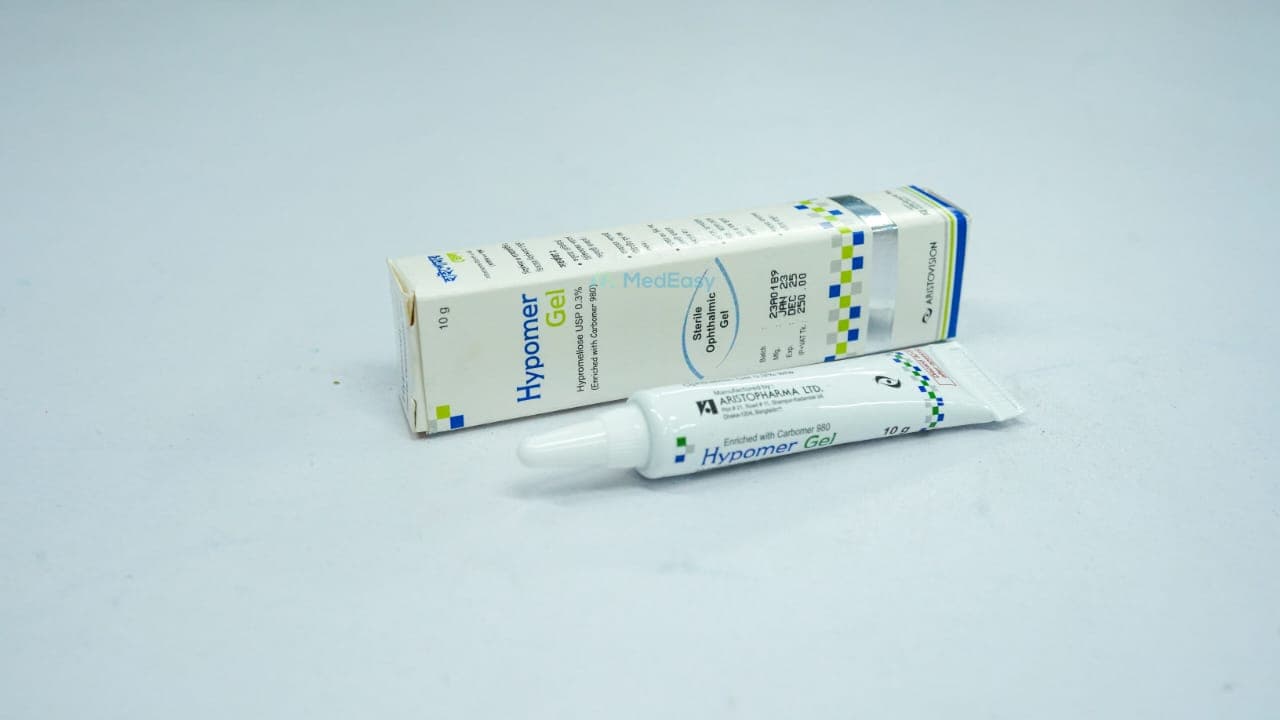

Medicine overview
Indications of Hypomer
Hypomer is indicated for the symptomatic relief of dry eye conditions. Established uses include:
- Relief of burning, stinging, irritation, and discomfort due to dryness of the eye (keratoconjunctivitis sicca)
- Protection against further irritation and to relieve dryness of the eye caused by exposure to wind or environmental factors such as air conditioning, wind, sun, or prolonged screen use
- As a lubricant to prevent dryness caused by reduced blinking (e.g., during prolonged reading, computer use, or in certain neurological conditions)
- As an artificial tear substitute in contact lens wearers experiencing dryness (only with lens-compatible formulations; remove lenses before use unless the product is specifically labeled safe for use with lenses in place)
It is used for symptomatic relief only and does not treat the underlying cause of dry eye.
Composition
Each formulation typically contains Hypromellose + Carbomer as the active viscosity-enhancing and gel-forming polymers, combined in an ophthalmic lubricant base. Concentrations vary by brand and product presentation (eye drops or gel). Preservative-free single-dose units and multi-dose preserved bottles are both commonly available.
Description
Hypomer is a combination ophthalmic lubricant preparation used as an artificial tear substitute. Hypromellose (hydroxypropyl methylcellulose) is a semi-synthetic, water-soluble cellulose derivative that increases the viscosity of the tear film, prolonging contact time on the ocular surface. Carbomer is a high-molecular-weight, cross-linked acrylic acid polymer that forms a gel matrix on the eye, further increasing retention time and providing sustained lubrication. Together, Hypomer mimics the natural tear film, providing longer-lasting relief than single-agent lubricants alone.
Therapeutic Class
Hypomer belongs to the therapeutic class of ophthalmic lubricants / artificial tear substitutes, used in the management of dry eye disease and ocular surface irritation.
Pharmacology
Hypromellose + Carbomer works through a combined mechanism of action:
- Hypromellose is a viscosity-enhancing polymer that increases the thickness and stability of the pre-corneal tear film, reducing the rate of tear evaporation and prolonging the time the lubricant remains on the ocular surface.
- Carbomer is a mucoadhesive gelling polymer that forms a transparent, lubricating gel layer over the cornea and conjunctiva on contact with the eye, further extending retention time and providing a physical barrier against further moisture loss and minor mechanical irritation.
Neither component has significant pharmacological activity beyond this local, physical lubricating and protective action; there is no clinically relevant systemic absorption when used as directed.
Dosage & Administration of Hypomer
| Population | Recommended Dose |
|---|---|
| Adults and elderly | Instill 1 drop into the affected eye(s) as needed, typically 3-4 times daily, or as directed by the physician/product labeling. Frequency may be increased for more severe dryness. |
| Children | Use only under medical advice; dosing as directed by a physician. |
Shake the container gently before use if the formulation is a suspension/gel. Tilt the head back, pull down the lower eyelid to form a small pocket, and instill the drop without letting the tip touch the eye or eyelid. Close the eye gently for 1-2 minutes after instillation. If using with other eye drops, wait at least 5-10 minutes between different products, and apply Hypomer (being a gel/thicker preparation) last.
Administration of Hypomer
For ophthalmic (eye) use only. Wash hands before use. Avoid touching the dropper tip to the eye, eyelid, or any other surface to prevent contamination. Remove contact lenses before instillation unless the specific product is labeled safe for use with lenses in place; lenses may generally be reinserted after 15-20 minutes. Replace the cap tightly after each use.
Interaction of Hypomer
No clinically significant systemic drug interactions have been established for Hypomer due to its local action and minimal systemic absorption.
- If other topical ophthalmic medications are being used concurrently, space administration at least 5-10 minutes apart, and instill Hypomer last, since as a gel/viscous preparation it may slow absorption of other eye medications applied afterward.
- Preservative-containing formulations used frequently alongside other preserved eye drops may theoretically increase the risk of ocular surface irritation; preservative-free preparations are preferred with frequent use or with other preserved products.
Contraindications
Hypromellose + Carbomer is contraindicated in patients with known hypersensitivity to hypromellose, carbomer, or any other ingredient in the specific formulation (including preservatives such as benzalkonium chloride, where present).
Side Effects of Hypomer
Hypomer is generally well tolerated. Reported effects include:
- Very common/common: Temporary blurred vision immediately after application (expected due to the gel/viscous nature of the product); mild transient stinging or burning on instillation
- Uncommon: Eye irritation, foreign body sensation, itching, or redness
- Rare: Hypersensitivity reactions (eyelid swelling, itching, or redness of the conjunctiva), particularly with preservative-containing formulations used long-term
Patients should discontinue use and consult a physician if eye pain, significant vision changes, or persistent redness/irritation develops.
Pregnancy & Lactation
Hypomer is applied topically to the eye with minimal systemic absorption, and is generally considered low risk during pregnancy and breastfeeding. However, as with any medication, it should be used during pregnancy and lactation only if clearly needed, and a physician or pharmacist should be consulted before use to confirm suitability for the individual situation.
Precautions & Warnings
The following precautions apply to the use of Hypomer:
- Temporary blurring of vision is common immediately after application; avoid driving or operating machinery until vision clears.
- Avoid touching the applicator tip to the eye, eyelid, fingers, or any surface to prevent contamination of the product.
- Remove contact lenses before use unless the specific product is labeled as safe for use with lenses in place; wait 15-20 minutes before reinserting lenses.
- Discontinue use and seek medical advice if eye pain, changes in vision, persistent redness, or irritation occurs, or if symptoms worsen or persist beyond 72 hours.
- Do not use if the solution has changed color or become cloudy, or after the labeled discard period once opened (for multi-dose bottles).
- For contraindication information, see Contraindications.
Overdose Effects of Hypomer
Ocular overdose (excessive instillation) is unlikely to cause serious harm due to the drug's local action and minimal systemic absorption; excess product will typically simply overflow from the eye. If accidentally ingested or if a severe local reaction occurs, seek immediate medical attention or contact a poison control center/emergency services for guidance rather than attempting home treatment.
Storage Conditions
Store at room temperature (below 30°C), away from light and moisture. Keep out of reach of children. Discard multi-dose bottles a specified number of weeks (commonly 4-6 weeks, per product labeling) after first opening, even if product remains.
Use In Special Populations
Elderly: No special dose adjustment is required; commonly used in this population for age-related dry eye.
Renal/hepatic impairment: No dose adjustment is required due to negligible systemic absorption.
Contact lens wearers: See Administration for lens removal guidance.
For pregnancy and lactation guidance, see Pregnancy and Lactation.
Duration Of Treatment
Hypomer may be used as needed for as long as symptoms of dry eye or ocular irritation persist. If symptoms do not improve within 72 hours of regular use, or if they worsen, a physician should be consulted, as an underlying condition may need further evaluation and treatment.
Drug Classes
Ophthalmic lubricant; artificial tear substitute; viscosity-enhancing and gel-forming ocular surface protectant.
Mode Of Action
Hypromellose + Carbomer acts locally on the ocular surface: hypromellose increases tear film viscosity and slows tear evaporation, while carbomer forms a mucoadhesive gel layer that prolongs contact time on the eye. Together they replace and supplement the natural tear film, providing extended lubrication and protection against dryness and irritation.
Pediatric Uses
Safety and efficacy of Hypomer in children have not been formally established through controlled pediatric trials; however, due to its local, non-systemically absorbed action, it is commonly used in children under medical guidance for dry eye or ocular irritation. Use in children should be under the supervision of a physician.
Frequently Asked Questions
Q: What is Hypomer 0.3%+0.22% Ophthalmic Gel used for?
A: Hypomer 0.3%+0.22% Ophthalmic Gel is an artificial tear preparation used to relieve dryness, burning, stinging, and irritation of the eyes caused by insufficient natural tear production or environmental factors such as wind, air conditioning, or prolonged screen use.
Q: Why is my vision blurry after using Hypomer 0.3%+0.22% Ophthalmic Gel?
A: Temporary blurred vision immediately after applying Hypomer 0.3%+0.22% Ophthalmic Gel is common and expected because of its gel-like consistency. It usually clears within a few minutes. Avoid driving or operating machinery until your vision returns to normal.
Q: Can I wear contact lenses while using Hypomer 0.3%+0.22% Ophthalmic Gel?
A: Contact lenses should generally be removed before using Hypomer 0.3%+0.22% Ophthalmic Gel, unless the specific product is labeled as safe for use with lenses in place. Lenses can usually be reinserted 15-20 minutes after application.
Q: Is Hypomer 0.3%+0.22% Ophthalmic Gel safe during pregnancy and breastfeeding?
A: Because it is applied topically with minimal absorption into the bloodstream, Hypomer 0.3%+0.22% Ophthalmic Gel is generally considered low risk in pregnancy and breastfeeding. Even so, it should be used only if clearly needed, and a physician or pharmacist should be consulted before use.
Q: How often can I use Hypomer 0.3%+0.22% Ophthalmic Gel eye drops?
A: Hypomer 0.3%+0.22% Ophthalmic Gel is usually used 3-4 times daily or as needed for symptom relief, unless your physician or the product label advises otherwise. Do not use more often than recommended without medical advice.
Q: What should I do if my eye pain or redness does not improve?
A: If eye pain, vision changes, or persistent redness or irritation occurs, or if symptoms do not improve within 72 hours of using Hypomer 0.3%+0.22% Ophthalmic Gel, stop use and consult a physician, as an underlying eye condition may require further evaluation.
Disclaimer
The information provided is accurate to the best of our knowledge, but it does not replace professional medical advice. We cannot guarantee its completeness or accuracy, and the absence of specific information about a drug should not be taken as an endorsement. We are not responsible for any consequences arising from this information, so please consult a healthcare professional for any concerns or questions.
