
10% Off
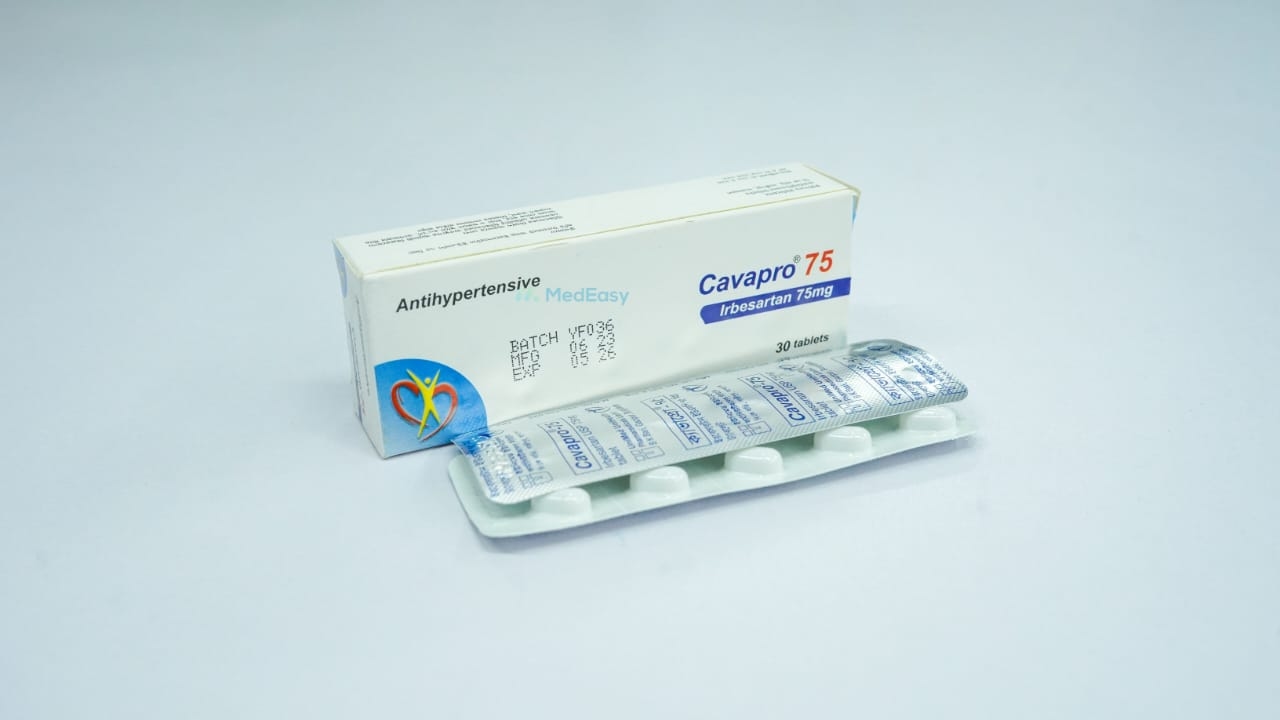
Cavapro75 mg
Unimed Unihealth MFG. Ltd.
৳54.00
Add to cart


Ibsan is an angiotensin II receptor blocker (ARB) with the following evidence-based indications:
Ibsan is not indicated, and must not be used, during pregnancy (see Contraindications and Pregnancy and Lactation).
Each tablet of Irbesartan contains irbesartan as the active pharmaceutical ingredient, commonly available in strengths of 75 mg, 150 mg, and 300 mg, along with standard pharmaceutical excipients (diluents, binders, disintegrants, and lubricants). Fixed-dose combination products containing Irbesartan with hydrochlorothiazide are also available.
Ibsan is a selective angiotensin II receptor blocker (ARB) belonging to the biphenyl-tetrazole group of ARBs. It is used mainly for the management of hypertension and for renal protection in patients with type 2 diabetes and hypertension. Ibsan is generally well tolerated and, unlike ACE inhibitors, is associated with a low incidence of dry cough, making it a useful alternative for patients who cannot tolerate an ACE inhibitor.
Ibsan is administered orally and does not require dose adjustment based on food intake.
Ibsan belongs to the angiotensin II receptor blocker (ARB) class of antihypertensive agents, also known as angiotensin receptor antagonists or "sartans."
Irbesartan is a potent, orally active, selective antagonist of the angiotensin II type 1 (AT1) receptor. By blocking the binding of angiotensin II to the AT1 receptor, Irbesartan blocks the vasoconstrictor and aldosterone-secreting effects of angiotensin II, leading to a reduction in blood pressure and to renal hemodynamic effects that help slow progression of diabetic nephropathy. Unlike ACE inhibitors, Irbesartan does not affect the metabolism of bradykinin, which accounts for its lower incidence of dry cough.
Irbesartan is well absorbed orally (absolute bioavailability approximately 60-80%), with peak plasma concentration reached in 1.5-2 hours. It is highly protein bound (~90%), metabolized in the liver primarily via glucuronide conjugation and CYP2C9-mediated oxidation, and has an elimination half-life of 11-15 hours, supporting once-daily dosing. It is eliminated mainly via the biliary and renal routes.
| Population | Dose |
|---|---|
| Usual starting/maintenance dose | 150 mg once daily |
| Dose not adequately controlled | May be increased to 300 mg once daily |
| Volume-depleted patients or those >75 years | Consider a starting dose of 75 mg once daily |
| Target dose | Detail |
|---|---|
| 300 mg once daily | The recommended target maintenance dose for renal protection, titrated up from a lower starting dose as tolerated |
Safety and efficacy of Ibsan for hypertension in pediatric patients under 6 years of age have not been established. Antihypertensive effect has been studied in children 6-16 years of age, but Ibsan is generally not preferred as a first-line agent in this age group; use only under specialist pediatric guidance.
Ibsan may be taken with or without food, at approximately the same time each day, exactly as prescribed by a physician. Do not stop or change the dose without medical advice, and discontinue immediately if pregnancy is suspected or confirmed (see Contraindications).
Ibsan is administered orally as a tablet, once daily, with or without food. Tablets should be swallowed whole with water. If a dose is missed, it should be taken as soon as remembered unless it is close to the time of the next dose, in which case the missed dose should be skipped; do not double the dose.
Irbesartan is contraindicated in:
Ibsan is generally well tolerated. Reported side effects include:
A notable, favorable feature of Ibsan, as with other ARBs, is a substantially lower incidence of persistent dry cough compared with ACE inhibitors, since it does not affect bradykinin metabolism.
Ibsan acts directly on the renin-angiotensin system and can cause injury or death to the developing fetus when used during the second and third trimesters of pregnancy, including oligohydramnios, fetal lung hypoplasia, skeletal deformations, and neonatal renal failure. Use of Ibsan during any trimester of pregnancy is contraindicated. If pregnancy is detected, Ibsan should be discontinued as soon as possible, and the patient should be switched to an alternative antihypertensive agent considered appropriate in pregnancy under medical supervision.
It is not known whether Ibsan is excreted in human breast milk. Because of the potential for adverse effects in a nursing infant, a decision should be made whether to discontinue breastfeeding or discontinue Ibsan, taking into account the importance of the drug to the mother; consult a physician before use while breastfeeding.
Ibsan can cause fetal harm, including injury and death, when used during pregnancy. Female patients of reproductive potential should be counseled about this risk, and Ibsan must be discontinued as soon as pregnancy is detected (see Contraindications and Pregnancy and Lactation).
Symptomatic hypotension may occur, particularly after the first dose, in patients who are volume- or salt-depleted (e.g., from high-dose diuretic therapy, dietary salt restriction, dialysis, diarrhea, or vomiting). This condition should be corrected prior to starting Ibsan, or a lower starting dose should be used.
As with other drugs affecting the renin-angiotensin system, hyperkalemia can occur with Ibsan, particularly in patients with renal impairment, diabetes mellitus, or those taking potassium supplements, potassium-sparing diuretics, or potassium-containing salt substitutes; periodic monitoring of serum potassium is advised in at-risk patients.
In patients whose renal function depends on the activity of the renin-angiotensin system (e.g., severe congestive heart failure or renal artery stenosis), treatment with agents that inhibit this system, including Ibsan, may be associated with oliguria, azotemia, or acute renal failure; monitor renal function during treatment.
The most likely manifestations of Ibsan overdose are hypotension and tachycardia; bradycardia may also occur from parasympathetic (vagal) stimulation. If symptomatic hypotension occurs, supportive treatment should be instituted. Ibsan is not removed by hemodialysis. If an overdose is suspected, seek immediate medical attention or contact a poison control center/emergency services right away; do not attempt to manage a suspected overdose at home.
Store at room temperature (below 30°C), away from light and moisture. Keep out of reach of children.
Safety and efficacy of Ibsan in children under 6 years of age have not been established. Data on antihypertensive use in children 6-16 years of age are limited, and Ibsan should be used in this age group only under specialist pediatric guidance, with the fetal toxicity risk kept in mind for adolescent females of reproductive potential.
No overall differences in effectiveness were observed between elderly and younger patients treated with Ibsan; a lower starting dose (e.g., 75 mg) may be considered in patients over 75 years of age or those who are volume-depleted, given a somewhat greater blood-pressure response in the elderly.
No initial dose adjustment of Ibsan is required in patients with mild-to-moderate renal impairment. Caution and monitoring of renal function and serum potassium are advised in patients with severe renal impairment or those on hemodialysis.
No dose adjustment of Ibsan is required in patients with mild hepatic impairment; data are limited in more severe hepatic impairment, and caution is advised.
Ibsan is typically used long-term for chronic conditions such as hypertension and diabetic nephropathy, with periodic reassessment of blood pressure, renal function, and serum potassium by the prescribing physician. Treatment should not be stopped abruptly without medical advice, and duration is determined by the physician based on ongoing clinical response and tolerability.
Irbesartan is classified as an angiotensin II receptor blocker (ARB), a class of antihypertensive agents also referred to as angiotensin receptor antagonists.
Irbesartan selectively and competitively blocks the binding of angiotensin II to the AT1 receptor subtype found in vascular smooth muscle and the adrenal gland, without activating the receptor. This blocks the vasoconstriction and aldosterone-release effects of angiotensin II, resulting in vasodilation, reduced peripheral vascular resistance, and lower blood pressure, along with favorable renal hemodynamic effects that slow progression of diabetic nephropathy.
Category D (FDA legacy classification for the second and third trimesters; contraindicated in all trimesters of pregnancy due to established risk of fetal toxicity)
The safety and efficacy of Ibsan have not been established in children under 6 years of age. Limited data exist for antihypertensive use in children 6-16 years of age, and Ibsan is not generally used as a first-line agent in this population. Any use in pediatric patients should be individualized and supervised by a pediatric specialist, and adolescent females of reproductive potential must be counseled about the fetal toxicity risk should pregnancy occur (see Pregnancy and Lactation).
Q: What is Ibsan 75 mg Tablet used for?
A: Ibsan 75 mg Tablet is used to treat high blood pressure (hypertension) and to protect the kidneys in people with type 2 diabetes and hypertension by slowing the progression of diabetic kidney disease.
Q: Can I take Ibsan 75 mg Tablet if I am pregnant or trying to become pregnant?
A: No. Ibsan 75 mg Tablet is contraindicated in pregnancy because it can cause serious injury or death to the developing fetus, including problems with the kidneys, lungs, and skeleton. If you become pregnant while taking Ibsan 75 mg Tablet, stop taking it and contact your physician immediately so you can be switched to a pregnancy-appropriate alternative.
Q: Does Ibsan 75 mg Tablet cause the same dry cough as other blood pressure medicines?
A: No, this is a favorable feature of Ibsan 75 mg Tablet. Unlike ACE inhibitors, which commonly cause a persistent dry cough, Ibsan 75 mg Tablet and other angiotensin receptor blockers (ARBs) have a much lower incidence of this side effect because they work differently and do not affect the breakdown of bradykinin.
Q: Can Ibsan 75 mg Tablet cause high potassium levels?
A: Yes. Ibsan 75 mg Tablet can raise blood potassium levels (hyperkalemia), especially in people with kidney problems, diabetes, or those taking potassium supplements, potassium-sparing diuretics, or salt substitutes containing potassium. Your physician may check your blood potassium periodically while you are taking Ibsan 75 mg Tablet.
Q: What should I do if I take too much Ibsan 75 mg Tablet?
A: An overdose of Ibsan 75 mg Tablet most commonly causes low blood pressure and a fast heart rate. If an overdose is suspected, seek immediate medical attention or contact a poison control center or emergency services right away; do not attempt to treat an overdose at home.
Q: Can Ibsan 75 mg Tablet be combined with other blood pressure medicines?
A: Ibsan 75 mg Tablet is often combined with a diuretic such as hydrochlorothiazide when blood pressure is not adequately controlled on Ibsan 75 mg Tablet alone. However, combining Ibsan 75 mg Tablet with an ACE inhibitor, another ARB, or aliskiren is generally not recommended (and is contraindicated with aliskiren in diabetic patients) due to increased risk of low blood pressure, high potassium, and kidney problems. Always follow your physician's guidance on combination therapy.
Disclaimer
The information provided is accurate to the best of our knowledge, but it does not replace professional medical advice. We cannot guarantee its completeness or accuracy, and the absence of specific information about a drug should not be taken as an endorsement. We are not responsible for any consequences arising from this information, so please consult a healthcare professional for any concerns or questions.

