
8% Off
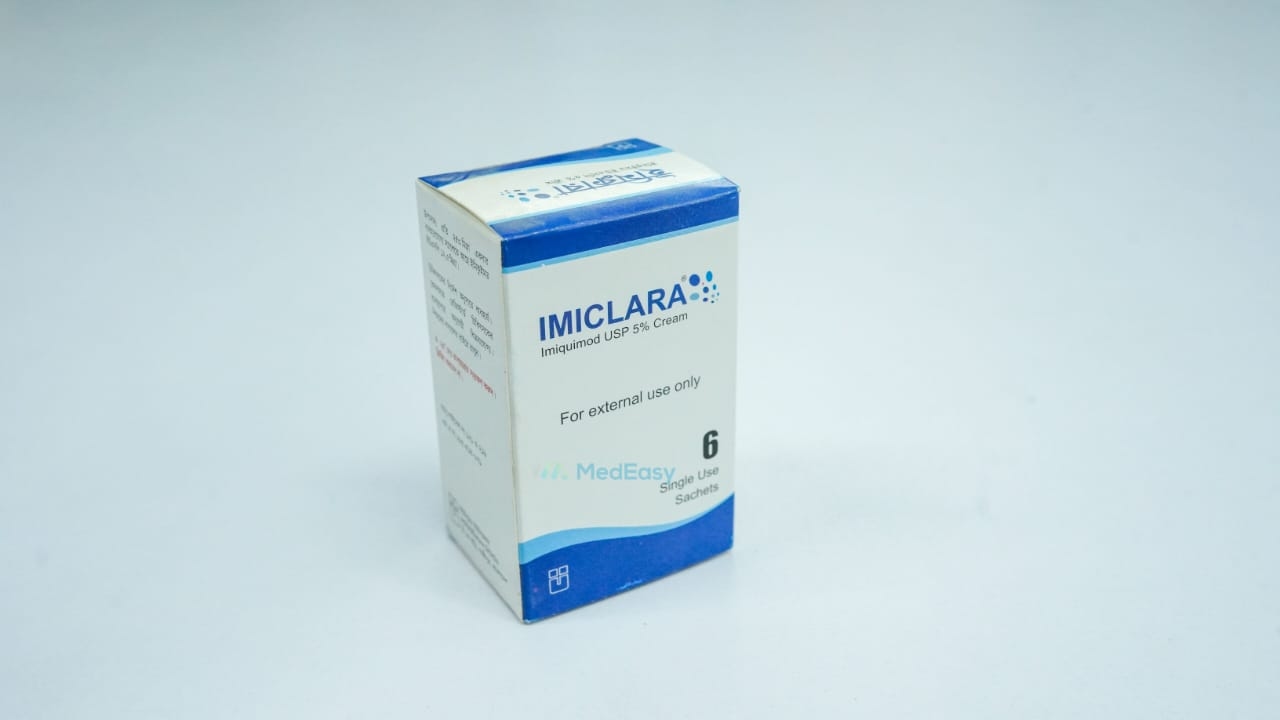
Imiclara5%
Unimed Unihealth MFG. Ltd.
৳55.20
Add to cart


Iminod cream is a topical immune response modifier approved for three distinct dermatological conditions. The specific product strength and treatment regimen differ by indication, so the exact product and schedule prescribed by a physician must be used for each condition.
Iminod has not been shown effective for molluscum contagiosum and is not indicated for urethral, intra-vaginal, cervical, rectal, or intra-anal human papillomavirus (HPV) disease. Use for actinic keratosis or superficial basal cell carcinoma is not recommended in immunosuppressed patients, as safety and efficacy have not been established in that population.
Each gram of Imiquimod cream contains 50 mg (5% w/w), 37.5 mg (3.75% w/w), or 25 mg (2.5% w/w) of imiquimod as the active ingredient, depending on the specific product strength, formulated in a white oil-in-water vanishing cream base with excipients such as isostearic acid, cetyl alcohol, stearyl alcohol, white petrolatum, polysorbate 60, sorbitan monostearate, glycerin, xanthan gum, benzyl alcohol, methylparaben, propylparaben, and purified water.
Iminod is a synthetic imidazoquinoline compound that acts as an immune response modifier rather than a direct antiviral or cytotoxic agent. Applied topically to the skin, Iminod works locally by stimulating the body's own innate and cell-mediated immune responses. It is supplied as a cream for external use only, in single-use sachets or a metered pump, in different strengths corresponding to its different approved indications.
Topical Immune Response Modifier; Toll-like Receptor 7 (TLR7) Agonist.
Imiquimod is a Toll-like receptor 7 (TLR7) agonist. After topical application it binds TLR7 on monocytes, macrophages, and dendritic cells, activating the innate immune system through the MyD88-dependent NF-κB signalling pathway. This induces local production and release of pro-inflammatory cytokines, notably interferon-alpha (IFN-α), tumour necrosis factor-alpha (TNF-α), interleukin-6 (IL-6), and interleukin-12 (IL-12). These cytokines drive a T-helper type 1 (Th1) cell-mediated immune response, which underlies the antiviral activity of Imiquimod against HPV-infected cells and its antitumour activity against superficial basal cell carcinoma. Imiquimod has no direct antiviral or antiproliferative activity in vitro; its effect is entirely immune-mediated.
Systemic absorption of Imiquimod through intact skin is minimal (less than 0.9% of an applied dose in clinical studies), and may be somewhat higher through inflamed or eroded skin. Trace concentrations may appear in plasma and urine; unchanged drug and metabolites are eliminated primarily via the kidneys.
The dose, frequency, and duration of Iminod treatment depend on the specific indication and product strength. The regimens below are typical; the treating physician's specific instructions should always be followed.
| Indication | Typical Regimen | Maximum Duration |
|---|---|---|
| External genital/perianal warts (5% cream) | Apply a thin layer 3 times per week (e.g., Mon-Wed-Fri) at bedtime; leave on 6-10 hours, then wash off with mild soap and water. | Until warts clear, up to 16 weeks per wart episode |
| External genital/perianal warts (3.75% cream) | Apply once daily at bedtime; leave on approximately 8 hours, then wash off. | Up to 8 weeks |
| Actinic keratosis (5% cream) | Apply twice weekly (e.g., Mon and Thu) at bedtime to the face or scalp; leave on approximately 8 hours, then wash off. | 16 weeks |
| Actinic keratosis (2.5%/3.75% cream) | Apply once daily at bedtime for two 2-week treatment cycles separated by a 2-week treatment-free interval; leave on approximately 8 hours, then wash off. | Two 2-week cycles |
| Superficial basal cell carcinoma (5% cream only) | Apply 5 times per week at bedtime to the tumour and a 1 cm margin of surrounding skin; leave on approximately 8 hours, then wash off. | 6 weeks |
If a severe local skin reaction occurs, a rest period of several days may be needed before resuming treatment, on a physician's advice. See Precautions and Warnings for details on expected local skin reactions.
Wash and dry hands before and after applying Iminod. Apply only a thin layer of cream to the affected area and rub in until it disappears; do not use more than the prescribed amount. Avoid application to open wounds or cuts beyond the labelled treatment area. Do not cover the treated area with an occlusive dressing (plastic wrap, bandages) after application. After the prescribed contact time, remove the cream by washing with mild soap and water. Iminod is for external use on the skin only and must not be swallowed or applied to the eyes, lips, nostrils, vagina, cervix, urethra, or anal canal.
No formal systemic drug-drug interaction studies have been conducted with Iminod, and because systemic absorption after topical application is minimal, clinically significant systemic interactions are unlikely. Concurrent use of other products on the same treatment area (e.g., other keratolytic agents, retinoids, or skin irritants) may increase local irritation and should generally be avoided during treatment. Systemic or topical immunosuppressive therapy may reduce the effectiveness of Iminod, since its action depends on an intact local immune response.
Imiquimod is contraindicated in patients with known hypersensitivity to imiquimod or to any component of the cream formulation.
Local skin reactions at the application site are expected and common as part of how Iminod works, including redness (erythema), erosion, excoriation/flaking, swelling (oedema), scabbing/crusting, itching, and burning. These can be intense, particularly during superficial basal cell carcinoma treatment, and may require a temporary rest from treatment (see Precautions and Warnings).
Patients should contact their physician if local reactions become severe or intolerable, or if systemic symptoms occur.
Pregnancy: Data on Iminod use in pregnant women are limited. Although systemic absorption from the skin is minimal, Iminod should be used during pregnancy only if clearly needed and if the potential benefit justifies the potential risk to the fetus; a physician should always be consulted before use.
Lactation: It is not known whether Iminod is excreted in human breast milk. Because systemic absorption is minimal, risk to a breastfeeding infant is expected to be low, but caution and physician consultation are advised, particularly if the treated area could contact the infant.
Local inflammatory skin reactions are an expected part of how Iminod works and are usually more intense than with other topical dermatological treatments. Patients should be counselled in advance about the likely severity and appearance of the reaction. A temporary rest period (stopping treatment for several days) may be needed if the reaction is severe, with treatment resumed once it subsides, on a physician's advice.
Iminod must not be applied to open wounds, cuts, or abrasions beyond the specifically labelled treatment area, and must not contact the eyes, lips, nostrils, or mucous membranes. It has not been evaluated and is not indicated for urethral, intra-vaginal, cervical, rectal, or intra-anal HPV disease — for the genital wart indication, use is limited to external genital and perianal skin only, per the specific product labelling.
During actinic keratosis treatment, treated skin may become more sensitive to sunlight. Patients should minimise sun exposure, including sunlamps and tanning beds, and use sun protection on treated areas during and after treatment.
For the genital/perianal wart indication, sexual (genital, anal, or oral) contact should be avoided while the cream remains on the skin, since Iminod cream may weaken latex condoms and diaphragms and may irritate a partner's skin or mucosa.
Safety and efficacy of Iminod for actinic keratosis and superficial basal cell carcinoma have not been established in immunosuppressed patients. Because Iminod stimulates the immune system, it should be used with caution in patients with pre-existing autoimmune conditions, as flares of underlying autoimmune disease have been reported.
Occlusive dressings should not be used over Iminod cream, as this may increase local irritation and systemic absorption.
Topical overuse of Iminod (more than the recommended amount, more frequent application, or longer than instructed) may cause severe local skin reactions and, rarely, systemic flu-like symptoms; serious systemic toxicity from topical overuse is unlikely given minimal skin absorption. Accidental oral ingestion could theoretically cause systemic effects related to cytokine induction (e.g., headache, nausea, hypotension). If overdose or accidental ingestion is suspected, seek immediate medical attention or contact a poison control centre; do not attempt unsupervised home treatment.
Store at room temperature (below 30°C), away from light and moisture. Keep out of reach of children. Discard any unused portion of an opened single-use sachet; do not reuse.
No formal studies have been conducted in patients with renal or hepatic impairment. Because systemic absorption of Iminod after topical application is minimal, clinically significant accumulation is not expected, but caution is reasonable in severe impairment.
Clinical studies of Iminod have included patients over 65 years of age, with no overall differences in safety or effectiveness compared with younger patients; skin in elderly patients may be more fragile, so local reactions should be monitored closely.
Safety and efficacy for actinic keratosis and superficial basal cell carcinoma have not been established in immunosuppressed or organ-transplant patients; use in this population should be individualised and physician-supervised. See Precautions and Warnings.
Duration depends on indication: up to 16 weeks per wart episode (5% cream, 3 times weekly) or up to 8 weeks (3.75% cream, once daily) for genital/perianal warts; 16 weeks (5% cream, twice weekly) or two 2-week cycles separated by a 2-week rest (2.5%/3.75% cream, once daily) for actinic keratosis; and 6 weeks (5% cream, 5 times weekly) for superficial basal cell carcinoma. Treatment should not continue beyond these durations without physician reassessment.
Immune Response Modifiers; Toll-like Receptor 7 (TLR7) Agonists; Topical Antiviral/Antineoplastic (Dermatological) Agents.
Imiquimod acts as a Toll-like receptor 7 (TLR7) agonist that stimulates local innate and cell-mediated immune responses rather than acting directly on the virus or tumour cells. See Pharmacology for full mechanistic detail.
C
Iminod 5% and 3.75% cream are approved for external genital and perianal warts in patients 12 years of age and older; safety and efficacy in children under 12 for this indication have not been established. Safety and efficacy of Iminod for actinic keratosis and superficial basal cell carcinoma have not been established in paediatric patients, and use for these indications in children is not recommended.
Q: What is Iminod 5% Cream used for?
A: Iminod 5% Cream cream is used to treat three specific skin conditions: external genital and perianal warts, actinic keratosis (sun-damaged pre-cancerous skin patches) on the face or scalp, and superficial basal cell carcinoma, an early type of skin cancer. The product strength and treatment schedule differ for each condition, so it should only be used exactly as prescribed by a physician.
Q: Is it normal for the skin to become red and irritated during treatment?
A: Yes. Iminod 5% Cream works by stimulating the body's own immune response in the skin, so redness, swelling, itching, burning, and even erosion or scabbing at the application site are expected and common reactions, not necessarily a sign of allergy. If the reaction becomes very severe or intolerable, contact a physician, who may recommend a temporary break from treatment.
Q: Can Iminod 5% Cream be used during pregnancy or breastfeeding?
A: Iminod 5% Cream should be used during pregnancy only if clearly necessary and if a physician judges the benefit outweighs any potential risk to the baby, since data in pregnant women are limited. Whether it passes into breast milk is unknown, though systemic absorption from the skin is minimal; consult a physician before use while breastfeeding.
Q: Can I have sexual contact while using Iminod 5% Cream for genital warts?
A: Sexual, genital, anal, or oral contact should be avoided while Iminod 5% Cream cream remains on the skin, because it can weaken latex condoms and diaphragms and may irritate a partner's skin. Plan application so the wash-off period does not overlap with sexual activity.
Q: What happens if Iminod 5% Cream is used inside the vagina or anus by mistake?
A: Iminod 5% Cream has not been studied and is not approved for use inside the vagina, cervix, urethra, rectum, or anal canal, or on mucous membranes, eyes, lips, or nostrils. Using it in these areas can cause severe irritation or damage and should be avoided; it is intended for external genital/perianal skin, or facial/scalp/trunk skin depending on indication, exactly as directed.
Q: Is Iminod 5% Cream an antibiotic?
A: No, Iminod 5% Cream is not an antibiotic. It is a topical immune response modifier that stimulates the body's own immune cells to fight HPV-infected tissue or abnormal skin cells; it does not directly kill bacteria, viruses, or cancer cells itself.
Disclaimer
The information provided is accurate to the best of our knowledge, but it does not replace professional medical advice. We cannot guarantee its completeness or accuracy, and the absence of specific information about a drug should not be taken as an endorsement. We are not responsible for any consequences arising from this information, so please consult a healthcare professional for any concerns or questions.
