
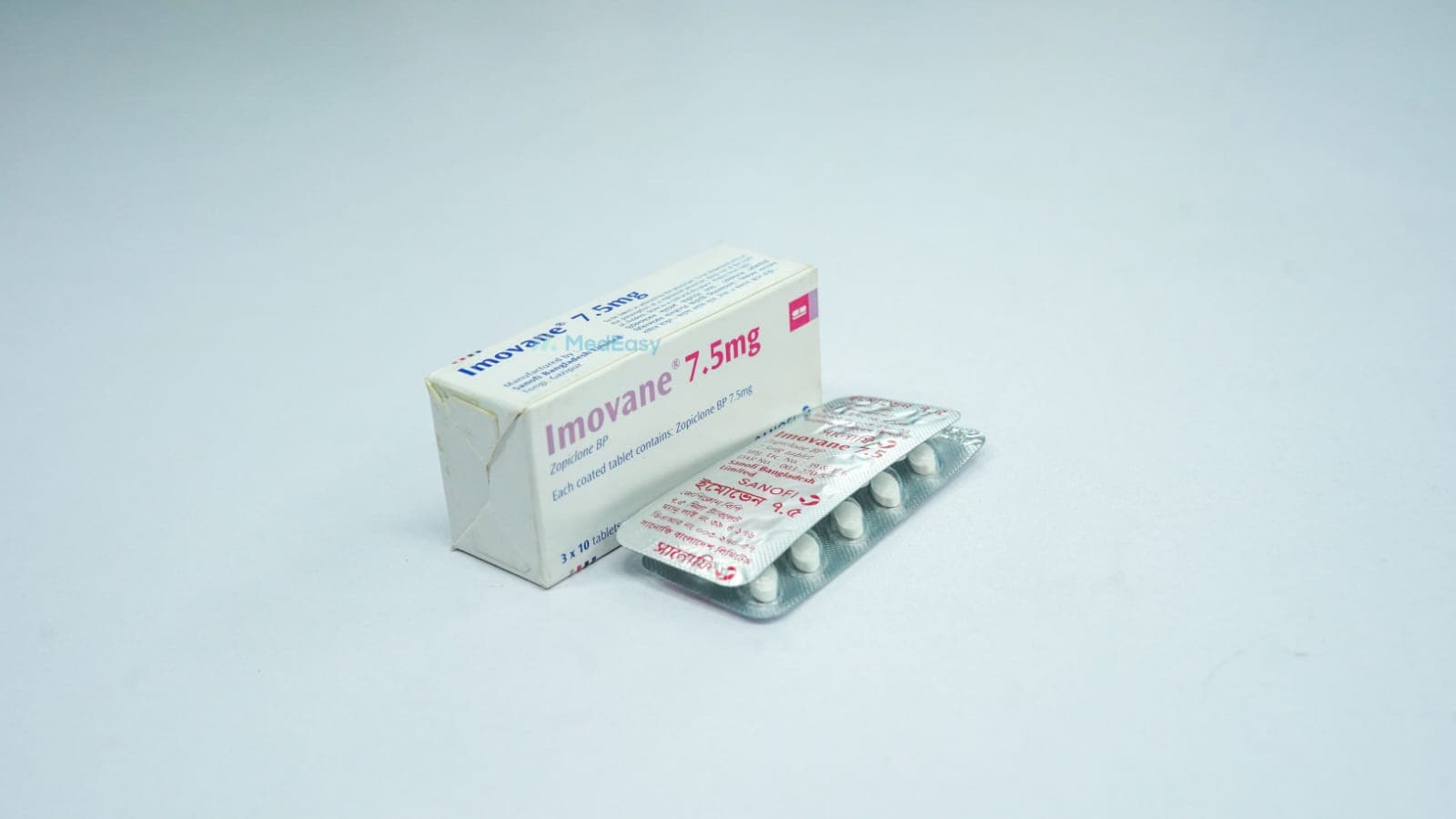

Medicine overview
Indications of Imovane
Imovane is a non-benzodiazepine sedative-hypnotic ("Z-drug") indicated for the following:
Established / Approved Use
- Short-term treatment of insomnia, including difficulty with sleep initiation, frequent nocturnal awakenings, and early morning awakening. Treatment is generally limited to a few weeks, as long-term efficacy and safety beyond this period are not well established.
Not Recommended / Off-Label
Imovane is not indicated for chronic, long-term management of insomnia, for anxiety disorders, or as a routine daytime sedative. Use for indications other than short-term insomnia is not supported by strong evidence and is not recommended.
Composition
Each film-coated tablet contains Zopiclone INN as the active pharmaceutical ingredient, commonly available in 3.75 mg and 7.5 mg strengths, along with standard pharmaceutical excipients (fillers, binders, coating agents).
Description
Imovane is a sedative-hypnotic agent belonging to the cyclopyrrolone chemical class. Although structurally unrelated to benzodiazepines, Imovane binds at (or very near) the benzodiazepine-binding site on the GABA-A receptor complex, which is why it is grouped with other non-benzodiazepine hypnotics ("Z-drugs") such as zolpidem and zaleplon.
Imovane is approved and marketed in many countries, including the United Kingdom, Canada, Australia, several European countries, and Bangladesh, for the short-term management of insomnia. (In the United States, only the S-enantiomer of Imovane, esImovane, is separately approved; Imovane itself is not marketed there.) It is a prescription-only, controlled medicine due to its potential for dependence and misuse.
Therapeutic Class
Sedative-hypnotic agent; non-benzodiazepine ('Z-drug'), cyclopyrrolone class — Imovane is a Central Nervous System (CNS) depressant used for insomnia.
Pharmacology
Mechanism
Zopiclone acts as a positive allosteric modulator at the GABA-A receptor-chloride channel complex, binding at (or overlapping with) the benzodiazepine recognition site. This enhances the inhibitory effect of the neurotransmitter GABA, increasing chloride ion influx into neurons, which produces sedative, hypnotic, anxiolytic, and, to a lesser degree, anticonvulsant and muscle-relaxant effects. The hypnotic effect is the dominant clinically used action of Zopiclone.
Pharmacokinetics
- Absorption: Rapidly absorbed orally, with peak plasma concentration reached in approximately 1.5–2 hours; food delays absorption and onset of action.
- Distribution: Low plasma protein binding (~45%); crosses the placenta and is excreted into breast milk.
- Metabolism: Extensively metabolized in the liver, mainly via CYP3A4 (oxidation) and CYP2E1, to an N-oxide metabolite (weakly active) and an N-desmethyl metabolite (largely inactive).
- Elimination: Elimination half-life is approximately 5 hours in healthy adults (longer in the elderly and in hepatic impairment); excreted mainly in urine as metabolites.
Dosage & Administration of Imovane
Dosage by Indication
| Population / Indication | Recommended Imovane Dose |
|---|---|
| Adults (short-term insomnia) | 7.5 mg once daily, immediately before bedtime |
| Elderly / debilitated patients | 3.75 mg once daily at bedtime; may be increased to 7.5 mg only if the lower dose is clinically insufficient and well tolerated |
| Hepatic impairment (mild–moderate) | 3.75 mg once daily at bedtime (dose reduction required); contraindicated in severe hepatic impairment |
| Renal impairment | 3.75 mg once daily at bedtime as a starting dose, with caution |
| Children and adolescents (<18 years) | Not recommended; safety and efficacy not established |
The maximum recommended dose of Imovane is 7.5 mg per day. Doses should not be repeated within the same night.
Administration of Imovane
Imovane should be swallowed whole with a glass of water, taken immediately before going to bed, and only when the patient is able to devote a full night (at least 7–8 hours) to sleep before needing to be active again. It should not be taken with or immediately after a heavy or fatty meal, as this delays absorption and onset of action. Alcohol should be avoided on the day Imovane is taken.
Interaction of Imovane
Imovane has clinically significant interactions with the following:
- Other CNS depressants (opioids, benzodiazepines, other sedative-hypnotics, alcohol): Concomitant use with Imovane increases the risk of profound sedation, respiratory depression, coma, and death. Concomitant use should be avoided unless no alternative is available, and if combined, doses should be minimized with close monitoring.
- CYP3A4 inhibitors (e.g., erythromycin, clarithromycin, ketoconazole, itraconazole, ritonavir): Can significantly increase plasma levels and effects of Imovane, increasing sedation risk; dose reduction of Imovane may be needed.
- CYP3A4 inducers (e.g., rifampin, carbamazepine, phenytoin, St. John's Wort): Can reduce plasma levels of Imovane, decreasing its hypnotic effectiveness.
- Other CNS-active drugs (antipsychotics, antidepressants, sedating antihistamines): Additive CNS depression and impairment of alertness.
Contraindications
Zopiclone is contraindicated in patients with:
- Known hypersensitivity to Zopiclone or any component of the formulation.
- Severe respiratory insufficiency.
- Severe hepatic impairment (risk of precipitating hepatic encephalopathy).
- Myasthenia gravis.
Side Effects of Imovane
| Frequency | Effects |
|---|---|
| Very common | Bitter or metallic taste in the mouth (a characteristic effect of Imovane) |
| Common | Dry mouth, drowsiness, dizziness, headache, next-day residual sedation, mild gastrointestinal upset |
| Uncommon | Irritability, confusion, incoordination, low mood |
| Rare / serious | Complex sleep behaviors (sleep-walking, sleep-driving, engaging in other activities while not fully awake, usually with no memory of the event), paradoxical reactions (agitation, aggression, hallucinations), dependence and withdrawal symptoms on abrupt discontinuation, allergic reactions (rash, angioedema) |
Patients experiencing complex sleep behaviors or any allergic reaction while taking Imovane should stop the medicine and seek medical attention immediately.
Pregnancy & Lactation
Pregnancy: Data on the use of Imovane in pregnancy are limited. Imovane should be used during pregnancy only if clearly needed and if the potential benefit justifies the potential risk to the fetus; a physician should be consulted before use. Use of Imovane (and related sedative-hypnotics) close to delivery has been associated with neonatal sedation, hypotonia ("floppy infant"), and withdrawal symptoms in the newborn.
Lactation: Imovane is excreted into breast milk. Breastfeeding should be avoided during treatment with Imovane where possible; if use cannot be avoided, the infant should be monitored for sedation and poor feeding, under medical supervision.
Precautions & Warnings
- Complex sleep behaviors: Imovane, like other Z-drugs, carries a boxed-warning-level risk of complex sleep behaviors (sleep-walking, sleep-driving) that can result in serious injury or death. Imovane should be discontinued immediately if this occurs.
- CNS and respiratory depression: Combining Imovane with opioids or alcohol can cause profound sedation, respiratory depression, coma, and death; such combinations should be avoided.
- Dependence and withdrawal: Prolonged use of Imovane can lead to physical and psychological dependence. Abrupt discontinuation after regular use can cause withdrawal symptoms (rebound insomnia, anxiety, tremor, sweating, and rarely seizures); Imovane should be tapered gradually under medical supervision rather than stopped abruptly.
- Duration of use: Imovane is intended for short-term use only (typically a few weeks, including any taper); it should not be used continuously for prolonged periods.
- Next-day impairment: Imovane can impair driving ability and other tasks requiring full mental alertness the morning after use; patients should not drive or operate machinery until fully alert.
- Abuse potential: Imovane is a controlled substance in most jurisdictions with recognized potential for misuse and addiction, particularly in patients with a history of substance use disorder.
- Elderly patients: Increased sensitivity to sedative effects and higher risk of falls and fractures; the lowest effective dose should be used (see Use in Special Populations).
Overdose Effects of Imovane
Overdose of Imovane, particularly when combined with alcohol or other CNS depressants, may cause symptoms ranging from drowsiness and confusion to impaired coordination, respiratory depression, profound sedation, coma, and, rarely, death.
Suspected overdose of Imovane is a medical emergency: seek immediate medical attention or contact emergency services / a poison control center. Treatment is generally supportive (airway management, monitoring of vital signs); the benzodiazepine antagonist flumazenil may be used by medical professionals in a hospital setting to reverse sedative effects, but carries its own risks (including seizures) and must only be administered under close medical supervision. Do not attempt to manage a suspected Imovane overdose at home.
Storage Conditions
Store at room temperature (below 30°C), away from light and moisture. Keep out of reach of children.
Use In Special Populations
- Elderly: More sensitive to the sedative and psychomotor effects of Imovane; a reduced starting dose (3.75 mg) is recommended, with increased monitoring for falls, confusion, and excessive sedation.
- Hepatic impairment: Dose reduction to 3.75 mg is required in mild-to-moderate hepatic impairment; Imovane is contraindicated in severe hepatic impairment (see Contraindications).
- Renal impairment: Use with caution and a reduced starting dose, as elimination may be delayed.
- Respiratory disease: Use with caution in patients with compromised respiratory function (e.g., COPD); contraindicated in severe respiratory insufficiency (see Contraindications).
- Pediatric patients: Not recommended; see Pediatric Uses.
- Pregnancy and lactation: See Pregnancy and Lactation section for detailed guidance.
Duration Of Treatment
Treatment with Imovane should be for the shortest duration possible, typically ranging from a few days up to a maximum of about 2–4 weeks, including any gradual dose tapering. Continuous long-term use is not recommended due to risks of tolerance, dependence, and diminishing effectiveness. Ongoing need for Imovane should be reassessed regularly by the prescribing physician.
Drug Classes
Zopiclone belongs to the cyclopyrrolone class of non-benzodiazepine sedative-hypnotics ('Z-drugs'), a subgroup of Central Nervous System (CNS) depressants.
Mode Of Action
Zopiclone exerts its hypnotic effect by binding at (or overlapping with) the benzodiazepine-binding site on the GABA-A receptor-chloride ionophore complex in the CNS. This allosteric binding increases the frequency of chloride channel opening in response to GABA, enhancing inhibitory neurotransmission and producing sedation and sleep induction.
Pediatric Uses
The safety and efficacy of Imovane have not been established in children and adolescents under 18 years of age. Imovane is therefore not recommended for use in this population outside of specialist clinical settings.
Frequently Asked Questions
Q: What is Imovane 7.5 mg Tablet used for?
A: Imovane 7.5 mg Tablet is used for the short-term treatment of insomnia, helping with difficulty falling asleep, frequent night-time awakenings, or waking too early.
Q: How long can I take Imovane 7.5 mg Tablet?
A: Imovane 7.5 mg Tablet is intended for short-term use only, usually a few weeks at most, including any tapering. It should not be used continuously for long periods without your doctor's review.
Q: Why does Imovane 7.5 mg Tablet leave a bitter or metallic taste in my mouth?
A: A bitter or metallic taste is a very common and characteristic side effect of Imovane 7.5 mg Tablet. It is usually harmless, but if it is bothersome, discuss it with your physician.
Q: Can I drink alcohol while taking Imovane 7.5 mg Tablet?
A: No. Combining alcohol with Imovane 7.5 mg Tablet can cause profound sedation, breathing difficulties, and other serious effects, so alcohol should be avoided while taking Imovane 7.5 mg Tablet.
Q: Is Imovane 7.5 mg Tablet safe in pregnancy or while breastfeeding?
A: Imovane 7.5 mg Tablet should only be used in pregnancy if clearly needed, since data are limited and use near delivery has been linked to neonatal sedation and withdrawal. It passes into breast milk, so breastfeeding should generally be avoided during treatment with Imovane 7.5 mg Tablet; always consult your physician first.
Q: Can I stop Imovane 7.5 mg Tablet suddenly?
A: No. Stopping Imovane 7.5 mg Tablet abruptly after regular use can cause withdrawal symptoms such as rebound insomnia, anxiety, and tremor. Your doctor will usually advise a gradual dose taper instead.
Disclaimer
The information provided is accurate to the best of our knowledge, but it does not replace professional medical advice. We cannot guarantee its completeness or accuracy, and the absence of specific information about a drug should not be taken as an endorsement. We are not responsible for any consequences arising from this information, so please consult a healthcare professional for any concerns or questions.
