
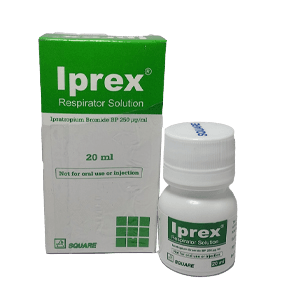

Medicine overview
Indications of Iprex
Iprex is a short-acting anticholinergic (antimuscarinic) bronchodilator used in respiratory disease. Its uses are classified below by strength of evidence:
- Established/FDA-approved use — Chronic Obstructive Pulmonary Disease (COPD): Maintenance treatment of bronchospasm associated with chronic bronchitis and emphysema, delivered by metered-dose inhaler or nebulizer solution.
- Established/FDA-approved use — Rhinorrhea: Nasal spray formulations of Iprex (0.03% and 0.06%) are indicated for symptomatic relief of rhinorrhea associated with allergic and non-allergic perennial rhinitis, and with the common cold, respectively.
- Guideline-supported adjunct use — Acute asthma exacerbation: Nebulized Iprex is recommended by asthma management guidelines as an add-on to inhaled short-acting beta-agonists (SABA) in the emergency treatment of moderate-to-severe acute asthma attacks; it is used in combination with a SABA, not as monotherapy, and is not intended as a stand-alone rescue medication.
- Combination therapy: Iprex is frequently formulated together with albuterol (salbutamol) for combined bronchodilation in COPD and acute bronchospasm, taking advantage of the two drugs' complementary mechanisms.
Iprex is not indicated as the sole agent for rapid relief of acute bronchospasm, since its onset of action is slower than that of short-acting beta-agonists.
Composition
Each formulation contains Ipratropium Bromide as the active ingredient. Common marketed strengths and forms include:
- Metered-dose inhaler (aerosol): 17–20 mcg of Ipratropium Bromide per actuation.
- Nebulizer solution: 0.02% (equivalent to 250 mcg/mL or 500 mcg per 2.5 mL unit-dose vial).
- Nasal spray: 0.03% and 0.06% strengths.
- Combination inhaler/nebules with albuterol (salbutamol), containing Ipratropium Bromide plus a short-acting beta-agonist.
Inactive ingredients vary by manufacturer and may include propellants (in aerosol forms), sodium chloride, and preservatives such as benzalkonium chloride (in some nasal/nebulizer formulations).
Description
Iprex is a synthetic quaternary ammonium anticholinergic (antimuscarinic) compound, structurally related to atropine, used as a bronchodilator in obstructive airway disease and, in nasal spray form, for control of rhinorrhea.
Because it carries a permanent positive charge (quaternary ammonium structure), Iprex is poorly absorbed across biological membranes, including the respiratory and gastrointestinal mucosa. This limits its action largely to the site of administration and minimizes systemic anticholinergic effects compared with atropine.
Iprex is delivered by inhalation (metered-dose inhaler or nebulizer) for airway disease, or intranasally for rhinorrhea, and is available both as a single-ingredient product and in fixed-dose combination with albuterol (salbutamol).
Therapeutic Class
Anticholinergic (antimuscarinic) bronchodilator; Iprex belongs to the short-acting muscarinic antagonist (SAMA) class of respiratory drugs.
Pharmacology
Mechanism of Action
Ipratropium Bromide competitively and reversibly blocks the action of acetylcholine at muscarinic (M1, M2, and M3) receptors on bronchial smooth muscle and submucosal glands. By antagonizing vagally-mediated cholinergic tone, it prevents the increase in intracellular cyclic guanosine monophosphate (cGMP) caused by acetylcholine binding, resulting in relaxation of bronchial smooth muscle (bronchodilation) and reduced mucus gland secretion. In the nasal mucosa, blockade of muscarinic receptors on submucosal glands reduces watery nasal secretions (rhinorrhea) without significantly affecting nasal congestion.
Pharmacokinetics
Following inhalation, only a small fraction (roughly 10–30%, depending on the device) of the dose reaches the lungs; most is swallowed. Because Ipratropium Bromide is a quaternary ammonium compound, systemic absorption from both the lung and the gastrointestinal tract is minimal (absolute bioavailability well under 10%), which limits systemic anticholinergic side effects. Onset of bronchodilation begins within 15 minutes, peaks at 1–2 hours, and effects last approximately 4–6 hours. Ipratropium Bromide undergoes partial hepatic metabolism to inactive ester-hydrolysis products, and the absorbed fraction is eliminated mainly via renal excretion.
Dosage & Administration of Iprex
Dosage by Indication
| Indication | Population | Typical Dose |
|---|---|---|
| COPD maintenance (metered-dose inhaler) | Adults | 2 inhalations (approx. 36 mcg) four times daily; additional inhalations may be needed but total should not exceed 12 inhalations in 24 hours. |
| COPD maintenance (nebulizer solution) | Adults | 500 mcg (one unit-dose vial) by nebulizer 3–4 times daily, doses spaced 6–8 hours apart. |
| Acute asthma exacerbation (adjunct to SABA, nebulized) | Adults | 500 mcg nebulized, combined with a short-acting beta-agonist, repeated at intervals as directed by the treating physician (e.g., every 20 minutes for up to 3 doses in the emergency setting, then as needed). |
| Acute asthma exacerbation (adjunct to SABA, nebulized) | Children (guideline-directed, off-label for Iprex alone in this setting) | 250 mcg (younger children) to 500 mcg (older children/adolescents) nebulized with a SABA, under direct medical supervision; safety and efficacy of routine outpatient use not established. |
| Rhinorrhea (nasal spray 0.03%) | Adults and children ≥6 years | 2 sprays per nostril 2–3 times daily. |
| Rhinorrhea associated with common cold (nasal spray 0.06%) | Adults and children ≥5 years | 2 sprays per nostril 3–4 times daily, for up to 4 days. |
No specific dose adjustment is well established for renal or hepatic impairment given the drug's minimal systemic absorption; use with the usual clinical caution in patients with significant organ impairment.
Administration
For inhaler use, shake the canister and prime before first use or after a period of non-use, as directed in the product leaflet; avoid spraying into the eyes. For nebulizer solution, the contents of the unit-dose vial are placed in the nebulizer chamber (undiluted or diluted as instructed) and inhaled via mouthpiece or well-fitting mask, again taking care to avoid contact with the eyes. Nasal spray should be primed before first use, and the head should be kept upright with sniffing avoided to reduce swallowing of the drug down the throat. Iprex should be used exactly as prescribed; do not exceed the recommended frequency or number of inhalations/sprays without medical advice.
Administration of Iprex
Iprex inhalation products are for oral inhalation (mouth) only; the nasal spray is for intranasal use only — the two forms are not interchangeable. Patients should be shown correct inhaler, nebulizer, or nasal-spray technique by a healthcare professional, since inadequate technique reduces drug delivery to the airway or nasal mucosa. Rinse the mouth after inhaled use is not typically required for Iprex alone (unlike inhaled corticosteroids), but any accidental contact with the eyes should be avoided and eyes rinsed promptly with water if it occurs.
Interaction of Iprex
Clinically significant, well-verified interactions with Iprex include:
- Other anticholinergic (antimuscarinic) agents (e.g., tiotropium, other long-acting muscarinic antagonists, certain antihistamines, tricyclic antidepressants): concurrent use may produce additive anticholinergic effects such as dry mouth, urinary retention, constipation, and blurred vision. Concurrent use of Iprex with another inhaled anticholinergic bronchodilator is generally not recommended.
- Short-acting and long-acting beta-agonists and methylxanthines (e.g., theophylline): these are commonly co-administered with Iprex for additive bronchodilator effect; no clinically important pharmacokinetic interaction is established, but combined use should be monitored for additive cardiovascular stimulant effects when used with beta-agonists.
Because systemic absorption of Iprex is minimal, clinically significant interactions with systemically-acting drugs (e.g., via cytochrome P450 metabolism) have not been well established.
Contraindications
Ipratropium Bromide is contraindicated in patients with known hypersensitivity to Ipratropium Bromide, atropine, or any of its derivatives, or to any other component of the formulation. Reported hypersensitivity reactions include urticaria, angioedema (including of the tongue, lips, and face), laryngospasm, and anaphylaxis.
Side Effects of Iprex
The most commonly reported adverse effects of Iprex are related to its local anticholinergic action:
- Very common/common: dry mouth, headache, cough, and throat irritation.
- Common: nausea, dizziness, dyspepsia (indigestion), and blurred vision (especially with accidental eye contact).
- Uncommon: palpitations, tachycardia, urinary retention or difficulty voiding (particularly in patients with pre-existing bladder outlet obstruction), and constipation.
- Rare but serious: paradoxical bronchospasm (a sudden worsening of wheeze/breathlessness immediately after use — treatment should be discontinued and alternative therapy sought if this occurs), acute angle-closure glaucoma or worsening of narrow-angle glaucoma from ocular exposure, and immediate hypersensitivity reactions such as angioedema, urticaria, or anaphylaxis (see Contraindications).
Pregnancy & Lactation
Pregnancy: There are no adequate and well-controlled studies of Iprex in pregnant women. Because systemic absorption is minimal, systemic fetal exposure is expected to be low, but Iprex should be used during pregnancy only if the potential benefit justifies the potential risk to the fetus; a physician should be consulted before use in pregnancy.
Lactation: It is not known whether Iprex is excreted in human breast milk. Given its low systemic bioavailability, systemic exposure of a breastfed infant is expected to be minimal, but caution is advised and a physician or lactation specialist should be consulted before use while breastfeeding.
Precautions & Warnings
- Ocular effects: Avoid spraying or nebulizing Iprex into the eyes; direct ocular contact (more likely with a nebulizer mask than a mouthpiece) can precipitate or worsen narrow-angle glaucoma, and can cause eye pain, blurred vision, mydriasis (pupil dilation), and halos around lights. Patients with pre-existing narrow-angle glaucoma should use Iprex with caution and be counseled to protect their eyes during nebulization.
- Urinary retention: Use with caution in patients with bladder outlet obstruction or prostatic hyperplasia, as anticholinergic effects may worsen urinary retention.
- Paradoxical bronchospasm: As with other inhaled bronchodilators, Iprex can rarely cause immediate paradoxical bronchospasm. If this occurs, the medication should be discontinued immediately and alternative therapy instituted.
- Hypersensitivity to soy/peanut: Some Iprex inhaler formulations contain soy lecithin as an excipient; these should be avoided in patients with known hypersensitivity to soybean or peanut, because of possible allergic cross-reactivity.
- Not a rescue medication: Iprex has a slower onset of bronchodilation than short-acting beta-agonists and is not intended for the initial rapid relief of acute, severe bronchospasm as a sole agent; it should be used according to the prescribed regimen, in combination with a fast-acting bronchodilator when rescue therapy is needed.
Overdose Effects of Iprex
Because systemic absorption of Iprex is minimal after inhaled or intranasal use, significant systemic toxicity from accidental overdose is unlikely; however, exaggerated anticholinergic effects such as dry mouth, blurred vision, tachycardia, urinary retention, and constipation could theoretically occur with excessive use. If overdose is suspected, or if the patient experiences severe or unusual symptoms, seek immediate medical attention or contact a poison control center; treatment is supportive and symptomatic, as there is no specific antidote for Iprex.
Storage Conditions
Store at room temperature (below 30°C), away from light, excessive heat, and moisture. Do not puncture, break, or burn the inhaler canister, and avoid exposing it to freezing temperatures or direct sunlight. Keep out of reach of children.
Use In Special Populations
- Renal impairment: No specific dose adjustment is well established, given minimal systemic absorption of Iprex; use with routine clinical caution.
- Hepatic impairment: No specific dose adjustment is well established; use with routine clinical caution.
- Elderly: No age-related dose adjustment is generally required, but elderly patients may be more susceptible to anticholinergic effects such as urinary retention and glaucoma exacerbation (see Precautions and Warnings).
- Pediatric: See Pediatric Uses for age-specific approved indications and dosing.
Duration Of Treatment
For COPD, Iprex is generally used as long-term, regular maintenance therapy for as long as the physician determines it is needed to control symptoms; it is not intended to be stopped and started intermittently for symptom relief alone. For acute asthma exacerbations, Iprex is used short-term, only for the duration of the acute episode, as an adjunct to a short-acting beta-agonist, and is typically discontinued once the exacerbation resolves and the patient reverts to their usual maintenance regimen. For rhinorrhea, the nasal spray is generally used only for as long as symptoms persist, with the 0.06% common-cold formulation limited to a maximum of 4 days of use. Any change in duration of Iprex therapy should be directed by the prescribing physician.
Drug Classes
Ipratropium Bromide belongs to the anticholinergic (antimuscarinic) bronchodilator class, also referred to as short-acting muscarinic antagonists (SAMA); related classes include long-acting muscarinic antagonists (e.g., tiotropium) and beta-2 agonist bronchodilators, with which Ipratropium Bromide is often combined.
Mode Of Action
Ipratropium Bromide works by competitively blocking muscarinic acetylcholine receptors (M1, M2, M3) on airway smooth muscle and submucosal glands, thereby inhibiting the bronchoconstrictor and secretory effects mediated by the vagus nerve. This antagonism reduces the resting bronchomotor tone that is driven by cholinergic (parasympathetic) activity, producing bronchodilation and decreased mucus secretion. Because Ipratropium Bromide is a quaternary ammonium compound with poor lipid solubility, its action is largely confined to the site of deposition (airway or nasal mucosa), with minimal systemic anticholinergic effect.
Pregnancy
B
Pediatric Uses
Use of Iprex in children is indication- and formulation-specific:
- Nasal spray 0.03% (rhinorrhea, allergic/perennial rhinitis): approved for use in children 6 years of age and older, at the same dosing frequency as adults.
- Nasal spray 0.06% (rhinorrhea with the common cold): approved for use in children 5 years of age and older, for a maximum of 4 days.
- Inhalation aerosol (MDI) for COPD: COPD is uncommon in children, and safety and efficacy of the inhaler for this indication have not been established in the pediatric population.
- Nebulizer solution in acute asthma (off-label/guideline-directed use): nebulized Iprex is commonly used as an adjunct to short-acting beta-agonists in children with moderate-to-severe acute asthma exacerbations under direct medical supervision (e.g., in the emergency department), even though it is not formally approved as a stand-alone pediatric indication; safety and efficacy for routine outpatient/home use in children have not been established, and use in infants and young children should be guided by a pediatrician.
Frequently Asked Questions
Q: What is Iprex 20 ml Respirator Solution used for?
A: Iprex 20 ml Respirator Solution is an inhaled anticholinergic bronchodilator used mainly for long-term maintenance treatment of bronchospasm in chronic obstructive pulmonary disease (COPD), and, as an adjunct to short-acting beta-agonist inhalers, in the emergency treatment of acute asthma exacerbations. Nasal spray forms of Iprex 20 ml Respirator Solution are also used to relieve a runny nose (rhinorrhea) due to allergic rhinitis or the common cold.
Q: Can Iprex 20 ml Respirator Solution be used to stop a sudden asthma attack on its own?
A: No. Iprex 20 ml Respirator Solution has a slower onset of action than short-acting beta-agonist rescue inhalers (such as salbutamol) and is not intended as a stand-alone rescue medication for sudden bronchospasm. In an acute asthma attack, Iprex 20 ml Respirator Solution is used together with, not instead of, a fast-acting beta-agonist, under medical guidance.
Q: Who should not use Iprex 20 ml Respirator Solution?
A: Iprex 20 ml Respirator Solution should not be used by anyone with a known allergy (hypersensitivity) to Iprex 20 ml Respirator Solution itself, to atropine, or to related anticholinergic derivatives, as this can cause reactions such as swelling of the face and throat, hives, or a severe allergic reaction. Always tell your doctor about any known drug allergies before starting Iprex 20 ml Respirator Solution.
Q: What are the common side effects of Iprex 20 ml Respirator Solution?
A: The most common side effects of Iprex 20 ml Respirator Solution are dry mouth, cough, headache, and a bitter or unusual taste. Some people experience nausea, dizziness, or blurred vision, especially if the spray or mist accidentally gets into the eyes. If you notice sudden worsening of wheezing or breathing difficulty right after using Iprex 20 ml Respirator Solution (paradoxical bronchospasm), stop use and contact your doctor immediately.
Q: Is Iprex 20 ml Respirator Solution safe to use during pregnancy or breastfeeding?
A: There is limited human data on Iprex 20 ml Respirator Solution in pregnancy and breastfeeding. Because very little of the drug is absorbed into the bloodstream after inhaled or nasal use, exposure to a fetus or breastfed infant is expected to be low, but Iprex 20 ml Respirator Solution should be used during pregnancy or breastfeeding only if your physician determines that the benefit outweighs any potential risk. Always consult your doctor before using Iprex 20 ml Respirator Solution if you are pregnant, planning pregnancy, or breastfeeding.
Q: Can Iprex 20 ml Respirator Solution be used in children?
A: Yes, but the approved age depends on the product: Iprex 20 ml Respirator Solution nasal spray (0.03%) is approved for children 6 years and older, and the 0.06% strength for children 5 years and older for cold-related runny nose. Nebulized Iprex 20 ml Respirator Solution is often used as an add-on treatment for acute asthma attacks in children under close medical supervision, but its routine safety and effectiveness for regular use at home has not been formally established in young children, so pediatric use should always be directed by a doctor.
Disclaimer
The information provided is accurate to the best of our knowledge, but it does not replace professional medical advice. We cannot guarantee its completeness or accuracy, and the absence of specific information about a drug should not be taken as an endorsement. We are not responsible for any consequences arising from this information, so please consult a healthcare professional for any concerns or questions.
