
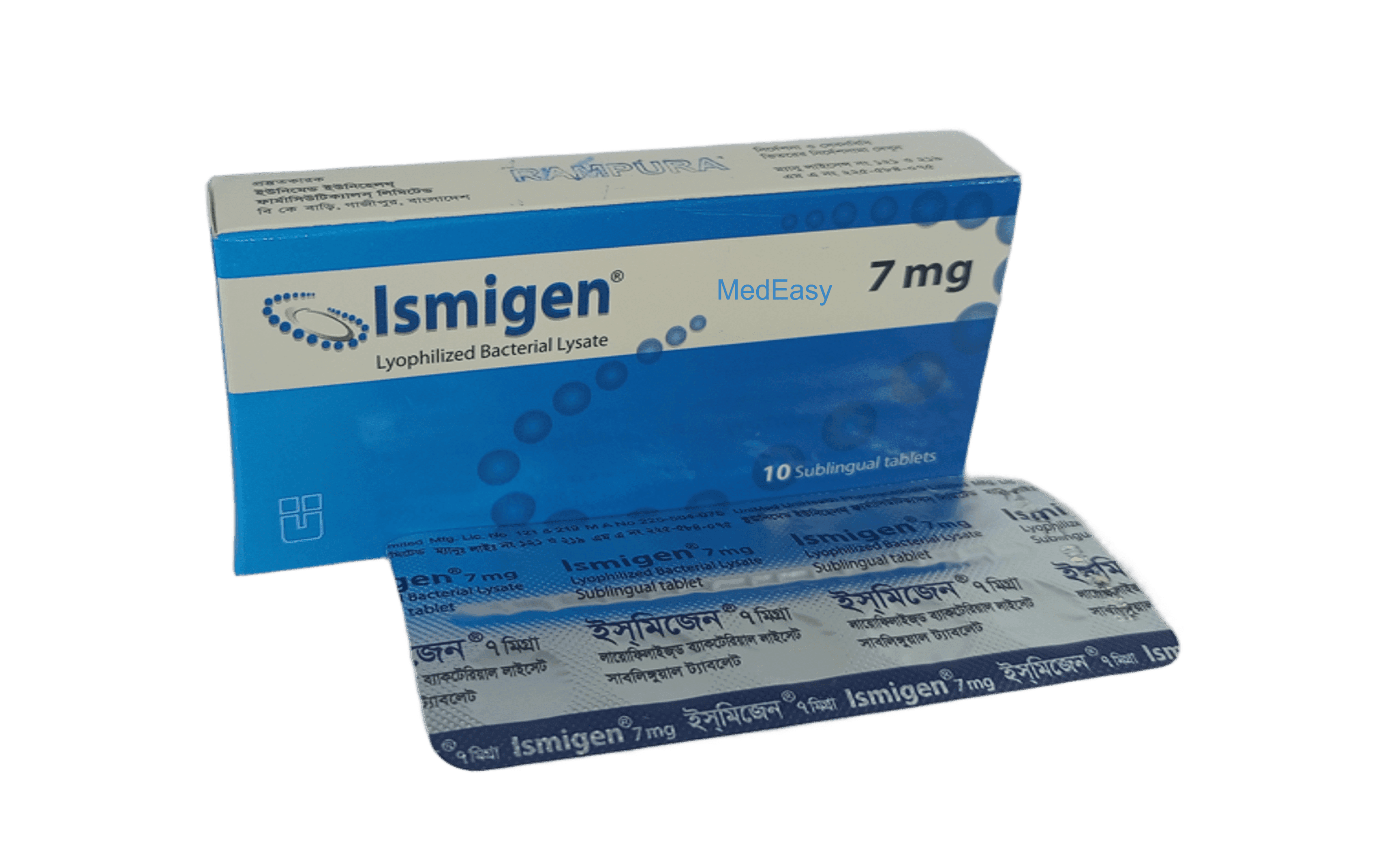

Medicine overview
Indications of Ismigen
Ismigen is an immunostimulant preparation made from freeze-dried lysates of common respiratory bacterial pathogens. It is used as follows, classified by strength of evidence:
Guideline/Evidence-supported adjunctive use
- Prevention of recurrent respiratory tract infections: Ismigen is used as adjunctive prophylactic therapy in patients (both adults and children) with a history of recurrent bronchitis, recurrent sinusitis, or frequent upper respiratory tract infections, to potentially reduce the frequency, severity, and duration of future episodes. Evidence is moderate in quality and largely product-specific (i.e., results from one bacterial lysate product cannot be assumed to apply identically to another).
Important limitations
- Ismigen is not indicated for the treatment of an acute, active bacterial or viral respiratory infection; it is a preventive/adjunctive measure, not an acute-phase treatment.
- Ismigen is not a substitute for routine immunization (vaccination) or for antibiotic therapy when a bacterial infection is already established and antibiotics are clinically indicated.
Composition
Lyophilized Bacterial Lysate consists of standardized, freeze-dried (lyophilized) lysates of inactivated bacterial strains commonly implicated in respiratory tract infections (such as species of Haemophilus, Streptococcus, Klebsiella, Staphylococcus, and Moraxella). The exact strain composition, number of bacterial species, and lysate concentration vary by manufacturer and specific product formulation.
Lyophilized Bacterial Lysate is typically supplied as capsules, sublingual tablets, or oral lyophilisate sachets for reconstitution/dissolution, depending on the manufacturer.
Description
Ismigen is a bacterial-lysate-based immunostimulant. It contains antigenic material derived from multiple bacterial species that are frequently responsible for upper and lower respiratory tract infections. Rather than acting as an antimicrobial agent, Ismigen works by stimulating the patient's own immune system — both at the mucosal level (respiratory and gut-associated lymphoid tissue) and systemically — with the goal of enhancing the body's natural defenses against future respiratory infections.
Ismigen is used mainly as a preventive/adjunctive therapy in individuals prone to recurrent respiratory infections, rather than as a treatment for an infection that is already present.
Therapeutic Class
Immunostimulant (bacterial lysate / bacterial immunomodulator); Ismigen is not an antibiotic and has no direct antimicrobial activity.
Pharmacology
Mechanism of Action
Lyophilized Bacterial Lysate acts as a mucosal and systemic immunostimulant. Following oral or sublingual administration, bacterial antigens contained in Lyophilized Bacterial Lysate are taken up by immune cells of the gut- and mucosa-associated lymphoid tissue. This is believed to:
- Activate macrophages and dendritic cells, enhancing antigen presentation.
- Stimulate proliferation and activity of T-lymphocytes and B-lymphocytes.
- Increase production of secretory IgA (sIgA) at respiratory mucosal surfaces, which helps limit bacterial/viral adherence and colonization.
- Modestly increase circulating immunoglobulins and enhance phagocytic activity of neutrophils.
The net clinical effect proposed for Lyophilized Bacterial Lysate is a reduction in the frequency and severity of recurrent respiratory infections over subsequent months, rather than an immediate antimicrobial effect.
Dosage & Administration of Ismigen
Adult Dose
Ismigen is commonly administered as one capsule/tablet (standard adult strength) once daily, taken on an empty stomach (e.g., in the morning before breakfast), typically for 10 consecutive days per month, repeated for 3 consecutive months as one treatment course.
Pediatric Dose
A lower-strength pediatric formulation of Ismigen is used in children, following the same cyclical schedule (10 days on, then off for the remainder of the month, repeated for 3 months), under physician supervision. Exact pediatric strength and minimum age depend on the specific product formulation; consult the product-specific labeling and a pediatrician.
Renal/Hepatic Impairment
No well-established dose adjustment of Ismigen is required for renal or hepatic impairment; however, such patients should use Ismigen under medical supervision.
| Population | Typical Regimen |
|---|---|
| Adults | 1 standard-strength capsule/tablet daily x 10 days/month x 3 months |
| Children | 1 pediatric-strength capsule/tablet daily x 10 days/month x 3 months (physician-directed) |
See Duration of Treatment for further detail on repeat cycles.
Administration of Ismigen
Ismigen is generally taken orally (capsule swallowed whole, or sublingual tablet allowed to dissolve under the tongue, depending on formulation), preferably on an empty stomach such as first thing in the morning before food. Do not chew capsule forms unless the specific product labeling states otherwise. Follow the specific product's instructions and the prescribing physician's advice.
Interaction of Ismigen
Clinically significant, well-verified drug interactions with Ismigen are limited, as it is not systemically absorbed in the manner of conventional small-molecule drugs. Notable points:
- Immunosuppressive therapy (e.g., systemic corticosteroids, other immunosuppressants): concurrent use may theoretically blunt the intended immune-stimulating effect of Ismigen; the clinical significance is not firmly established, but concurrent use should be discussed with a physician.
- Live vaccines: because Ismigen modulates immune activity, spacing administration from live vaccine schedules is a reasonable precaution, though no major documented interaction exists; follow physician guidance on vaccination timing.
No well-established, clinically significant food or major drug-drug interactions have been documented for Ismigen.
Contraindications
Lyophilized Bacterial Lysate is contraindicated in patients with known hypersensitivity to Lyophilized Bacterial Lysate or to any component of the specific formulation used.
Side Effects of Ismigen
Ismigen is generally well tolerated. Most reported adverse effects are mild and transient, particularly during the first days of a treatment cycle:
- Gastrointestinal: nausea, abdominal discomfort, diarrhea.
- Respiratory: mild cough or transient worsening of respiratory symptoms.
- Dermatologic: skin rash or urticaria (uncommon).
- General: low-grade fever (uncommon).
Severe or allergic reactions are rare; discontinue Ismigen and seek medical advice if a significant allergic reaction (e.g., swelling, severe rash, breathing difficulty) occurs.
Pregnancy & Lactation
Data on the use of Ismigen during pregnancy and lactation are limited. As a precaution, Ismigen should be used during pregnancy or breastfeeding only if clearly needed and if the potential benefit justifies the potential risk to the fetus or infant; consult a physician before use in these situations.
Precautions & Warnings
- Ismigen should be used with caution in patients with an active autoimmune disease, due to a theoretical concern that immune stimulation could aggravate autoimmune activity.
- Ismigen is not a substitute for vaccination or for antibiotic treatment of an active bacterial infection when antibiotics are clinically indicated.
- Mild gastrointestinal or respiratory symptoms may occur during the initial days of use (see Side Effects); these are usually self-limited.
- Use in children should be under physician guidance, particularly regarding correct pediatric-strength formulation and treatment cycle.
- For hypersensitivity, see Contraindications.
Overdose Effects of Ismigen
Specific data on overdose with Ismigen are limited, and no specific antidote is known. In case of suspected overdose or accidental ingestion of an excessive amount of Ismigen, seek immediate medical attention or contact a poison control center; treatment should be supportive and symptomatic, as directed by a physician.
Storage Conditions
Store at room temperature (below 30°C), away from light and moisture. Keep out of reach of children.
Use In Special Populations
- Pediatric patients: A lower-strength pediatric formulation of Ismigen is used under physician supervision; safety and efficacy in very young infants have not been firmly established for all products, so consult product-specific labeling.
- Elderly patients: No specific dose adjustment of Ismigen is established for elderly patients; general precautions apply.
- Renal/Hepatic impairment: No well-established dose adjustment is required; use under medical supervision.
- Autoimmune disease: Use with caution — see Precautions and Warnings.
- Pregnancy/Lactation: See Pregnancy and Lactation section.
Duration Of Treatment
A standard course of Ismigen typically consists of daily dosing for 10 consecutive days each month, repeated for 3 consecutive months. Some physicians may recommend an additional repeat course after an interval (e.g., several months later) for patients with ongoing recurrent infections. The exact duration should be individualized by the prescribing physician.
Drug Classes
Immunostimulants; bacterial lysates / bacterial immunomodulator preparations used for prophylaxis of recurrent respiratory tract infections. Lyophilized Bacterial Lysate belongs to this class.
Mode Of Action
Lyophilized Bacterial Lysate works by exposing the immune system to bacterial antigens from common respiratory pathogens, thereby stimulating mucosal and systemic immune responses (activation of macrophages/dendritic cells, T- and B-lymphocyte stimulation, and increased secretory IgA production) intended to enhance the body's natural defenses against future respiratory tract infections. See Pharmacology for full detail.
Pediatric Uses
Ismigen is used in children with recurrent respiratory tract infections, typically as a lower-strength pediatric formulation, following the same cyclical dosing schedule as in adults, under physician supervision. Safety and efficacy in very young infants (below the minimum age specified by the particular product's labeling) have not been established; use only under pediatrician guidance.
Frequently Asked Questions
Q: What is Ismigen 7 mg Tablet used for?
A: Ismigen 7 mg Tablet is an immunostimulant used as an adjunctive, preventive therapy to help reduce the frequency and severity of recurrent respiratory tract infections such as recurrent bronchitis or sinusitis. It is not used to treat an active infection.
Q: Is Ismigen 7 mg Tablet an antibiotic?
A: No. Ismigen 7 mg Tablet has no direct antimicrobial activity. It works by stimulating the body's own immune system rather than killing bacteria, so it is not a substitute for antibiotics when a bacterial infection is already established and antibiotic treatment is clinically indicated.
Q: How is Ismigen 7 mg Tablet taken?
A: Ismigen 7 mg Tablet is usually taken orally once daily on an empty stomach, for 10 consecutive days each month, repeated for 3 consecutive months, following the specific product's instructions and your physician's advice.
Q: Can Ismigen 7 mg Tablet be used during pregnancy?
A: Data on Ismigen 7 mg Tablet in pregnancy are limited. It should be used during pregnancy or breastfeeding only if clearly needed and if the potential benefit outweighs the potential risk to the fetus or infant; consult a physician first.
Q: What side effects can Ismigen 7 mg Tablet cause?
A: Ismigen 7 mg Tablet is generally well tolerated. Mild, transient gastrointestinal upset (nausea, abdominal discomfort, diarrhea), mild cough or respiratory symptoms, and occasionally skin rash or low-grade fever may occur, particularly early in a treatment cycle. Severe allergic reactions are rare but require immediate medical attention.
Q: Who should not take Ismigen 7 mg Tablet?
A: Ismigen 7 mg Tablet should not be used by anyone with a known hypersensitivity to Ismigen 7 mg Tablet or to any component of the specific formulation. It should also be used with caution in people with active autoimmune disease; consult a physician in that situation.
Disclaimer
The information provided is accurate to the best of our knowledge, but it does not replace professional medical advice. We cannot guarantee its completeness or accuracy, and the absence of specific information about a drug should not be taken as an endorsement. We are not responsible for any consequences arising from this information, so please consult a healthcare professional for any concerns or questions.
