10% Off
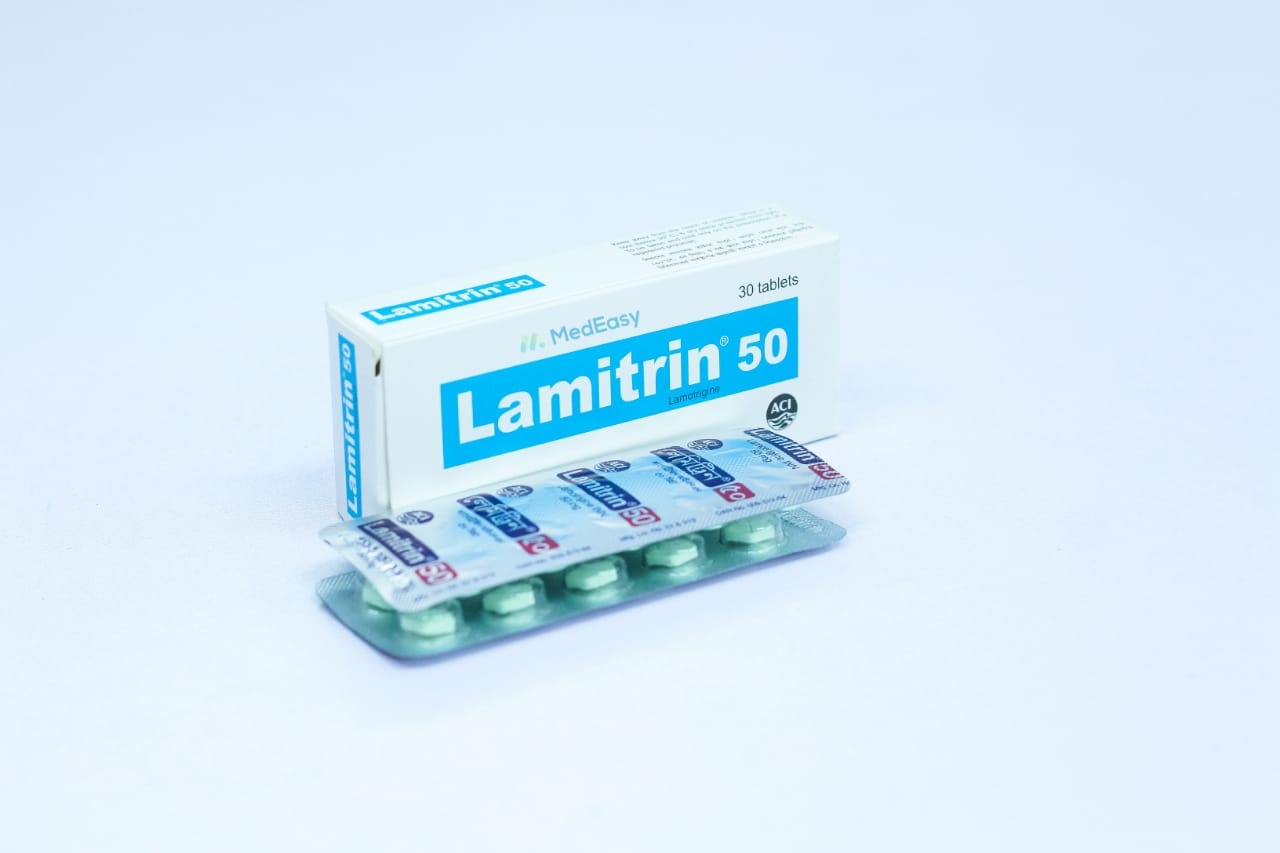
Lamitrin50 mg
ACI Limited
৳180.00
Add to cart


Lameptil is an anticonvulsant (antiepileptic) and mood-stabilizing medicine. Its established, guideline-supported uses are:
Each tablet contains Lamotrigine as the active pharmaceutical ingredient. Lamotrigine is available as immediate-release tablets, chewable/dispersible tablets, and extended-release tablets in various strengths (commonly 25 mg, 50 mg, 100 mg, and 200 mg), along with standard pharmaceutical excipients. Please check the product label of the specific brand for the exact composition and strength.
Lameptil is a phenyltriazine-class anticonvulsant and mood stabilizer, chemically unrelated to other commonly used antiepileptic drugs. It is used long-term for the control of certain seizure types and for the maintenance treatment of bipolar I disorder. Lameptil requires a slow, stepwise dose increase (titration) at the start of treatment and after certain medication changes, because rapid titration significantly increases the risk of serious skin rash.
Lameptil belongs to the anticonvulsant (antiepileptic drug, AED) class, specifically the phenyltriazine derivatives. It is also classified as a mood stabilizer when used for bipolar I disorder maintenance treatment.
Lamotrigine's precise mechanism of action is not completely understood. It is believed to act primarily by blocking voltage-sensitive sodium channels in neurons, which stabilizes neuronal membranes and inhibits the release of excitatory neurotransmitters, particularly glutamate and aspartate. This reduces repetitive neuronal firing and dampens the spread of seizure activity. The precise mechanism by which Lamotrigine exerts its mood-stabilizing effect in bipolar I disorder is unknown.
Pharmacokinetics: Lamotrigine is rapidly and almost completely absorbed after oral administration, with negligible first-pass metabolism. It is metabolized mainly in the liver via glucuronidation (UGT enzymes) and excreted predominantly in urine as glucuronide conjugates. Its half-life varies markedly depending on concomitant medications — shortened by enzyme-inducing antiepileptics and prolonged by valproate.
Dosing of Lameptil is highly individualized and depends on the indication, patient age, and — critically — on concomitant medications, because the risk of serious rash rises sharply with faster-than-recommended titration. Always follow the exact titration schedule prescribed by the physician; do not increase the dose faster than instructed.
| Concomitant medication | Typical starting approach | Usual maintenance dose (adults) |
|---|---|---|
| With valproate (enzyme inhibitor) | Slowest titration; very low starting dose, increased gradually over weeks | Approximately 100–200 mg/day |
| Without enzyme inducers or valproate | Low starting dose, increased gradually over weeks | Approximately 225–375 mg/day |
| With enzyme-inducing anticonvulsants (e.g. carbamazepine, phenytoin, phenobarbital, primidone), without valproate | Higher starting dose, increased gradually over weeks | Approximately 300–500 mg/day |
A specific, gradual switch-over schedule is used to transition from the prior antiepileptic drug to Lameptil monotherapy over several weeks, per the prescribing physician's instructions; typical target maintenance dose is around 300–500 mg/day.
Started with a slow titration over about 6 weeks, similar in principle to the epilepsy titration (adjusted for concomitant valproate or enzyme inducers), reaching a usual target maintenance dose of approximately 200 mg/day (100 mg/day with valproate; up to 400 mg/day with enzyme inducers, without valproate), as directed by the physician.
Lameptil tablets are taken orally, generally once or twice daily as directed, with or without food. Chewable/dispersible tablets may be swallowed whole, chewed and taken with water/diluted fruit juice, or dispersed in a small amount of water and swallowed. Extended-release tablets must be swallowed whole and not chewed, divided, or crushed. Doses should be taken at the same time(s) each day to maintain consistent blood levels.
Lameptil has several clinically important drug interactions, mainly affecting its blood levels:
Lamotrigine is contraindicated in patients with known hypersensitivity to Lamotrigine or any component of the formulation.
Serious side effect — seek immediate medical attention:
Pregnancy: Lameptil should be used during pregnancy only if clearly needed and if the potential benefit to the mother justifies the potential risk to the fetus; always consult a physician before starting, stopping, or changing the dose during pregnancy. Uncontrolled epilepsy itself poses risks to both mother and fetus, so anticonvulsant therapy is generally continued under close medical supervision rather than stopped abruptly. Lameptil blood levels can change substantially (typically decreasing) during pregnancy due to hormonal changes, so more frequent monitoring and dose adjustment by the treating physician is usually required throughout pregnancy and after delivery. Patients should enroll in or ask their physician about relevant pregnancy exposure registries where available.
Lactation: Lameptil passes into breast milk in clinically relevant amounts. Breastfeeding infants should be monitored for possible side effects (e.g. rash, drowsiness, poor feeding). The decision to breastfeed while taking Lameptil should be made in consultation with a physician, weighing the benefits of breastfeeding against the potential risk to the infant.
Serious rash risk: The risk of life-threatening rash (including Stevens-Johnson syndrome and toxic epidermal necrolysis) with Lameptil is significantly increased by: rapid dose titration, exceeding the recommended starting dose or titration rate, and concomitant use of valproate. Children are at higher risk than adults. To minimize risk, Lameptil dosing must strictly follow the prescribed titration schedule; patients and caregivers should report any new rash to the physician immediately.
Symptoms of Lameptil overdose may include dizziness, headache, drowsiness, loss of coordination (ataxia), double vision, nausea/vomiting, seizures, coma, and, in severe cases, irregular heart rhythm. Overdose is a medical emergency — seek immediate medical attention or contact a poison control center/emergency services right away. Do not attempt to manage an overdose at home. Treatment in a medical facility is generally supportive; there is no specific antidote for Lameptil overdose.
Store at room temperature (below 30°C), away from light and moisture. Keep out of reach of children.
Elderly: Use with caution; may be more sensitive to side effects such as dizziness and incoordination. Dose adjustment is generally not required based on age alone, but should account for renal function and concomitant medications.
Renal impairment: Use with caution; patients with significant renal impairment may require lower maintenance doses and closer monitoring, as clearance of Lameptil and its metabolites may be reduced.
Hepatic impairment: Dose reduction is generally recommended in moderate to severe hepatic impairment, as Lameptil is extensively metabolized by the liver; follow physician guidance closely.
Children: See Pediatric Uses. See Precautions and Warnings for the increased rash risk in this age group.
Duration of Lameptil therapy is individualized by the treating physician based on seizure control or mood-episode prevention, and is typically long-term/chronic for both epilepsy and bipolar I disorder maintenance. Any decision to stop or reduce Lameptil should be made together with the physician, using a gradual taper (usually over at least 2 weeks), as abrupt discontinuation can increase seizure risk.
Anticonvulsant (antiepileptic drug); phenyltriazine derivative; mood stabilizer.
Lamotrigine primarily blocks voltage-gated sodium channels in neurons, stabilizing neuronal membranes and inhibiting the excessive release of excitatory neurotransmitters (particularly glutamate), which reduces abnormal, repetitive neuronal firing underlying seizures. The mechanism underlying its mood-stabilizing effect in bipolar I disorder is not fully established.
C
Lameptil is approved as adjunctive therapy for partial-onset seizures, primary generalized tonic-clonic seizures, and Lennox-Gastaut syndrome-associated seizures in children aged 2 years and older, using a weight-based, slow titration schedule that depends on concomitant medications (valproate, enzyme-inducing anticonvulsants, or neither), as determined by the treating physician.
Lameptil monotherapy conversion is approved only for patients 16 years and older; safety and efficacy of monotherapy conversion have not been established in children under 16.
Lameptil is not approved for bipolar I disorder in children; safety and efficacy for this indication have not been established in the pediatric population.
Children are at higher risk than adults for serious rash with Lameptil; strict adherence to the prescribed titration schedule is essential, and any new rash requires immediate medical evaluation.
Q: Why does Lameptil 50 mg Tablet need to be started at such a low dose and increased so slowly?
A: Starting Lameptil 50 mg Tablet at a low dose and increasing it gradually (titrating) over several weeks substantially reduces the risk of a serious, potentially life-threatening skin rash, including Stevens-Johnson syndrome and toxic epidermal necrolysis. Never increase the dose faster than your physician has prescribed.
Q: What should I do if I develop a rash while taking Lameptil 50 mg Tablet?
A: Contact your physician immediately if you develop any rash while taking Lameptil 50 mg Tablet, and seek emergency care right away if the rash is widespread, blistering, involves your mouth, eyes, or genitals, or is accompanied by fever or swollen glands. In most cases Lameptil 50 mg Tablet will need to be stopped promptly under medical guidance.
Q: Can I take Lameptil 50 mg Tablet with valproate (valproic acid)?
A: Yes, but only under close medical supervision. Valproate markedly raises Lameptil 50 mg Tablet blood levels and significantly increases rash risk, so when the two are combined, Lameptil 50 mg Tablet must be started at a much lower dose and titrated much more slowly than usual, exactly as your physician prescribes.
Q: Does Lameptil 50 mg Tablet affect birth control pills?
A: Yes. Estrogen-containing hormonal contraceptives can lower Lameptil 50 mg Tablet blood levels, and Lameptil 50 mg Tablet may modestly reduce the effectiveness of hormonal contraceptives. This bidirectional interaction may require a Lameptil 50 mg Tablet dose adjustment and/or additional contraceptive precautions — discuss your contraceptive method with your physician before starting Lameptil 50 mg Tablet.
Q: What happens if I miss several days of Lameptil 50 mg Tablet doses?
A: Do not simply restart Lameptil 50 mg Tablet at your usual maintenance dose if you have missed doses for several consecutive days (e.g. 5 or more days), as restarting at the full prior dose significantly increases rash risk. Contact your physician, who will likely have you restart at a lower dose and re-titrate gradually.
Q: Is Lameptil 50 mg Tablet safe to use during pregnancy?
A: Lameptil 50 mg Tablet should be used in pregnancy only if clearly needed, with the potential benefit outweighing potential risk to the fetus, and always under close physician supervision, since Lameptil 50 mg Tablet blood levels can change substantially during pregnancy and require monitoring and dose adjustment. Do not stop Lameptil 50 mg Tablet on your own if you become pregnant — discuss this with your physician first, since uncontrolled seizures also carry risks.
Disclaimer
The information provided is accurate to the best of our knowledge, but it does not replace professional medical advice. We cannot guarantee its completeness or accuracy, and the absence of specific information about a drug should not be taken as an endorsement. We are not responsible for any consequences arising from this information, so please consult a healthcare professional for any concerns or questions.