
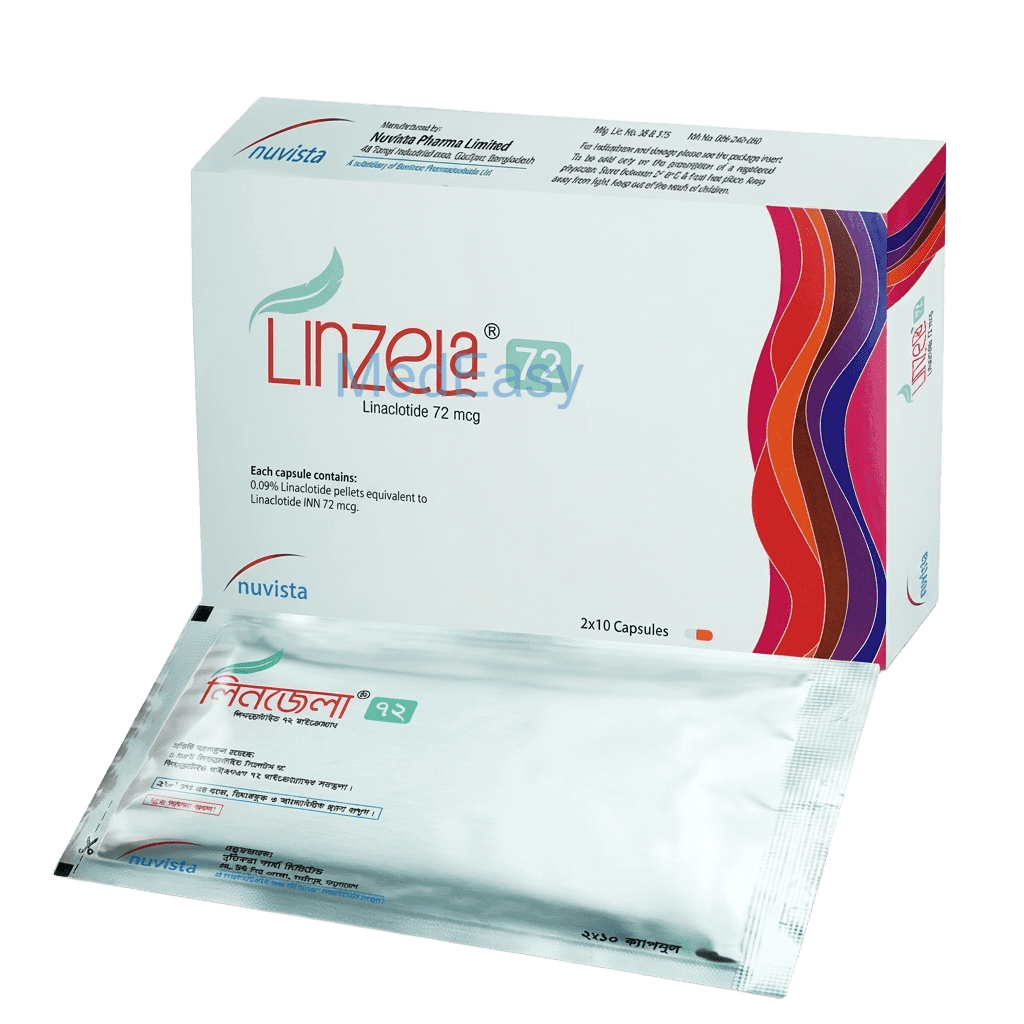

Medicine overview
Indications of Linzela
Linzela is a guanylate cyclase-C (GC-C) agonist used to treat certain chronicconstipation disorders in adults. Its indications, classified by strength of evidence, are:
Established / FDA-approved uses (adults)
- Irritable bowel syndrome with constipation (IBS-C): Linzela is approved to relieveglobal IBS symptoms and improve bowel habits (stool frequency and consistency, straining, abdominalpain and bloating).
- Chronic idiopathic constipation (CIC): Linzela is approved to increase spontaneousbowel movement frequency and improve stool consistency, straining, and abdominal discomfort inpatients without an identifiable underlying cause of constipation.
Not established / off-label
Linzela is not established as safe or effective for constipation caused by mechanical bowelobstruction, opioid-induced constipation, or for use in children under 6 years. It is notrecommended for use in patients 6 to 17 years of age. Use for indications other than IBS-C and CICshould only be on the specific advice of a physician.
Composition
Each capsule contains Linaclotide as the active pharmaceutical ingredient, generallyavailable in strengths such as 72 mcg, 145 mcg, and 290 mcg, along with pharmaceutically approvedexcipients. The exact strength(s) and available brand(s) may vary; always check the pack label forthe specific product dispensed.
Description
Linzela is a synthetic 14-amino-acid peptide that acts locally in the intestine as aguanylate cyclase-C (GC-C) receptor agonist. It is taken orally as a capsule for the treatment ofirritable bowel syndrome with constipation (IBS-C) and chronic idiopathic constipation (CIC) inadults. Linzela works mainly at the level of the intestinal lining and has minimal systemicabsorption.
Therapeutic Class
Linzela belongs to the guanylate cyclase-C (GC-C) agonist class, a group of gastrointestinal secretagogue/prokinetic agents used for chronic constipation disorders.
Pharmacology
Linaclotide and its active metabolite bind to and activate guanylate cyclase-C (GC-C)receptors on the luminal surface of intestinal epithelial cells. This increases intracellular andextracellular concentrations of cyclic guanosine monophosphate (cGMP), which in turn:
- Stimulates secretion of chloride and bicarbonate into the intestinal lumen (largely via theCFTR chloride channel), increasing intestinal fluid and accelerating gastrointestinal transit.
- Reduces the activity of pain-sensing (visceral afferent) nerve fibers, which is thought tocontribute to reduced abdominal pain in IBS-C.
Linaclotide and its metabolite are minimally absorbed systemically, so pharmacologic activity is largelyconfined to the GI tract.
Dosage & Administration of Linzela
Dosing of Linzela is indication-specific. It should be taken on an empty stomach,at least 30 minutes before the first meal of the day, as taking it with food may increase the riskand severity of diarrhea.
| Indication | Adult dose | Notes |
|---|---|---|
| IBS-C | 290 mcg orally once daily | Take on an empty stomach, at least 30minutes before breakfast. |
| CIC | 145 mcg orally once daily (some patients may be started on 72 mcg based ontolerability) | Take on an empty stomach, at least 30 minutes before breakfast. |
Missed dose
If a dose of Linzela is missed, skip it and take the next dose at the usual time; do not double thedose.
See Use in Special Populations for pediatric dosing information (notrecommended under 18 years).
Administration of Linzela
Swallow the Linzela capsule whole with water. Do not crush or chew the capsule, as this may affectonset and intensity of diarrhea. Take on an empty stomach, at least 30 minutes before the first mealof the day, preferably at the same time each day.
Patients who have difficulty swallowing capsules may, on their physician's advice, open thecapsule and mix the contents with soft food (such as applesauce) or liquid as directed on theproduct label, and take immediately without chewing.
Interaction of Linzela
Linzela has minimal systemic absorption, so clinically significant systemic druginteractions (e.g. via CYP enzymes) are not expected. Reported interaction concerns are mainlyadditive gastrointestinal effects:
- Other laxatives or stool softeners: concurrent use may increase the risk andseverity of diarrhea; avoid routine combination unless advised by a physician.
- Antidiarrheal agents (e.g. loperamide): may be used under medical supervisionif diarrhea occurs, but can mask an early warning sign of excessive effect.
Always inform your physician or pharmacist of all medicines, including over-the-counter productsand supplements, before starting Linzela.
Contraindications
- Children younger than 6 years of age — Linaclotide is contraindicated in this agegroup due to the risk of serious dehydration (boxed warning).
- Known or suspected mechanical gastrointestinal obstruction.
- Known hypersensitivity to Linaclotide or any component of the formulation.
Side Effects of Linzela
The most common side effect of Linzela is diarrhea, which is usually mild tomoderate but can occasionally be severe.
- Very common: diarrhea.
- Common: abdominal pain, flatulence (gas), abdominal distension/bloating,viral gastroenteritis, headache.
- Less common: vomiting, dyspepsia (indigestion), fecal incontinence, blood instool.
Severe diarrhea can lead to significant fluid and electrolyte loss; patients should stop Linzelaand contact a physician if severe or persistent diarrhea occurs.
Pregnancy & Lactation
Pregnancy: Linzela has minimal systemic absorption, so exposure to a developingfetus is expected to be limited; however, adequate and well-controlled studies in pregnant women arelacking. Linzela should be used during pregnancy only if clearly needed and if the potential benefitjustifies the potential risk to the fetus. Always consult a physician before use duringpregnancy.
Lactation: It is not known whether Linzela passes into human breast milk, butbecause systemic absorption is minimal, clinically relevant exposure of a breastfed infant isconsidered unlikely. Nonetheless, Linzela should be used during breastfeeding only on medical advice,weighing the benefits of treatment against any potential risk.
Precautions & Warnings
- Diarrhea: Linzela can cause diarrhea, sometimes severe; discontinue if severediarrhea occurs and consult a physician (see Side Effects).
- Pediatric risk: Linzela is contraindicated under 6 years of age and notrecommended for ages 6–17 years due to a boxed warning for serious dehydration seen in young animalstudies (see Contraindications and Pediatric Uses).
- History of severe or persistent diarrhea: use with caution; discuss alternativeoptions with a physician.
- Mechanical bowel obstruction: rule out before starting therapy in patients withsymptoms suggestive of obstruction.
- Take Linzela exactly as directed by the physician, on an empty stomach, for optimal effect and tominimize gastrointestinal side effects.
Overdose Effects of Linzela
Overdose of Linzela is most likely to cause severe diarrhea with resultingdehydration and electrolyte disturbances. There is no specific antidote. If overdose is suspected,seek immediate medical attention or contact a poison control center right away. Supportive care,including fluid and electrolyte replacement, should be provided by a healthcare professional asneeded; do not attempt unsupervised home treatment of a suspected overdose.
Storage Conditions
Store at room temperature (below 30°C), away from light and moisture. Keep out of reach of children.
Use In Special Populations
Pediatric use
Linzela is contraindicated in children younger than 6 years of age because of the risk of seriousdehydration. It is not recommended in patients 6 through 17 years of age, as safety and efficacyhave not been established in this age group.
Geriatric use
No specific dose adjustment is required based on age alone; however, elderly patients, especiallythose who are frail or have reduced fluid reserve, should be monitored for diarrhea anddehydration.
Renal and hepatic impairment
Linzela has minimal systemic absorption and has not been extensively studied in renal or hepaticimpairment; no specific dose adjustment is established, but such patients should be monitored forexcessive gastrointestinal fluid loss.
Duration Of Treatment
Duration of Linzela therapy should be determined by the prescribing physician based on symptomresponse. It is intended for ongoing/chronic use in IBS-C and CIC as long as it continues to providebenefit and is well tolerated; clinical trials have evaluated continuous use for up to severalmonths. Periodic medical review is recommended to confirm continued need and tolerability.
Drug Classes
Linaclotide is classified as a guanylate cyclase-C (GC-C) agonist, a type of intestinal secretagogue used in the management of chronic constipation disorders.
Mode Of Action
Linaclotide and its active metabolite act locally on the luminal surface of intestinalepithelial cells by binding to and activating the guanylate cyclase-C (GC-C) receptor. Thisactivation raises intracellular cyclic GMP (cGMP), which stimulates secretion of chloride andbicarbonate into the intestinal lumen chiefly through the CFTR channel. The resulting increase inintestinal fluid softens stool and accelerates transit. Increased extracellular cGMP is also thoughtto decrease the activity of pain-sensing sensory neurons within the gut, which may reduce visceralabdominal pain associated with IBS-C.
Pediatric Uses
Linzela carries a boxed warning: it is contraindicated in children youngerthan 6 years of age because of the risk of serious dehydration, based on deaths observed inyoung juvenile mice given a single dose. Linzela is not recommended in patients 6 through 17years of age, as safety and efficacy have not been established in this population. There isno approved pediatric dosing for Linzela.
Frequently Asked Questions
Q: What is Linzela 72 mcg Capsule used for?
A: Linzela 72 mcg Capsule is used in adults to treat irritable bowel syndrome with constipation (IBS-C) and chronic idiopathic constipation (CIC), helping to relieve constipation, straining, and related abdominal discomfort.
Q: How should I take Linzela 72 mcg Capsule?
A: Take Linzela 72 mcg Capsule exactly as prescribed, usually once daily on an empty stomach at least 30 minutes before your first meal. Swallow the capsule whole with water; do not crush or chew it, unless your physician has specifically advised an alternative method for swallowing difficulty.
Q: What is the most common side effect of Linzela 72 mcg Capsule?
A: The most common side effect of Linzela 72 mcg Capsule is diarrhea, which is usually mild to moderate but can sometimes be severe. If you develop severe or watery diarrhea, stop Linzela 72 mcg Capsule and contact your physician, as this can lead to dehydration.
Q: Can children take Linzela 72 mcg Capsule?
A: No. Linzela 72 mcg Capsule is contraindicated in children under 6 years of age due to the risk of serious dehydration, and it is not recommended for children and adolescents aged 6 to 17 years because safety and effectiveness have not been established in this age group.
Q: Is Linzela 72 mcg Capsule safe during pregnancy or breastfeeding?
A: Linzela 72 mcg Capsule has minimal absorption into the bloodstream, but there is limited data on its use in pregnancy and breastfeeding. It should be used during pregnancy or breastfeeding only if clearly needed and after consulting a physician, who will weigh the potential benefits against any potential risks.
Q: Who should not take Linzela 72 mcg Capsule?
A: Linzela 72 mcg Capsule should not be used by children under 6 years of age, by anyone with known or suspected mechanical bowel obstruction, or by patients with known hypersensitivity to Linzela 72 mcg Capsule or its ingredients.
Disclaimer
The information provided is accurate to the best of our knowledge, but it does not replace professional medical advice. We cannot guarantee its completeness or accuracy, and the absence of specific information about a drug should not be taken as an endorsement. We are not responsible for any consequences arising from this information, so please consult a healthcare professional for any concerns or questions.
