
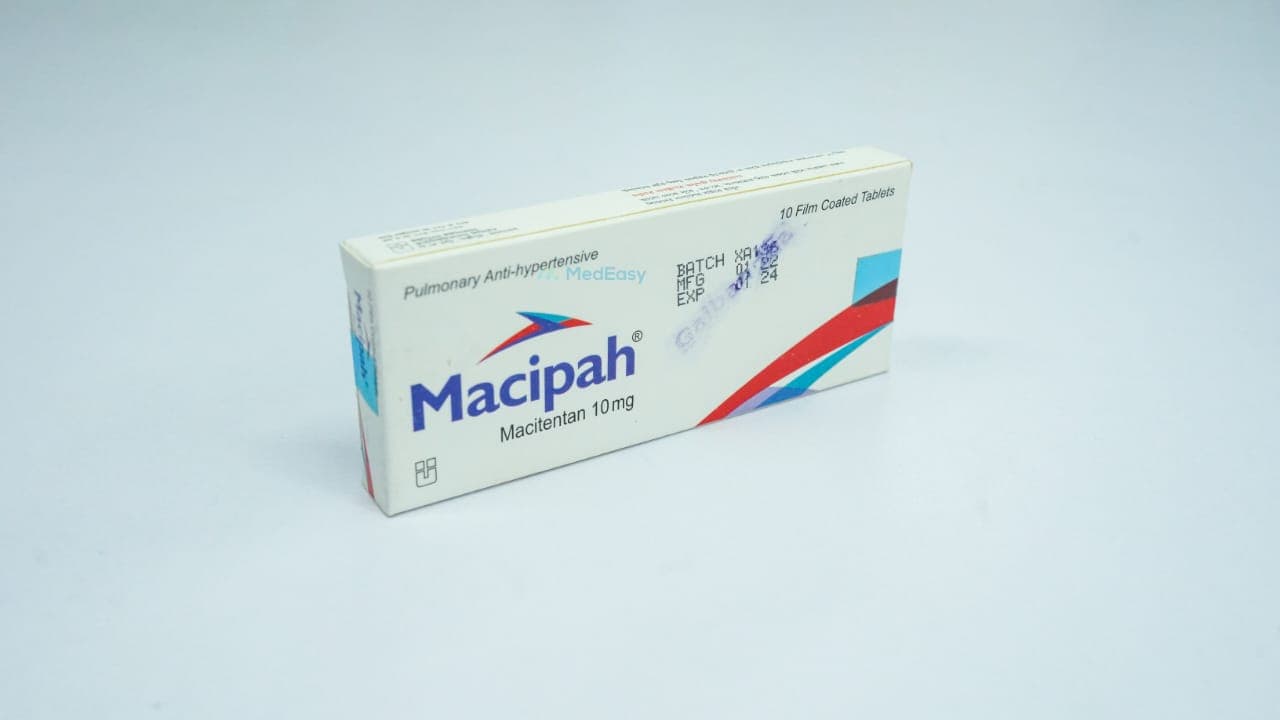

Medicine overview
Indications of Macipah
Established / FDA-Approved Indication
Macipah is indicated for the treatment of pulmonary arterial hypertension (PAH, WHO Group I) in adults, to delay disease progression and reduce the risk of hospitalization for PAH. Disease progression events in the pivotal trial included death, atrial septostomy, lung transplantation, initiation of intravenous or subcutaneous prostanoid therapy, and worsening of PAH.
Macipah may be used as monotherapy or in combination with other approved PAH therapies (for example, phosphodiesterase-5 inhibitors), consistent with current pulmonary hypertension treatment guidelines that support combination therapy for many patients.
Not Established
Macipah is not approved and not recommended for other forms of pulmonary hypertension (e.g., WHO Groups 2, 3, 4, or 5) or for any indication outside PAH; such use would be off-label and is not supported by adequate evidence.
Composition
Description
Macipah is an orally active endothelin receptor antagonist (ERA) that blocks both endothelin type A (ETA) and type B (ETB) receptors. It is used long-term in adults with pulmonary arterial hypertension to slow disease progression. Macipah is taken once daily as a film-coated tablet and is metabolized to a pharmacologically active metabolite that contributes to its prolonged effect.
Therapeutic Class
Pharmacology
Endothelin-1 (ET-1) and its receptors (ETA and ETB) mediate vasoconstriction, fibrosis, and cell proliferation in the pulmonary vasculature, and are involved in the pathogenesis of pulmonary arterial hypertension. macitentan binds to and blocks both ETA and ETB receptors, inhibiting endothelin-1-mediated vasoconstriction and vascular smooth muscle proliferation, which lowers pulmonary vascular resistance.
macitentan is extensively metabolized to a pharmacologically active metabolite that has a long elimination half-life and contributes substantially to the overall effect, allowing once-daily dosing.
Dosage & Administration of Macipah
Adults - Pulmonary Arterial Hypertension
| Population | Recommended dose of Macipah |
|---|---|
| Adults with PAH | 10 mg orally once daily, with or without food |
| Mild-moderate hepatic impairment (Child-Pugh A/B) | No dose adjustment required |
| Severe hepatic impairment (Child-Pugh C) | Not recommended; not studied |
| Mild-moderate renal impairment | No dose adjustment required |
| Severe renal impairment (including dialysis) | Not studied; use with caution |
Pediatric Use
The standard Macipah tablet has not been established as safe and effective in patients under 18 years of age. A dispersible tablet formulation of Macipah with weight-based dosing has been evaluated and authorized in some markets for children 2 years of age and older with PAH; such use should be guided by a pediatric pulmonary hypertension specialist. See Use in Special Populations.
Missed Dose
If a dose of Macipah is missed, it should be taken as soon as remembered on the same day; if it is almost time for the next dose, the missed dose should be skipped. Do not double the dose.
Administration of Macipah
Interaction of Macipah
- Strong CYP3A4 inducers (e.g., rifampin, carbamazepine, phenytoin, St. John's Wort): significantly decrease plasma concentrations of Macipah, which may reduce its effectiveness; coadministration should generally be avoided.
- Strong CYP3A4 inhibitors (e.g., ketoconazole, itraconazole, ritonavir, clarithromycin): significantly increase plasma concentrations of Macipah, raising the risk of adverse effects; coadministration should generally be avoided.
- Other antihypertensive agents and PDE5 inhibitors: concomitant use with drugs that lower blood pressure may increase the risk of hypotension; blood pressure should be monitored, although combination with PDE5 inhibitors for PAH is an established treatment strategy under specialist supervision.
Contraindications
- Pregnancy - macitentan is contraindicated in pregnant women because of demonstrated teratogenicity and embryo-fetal toxicity in animal studies (see boxed warning under Pregnancy and Lactation).
- Known hypersensitivity to macitentan or any component of the formulation.
Side Effects of Macipah
Common side effects of Macipah (occurring more often than with placebo) include:
- Anemia / decreased hemoglobin
- Headache
- Nasopharyngitis and pharyngitis (upper respiratory infection)
- Bronchitis and influenza-like illness
- Urinary tract infection
- Peripheral edema / fluid retention
Less common but serious effects include liver enzyme elevation or hepatotoxicity, severe anemia requiring transfusion, and pulmonary edema in patients with underlying pulmonary veno-occlusive disease (see Precautions and Warnings).
Pregnancy & Lactation
Boxed Warning - Embryo-Fetal Toxicity: Macipah must not be used during pregnancy. Animal studies have shown that Macipah causes birth defects and fetal harm. Females of reproductive potential must have a negative pregnancy test before starting Macipah, monthly during treatment, and use two reliable forms of contraception during treatment and for one month after stopping, unless permanent sterilization has been performed. If pregnancy occurs during treatment with Macipah, treatment must be stopped immediately and a physician consulted.
Lactation: It is not known whether Macipah passes into human breast milk. Because of the potential for serious adverse effects in a nursing infant, a decision should be made to discontinue breastfeeding or discontinue Macipah, taking into account the importance of treatment to the mother; use only under close medical supervision.
Precautions & Warnings
- Hepatotoxicity: Cases of liver injury have been reported with Macipah. Liver function should be evaluated before starting treatment and periodically or if symptoms of liver injury (nausea, jaundice, dark urine, right upper quadrant pain) occur.
- Fluid retention: Peripheral edema and fluid retention may occur, particularly in the first weeks of treatment with Macipah; patients with pre-existing volume overload should be monitored and managed appropriately.
- Decreased hemoglobin / anemia: Macipah can decrease hemoglobin. Hemoglobin should be checked before starting treatment, at one month, and periodically thereafter; consider dose interruption if a clinically significant fall occurs.
- Pulmonary veno-occlusive disease (PVOD): If signs of pulmonary edema occur after starting Macipah, the possibility of underlying PVOD should be considered; if confirmed, Macipah should be discontinued.
- Hepatic/renal impairment: Use with caution and only under specialist supervision in severe hepatic or renal impairment (see Dosage and Administration).
Overdose Effects of Macipah
Storage Conditions
Use In Special Populations
- Pregnancy: Contraindicated - see Contraindications and Pregnancy and Lactation.
- Lactation: Use only if clearly needed, under medical supervision - see Pregnancy and Lactation.
- Pediatric patients: Safety and efficacy of standard Macipah tablets not established under 18 years; a weight-based dispersible tablet is used in some settings for children 2 years and older under specialist care.
- Elderly patients: No overall differences in safety or effectiveness have been observed compared with younger adults; no dose adjustment is required based on age alone.
- Hepatic impairment: No adjustment needed in mild-moderate impairment; not recommended in severe impairment.
- Renal impairment: No adjustment needed in mild-moderate impairment; use with caution in severe impairment or dialysis.
Duration Of Treatment
Drug Classes
Endothelin Receptor Antagonists (ERAs)
Mode Of Action
macitentan acts as a dual antagonist of endothelin type A (ETA) and type B (ETB) receptors, which are found on vascular smooth muscle and endothelial cells of the pulmonary arteries. By blocking these receptors, macitentan prevents endothelin-1-induced vasoconstriction and proliferation of vascular smooth muscle, thereby reducing pulmonary vascular resistance and right ventricular workload in pulmonary arterial hypertension. Its active circulating metabolite has a long half-life, sustaining receptor blockade over a 24-hour dosing interval.
Pregnancy
X
Pediatric Uses
Frequently Asked Questions
Q: What is Macipah 10 mg Tablet used for?
A: Macipah 10 mg Tablet is used to treat pulmonary arterial hypertension (PAH), a type of high blood pressure in the arteries of the lungs, to slow disease progression and reduce the risk of hospitalization.
Q: How should I take Macipah 10 mg Tablet?
A: Macipah 10 mg Tablet is usually taken as one 10 mg tablet by mouth once daily, with or without food, swallowed whole with water at about the same time each day.
Q: Can I take Macipah 10 mg Tablet during pregnancy?
A: No. Macipah 10 mg Tablet must not be used during pregnancy because it can cause serious birth defects. Women who can become pregnant need a negative pregnancy test before starting and monthly during treatment, and must use reliable contraception while taking Macipah 10 mg Tablet and for one month after stopping.
Q: What are the common side effects of Macipah 10 mg Tablet?
A: Common side effects include headache, anemia (low hemoglobin), swelling of the legs or ankles, and symptoms of respiratory infections such as a stuffy nose or sore throat. Your doctor will monitor your blood counts and liver function periodically while you take Macipah 10 mg Tablet.
Q: Can Macipah 10 mg Tablet be combined with other PAH medicines?
A: Yes, Macipah 10 mg Tablet is often used together with other approved pulmonary arterial hypertension medicines, such as phosphodiesterase-5 inhibitors, as part of a combination treatment plan decided by your specialist.
Q: What should I do if I miss a dose or think I have taken too much Macipah 10 mg Tablet?
A: If you miss a dose, take it as soon as you remember unless it is almost time for your next dose - do not double up. If you think you or someone else has taken too much Macipah 10 mg Tablet, seek immediate medical attention or contact a poison control center.
Disclaimer
The information provided is accurate to the best of our knowledge, but it does not replace professional medical advice. We cannot guarantee its completeness or accuracy, and the absence of specific information about a drug should not be taken as an endorsement. We are not responsible for any consequences arising from this information, so please consult a healthcare professional for any concerns or questions.
