
10% Off
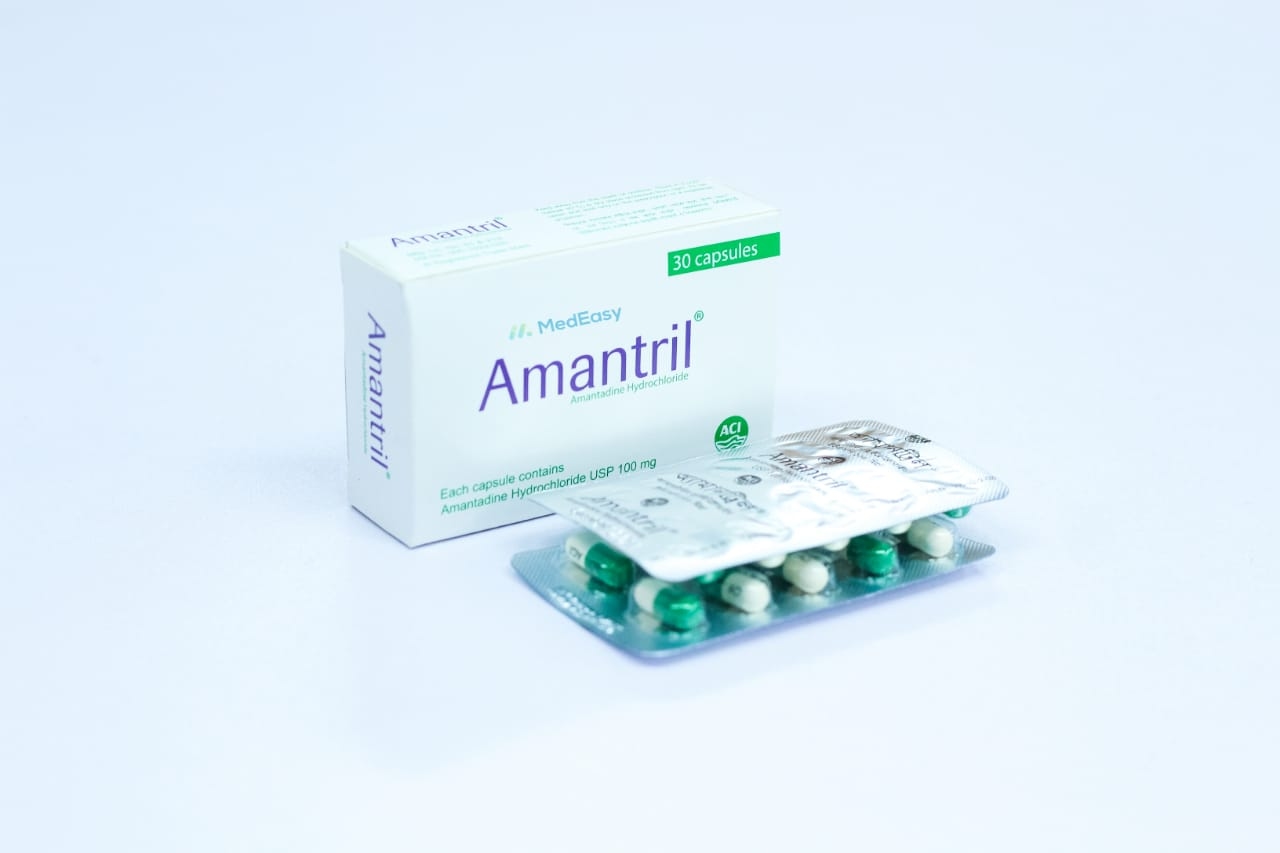
Amantril100 mg
ACI Limited
৳90.00
Add to cart
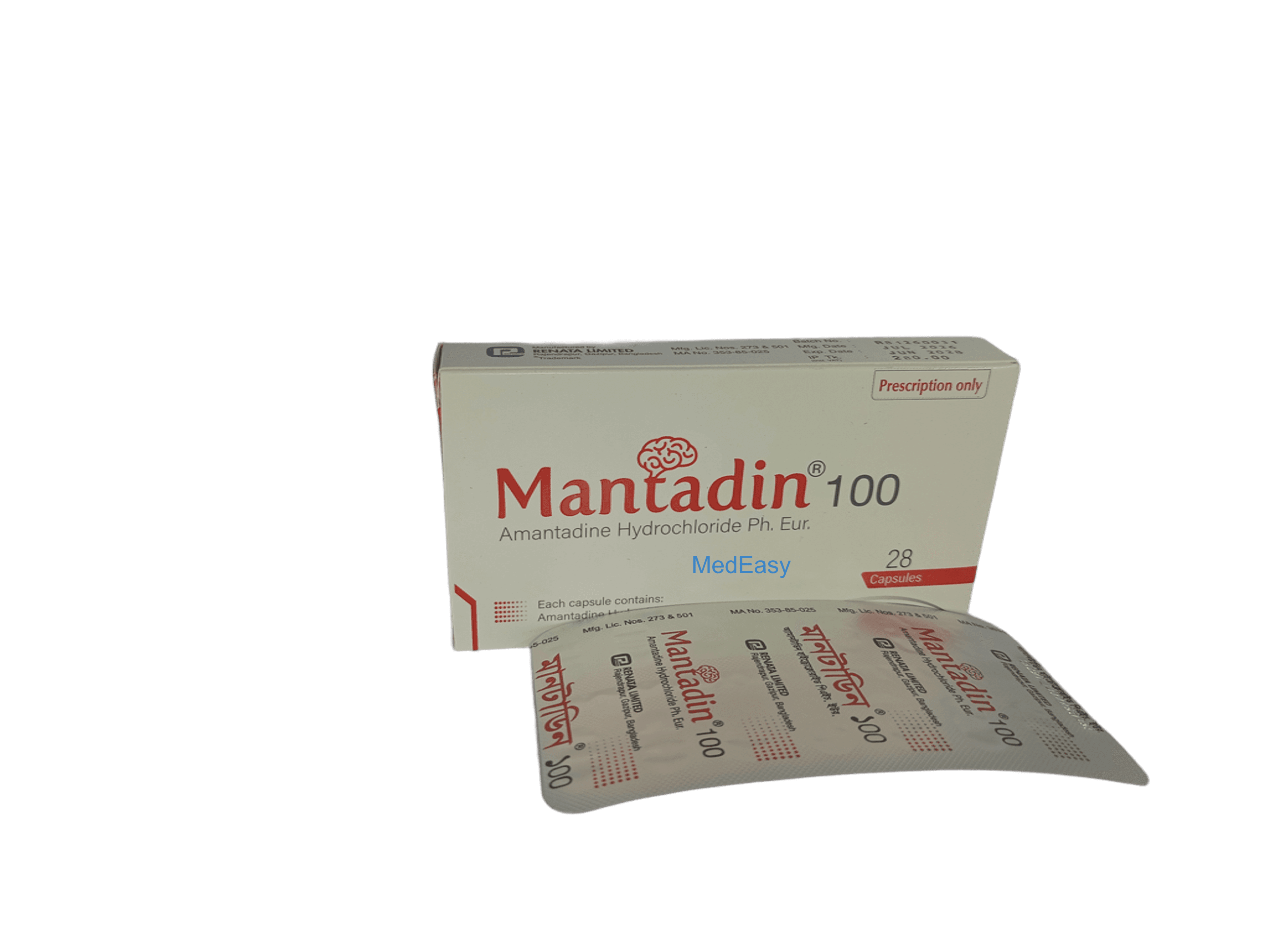

Mantadin is indicated for the following conditions, with evidence strength noted for each:
The Parkinson's disease and drug-induced extrapyramidal reaction indications are well established. The influenza indication, while still present on some regulatory labels, should only be used based on current local resistance-surveillance data and physician judgment, not as first-line antiviral therapy.
Each tablet/capsule contains Amantadine Hydrochloride as the active ingredient, commonly available in strengths such as 100 mg. Oral syrup formulations may contain Amantadine Hydrochloride equivalent to 50 mg amantadine base per 5 mL. Strength and formulation (tablet, capsule, or syrup) vary by manufacturer; refer to the specific product label for exact composition.
Mantadin is a synthetic tricyclic amine (adamantane derivative) with dual antiviral and antiparkinsonian (dopaminergic) activity. It was originally developed as an antiviral agent against influenza A and was later found, largely by clinical observation, to improve symptoms of Parkinson's disease.
Mantadin is administered orally as tablets, capsules, or oral solution/syrup. It is well absorbed from the gastrointestinal tract, is not significantly metabolized, and is eliminated largely unchanged by the kidneys, which makes renal function an important consideration in dosing.
Mantadin belongs to the adamantane class of antiviral agents and is also classified as an antiparkinsonian (dopaminergic/anti-dyskinetic) agent.
The precise mechanism of Amantadine Hydrochloride is not completely understood, but it is believed to act through several pathways:
Amantadine Hydrochloride is rapidly absorbed after oral administration, undergoes minimal hepatic metabolism, and is excreted largely unchanged in the urine via glomerular filtration and tubular secretion, with an elimination half-life of approximately 10-30 hours in patients with normal renal function (prolonged in renal impairment).
Usual adult dose of Mantadin: 100 mg twice daily. In patients with serious associated illness, or those already receiving other antiparkinsonian medication, therapy may be started at 100 mg once daily, increasing to 100 mg twice daily after one to several weeks, based on clinical response and tolerability. In some patients, a dose of up to 400 mg/day in divided doses may be used under close medical supervision.
Usual adult dose of Mantadin: 100 mg twice daily; up to 300 mg/day in divided doses may be used if needed and tolerated.
Adults and children 9-12 years: 200 mg/day as a single dose or in two divided doses. Adults over 65 years: 100 mg/day. Treatment should start within 24-48 hours of symptom onset and continue for about 3-5 days, or up to 24-48 hours after symptoms resolve.
| Creatinine Clearance | Suggested Mantadin Dosing |
|---|---|
| 30-50 mL/min/1.73m² | 200 mg on day 1, then 100 mg once daily |
| 15-29 mL/min/1.73m² | 200 mg on day 1, then 100 mg on alternate days |
| Less than 15 mL/min/1.73m² | 200 mg once every 7 days |
| Hemodialysis | 200 mg once every 7 days |
Doses should always be individualized and adjusted by the treating physician based on renal function, response, and tolerability. Discontinuation of Mantadin in Parkinson's disease should be gradual (tapered), as abrupt withdrawal can precipitate a serious neuroleptic-malignant-syndrome-like reaction (see Precautions and Warnings).
Mantadin may be taken with or without food; taking it with food may reduce stomach upset. Tablets/capsules should be swallowed whole with water; the oral solution should be measured with an accurate dosing device. If taken once daily, morning administration is preferred to reduce the risk of insomnia. Do not stop Mantadin suddenly in Parkinson's disease without consulting a physician, as abrupt discontinuation can cause serious withdrawal effects (see Precautions and Warnings).
Mantadin has the following clinically significant drug interactions:
Amantadine Hydrochloride is contraindicated in:
Other conditions such as seizure disorders, congestive heart failure, renal impairment, and psychiatric illness are important cautions requiring dose adjustment or close monitoring, but are not absolute contraindications; see Precautions and Warnings.
Side effects of Mantadin are generally dose-related and more common in elderly patients or those with renal impairment.
Patients should seek prompt medical attention for sudden vision changes, high fever with muscle rigidity, or thoughts of self-harm while taking Mantadin.
Pregnancy: Animal studies with Mantadin have shown teratogenic and embryotoxic effects at high doses; there are no adequate and well-controlled studies in pregnant women. Mantadin should be used during pregnancy only if clearly needed and if the potential benefit justifies the potential risk to the fetus. A physician should be consulted before use in pregnancy.
Lactation: Mantadin is excreted into human breast milk. Because of the potential for serious adverse reactions in nursing infants, use of Mantadin is generally not recommended in breastfeeding mothers; a physician should be consulted to weigh alternatives.
The following precautions apply to the use of Mantadin:
Overdose of Mantadin is a medical emergency. Reported manifestations of acute overdose include cardiac arrhythmias, tachycardia, hypertension, pulmonary edema, respiratory distress, renal dysfunction, and central nervous system effects such as severe confusion, agitation, hallucinations, seizures, and coma. Fatalities have been reported at doses as low as 1 gram in some individuals.
If overdose of Mantadin is suspected, seek immediate medical attention or contact a poison control center / emergency services without delay. There is no specific antidote; management is supportive, and may include gastric decontamination if presenting early, intravenous fluids, cardiac monitoring, and other measures as directed by treating physicians in a hospital setting. Do not attempt to manage a suspected Mantadin overdose at home.
Store at room temperature (below 30°C), away from light and moisture. Keep out of reach of children.
Elderly: Elderly patients are more susceptible to the CNS side effects of Mantadin (confusion, hallucinations, dizziness) and may require lower doses (e.g., 100 mg once daily for influenza) and closer monitoring, particularly given age-related decline in renal function.
Renal impairment: Dose reduction is required, as Mantadin is renally eliminated and can accumulate to toxic levels in patients with reduced creatinine clearance (see Dosage and Administration for the adjustment table).
Hepatic impairment: Specific dose adjustment data are limited; Mantadin should be used with caution and clinical monitoring in patients with significant hepatic impairment.
Pediatric use: See Pediatric Uses section.
For Parkinson's disease and drug-induced extrapyramidal reactions, Mantadin is typically used long-term as directed by a physician; some patients experience a reduction in benefit after several weeks to months (tachyphylaxis), which may be managed by temporary dose escalation or a brief drug holiday under medical supervision. For influenza A, when used, treatment is typically limited to a short course of about 3-5 days, or until 24-48 hours after symptoms resolve. Duration should always be individualized by the prescribing physician.
Amantadine Hydrochloride is classified under adamantane antivirals and antiparkinsonian (dopaminergic) agents.
Amantadine Hydrochloride exerts its antiparkinsonian effect primarily by enhancing dopaminergic neurotransmission (increasing dopamine release and blocking reuptake) and by antagonizing NMDA-type glutamate receptors, which helps reduce rigidity and tremor. Its antiviral effect against influenza A results from blockade of the viral M2 ion channel, which prevents viral uncoating inside host cells; this antiviral mechanism is largely ineffective against currently circulating resistant influenza A strains.
C
The safety and efficacy of Mantadin for Parkinson's disease and drug-induced extrapyramidal reactions have not been established in children, as these conditions are rare in the pediatric population.
For influenza A prophylaxis/treatment (where locally appropriate based on resistance patterns), Mantadin has established pediatric dosing:
Pediatric dosing of Mantadin should always be determined and supervised by a physician, with attention to renal function and close monitoring for CNS side effects.
Q: What is Mantadin 100 mg Capsule used for?
A: Mantadin 100 mg Capsule is mainly used to treat Parkinson's disease and drug-induced extrapyramidal reactions caused by antipsychotic medicines. It was also historically used for influenza A, though this use is now uncommon due to widespread viral resistance; your physician will advise if it is appropriate for you.
Q: Can I stop taking Mantadin 100 mg Capsule suddenly if I feel better?
A: No. If you are taking Mantadin 100 mg Capsule for Parkinson's disease, stopping it suddenly can cause a serious reaction with high fever, muscle stiffness, and confusion. Always reduce the dose gradually under your physician's supervision.
Q: What are the most common side effects of Mantadin 100 mg Capsule?
A: The most common side effects of Mantadin 100 mg Capsule are nausea, dizziness, and insomnia. Some patients also develop a mottled skin discoloration on the legs called livedo reticularis, which usually resolves after stopping the medicine.
Q: Is Mantadin 100 mg Capsule safe during pregnancy or breastfeeding?
A: Mantadin 100 mg Capsule should be used in pregnancy only if clearly necessary and if your physician decides the benefit outweighs the potential risk to the baby, since animal studies have shown risk at high doses. It is generally not recommended during breastfeeding because it passes into breast milk. Always consult your physician.
Q: Who should not take Mantadin 100 mg Capsule?
A: Mantadin 100 mg Capsule should not be used by anyone with a known allergy (hypersensitivity) to amantadine or any ingredient in the product. People with seizure disorders, heart failure, fluid retention, or psychiatric conditions should use it only with close medical supervision.
Q: What should I do if I take too much Mantadin 100 mg Capsule?
A: An overdose of Mantadin 100 mg Capsule is a medical emergency that can cause irregular heartbeat, severe confusion, or seizures. Seek immediate medical attention or contact emergency services / a poison control center right away; do not try to treat an overdose at home.
Disclaimer
The information provided is accurate to the best of our knowledge, but it does not replace professional medical advice. We cannot guarantee its completeness or accuracy, and the absence of specific information about a drug should not be taken as an endorsement. We are not responsible for any consequences arising from this information, so please consult a healthcare professional for any concerns or questions.
