10% Off
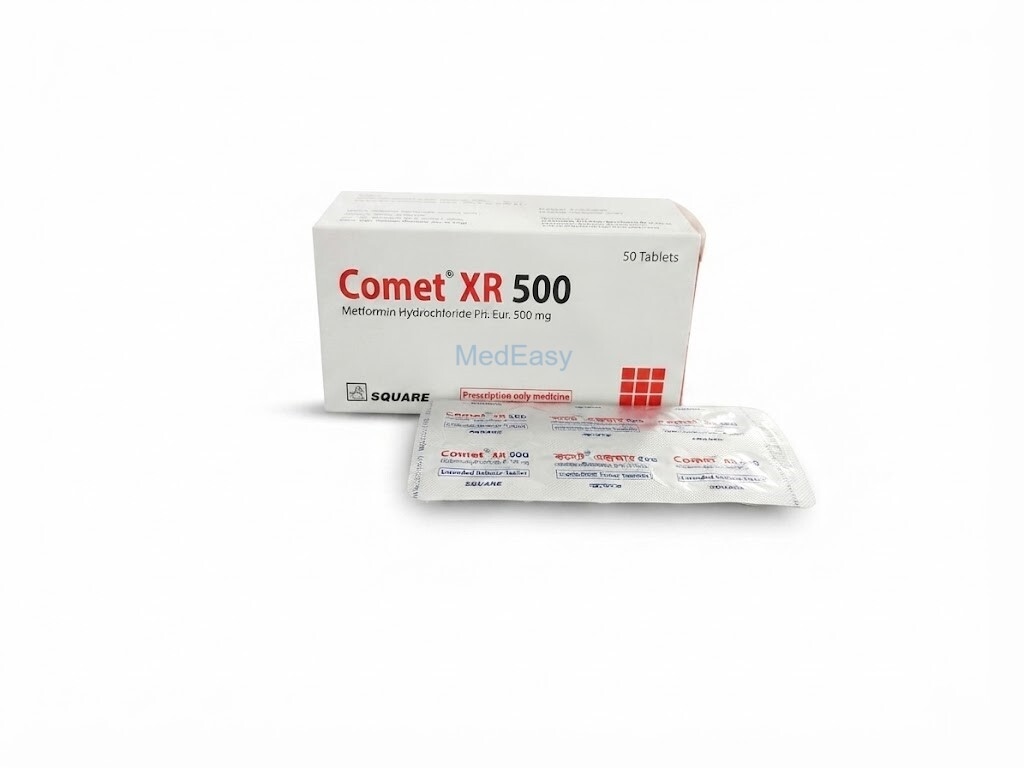
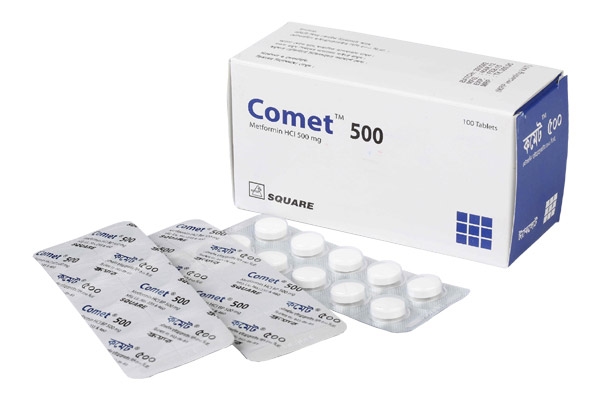
Comet500 mg
Square Pharmaceuticals PLC.
৳45.00
Add to cart


Meforex is indicated as an adjunct to diet and exercise for the management of type 2 diabetes mellitus. Evidence classification by strength of use:
Meforex does not by itself cause hypoglycemia and is not indicated for type 1 diabetes mellitus or diabetic ketoacidosis.
Each tablet/extended-release tablet contains Metformin Hydrochloride as the active pharmaceutical ingredient, commonly available in strengths such as 500 mg, 850 mg, and 1000 mg (immediate-release), and 500 mg/750 mg/1000 mg (extended-release). Excipients vary by manufacturer and formulation (immediate-release vs. extended-release matrix) and are listed on the product label/pack insert of the specific brand.
Meforex is an oral antihyperglycemic agent belonging to the biguanide class, used in the management of type 2 diabetes mellitus. Unlike sulfonylureas, Meforex does not stimulate insulin secretion from the pancreas and therefore does not typically cause hypoglycemia when used alone.
Meforex is available as immediate-release tablets (usually taken with meals, multiple times daily) and extended-release tablets (usually taken once daily with the evening meal), as well as oral solution in some markets. It is marketed in Bangladesh under various brand names as tablets and extended-release tablets.
Meforex belongs to the biguanide class of oral antidiabetic (antihyperglycemic) agents.
Metformin Hydrochloride lowers blood glucose through several complementary mechanisms without stimulating insulin secretion:
Metformin Hydrochloride generally has a favorable effect on lipid profile (modest reduction in LDL cholesterol and triglycerides) and is typically weight-neutral or associated with modest weight loss, unlike some other antidiabetic classes.
| Formulation | Starting Dose | Titration | Maximum Dose |
|---|---|---|---|
| Immediate-release | 500 mg once or twice daily, or 850 mg once daily, with meals | Increase by 500 mg weekly or 850 mg every 2 weeks, based on glycemic response and tolerability | 2550 mg/day in divided doses (typically 2-3 times daily) |
| Extended-release | 500-1000 mg once daily with the evening meal | Increase by 500 mg weekly | 2000-2500 mg/day depending on product, once daily |
Immediate-release: 500 mg twice daily with meals, titrated in increments of 500 mg weekly to a maximum of 2000 mg/day in divided doses. Extended-release formulations are generally not established for pediatric use below 18 years in many labels; refer to the specific product label.
Assess renal function (eGFR) before starting and at least annually thereafter:
Avoid use in patients with clinically evident hepatic impairment, as this increases the risk of lactic acidosis (see Precautions and Warnings).
Take Meforex with meals/food to reduce gastrointestinal side effects. Extended-release tablets must be swallowed whole and not crushed, split, or chewed. Meforex should be temporarily discontinued before or at the time of iodinated contrast imaging procedures and withheld for 48 hours afterward, restarting only after renal function has been confirmed stable (see Precautions and Warnings).
Meforex should be taken orally with meals or immediately after eating to minimize gastrointestinal upset. Extended-release tablets should be swallowed whole with a full glass of water and never crushed, cut, or chewed. Doses are typically taken with the evening meal for extended-release formulations, or divided across meals for immediate-release formulations. Do not skip doses; take at the same time(s) each day for consistent blood glucose control.
The following are well-verified, clinically significant interactions with Meforex:
Metformin Hydrochloride is contraindicated in the following situations (true absolute contraindications only):
Side effects of Meforex by frequency:
Pregnancy: Meforex is increasingly used during pregnancy, including for gestational diabetes mellitus, under specialist supervision, and available data have not shown a clear increased risk of major birth defects when used as directed. However, insulin remains the preferred agent in some clinical protocols, particularly for pre-existing (pregestational) diabetes. Meforex should be used during pregnancy only if clearly needed and if the potential benefit justifies the potential risk to the fetus; use only under the guidance of a physician experienced in managing diabetes in pregnancy.
Lactation: Meforex is present in breast milk in small amounts. Available data have not reported adverse effects on breastfed infants, but breastfeeding mothers should use Meforex only under medical supervision, with the infant monitored for any signs of gastrointestinal disturbance; consult a physician before use while breastfeeding.
Meforex can rarely cause lactic acidosis, a serious and potentially fatal metabolic complication, due to accumulation of the drug in the setting of impaired clearance. Risk is increased by renal impairment, hepatic impairment, congestive heart failure requiring pharmacologic management, sepsis, dehydration, excessive alcohol intake, and iodinated contrast procedures. Symptoms include malaise, myalgia, respiratory distress, increasing somnolence, and non-specific abdominal distress; if lactic acidosis is suspected, Meforex should be discontinued immediately and the patient should seek emergency medical care.
Long-term use of Meforex is associated with a decrease in vitamin B12 absorption and serum levels, which may occasionally result in clinically significant deficiency (e.g., anemia, peripheral neuropathy). Periodic monitoring of vitamin B12 levels should be considered, particularly in patients with anemia or peripheral neuropathy.
Renal function should be assessed before starting Meforex and at least annually thereafter (more frequently in the elderly or those at risk of renal decline); see Dosage and Administration for eGFR-based recommendations, including contraindication below eGFR 30.
Temporarily discontinue Meforex at or before receiving iodinated contrast media and for major surgical procedures with restricted food/fluid intake; restart only after renal function has been re-evaluated and found stable.
Use with caution or avoid in conditions associated with hypoxemia, dehydration, or sepsis (e.g., acute congestive heart failure, myocardial infarction, severe infection), as these increase the risk of lactic acidosis.
Avoid excessive alcohol intake while taking Meforex, as it potentiates the risk of lactic acidosis and hypoglycemia (see Interactions).
Overdose of Meforex can lead to hypoglycemia in some circumstances but is more specifically associated with a significantly increased risk of lactic acidosis, which is a medical emergency. Signs may include malaise, muscle pain, rapid breathing, drowsiness, and abdominal discomfort. In case of suspected overdose, seek immediate medical attention or contact emergency services / a poison control center right away. Do not attempt to manage a suspected overdose at home; hospital-based management, including possible hemodialysis to remove Meforex and correct acidosis, may be required and should only be performed by qualified medical professionals.
Store at room temperature (below 30°C), away from light and moisture. Keep out of reach of children.
Safety and efficacy of Meforex (immediate-release) have been established in children 10 years of age and older with type 2 diabetes mellitus. Safety and efficacy in children below 10 years of age, and of extended-release formulations in pediatric patients, have not been well established in many product labels; consult the specific product labeling and a pediatrician.
Meforex should be used with caution in elderly patients due to the age-related decline in renal function, which increases the risk of lactic acidosis. Renal function should be assessed more frequently, and dosing should not be titrated to the maximum dose unless renal function is confirmed normal.
See Dosage and Administration for eGFR-based dosing recommendations; Meforex is contraindicated at eGFR less than 30 mL/min/1.73 m².
Avoid use in patients with clinically evident hepatic disease due to increased risk of lactic acidosis.
Meforex is typically used long-term as part of chronic management of type 2 diabetes mellitus, with duration guided by ongoing glycemic control (e.g., HbA1c targets), tolerability, and renal function, as determined by the treating physician. It is not intended for short-course or as-needed use. Periodic reassessment (including renal function and vitamin B12 status) is recommended throughout treatment.
Biguanide; oral antihyperglycemic (antidiabetic) agent.
Metformin Hydrochloride reduces blood glucose primarily by decreasing hepatic glucose production (via inhibition of gluconeogenesis and glycogenolysis), increasing peripheral tissue (skeletal muscle) sensitivity to insulin, and modestly decreasing intestinal absorption of glucose. It works partly through activation of AMP-activated protein kinase (AMPK). Metformin Hydrochloride does not stimulate insulin secretion from pancreatic beta cells and therefore does not typically cause hypoglycemia when used as monotherapy.
Meforex (immediate-release) is approved for use in children 10 years of age and older with type 2 diabetes mellitus, as an adjunct to diet and exercise, either as monotherapy or in combination with insulin. Dosing is weight/age-based and should be titrated gradually starting at 500 mg twice daily with meals up to a maximum of 2000 mg/day in divided doses (see Dosage and Administration). Safety and efficacy of extended-release Meforex in pediatric patients, and of any formulation in children under 10 years, are not well established in many product labels - use only under pediatric endocrinology or specialist supervision.
Q: What is Meforex 500 mg Tablet used for?
A: Meforex 500 mg Tablet is used to manage type 2 diabetes mellitus by lowering blood glucose levels, as an adjunct to diet and exercise. It is often the first medicine prescribed for type 2 diabetes and may be used alone or together with other diabetes medicines or insulin.
Q: Can Meforex 500 mg Tablet cause low blood sugar (hypoglycemia)?
A: Meforex 500 mg Tablet does not usually cause hypoglycemia when used alone, because it does not stimulate insulin release. However, the risk of hypoglycemia increases if it is combined with insulin or sulfonylurea medicines, so blood glucose should be monitored closely in that situation.
Q: What is the most serious risk associated with Meforex 500 mg Tablet?
A: The most serious, though rare, risk with Meforex 500 mg Tablet is lactic acidosis, a build-up of lactic acid in the blood that can be life-threatening. Risk is higher in people with kidney or liver problems, dehydration, serious infection, heavy alcohol use, or those undergoing procedures involving injectable iodine-based contrast dye. Seek emergency medical care immediately if you notice unusual tiredness, muscle pain, difficulty breathing, or stomach discomfort while taking this medicine.
Q: Do I need to stop Meforex 500 mg Tablet before a scan with contrast dye or before surgery?
A: Yes. Meforex 500 mg Tablet is usually stopped at or before receiving iodinated (X-ray) contrast dye and for major surgery, and is only restarted after your doctor confirms your kidney function is stable, typically after 48 hours. Always inform your doctor and radiologist that you are taking Meforex 500 mg Tablet before any imaging procedure or surgery.
Q: Can Meforex 500 mg Tablet be used during pregnancy or while breastfeeding?
A: Meforex 500 mg Tablet is increasingly used in pregnancy, including for gestational diabetes, under specialist supervision, but should be used only if the potential benefit justifies the potential risk, and only as directed by a physician. Small amounts pass into breast milk; use while breastfeeding should also be discussed with and supervised by a physician.
Q: How should I take Meforex 500 mg Tablet and what side effects might I notice?
A: Meforex 500 mg Tablet should be taken with meals to reduce stomach upset, and extended-release tablets should be swallowed whole, not crushed or chewed. Common side effects, especially when starting treatment, include nausea, diarrhea, gas, and a metallic taste - these usually improve over time. Long-term use can lower vitamin B12 levels, so your doctor may check this periodically.
Disclaimer
The information provided is accurate to the best of our knowledge, but it does not replace professional medical advice. We cannot guarantee its completeness or accuracy, and the absence of specific information about a drug should not be taken as an endorsement. We are not responsible for any consequences arising from this information, so please consult a healthcare professional for any concerns or questions.