
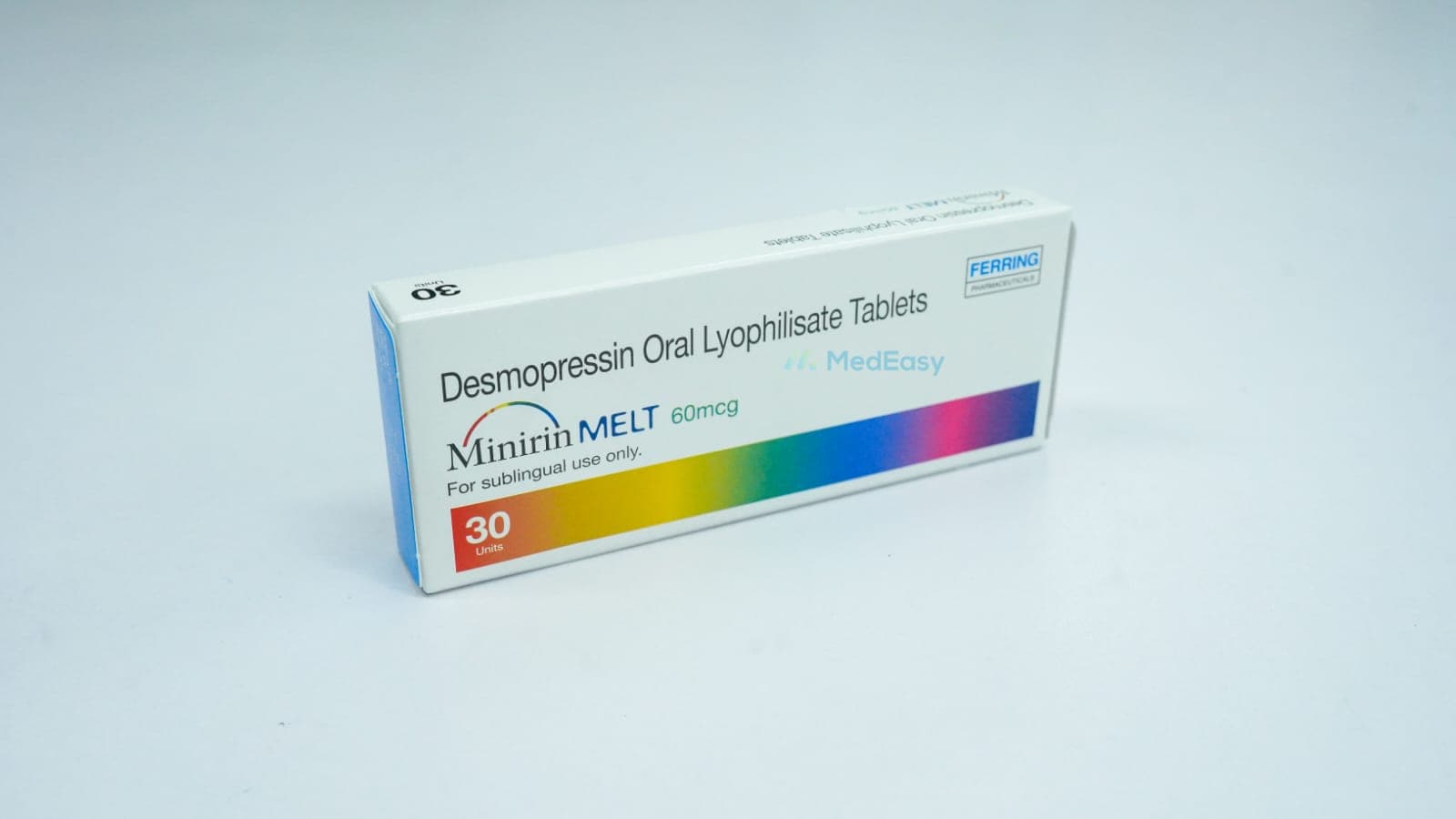

Medicine overview
Indications of Minirin Melt
Minirin Melt is a synthetic analog of the natural hormone vasopressin (antidiuretic hormone). It is prescribed for the following indications, which vary in strength of evidence:
Established/approved uses
- Central diabetes insipidus — as antidiuretic replacement therapy to control excessive thirst and urination caused by deficient endogenous vasopressin.
- Temporary polyuria and polydipsia following head trauma or pituitary surgery.
- Primary nocturnal enuresis (bedwetting) in children aged 6 years and older, used alone or together with behavioral measures; oral tablet or sublingual formulations of Minirin Melt are generally preferred over intranasal spray for this indication (see Precautions and Warnings).
Specialist-guided / hemostatic uses (higher-dose injectable or concentrated intranasal formulations)
- To temporarily raise plasma factor VIII and von Willebrand factor levels in selected patients with mild haemophilia A or type 1 von Willebrand disease, to control or prevent bleeding around minor surgery or dental procedures. Response varies by patient and requires factor-level testing and haematology specialist supervision.
Minirin Melt is not effective for nephrogenic diabetes insipidus.
Composition
Each formulation of Desmopressin Acetate contains desmopressin acetate as the active ingredient. Depending on the market, it is available as sublingual tablets (e.g., 60 mcg, 120 mcg), oral film-coated tablets (e.g., 0.1 mg, 0.2 mg), an oral solution, and, in some settings, as an intranasal spray or injectable solution for hospital/specialist use.
Description
Minirin Melt is a synthetic structural analog of arginine vasopressin (antidiuretic hormone) with selective agonist activity at renal V2 receptors and, at higher doses, effects on coagulation factors. Compared with natural vasopressin, it has a longer duration of action, negligible pressor (V1) activity at antidiuretic doses, and no significant oxytocic activity. It is used to reduce excessive urination in diabetes insipidus and nocturnal enuresis, and, at higher doses, to raise clotting factor levels in selected bleeding disorders.
Therapeutic Class
Minirin Melt belongs to the therapeutic class of antidiuretic hormone (vasopressin) analogues, classified under posterior pituitary hormones. At higher, hemostatic doses it is also used within the class of non-transfusional hemostatic agents for selected bleeding disorders.
Pharmacology
Desmopressin Acetate acts as a selective agonist at vasopressin V2 receptors in the renal collecting ducts, increasing water reabsorption via aquaporin-2 channel insertion and producing an antidiuretic effect (reduced urine volume, increased urine osmolality) without a clinically significant pressor (V1-receptor) effect at usual doses. At the higher doses used for hemostasis, Desmopressin Acetate also stimulates release of endogenous factor VIII and von Willebrand factor from vascular endothelial storage sites, transiently raising plasma levels of these clotting factors and shortening bleeding time in appropriate patients.
After oral or sublingual administration, bioavailability is low (a small percentage of the dose) but sufficient for the drug's antidiuretic effect; onset of action is generally within 1-2 hours, with a duration of roughly 8-12 hours or longer, allowing once- to thrice-daily dosing depending on the indication and formulation.
Dosage & Administration of Minirin Melt
Dosing of Minirin Melt is individualized to the lowest effective dose for each patient and indication. The following is a general guide; the prescribing physician's instructions should always be followed.
| Indication | Population | Typical Dosing |
|---|---|---|
| Central diabetes insipidus | Adults | Oral tablet: start 0.05 mg (half of a 0.1 mg tablet) twice daily; usual maintenance 0.1-0.8 mg/day in 2-3 divided doses (max approximately 1.2 mg/day). Sublingual: start 60 mcg three times daily; usual range 60-120 mcg three times daily. |
| Central diabetes insipidus | Children (≥4 years) | Same formulations as adults, started at the lowest dose (e.g., 0.05 mg orally) and individually titrated, with close monitoring for hyponatremia. |
| Primary nocturnal enuresis | Children ≥6 years | Oral tablet: start 0.2 mg at bedtime, may increase up to 0.6 mg if needed. Fluid intake must be restricted from 1 hour before the dose until the following morning (see Precautions). |
| Hemostatic use (mild haemophilia A, von Willebrand disease type 1) | Adults and selected children (specialist use) | Higher-dose intranasal or intravenous formulations dosed by body weight under haematology specialist supervision, typically 20-30 minutes before a procedure; response confirmed by factor VIII/von Willebrand factor testing. |
Fluid intake should be limited to what is necessary to satisfy thirst, beginning approximately one hour before each dose of Minirin Melt and continuing until the next morning or for about 8 hours after dosing, to reduce the risk of hyponatremia and water intoxication.
Administration of Minirin Melt
Minirin Melt oral tablets should be taken on an empty stomach (at least 1 hour before or 2 hours after food) for consistent absorption. Sublingual tablets should be placed under the tongue and allowed to dissolve completely without chewing or swallowing whole. Injectable or intranasal formulations (where prescribed for hemostatic use) must be administered only by, or under the direct guidance of, a qualified healthcare professional. Fluid intake must be restricted around the time of dosing as instructed by the physician, and doses should not be doubled or skipped without medical advice.
Interaction of Minirin Melt
The following interactions with Minirin Melt are clinically significant:
- Drugs that increase the risk of water retention/hyponatremia — including tricyclic antidepressants, selective serotonin reuptake inhibitors (SSRIs), chlorpromazine, opioid analgesics, NSAIDs, carbamazepine, and lamotrigine — may potentiate the antidiuretic effect of Minirin Melt and increase the risk of hyponatremia and water intoxication when used together; concurrent use requires closer monitoring of serum sodium.
- Loperamide may increase plasma concentrations of oral Minirin Melt, potentially increasing the risk of water retention.
- Other drugs affecting the vasopressin system or renal water handling should be used cautiously and only under medical supervision alongside Minirin Melt.
Contraindications
Desmopressin Acetate is contraindicated in patients with:
- Known hypersensitivity to Desmopressin Acetate or any component of the formulation.
- Hyponatremia or a history of hyponatremia.
- Moderate to severe renal impairment (creatinine clearance below approximately 50 mL/min), for the diabetes insipidus and enuresis indications, due to reduced ability to excrete free water.
- Syndrome of inappropriate antidiuretic hormone secretion (SIADH).
- Habitual or psychogenic polydipsia (patients who drink more fluid than physiologically needed), because of the increased risk of water intoxication.
Side Effects of Minirin Melt
Common side effects of Minirin Melt include headache, nausea, mild abdominal pain, nasal congestion or irritation (with intranasal use), and flushing. Less commonly, mild transient blood pressure changes may occur.
The most important serious adverse effect is hyponatremia (low blood sodium) and water intoxication, which can present as headache, nausea/vomiting, weight gain, confusion, and, if severe and untreated, seizures or coma (see Precautions and Warnings). Rare hypersensitivity/allergic reactions have also been reported.
Pregnancy & Lactation
Pregnancy: Minirin Melt has been assigned a legacy FDA Pregnancy Category B. Animal reproduction studies have not shown fetal harm, and available human data (including epidemiologic follow-up) have not shown an increased rate of birth defects, but there are no adequate and well-controlled studies in pregnant women. Minirin Melt should be used during pregnancy only if clearly needed and if the potential benefit justifies the potential risk to the fetus; a physician should be consulted.
Lactation: It is not definitively known whether Minirin Melt is excreted in human breast milk in clinically significant amounts. Caution is advised, and a physician should be consulted before use of Minirin Melt while breastfeeding.
Precautions & Warnings
Fluid restriction is essential during and after each dose of Minirin Melt — patients and caregivers must limit fluid intake to what is needed to satisfy thirst, from about one hour before dosing until the following morning (or about 8 hours after dosing), because excess fluid intake combined with the antidiuretic effect of Minirin Melt substantially increases the risk of hyponatremia and water intoxication, which can be life-threatening.
Historical boxed warning (intranasal formulations, enuresis)
Hyponatremia and seizures have been reported with intranasal formulations of Minirin Melt used for primary nocturnal enuresis in children; because of this risk, oral (tablet or sublingual) formulations of Minirin Melt are now generally preferred over the intranasal route for this indication, and intranasal formulations are not recommended for enuresis.
Other precautions
- Use with caution in patients with cystic fibrosis, who have an increased risk of hyponatremia.
- Use with caution in elderly patients, who are at increased risk of hyponatremia and may need downward adjustment of fluid intake.
- Use with caution in patients with cardiovascular disease, hypertension, or conditions predisposing to fluid/electrolyte imbalance.
- Interrupt treatment temporarily during acute intercurrent illness associated with fluid or electrolyte imbalance (e.g., vomiting, diarrhea, fever) or during conditions of increased water intake (intense exercise, heat exposure).
- For the hemostatic indication, factor VIII/von Willebrand factor levels should be monitored, and repeated dosing may result in a diminished response (tachyphylaxis).
Overdose Effects of Minirin Melt
Overdosage of Minirin Melt can cause fluid retention and hyponatremia (water intoxication), with symptoms such as persistent headache, drowsiness, confusion, nausea and vomiting, rapid weight gain, decreased urine output, and, in severe cases, seizures. If overdose is suspected, seek immediate medical attention or contact emergency services/a poison control center. Management generally involves stopping Minirin Melt, restricting fluid intake, and supportive/symptomatic treatment under medical supervision; there is no specific antidote.
Storage Conditions
Store Minirin Melt at room temperature, below 30°C, protected from light and moisture. Do not freeze injectable or nasal-spray formulations of Minirin Melt unless otherwise directed. Keep all forms of Minirin Melt out of the reach and sight of children.
Use In Special Populations
Renal impairment: Minirin Melt is contraindicated in moderate to severe renal impairment (creatinine clearance below approximately 50 mL/min) for the diabetes insipidus and enuresis indications, due to a reduced ability to excrete free water.
Hepatic impairment: No well-established dose adjustment is defined for Minirin Melt; use with caution and physician supervision.
Elderly: Increased risk of hyponatremia with Minirin Melt; fluid intake should be adjusted downward and serum sodium monitored, especially at the start of treatment.
Children: See Pediatric Uses.
Bleeding disorders (hemostatic use): Response to Minirin Melt varies by the specific type and severity of factor VIII deficiency or von Willebrand disease; use requires prior factor-level testing and hematology specialist guidance, and is not effective in severe haemophilia A or in von Willebrand disease types 2B or 3.
Duration Of Treatment
Duration of treatment with Minirin Melt depends on the indication. In central diabetes insipidus, treatment is typically long-term (often lifelong) as antidiuretic replacement therapy, with periodic reassessment of dose and serum sodium. In primary nocturnal enuresis, treatment is usually given for defined courses (e.g., around 3 months) with periodic breaks to reassess whether continued treatment with Minirin Melt is needed. For hemostatic use in bleeding disorders, Minirin Melt is typically used short-term, around planned procedures or bleeding episodes, under specialist direction. The treating physician should determine the appropriate duration in each case.
Drug Classes
Antidiuretic hormone (vasopressin) analogues; posterior pituitary hormone replacements; non-transfusional hemostatic agents.
Mode Of Action
Desmopressin Acetate selectively stimulates renal V2 vasopressin receptors, increasing water reabsorption in the collecting ducts and concentrating urine, with minimal V1 (vasopressor) activity at antidiuretic doses. At higher doses, it also triggers release of stored factor VIII and von Willebrand factor from vascular endothelium, transiently improving hemostasis in appropriate bleeding disorders.
Pregnancy
B
Pediatric Uses
Minirin Melt is approved for use in children aged 4 years and older for central diabetes insipidus, and in children aged 6 years and older for primary nocturnal enuresis, using the lowest effective dose with close monitoring for hyponatremia (headache, nausea, vomiting, weight gain, confusion). Fluid intake in children must be carefully restricted around dosing times. Safety and efficacy of Minirin Melt for the hemostatic (bleeding disorder) indication in young children have not been as extensively established and should be guided by a pediatric hematology specialist. Intranasal formulations of Minirin Melt are not recommended for nocturnal enuresis in children because of the reported risk of hyponatremia and seizures with that route.
Frequently Asked Questions
Q: What is Minirin Melt 60 mcg Tablet used for?
A: Minirin Melt 60 mcg Tablet is mainly used to treat central diabetes insipidus (a condition of excessive thirst and urination due to low antidiuretic hormone) and primary nocturnal enuresis (bedwetting) in children aged 6 years and older. Higher-dose formulations are also used, under specialist supervision, to temporarily raise clotting factor levels in mild haemophilia A and von Willebrand disease.
Q: Why do I need to limit fluids while taking Minirin Melt 60 mcg Tablet?
A: Because Minirin Melt 60 mcg Tablet reduces how much water the kidneys remove from the body, drinking too much fluid while it is working can cause the body to retain too much water, leading to low blood sodium (hyponatremia) and, in severe cases, seizures. You should limit fluid intake to just what is needed to satisfy thirst, generally from about one hour before your dose until the next morning, as instructed by your physician.
Q: Can Minirin Melt 60 mcg Tablet be used in pregnancy or while breastfeeding?
A: Minirin Melt 60 mcg Tablet falls under legacy FDA Pregnancy Category B; available data have not shown an increased risk of birth defects, but there are no well-controlled studies in pregnant women, so it should be used only if clearly needed and if the benefit outweighs the potential risk, under a physician's guidance. It is not definitively known whether it passes into breast milk in significant amounts, so breastfeeding mothers should consult their physician before use.
Q: Who should not take Minirin Melt 60 mcg Tablet?
A: Minirin Melt 60 mcg Tablet should not be used by people with known hypersensitivity to it, current or past hyponatremia, moderate-to-severe kidney impairment, syndrome of inappropriate antidiuretic hormone secretion (SIADH), or habitual/psychogenic polydipsia (drinking excessive fluids), because of the increased risk of dangerous water retention.
Q: What should I do if I miss a dose or take too much Minirin Melt 60 mcg Tablet?
A: If you miss a dose of Minirin Melt 60 mcg Tablet, take it when you remember unless it is close to your next dose; do not double the dose. If you or someone else has taken too much Minirin Melt 60 mcg Tablet and has symptoms such as severe headache, confusion, rapid weight gain, or reduced urination, seek immediate medical attention or contact emergency services, as this may indicate dangerous water retention.
Q: Is intranasal Minirin Melt 60 mcg Tablet safe for bedwetting in children?
A: Intranasal formulations of Minirin Melt 60 mcg Tablet have been associated with reports of hyponatremia and seizures when used for nocturnal enuresis in children, so oral tablet or sublingual formulations of Minirin Melt 60 mcg Tablet are now generally preferred for this indication. Discuss the most appropriate formulation with your physician.
Disclaimer
The information provided is accurate to the best of our knowledge, but it does not replace professional medical advice. We cannot guarantee its completeness or accuracy, and the absence of specific information about a drug should not be taken as an endorsement. We are not responsible for any consequences arising from this information, so please consult a healthcare professional for any concerns or questions.
