
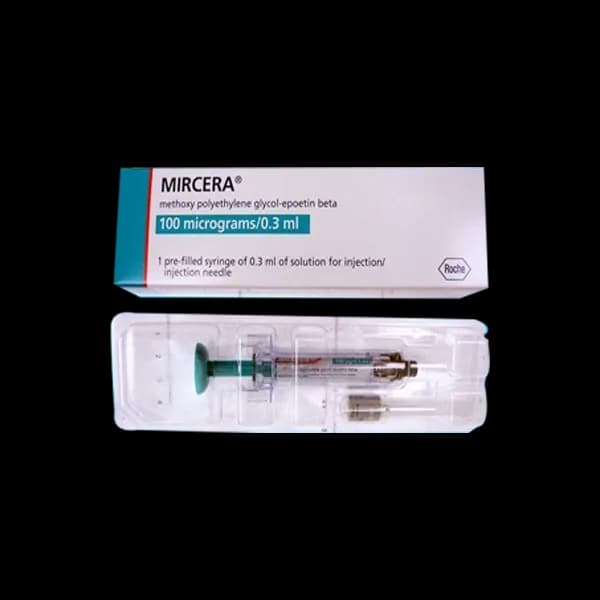

Medicine overview
Indications of Mircera
Mircera is a long-acting erythropoiesis-stimulating agent (ESA), also known as pegylated epoetin beta or methoxy polyethylene glycol-epoetin beta (C.E.R.A.), used for the following indication:
FDA-Approved / Established Use
- Anemia associated with chronic kidney disease (CKD): Mircera is indicated for the treatment of anemia associated with CKD in adult patients, including those on dialysis and those not on dialysis.
Not Indicated For
- Mircera is not indicated for use in patients with cancer receiving chemotherapy, as a substitute for red blood cell transfusion in patients who require immediate correction of anemia, or for reduction of allogeneic blood transfusion in surgery patients — these are not established or approved uses for this specific agent.
Mircera is intended to reduce the need for red blood cell transfusions in appropriately selected patients, not to normalize hemoglobin levels.
Composition
Each pre-filled syringe/vial of Epoetin Beta [Methoxy Polyethyelene Glycol] contains methoxy polyethylene glycol-epoetin beta (a pegylated derivative of recombinant human erythropoietin produced by conjugation of epoetin beta with a linear methoxy polyethylene glycol polymer) as the active ingredient, along with pharmaceutical excipients such as sodium sulfate, sodium and potassium phosphate, mannitol, methionine, poloxamer 188, and water for injection.
Epoetin Beta [Methoxy Polyethyelene Glycol] is available in single-use pre-filled syringes/vials in a range of strengths (e.g., 30, 50, 75, 100, 120, 150, 200, 250, 360 micrograms per 0.3 mL) as a sterile, clear, colorless solution for injection.
Description
Mircera is a long-acting erythropoiesis-stimulating agent (ESA) that stimulates erythropoiesis (red blood cell production) by the same mechanism as endogenous erythropoietin. It differs from other ESAs (such as epoetin alfa and darbepoetin alfa) by its unique interaction with the erythropoietin receptor, which results in a slower association/faster dissociation profile and a substantially longer serum half-life, allowing for extended dosing intervals (once every two weeks or once monthly).
Mircera is administered by subcutaneous or intravenous injection and is used specifically to manage anemia related to chronic kidney disease.
Therapeutic Class
Mircera belongs to the therapeutic class of erythropoiesis-stimulating agents (ESAs), a subclass of antianemic preparations used in the management of anemia of chronic kidney disease.
Pharmacology
Mechanism of Action
Epoetin Beta [Methoxy Polyethyelene Glycol] acts on the erythropoietin receptor on erythroid progenitor cells in the bone marrow in the same way as endogenous erythropoietin, stimulating their division and differentiation into mature red blood cells, thereby increasing hemoglobin and red blood cell production.
Pharmacokinetics
The methoxy polyethylene glycol moiety confers a markedly extended terminal half-life (approximately 130 hours after intravenous administration and 140 hours after subcutaneous administration in dialysis patients) compared with other ESAs, permitting once-every-2-weeks or once-monthly dosing. Bioavailability after subcutaneous injection is approximately 54%. Steady-state hemoglobin levels are typically reached within about 12 weeks of dose titration.
Dosage & Administration of Mircera
General Principles
Before initiating Mircera, evaluate iron status; all patients should have adequate iron stores. Correct or exclude other causes of anemia (e.g., vitamin deficiency, hemolysis, bleeding) before treatment. Use the lowest dose sufficient to reduce the need for red blood cell transfusion.
| Population | Starting Dose | Maintenance/Notes |
|---|---|---|
| Adult CKD on dialysis (ESA-naive) | 0.6 mcg/kg IV or SC once every 2 weeks | May convert to once-monthly dosing at twice the biweekly dose once hemoglobin is stable |
| Adult CKD not on dialysis (ESA-naive) | 0.6 mcg/kg IV or SC once every 2 weeks, or 1.2 mcg/kg SC once monthly | Titrate based on hemoglobin response |
| Conversion from another ESA | Dose calculated from prior weekly ESA dose per approved conversion table | Administer once every 2 weeks initially |
Do not increase the dose more than once every 4 weeks. If hemoglobin rises rapidly (more than 1 g/dL in any 2-week period), reduce the dose by at least 25%. Withhold dosing if hemoglobin exceeds the level needed to avoid transfusion. See Dosage and Administration sections for further detail, and Precautions and Warnings for hemoglobin target guidance.
Administration of Mircera
Mircera is administered by subcutaneous (SC) or intravenous (IV) injection. It is supplied as a ready-to-use sterile solution in a pre-filled syringe and does not require reconstitution or dilution.
- Inspect the solution visually; do not use if discolored or if particulate matter is present.
- Do not shake the syringe vigorously, as this may denature the protein.
- Allow the syringe to reach room temperature before injection.
- Rotate subcutaneous injection sites (abdomen, thigh, or upper arm).
- Each syringe is for single use only; discard any unused portion.
Interaction of Mircera
No formal drug-drug interaction studies have been conducted with Mircera. Erythropoiesis-stimulating agents as a class do not have well-established, clinically significant pharmacokinetic drug interactions. The following points are clinically relevant:
- Iron supplements: Adequate iron stores are required for an effective erythropoietic response; iron supplementation is often needed concurrently and does not reduce efficacy, but iron status should be monitored.
- Other erythropoiesis-stimulating agents: Mircera should not be used concurrently with other ESAs due to overlapping mechanism and additive risk of excessive hemoglobin response.
Contraindications
Epoetin Beta [Methoxy Polyethyelene Glycol] is contraindicated in patients with:
- Uncontrolled hypertension.
- Pure red cell aplasia (PRCA) that begins after treatment with Epoetin Beta [Methoxy Polyethyelene Glycol] or other erythropoietin protein drugs — patients who develop antibody-mediated PRCA on any ESA must not be switched to Epoetin Beta [Methoxy Polyethyelene Glycol] or any other ESA.
- Serious hypersensitivity to Epoetin Beta [Methoxy Polyethyelene Glycol] or to any of its components, or to other mammalian cell-derived erythropoietin products.
Side Effects of Mircera
The most commonly reported adverse reactions with Mircera include:
- Hypertension
- Diarrhea
- Nasopharyngitis / upper respiratory tract infection
- Headache
- Arthralgia
- Hypotension
- Cough
- Vascular access thrombosis (in dialysis patients)
- Nausea and peripheral edema
Serious but less common reactions include serious allergic/hypersensitivity reactions, and the boxed-warning risks (cardiovascular events, thrombosis, tumor progression) described under Precautions and Warnings.
Pregnancy & Lactation
Data on the use of Mircera in pregnant women are limited. Mircera should be used during pregnancy only if the potential benefit justifies the potential risk to the fetus, and only under close physician supervision.
It is not known whether Mircera is excreted in human milk; because many drugs are excreted in human milk, caution should be exercised, and a decision should be made whether to discontinue nursing or discontinue the drug, taking into account the importance of the drug to the mother, in consultation with a physician.
Precautions & Warnings
Boxed Warning — Class Risks of ESAs
Mircera, like all erythropoiesis-stimulating agents, increases the risk of death, myocardial infarction, stroke, venous thromboembolism, and thrombosis of vascular access when administered to target a hemoglobin level greater than the recommended range. In patients with cancer, ESAs have been shown to increase the risk of tumor progression or recurrence in some settings.
- Use the lowest dose of Mircera sufficient to reduce the need for red blood cell transfusion.
- Do not exceed the hemoglobin target recommended in the approved labeling; avoid rapid increases in hemoglobin.
- Monitor blood pressure regularly; treat hypertension before and during therapy, as uncontrolled hypertension is a contraindication (see Contraindications).
- Monitor hemoglobin and iron status (ferritin, transferrin saturation) periodically throughout treatment.
- Evaluate for loss of response or failure to maintain hemoglobin response, which may indicate antibody-mediated pure red cell aplasia (PRCA); if suspected, discontinue Mircera and do not switch to another ESA (see Contraindications).
- Serious allergic reactions, including anaphylaxis, have been reported; discontinue immediately if a serious hypersensitivity reaction occurs.
- Increased mortality and/or increased risk of tumor progression/recurrence has been observed in some studies when ESAs were administered to certain cancer patients; Mircera is not approved for this use.
Overdose Effects of Mircera
Overdosage of Mircera can lead to polycythemia (excessive red blood cell production), which may manifest as symptoms related to hyperviscosity of the blood such as severe hypertension, headache, or thrombotic events. There is no specific antidote for Mircera overdose.
If overdose is suspected, seek immediate medical attention or contact emergency services / a poison control center. Management is supportive; phlebotomy may be performed as clinically indicated under medical supervision, and Mircera therapy should be temporarily withheld with close monitoring of hemoglobin and blood pressure.
Storage Conditions
Store in a refrigerator at 2°C to 8°C (36°F to 46°F). Do not freeze; discard if the product has been frozen. Protect from light by keeping the syringe in its original carton until time of use. If needed, may be kept at room temperature (up to 30°C) for a single period of up to one month, then discarded if not used. Keep out of reach of children.
Use In Special Populations
Renal Impairment
Mircera is specifically indicated for anemia of chronic kidney disease; dosing is titrated based on hemoglobin response regardless of dialysis status, as described in Dosage and Administration.
Hepatic Impairment
No formal studies have established dose adjustment requirements in hepatic impairment; use with caution and monitor closely.
Elderly
No overall differences in safety or effectiveness have been observed between elderly and younger patients, but greater sensitivity in some older individuals cannot be ruled out; use standard monitoring.
Pediatric Patients
Safety and efficacy of Mircera have not been established in pediatric patients (see Pediatric Uses).
Duration Of Treatment
Mircera is intended for long-term, chronic management of anemia associated with chronic kidney disease, with treatment continued as long as clinically indicated and hemoglobin remains within the target range. Dose and dosing interval are periodically reassessed (approximately every 4 weeks, or as clinically indicated) based on hemoglobin trends, iron status, and clinical response. There is no fixed maximum duration of therapy; the physician determines continued need based on ongoing anemia and risk-benefit assessment.
Drug Classes
Erythropoiesis-stimulating agent (ESA); antianemic preparation; recombinant human erythropoietin derivative (pegylated).
Mode Of Action
Epoetin Beta [Methoxy Polyethyelene Glycol] binds to and activates the erythropoietin receptor on erythroid progenitor cells in the bone marrow, triggering intracellular signaling pathways (via JAK2/STAT5) that promote proliferation, differentiation, and survival of these progenitors into mature erythrocytes. Its pegylation with methoxy polyethylene glycol reduces receptor-binding affinity but slows clearance, giving a distinctive pharmacokinetic/pharmacodynamic profile characterized by a much longer circulating half-life than non-pegylated epoetins, enabling extended dosing intervals while achieving comparable erythropoietic effect.
Pregnancy
C
Pediatric Uses
The safety and efficacy of Mircera have not been established in pediatric patients. Use in this population is not recommended outside of specialist supervision until further data become available.
Frequently Asked Questions
Q: What is Mircera 100 µg Injection used for?
A: Mircera 100 µg Injection is used to treat anemia (low red blood cell count) that occurs as a result of chronic kidney disease, in both patients on dialysis and those not yet on dialysis. It works by stimulating the bone marrow to produce more red blood cells.
Q: How is Mircera 100 µg Injection given?
A: Mircera 100 µg Injection is given by injection, either under the skin (subcutaneous) or into a vein (intravenous), usually once every two weeks or once a month, exactly as prescribed by your physician or administered by a healthcare professional.
Q: Who should not use Mircera 100 µg Injection?
A: Mircera 100 µg Injection should not be used by people with uncontrolled high blood pressure, those who have developed pure red cell aplasia (a specific type of severe anemia caused by antibodies against erythropoietin) after treatment with any erythropoietin-based medicine, or those with a known serious allergy to Mircera 100 µg Injection or similar products.
Q: What are the serious risks of Mircera 100 µg Injection?
A: Like all medicines in its class, Mircera 100 µg Injection can increase the risk of serious heart and blood vessel problems (heart attack, stroke, blood clots) and, in some cancer patients, may affect tumor growth, if the blood hemoglobin level rises too high. Your doctor will use the lowest effective dose and monitor your blood counts and blood pressure regularly to reduce these risks.
Q: Can Mircera 100 µg Injection be used during pregnancy or breastfeeding?
A: Mircera 100 µg Injection should be used during pregnancy only if clearly needed and if the potential benefit justifies the potential risk to the baby. It is not known whether it passes into breast milk, so breastfeeding mothers should consult their physician before use.
Q: What should I do if I miss a dose or suspect an overdose?
A: Do not double a dose to make up for a missed one; contact your physician for guidance. If an overdose is suspected, seek immediate medical attention or contact a poison control center right away.
Disclaimer
The information provided is accurate to the best of our knowledge, but it does not replace professional medical advice. We cannot guarantee its completeness or accuracy, and the absence of specific information about a drug should not be taken as an endorsement. We are not responsible for any consequences arising from this information, so please consult a healthcare professional for any concerns or questions.
