

10% Off
A-Card20 mg
ACME Laboratories Ltd.
৳12.87
Add to cart
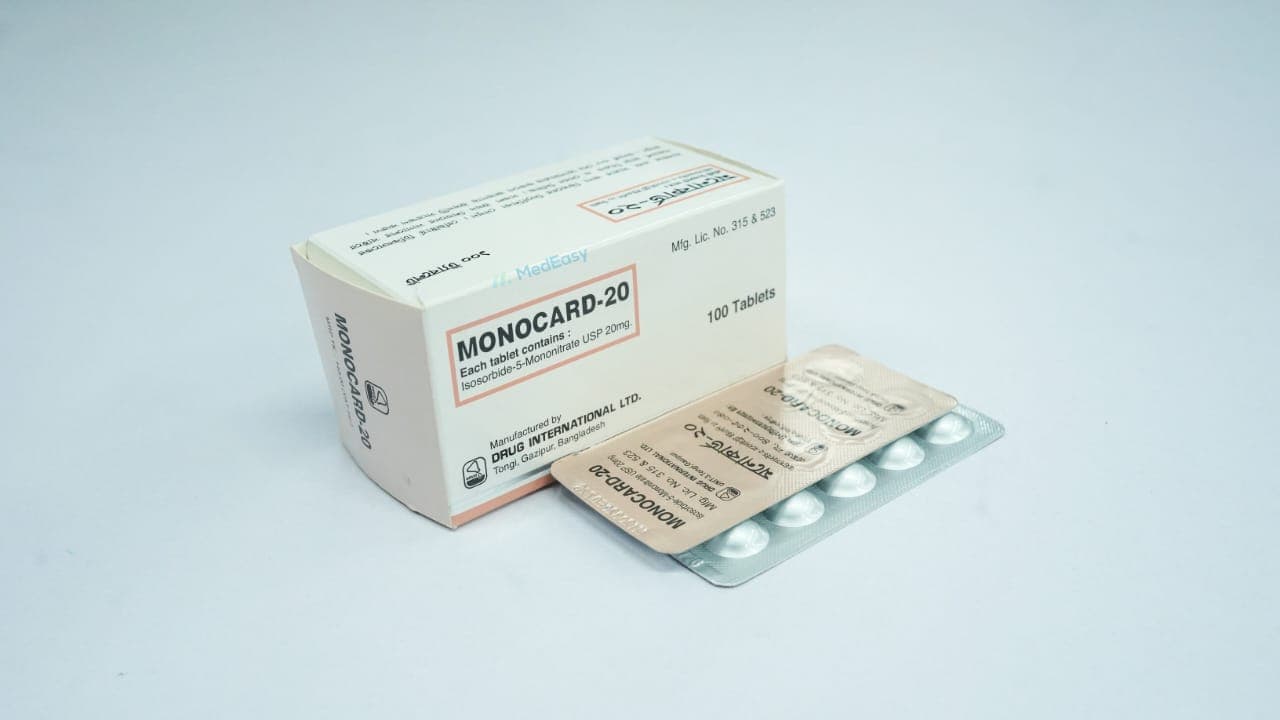

Monocard is indicated for the prevention of angina pectoris due to coronary artery disease. It is used for long-term prophylaxis of exertional angina and is intended to reduce the frequency of anginal attacks with regular, scheduled dosing.
Monocard is not intended to abort an acute anginal attack because its onset of action is too slow for that purpose; a fast-acting sublingual nitrate should be used for acute episodes.
Monocard is not approved for acute coronary syndromes, acute myocardial infarction, or acute decompensated heart failure, and should not be relied upon for these indications.
Monocard is a long-acting organic nitrate vasodilator used in the long-term management of coronary artery disease to prevent episodes of angina pectoris. It is the active metabolite of isosorbide dinitrate and is available in immediate-release and extended-release oral tablet forms.
Monocard works by relaxing vascular smooth muscle, predominantly in the venous system, which reduces the workload of the heart and lowers myocardial oxygen demand.
Long-acting organic nitrate vasodilator; Anti-anginal agent
Isosorbide Mononitrate is metabolized to release nitric oxide (NO), which activates guanylate cyclase in vascular smooth muscle, increasing intracellular cyclic GMP (cGMP). This causes relaxation of vascular smooth muscle, with a predominant effect on venous capacitance vessels and a lesser effect on arterioles. The resulting venodilation reduces venous return (preload), decreasing left ventricular wall stress and myocardial oxygen demand. At higher doses, mild arterial dilation also reduces afterload and modestly reduces coronary vascular resistance, improving oxygen supply to ischemic myocardium.
Isosorbide Mononitrate does not undergo first-pass hepatic metabolism (unlike isosorbide dinitrate), giving it essentially 100% oral bioavailability and more predictable plasma levels. It is metabolized in the liver mainly by denitration and glucuronidation, and metabolites are excreted primarily in the urine. Immediate-release tablets have an onset within about 30-60 minutes; extended-release formulations provide sustained plasma levels over approximately 24 hours.
| Formulation | Adult Dose | Notes |
|---|---|---|
| Immediate-release tablet | Initially 5-20 mg twice daily, with the two doses given 7 hours apart (e.g., on waking and 7 hours later); may be titrated to 20 mg twice daily after 2-3 days if needed | Asymmetric schedule maintains a nitrate-free interval to reduce tolerance |
| Extended-release tablet | Initially 30-60 mg once daily in the morning; may be increased at intervals of several days to 120 mg once daily; maximum 240 mg/day (rarely required) | Swallow whole; do not crush, chew, or split |
Safety and efficacy in children have not been established; Monocard is not recommended for pediatric use.
No well-established dose adjustment is required for renal impairment. In hepatic impairment, start at the lower end of the dosing range with close monitoring for hypotension, as bioavailability may be increased.
Concomitant use of Monocard with phosphodiesterase-5 (PDE5) inhibitors (sildenafil, tadalafil, vardenafil) or with the soluble guanylate cyclase stimulator riociguat can cause severe, potentially life-threatening hypotension due to additive nitric oxide/cGMP-mediated vasodilation. This combination must be avoided (see Contraindications).
Very common: Headache is very common when starting Monocard, particularly at the beginning of therapy; it often diminishes with continued regular use and may respond to a mild analgesic.
Common: Dizziness, lightheadedness, flushing, orthostatic (postural) hypotension, reflex tachycardia, nausea.
Less common/rare: Syncope (fainting), especially after the first few doses or with dose increases; rash; and, rarely with very high doses, methemoglobinemia.
Pregnancy: Data on the use of Monocard in human pregnancy are limited. Monocard should be used during pregnancy only if clearly needed and if the potential benefit justifies the potential risk to the fetus. A physician should be consulted before use in pregnancy.
Lactation: It is not known whether Monocard is excreted in human breast milk. Caution is advised, and a physician should be consulted before use while breastfeeding, weighing the benefits of treatment against potential risk to the infant.
Overdose with Monocard may cause severe hypotension, reflex tachycardia, throbbing headache, dizziness, flushing, weakness, syncope, and, rarely with very large doses, methemoglobinemia (presenting as cyanosis and shortness of breath despite adequate oxygenation). Seek immediate medical attention or contact a poison control center/emergency services if overdose is suspected. Management is supportive and should be carried out under medical supervision (e.g., positioning to improve venous return, intravenous fluids for hypotension, and specific treatment such as methylene blue for clinically significant methemoglobinemia); do not attempt specific home treatment.
Store at room temperature (below 30°C), away from light and moisture. Keep out of reach of children.
Elderly: May be more sensitive to the hypotensive effects of Monocard; start at the lower end of the dosing range and monitor closely.
Renal impairment: No well-established dose adjustment; use with routine monitoring.
Hepatic impairment: Use with caution; bioavailability may be increased, raising the risk of hypotension.
Pediatric patients: Safety and efficacy have not been established (see Pediatric Uses).
Pregnancy and lactation: See Pregnancy and Lactation section.
Monocard is generally used as long-term, ongoing prophylactic therapy for chronic stable angina, with treatment duration determined by the prescribing physician based on continued need for anginal prevention and response to therapy. Periodic clinical review is recommended. If long-term high-dose therapy is to be stopped, the dose should be tapered gradually rather than stopped abruptly (see Precautions and Warnings).
Nitrates / Anti-anginal agents / Vasodilators
Isosorbide Mononitrate is denitrated in tissues to release nitric oxide (NO), which stimulates soluble guanylate cyclase in vascular smooth muscle cells, increasing cyclic guanosine monophosphate (cGMP). Elevated cGMP triggers smooth muscle relaxation, producing predominant venodilation (reducing cardiac preload) and, at higher doses, some arterial dilation (reducing afterload). The net effect is decreased myocardial oxygen demand and improved myocardial oxygen supply, which relieves and helps prevent angina.
C
The safety and efficacy of Monocard in pediatric patients have not been established. Monocard is therefore not recommended for use in children and adolescents outside of specialist supervision.
Q: What is Monocard 20 mg Tablet used for?
A: Monocard 20 mg Tablet is used to prevent episodes of angina (chest pain) in people with coronary artery disease. It is taken on a regular schedule to reduce how often angina occurs; it is not used to treat an angina attack that has already started.
Q: Can I take Monocard 20 mg Tablet if I use sildenafil, tadalafil, or vardenafil?
A: No. Monocard 20 mg Tablet must never be combined with PDE5 inhibitors such as sildenafil, tadalafil, or vardenafil, or with riociguat, because this combination can cause severe, potentially life-threatening drops in blood pressure. Tell your doctor about all medicines you take, including those for erectile dysfunction or pulmonary hypertension.
Q: Why do I need to take my two daily doses 7 hours apart instead of evenly spaced?
A: Monocard 20 mg Tablet loses effectiveness (develops tolerance) if blood levels stay high all day. Taking the two immediate-release doses about 7 hours apart leaves a nitrate-free interval, usually overnight, which helps Monocard 20 mg Tablet keep working.
Q: Is it safe to stop Monocard 20 mg Tablet suddenly?
A: Stopping Monocard 20 mg Tablet abruptly after long-term, high-dose use may trigger rebound angina. If your doctor advises stopping long-term high-dose therapy, the dose should be reduced gradually rather than stopped all at once.
Q: What is the most common side effect of Monocard 20 mg Tablet?
A: Headache is very common, especially when starting Monocard 20 mg Tablet. It usually becomes less noticeable with continued use; tell your doctor if it is severe or persistent.
Q: Can Monocard 20 mg Tablet be used during pregnancy?
A: Data are limited. Monocard 20 mg Tablet should be used in pregnancy only if clearly needed and if the potential benefit outweighs the potential risk to the fetus, and only after consulting a physician.
Disclaimer
The information provided is accurate to the best of our knowledge, but it does not replace professional medical advice. We cannot guarantee its completeness or accuracy, and the absence of specific information about a drug should not be taken as an endorsement. We are not responsible for any consequences arising from this information, so please consult a healthcare professional for any concerns or questions.
