

5% Off
Paraciv10 mg/ml
Beacon Pharmaceuticals PLC
৳114.34
Add to cart
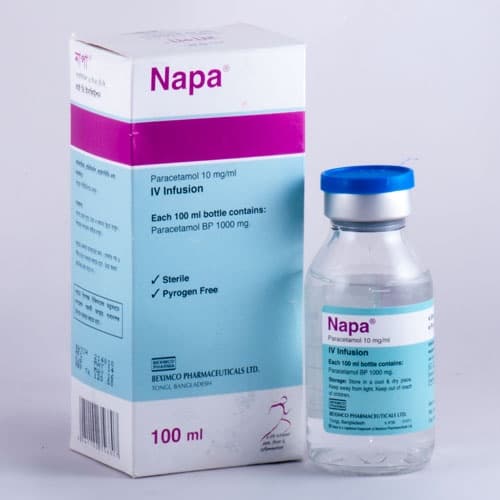

Napa is an analgesic and antipyretic indicated for:
Napa is typically reserved for situations where oral or rectal paracetamol cannot be used, such as perioperative pain, patients who are NPO (nil by mouth), or those with impaired swallowing.
Each mL of Paracetamol [IV Infusion] contains paracetamol (acetaminophen) 10 mg, formulated as a ready-to-use, isotonic, sterile solution for intravenous infusion. It is typically supplied in single-dose glass vials or polypropylene bottles of 50 mL (500 mg) or 100 mL (1000 mg) for adult use, and smaller volumes for pediatric/neonatal use.
Napa is a sterile, clear, colorless solution of paracetamol (acetaminophen) intended for direct intravenous infusion. It provides a non-opioid option for analgesia and antipyresis in patients who cannot receive medication by the oral or rectal route, such as postoperative patients or those who are critically ill. Napa is administered as a controlled intravenous infusion over 15 minutes and is not intended for intramuscular, subcutaneous, or intra-arterial injection.
Napa belongs to the therapeutic class of non-opioid analgesics and antipyretics (para-aminophenol derivatives). It is used alone for mild-to-moderate pain and fever, or in combination with opioids for moderate-to-severe pain.
The exact mechanism of action of Paracetamol [IV Infusion] is not completely established. It is believed to act primarily through central inhibition of prostaglandin synthesis (via inhibition of cyclooxygenase, particularly in the central nervous system) and modulation of the descending serotonergic pain pathways, producing analgesic and antipyretic effects. Unlike NSAIDs, Paracetamol [IV Infusion] has minimal peripheral anti-inflammatory activity and does not significantly inhibit peripheral prostaglandin synthesis, which explains its lack of gastric irritation and antiplatelet effect.
Pharmacokinetics: Following intravenous infusion, plasma concentrations of paracetamol are immediate and predictable (bypassing first-pass hepatic metabolism seen with oral dosing). It is metabolized mainly in the liver via glucuronidation and sulfation, with a small fraction (about 5-10%) oxidized by CYP2E1 to the reactive, hepatotoxic metabolite NAPQI, which is normally detoxified by conjugation with glutathione. The elimination half-life is approximately 2-3 hours in adults with normal hepatic function.
Napa is administered as an intravenous infusion over 15 minutes. Dosing is weight-based, especially in patients under 50 kg and in pediatric patients, to avoid inadvertent overdose. The maximum daily dose must account for all sources of paracetamol (oral, rectal, and intravenous) taken together.
| Population | Dose | Maximum Single Dose | Maximum Daily Dose |
|---|---|---|---|
| Adults and adolescents ≥50 kg | 1000 mg every 6 hours or 650 mg every 4 hours | 1000 mg | 4000 mg |
| Adults and adolescents <50 kg | 15 mg/kg every 6 hours or 12.5 mg/kg every 4 hours | 15 mg/kg (not to exceed 750 mg) | 75 mg/kg (not to exceed 3750 mg) |
| Children 2-12 years | 15 mg/kg every 6 hours | 15 mg/kg | 75 mg/kg |
| Infants 29 days to <2 years | 15 mg/kg every 6 hours | 15 mg/kg | 60 mg/kg |
| Neonates (≥32 weeks gestational age to 28 days) | 12.5 mg/kg every 6 hours | 12.5 mg/kg | 50 mg/kg |
Minimum dosing interval is 4 hours in adults and older children, and 6 hours in infants and neonates. No dose adjustment is required for mild-to-moderate hepatic or renal impairment; however, in severe renal impairment (creatinine clearance ≤30 mL/min), a longer minimum dosing interval of at least 6 hours is recommended.
Napa is administered by direct intravenous infusion over 15 minutes using the vial/bottle as supplied; it must not be diluted further for administration in most preparations (check specific product labeling for concentration). It can be administered directly or, in pediatric patients requiring smaller doses, an appropriate volume may be withdrawn and further diluted per institutional protocol immediately prior to administration. Do not administer by intramuscular, subcutaneous, or intra-arterial routes. Visually inspect for particulate matter and discoloration prior to use; discard if the solution is not clear or contains particles. Once opened, use within 6 hours; discard any unused portion (single-dose container).
Warfarin and other oral anticoagulants: Chronic or repeated dosing of Napa may enhance the anticoagulant effect, increasing INR and bleeding risk; monitor INR more frequently, particularly with regular use beyond a few days.
CYP2E1 inducers (e.g., isoniazid, chronic alcohol use, certain anticonvulsants such as phenytoin and carbamazepine): May increase production of the hepatotoxic metabolite NAPQI, raising the risk of liver injury, particularly with high or prolonged dosing of Napa.
Probenecid: May decrease clearance of paracetamol; dose reduction of Napa may be considered with prolonged co-administration.
Hepatotoxic drugs and chronic alcohol use: Concurrent use with other hepatotoxic medications or chronic alcohol consumption increases the risk of liver injury with Napa; see Precautions and Warnings.
Paracetamol [IV Infusion] is contraindicated in patients with:
Napa is generally well tolerated. Reported adverse effects include:
Pregnancy: Available epidemiologic data have not established a clear association between paracetamol use in pregnancy and adverse fetal outcomes; however, Napa should be used during pregnancy only if clearly needed, at the lowest effective dose for the shortest duration, and only after a physician has weighed the potential benefit against potential risk to the fetus.
Lactation: Paracetamol is excreted in breast milk in small amounts. Napa may generally be used with caution during breastfeeding under medical supervision, weighing the benefits of treatment against any potential risk to the breastfed infant; consult a physician before use.
Hepatotoxicity (most important warning): Serious, sometimes fatal, hepatic injury can occur if the maximum recommended daily dose of paracetamol is exceeded, whether from Napa alone or when combined with other paracetamol-containing products (oral, rectal, or other IV sources). Doses must always account for total paracetamol intake from ALL sources. Risk of hepatotoxicity is increased in patients with hepatic impairment, chronic alcoholism, chronic malnutrition, dehydration, or low body weight. Medication errors (administering the wrong concentration, confusing mg and mL, or incorrect weight-based calculation, especially in pediatric and low-body-weight patients) have resulted in overdose and death; exercise extreme care in prescribing, preparing, and administering Napa.
Serious skin reactions: Rare but potentially fatal skin reactions (Stevens-Johnson syndrome, toxic epidermal necrolysis, acute generalized exanthematous pustulosis) have been reported; discontinue Napa at the first sign of skin rash or other hypersensitivity reaction.
Hypersensitivity/anaphylaxis: Discontinue immediately and seek medical attention if symptoms of a hypersensitivity reaction occur.
Renal impairment: Use with caution in severe renal impairment (creatinine clearance ≤30 mL/min); a longer minimum dosing interval is recommended.
Hypovolemia/hypotension: Hypotension has been reported during or shortly after infusion, particularly in critically ill or volume-depleted patients; monitor vital signs during administration.
Overdose of Napa is a recognized cause of severe, potentially fatal, acute liver failure, and may also cause renal injury. Early symptoms of overdose (nausea, vomiting, pallor, abdominal pain, sweating) may be absent or nonspecific in the first 24 hours and do not reflect the severity of potential liver injury, which typically becomes apparent 1-4 days after ingestion.
If overdose of Napa is suspected, seek immediate emergency medical attention or contact a poison control center, even if the patient appears well, as prompt treatment is critical. A specific antidote, N-acetylcysteine, is highly effective in preventing or limiting liver damage when administered early, ideally within 8-10 hours of overdose, based on serum paracetamol levels and clinical assessment by a physician. Do not attempt to manage a suspected overdose at home.
Store at room temperature (20-25°C/68-77°F), protected from light. Do not refrigerate or freeze. Use immediately or within 6 hours after opening a single-dose container; discard any unused portion. Keep out of reach of children.
Hepatic impairment: Contraindicated in severe hepatic impairment or severe active liver disease. Use with caution and consider reduced total daily dose in mild-to-moderate hepatic impairment, active liver disease, chronic alcoholism, chronic malnutrition, or low body weight, due to increased hepatotoxicity risk.
Renal impairment: No dose adjustment needed for mild-to-moderate renal impairment. In severe renal impairment (creatinine clearance ≤30 mL/min), a minimum dosing interval of 6 hours is recommended for Napa.
Elderly: No dose adjustment is required based on age alone, though elderly patients may have a higher likelihood of hepatic, renal, or cardiac impairment, warranting careful dose selection.
Pediatric patients: Napa is approved for use from term neonates (≥32 weeks gestational age) through adolescence, with weight- and age-based dosing as detailed in Dosage and Administration; safety and efficacy in preterm neonates below 32 weeks gestational age have not been established.
Napa is intended for short-term use, typically limited to the perioperative period or the duration during which oral/rectal administration is not feasible (usually a few days). Treatment should be transitioned to oral paracetamol or an alternative analgesic as soon as the patient can tolerate oral intake. Prolonged use should be under continued medical supervision, with attention to cumulative dose and liver function if used beyond a few days.
Analgesics (non-opioid), Antipyretics
Paracetamol [IV Infusion] is believed to exert its analgesic and antipyretic effects primarily through central inhibition of cyclooxygenase (COX) enzymes, reducing prostaglandin synthesis within the central nervous system, along with modulation of descending inhibitory serotonergic pathways. It has minimal effect on peripheral COX activity, which accounts for its lack of significant anti-inflammatory, antiplatelet, and gastrointestinal-irritant effects compared with NSAIDs.
Napa is approved for pain management and fever reduction in pediatric patients from term neonates (≥32 weeks gestational age) through adolescents, using weight-based dosing (see Dosage and Administration). Careful attention to accurate weight-based dose calculation is essential in pediatric patients to prevent inadvertent overdose, a recognized cause of serious medication errors with this product. Safety and efficacy in preterm neonates below 32 weeks gestational age have not been established.
Q: What is Napa 10 mg/ml IV Infusion used for?
A: Napa 10 mg/ml IV Infusion is used to manage mild to moderate pain, to help manage moderate to severe pain alongside opioid medications, and to reduce fever in patients who cannot take medication by mouth or rectally, such as before or after surgery.
Q: How is Napa 10 mg/ml IV Infusion given?
A: Napa 10 mg/ml IV Infusion is given only by a healthcare professional as a slow intravenous infusion over 15 minutes. It is not given by intramuscular or subcutaneous injection.
Q: Can Napa 10 mg/ml IV Infusion cause liver damage?
A: Yes, if the maximum daily dose is exceeded, whether from Napa 10 mg/ml IV Infusion alone or added together with other paracetamol-containing products taken by mouth or rectally, serious and potentially fatal liver damage can occur. It is essential that all paracetamol sources are counted toward the daily limit and that dosing is calculated carefully based on body weight.
Q: Who should not receive Napa 10 mg/ml IV Infusion?
A: Napa 10 mg/ml IV Infusion should not be given to anyone with a known allergy to paracetamol or any ingredient in the product, or to patients with severe liver impairment or severe active liver disease.
Q: Is Napa 10 mg/ml IV Infusion safe during pregnancy or breastfeeding?
A: Napa 10 mg/ml IV Infusion should be used during pregnancy only if clearly needed, at the lowest effective dose, after a physician weighs the potential benefits against potential risks to the fetus. Small amounts pass into breast milk, so it should be used during breastfeeding only under medical guidance.
Q: What should I do if an overdose of Napa 10 mg/ml IV Infusion is suspected?
A: Seek immediate emergency medical attention or contact a poison control center right away, even if the person seems fine, because early symptoms can be absent while serious liver damage develops. A specific antidote is most effective when given early.
Disclaimer
The information provided is accurate to the best of our knowledge, but it does not replace professional medical advice. We cannot guarantee its completeness or accuracy, and the absence of specific information about a drug should not be taken as an endorsement. We are not responsible for any consequences arising from this information, so please consult a healthcare professional for any concerns or questions.
