
5% Off
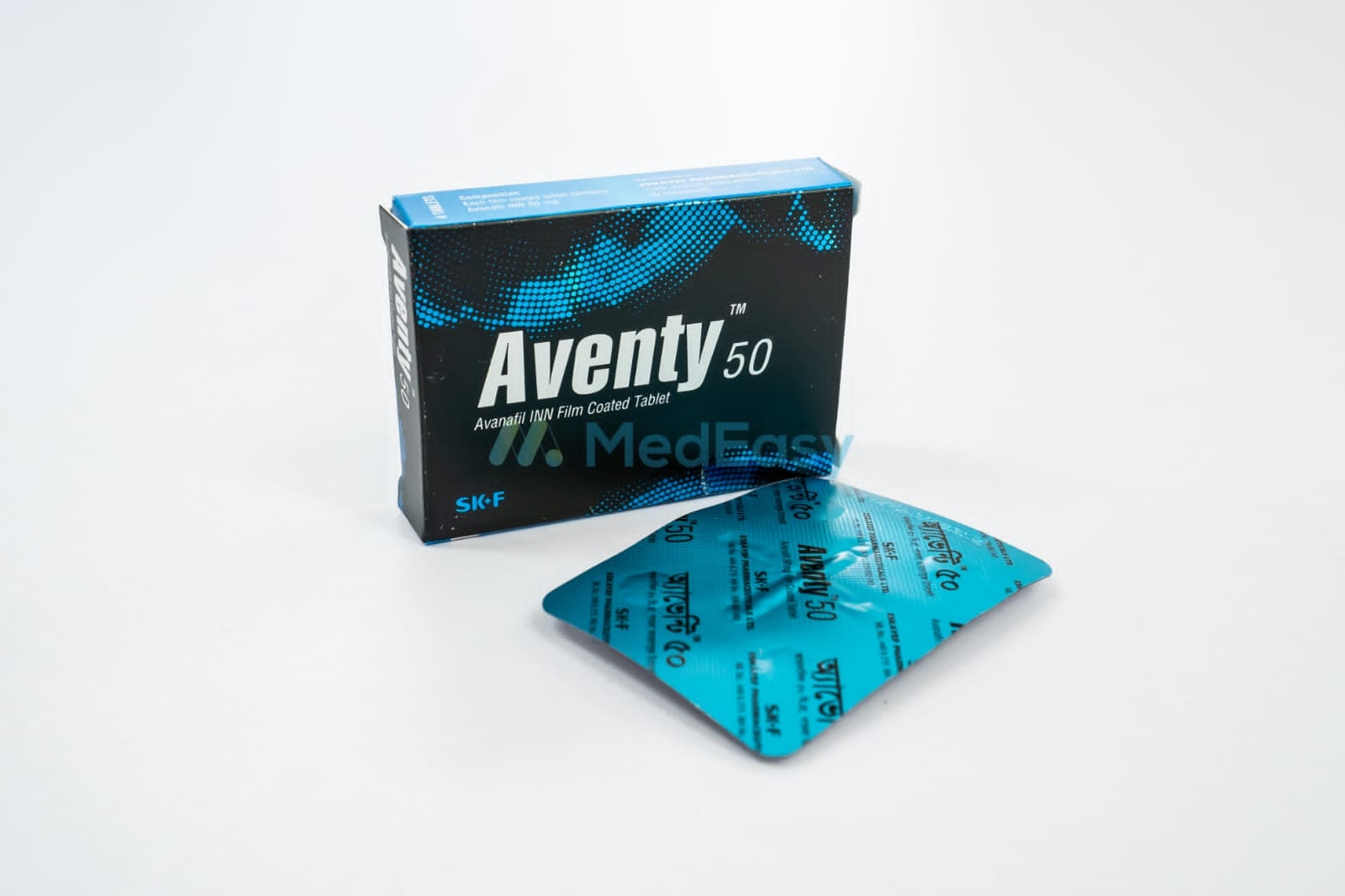
Aventy50 mg
Eskayef Bangladesh Ltd.
৳228.00
Add to cart


Navafil is a phosphodiesterase type 5 (PDE5) inhibitor that is FDA-approved for one established indication:
Navafil is not indicated for use in women or children, and it does not treat premature ejaculation, low libido, or infertility. It also does not protect against sexually transmitted infections (STIs), including HIV.
Each film-coated tablet contains Avanafil as the active pharmaceutical ingredient, commonly available in strengths of 50 mg, 100 mg, and 200 mg. Tablets also contain standard inactive excipients such as diluents, binders, disintegrants, and film-coating agents, which may vary by manufacturer.
Navafil is an orally administered, highly selective phosphodiesterase type 5 (PDE5) inhibitor developed for the on-demand treatment of erectile dysfunction. It belongs to the same pharmacological class as sildenafil, tadalafil, and vardenafil, but has a distinct chemical (pyrimidine) structure that is associated with a rapid onset of action.
Navafil is supplied as a film-coated oral tablet in 50 mg, 100 mg, and 200 mg strengths and is intended to be taken as needed, not on a fixed daily schedule.
Navafil belongs to the therapeutic class of Phosphodiesterase type 5 (PDE5) inhibitors, used in the management of erectile dysfunction.
Avanafil is a potent and highly selective inhibitor of phosphodiesterase type 5 (PDE5), the enzyme responsible for the degradation of cyclic guanosine monophosphate (cGMP) in the smooth muscle of the corpus cavernosum of the penis.
Sexual stimulation causes local release of nitric oxide, which activates guanylate cyclase, increasing cGMP levels and producing smooth muscle relaxation and inflow of blood into the corpus cavernosum. By inhibiting PDE5, Avanafil enhances this natural erectile response by prolonging the smooth-muscle-relaxant effect of cGMP; it has no direct effect in the absence of sexual stimulation.
Pharmacokinetics: Avanafil is rapidly absorbed, reaching peak plasma concentration in approximately 30–45 minutes, and can be taken with or without food (a high-fat meal delays but does not markedly reduce overall absorption). It is highly protein bound (>99%), extensively metabolized in the liver primarily via the CYP3A4 enzyme, and has a mean elimination half-life of approximately 6–17 hours. It is excreted mainly in the feces, with a smaller amount in urine.
| Population | Recommended Dose |
|---|---|
| Adult men (starting dose) | 100 mg taken approximately 15–30 minutes before anticipated sexual activity, as needed |
| Dose range | 50 mg to 200 mg, adjusted based on individual efficacy and tolerability |
| Maximum frequency | One dose per day; not for continuous daily use |
| With moderate CYP3A4 inhibitors (e.g. erythromycin, fluconazole, diltiazem) | Maximum 50 mg in a 24-hour period |
| With alpha-blockers | Start at 50 mg once alpha-blocker therapy is stable (see Interactions) |
| Severe hepatic or renal impairment | Navafil is not recommended (see Use in Special Populations) |
Navafil may be taken with or without food. Sexual stimulation is required for Navafil to produce an erection. Navafil should not be used more than once daily, and it is not indicated for use in women or in patients under 18 years of age.
Navafil is taken orally, by mouth, with a glass of water, with or without food. It should be taken on an as-needed basis, roughly 15–30 minutes before planned sexual activity, and not more than once per day. Navafil is only effective in the presence of sexual stimulation; it will not cause an erection on its own.
Navafil is metabolized mainly by the CYP3A4 enzyme, so drugs that affect this pathway can significantly change Navafil exposure. Clinically important interactions include:
Avanafil is contraindicated in the following situations:
The most commonly reported side effects of Navafil (occurring in approximately 2% or more of users) include:
Less common but more serious effects that require prompt medical attention include:
Most side effects of Navafil are mild to moderate and transient. If any side effect is severe, persistent, or concerning, medical advice should be sought.
Navafil is not indicated for use in women, so there is no established human data on its use during pregnancy or breastfeeding. Animal reproduction studies have not shown evidence of harm to the fetus at exposures several times the maximum recommended human dose, but this has not been confirmed in humans. As Navafil has no approved use in females, it should not be taken by women who are pregnant, planning pregnancy, or breastfeeding.
Before using Navafil, the following precautions should be observed:
Doses of Navafil higher than recommended may increase the likelihood of side effects such as headache, flushing, dizziness, and hypotension. In case of a suspected overdose of Navafil, seek immediate medical attention or contact a poison control center/emergency services. Treatment of overdose is supportive; because Navafil is highly protein-bound, hemodialysis is unlikely to significantly accelerate its removal from the body. Do not attempt to manage a suspected overdose at home without medical guidance.
Store at room temperature (below 30°C), away from light and moisture. Keep out of reach of children.
No dose adjustment of Navafil is needed in mild-to-moderate renal impairment. Navafil is not recommended in patients with severe renal impairment or those requiring dialysis, as it has not been studied in this population.
No dose adjustment is needed in mild-to-moderate hepatic impairment. Navafil is not recommended in patients with severe hepatic impairment.
No overall differences in safety were observed between elderly and younger patients in clinical trials, and no dose adjustment is required based on age alone; however, elderly patients often have more comorbidities and use more concomitant medications, so individual assessment is advised.
Navafil is not indicated for use in individuals under 18 years of age; safety and efficacy have not been established in this age group (see Pediatric Uses).
Navafil is not indicated for use in women.
Navafil is intended for on-demand (as-needed) use before sexual activity, not for continuous or fixed daily dosing. There is no fixed treatment duration; it may be used intermittently for as long as erectile dysfunction treatment is needed, under a physician's ongoing guidance, with no more than one dose taken per day.
Avanafil belongs to the drug class of phosphodiesterase type 5 (PDE5) inhibitors, which also includes sildenafil, tadalafil, and vardenafil.
Avanafil selectively inhibits phosphodiesterase type 5 (PDE5), the enzyme that breaks down cyclic GMP (cGMP) in penile smooth muscle. By blocking PDE5, Avanafil allows cGMP levels to remain elevated during sexual stimulation, sustaining smooth muscle relaxation and blood flow into the penis, which helps produce and maintain an erection.
Navafil is not indicated for use in children or adolescents under 18 years of age. Its safety and efficacy in this population have not been established, and it should not be given to pediatric patients.
Q: What is Navafil 50 mg Tablet used for?
A: Navafil 50 mg Tablet is used to treat erectile dysfunction (ED) in adult men, helping them achieve and maintain an erection sufficient for sexual activity when combined with sexual stimulation.
Q: How should I take Navafil 50 mg Tablet?
A: Navafil 50 mg Tablet is usually taken as a single 100 mg dose about 15–30 minutes before sexual activity, with or without food, and should not be taken more than once a day. Your doctor may adjust the dose between 50 mg and 200 mg based on your response.
Q: Can I take Navafil 50 mg Tablet with nitrate medicines?
A: No. Taking Navafil 50 mg Tablet together with nitrate medicines (such as nitroglycerin, used for chest pain) or guanylate cyclase stimulators like riociguat is strictly contraindicated, as this combination can cause a severe, potentially fatal, drop in blood pressure.
Q: What are the common side effects of Navafil 50 mg Tablet?
A: The most common side effects of Navafil 50 mg Tablet include headache, flushing, nasal congestion, back pain, and dizziness. Most are mild and temporary, but an erection lasting more than 4 hours, or sudden vision or hearing loss, needs immediate medical attention.
Q: Can women or children use Navafil 50 mg Tablet?
A: No. Navafil 50 mg Tablet is not indicated for use in women or in individuals under 18 years of age; its safety and effectiveness have not been established in these groups.
Q: Does Navafil 50 mg Tablet protect against sexually transmitted infections?
A: No. Navafil 50 mg Tablet treats erectile dysfunction only; it does not protect against sexually transmitted infections (STIs), including HIV, so appropriate precautions should still be used.
Disclaimer
The information provided is accurate to the best of our knowledge, but it does not replace professional medical advice. We cannot guarantee its completeness or accuracy, and the absence of specific information about a drug should not be taken as an endorsement. We are not responsible for any consequences arising from this information, so please consult a healthcare professional for any concerns or questions.
